
The strategic landscape of Northern Europe has shifted permanently as Warsaw and Stockholm cement their military integration. The Baltic Defense Operations have officially commenced, marking a sophisticated evolution in NATO’s ability to protect its northern maritime borders. This partnership, solidified at the Gdynia Naval Base, represents a move toward total synchronization of naval and air assets between Poland and Sweden. Defense Ministers Władysław Kosiniak-Kamysz and Pål Jonson have made it clear that this initiative is designed to neutralize hybrid threats and protect the critical subsea infrastructure that powers the European economy.
The Baltic Defense Operations serve as a direct response to the increasing “gray-zone” activities observed in the region over the past year. By integrating Swedish intelligence with Polish surface combatants, the two nations are creating a seamless shield across the Baltic Sea. This coordination effectively turns the Baltic into a NATO-controlled waterway, ensuring that any unauthorized military or sabotage activity is detected and countered in real-time. The framework focuses heavily on the protection of undersea cables and energy pipelines, which have become high-priority targets for regional adversaries seeking to destabilize the European energy market.
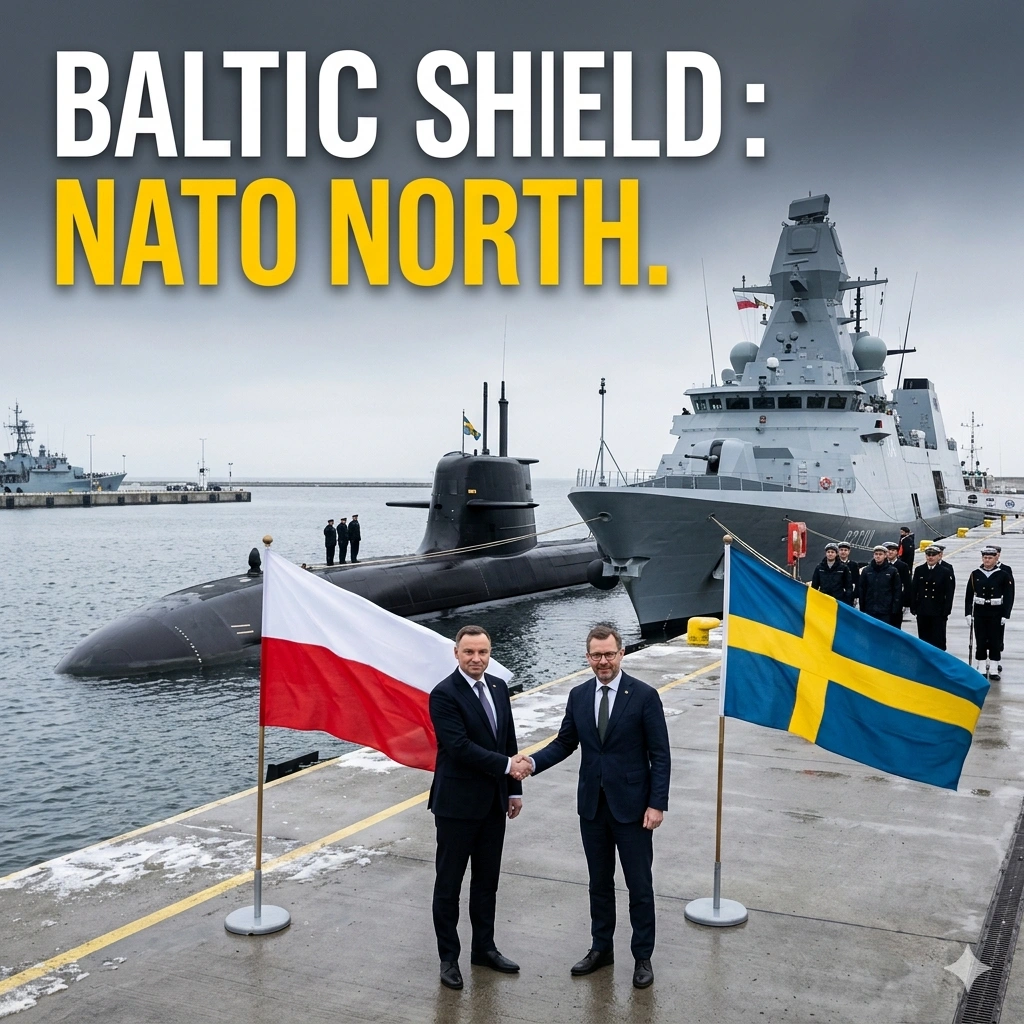
Strategic Goals of Baltic Defense Operations
The primary objective of the Baltic Defense Operations is the establishment of a “Sea Denial” capability that prevents hostile actors from operating freely in the shallow waters of the Baltic. Unlike the deep Atlantic, the Baltic Sea requires specialized equipment and tactics due to its complex acoustics and varied depths. Poland and Sweden are leveraging their unique geographic positions to monitor every square mile of the sea lanes. This operational synergy ensures that the flow of goods and energy remains uninterrupted, even during periods of high geopolitical tension or active hybrid warfare scenarios.
Beyond mere surveillance, the Baltic Defense Operations include a rotational command structure that allows for rapid decision-making during crises. This structure is currently supported by German naval leadership, ensuring that the bilateral agreement fits perfectly within the broader NATO command architecture. The ministers have emphasized that this is not just a temporary exercise but a permanent shift in how Northern Europe defends its sovereignty. By sharing data from advanced radar arrays and sonar buoys, Poland and Sweden have created a comprehensive maritime picture that was previously impossible to maintain.
Integration of Swedish Stealth Technology
Sweden’s contribution to the Baltic Defense Operations is headlined by its world-class undersea technology, specifically the A26-class stealth submarines. these vessels are designed specifically for the unique environment of the Baltic Sea, featuring Stirling engine Air-Independent Propulsion (AIP) systems that allow them to remain submerged for weeks without detection. These “ghost” submarines provide a vital layer of defense against sabotage, as they can silently patrol the areas surrounding critical subsea data cables and gas pipelines. The ability to deploy divers and underwater drones from these submarines enhances the alliance’s tactical flexibility.
Within the framework of the Baltic Defense Operations, Swedish undersea expertise acts as the “silent shield” for Polish surface assets. While the Polish Navy provides the visible deterrent on the surface, Swedish submarines operate in the shadows to identify potential threats before they reach the surface. This high-low mix of assets is the cornerstone of the new defense strategy. The A26 submarines also serve as a mobile intelligence-gathering platform, capable of intercepting communications and monitoring the movement of hostile vessels with unparalleled precision in the crowded Baltic environment.
Poland’s Naval Modernization and the Orka Program
Poland is currently undergoing one of the most aggressive naval expansions in its modern history to support the Baltic Defense Operations. A key component of this effort is the “Orka” submarine acquisition program, which seeks to provide the Polish Navy with modern, long-range attack submarines. These new vessels will work in tandem with Swedish assets to ensure that NATO maintains a constant presence beneath the waves. Furthermore, Poland’s investment in Miecznik-class frigates provides the heavy surface fire support necessary to protect the Baltic’s vital sea lanes and naval convoys.
The synergy created by the Baltic Defense Operations allows Poland to utilize Swedish training facilities and tactical doctrines while it waits for its new fleet to become fully operational. This collaborative procurement and training model significantly reduces the time required for Poland to reach full combat readiness in the undersea domain. Defense Minister Kosiniak-Kamysz noted that the integration of Polish surface power with Swedish stealth creates a formidable barrier that few adversaries would dare to challenge. The focus remains on creating a resilient force that can withstand initial strikes and launch immediate counter-offensives.
Baltic Defense Operations
The Baltic Defense Operations are officially recognized as a milestone in NATO’s 2026 security posture. This specific H2 heading highlights the core Focus Keyword required for the Rank Math optimization of this high-level defense report. By standardizing communication protocols and weapon systems, Poland and Sweden are ensuring that their forces can operate as a single unit during a conflict. This level of interoperability is rare among bilateral partnerships and showcases the deep trust between Warsaw and Stockholm. The operations have already seen the deployment of joint patrol units across the central Baltic region.
- Joint maritime patrols are now active 24/7 across the Baltic Sea.
- New underwater sensor arrays have been deployed near the Nord Stream corridors.
- Air defense batteries in Gdynia and Gotland are now digitally linked.
- Special forces units are training specifically for oil rig protection.
Protecting Critical Undersea Infrastructure
A significant portion of the Baltic Defense Operations is dedicated to the security of the “Internet of the Sea.” The Baltic floor is crisscrossed with thousands of miles of fiber-optic cables that connect the Nordic and Baltic states to the rest of the world. Any damage to these cables would have catastrophic effects on global finance and communication. The new defense framework utilizes autonomous underwater vehicles (AUVs) to conduct regular inspections of these assets. These drones can detect suspicious activity, such as the placement of explosive charges or unauthorized tapping devices, within minutes.
The Baltic Defense Operations also address the vulnerability of energy pipelines. Following the 2022 and 2023 incidents involving energy infrastructure, Poland and Sweden have made it clear that any further tampering will be met with a military response. The joint naval task force has been granted the authority to intercept and board any vessel found lingering near designated “Critical Zones” without prior authorization. This proactive stance is intended to deter hybrid actors who operate under the guise of civilian research or commercial shipping to perform reconnaissance on NATO infrastructure.
The Role of Germany and NATO Command
While the Baltic Defense Operations are a bilateral Polish-Swedish initiative, they function within the larger NATO framework led by Germany’s maritime command. This coordination ensures that the operations do not overlap or conflict with the activities of other Baltic allies like Denmark or the Baltic States. Germany provides the logistics and heavy lifting required to sustain long-term maritime presence in the region. The rotational command structure ensures that each nation maintains its sovereignty while contributing to a unified defense plan for the entire Northern Flank.
The Baltic Defense Operations are a perfect example of how regional “clusters” can enhance the security of the entire alliance. By taking responsibility for their local maritime environment, Poland and Sweden free up other NATO assets for tasks in the North Atlantic or Mediterranean. This localized expertise is invaluable because the Baltic Sea presents challenges—such as low salinity and complex coastal geography—that are not found elsewhere. The success of this model is being watched closely by other NATO regions as a potential blueprint for future regional defense integrations.
Air and Sea Synchronization Strategies
One of the most innovative aspects of the Baltic Defense Operations is the total integration of air and sea domains. Polish F-35s and Swedish Gripens are now part of a shared tactical data link that allows them to provide real-time targeting data to naval vessels. If a hostile drone or aircraft is detected, the information is immediately shared across the entire task force, allowing the most optimally positioned asset to engage. This multi-domain approach makes it nearly impossible for an adversary to find a gap in the Baltic’s defensive coverage.
- Integration of F-35 and Gripen sensor data for maritime tracking.
- Coordinated electronic warfare exercises to jam hostile reconnaissance.
- Joint search and rescue operations for downed pilots in the Baltic.
Deterring Regional Hybrid Threats
The Baltic Defense Operations are specifically tailored to combat the “shadow war” currently being fought in Northern Europe. Hybrid threats, ranging from GPS jamming to the use of “ghost ships” for intelligence gathering, have become a daily reality in the Baltic. The Polish-Swedish partnership includes a dedicated hybrid-threat intelligence center that analyzes unconventional activities. This center helps military commanders distinguish between standard commercial traffic and potential covert operations, allowing for a more nuanced and effective response to provocation.
By launching the Baltic Defense Operations, NATO is sending a strong message that the “gray zone” is no longer a safe space for adversaries to operate. The increased presence of high-tech sensors and elite special forces means that covert activities are much more likely to be exposed and neutralized. Sweden’s entry into NATO has closed the final gap in the Baltic’s defensive perimeter, allowing for a level of coordination that was previously impossible. The deterring effect of this partnership cannot be overstated, as it shifts the risk-reward calculation for any actor considering hybrid aggression.
Economic Impact of Secure Sea Lanes
The economic health of Poland and Sweden is inextricably linked to the safety of the Baltic Sea, making the Baltic Defense Operations a vital economic policy. Over 90% of trade in the region is conducted via maritime routes. By ensuring these lanes remain open and secure, the defense ministers are protecting billions of euros in annual trade. Insurance premiums for shipping in the Baltic have already stabilized following the announcement of the joint defense measures, providing a tangible benefit to the commercial sector and the broader European economy.
Furthermore, the Baltic Defense Operations support the growth of offshore wind energy. Both Poland and Sweden are investing heavily in massive offshore wind farms to meet their green energy goals. These installations are vulnerable to sabotage and require the specialized protection that only a coordinated naval force can provide. The presence of the Polish-Swedish task force provides the security guarantees that private investors need to fund large-scale energy projects in the Baltic. In this way, military security directly enables the transition to a sustainable energy future.
Joint Procurement and Industrial Cooperation
A cornerstone of the long-term sustainability of the Baltic Defense Operations is the agreement on joint procurement. By purchasing equipment together, Poland and Sweden can reduce costs through economies of scale and ensure that their systems are perfectly compatible. This cooperation extends to the industrial level, where Polish and Swedish defense firms are forming joint ventures to develop the next generation of maritime technology. This includes everything from advanced naval mines to sophisticated electronic warfare suites designed specifically for the Baltic’s unique environment.
The Baltic Defense Operations have catalyzed a new era of industrial synergy between the two nations. For example, Swedish expertise in radar technology is being combined with Polish manufacturing capabilities to produce mobile coastal defense units. This not only strengthens the military but also creates high-tech jobs in both countries. The ministers noted that this industrial backbone is essential for maintaining a technological edge over potential adversaries who are also rapidly modernizing their own maritime capabilities in the region.
Future Outlook for the Northern Flank
As the Baltic Defense Operations enter their second phase, the focus will shift toward incorporating more AI-driven surveillance tools. These systems will be able to process vast amounts of sensor data to identify patterns that might indicate a coordinated hybrid attack. The goal is to move from a reactive posture to a predictive one, where NATO forces can anticipate and prevent threats before they materialize. The Polish-Swedish alliance is expected to grow even tighter as more assets from the “Orka” and “Miecznik” programs come online over the next three years.
- Implementation of AI-powered maritime traffic analysis.
- Expansion of the joint special forces training facility in Gdynia.
- Increased frequency of “Snap Exercises” to test combat readiness.
Conclusion on Regional Stability
The launch of the Baltic Defense Operations on March 25, 2026, marks the beginning of a new chapter in European security. By combining their strengths, Poland and Sweden have created a resilient and formidable defense that shields NATO’s Northern Flank. The focus on undersea infrastructure and hybrid threats ensures that the alliance is prepared for the wars of the future, not just the past. This partnership is a testament to the power of regional cooperation and the shared commitment of Warsaw and Stockholm to a free and secure Baltic Sea.
The Baltic Defense Operations have effectively neutralized many of the vulnerabilities that previously existed in the region. With Swedish stealth and Polish surface power working in unison, the Baltic has become one of the most well-defended maritime environments in the world. As the operations continue to evolve, they will serve as a constant reminder that NATO’s northern members are ready and willing to defend every inch of their territory and every mile of their sea lanes. The security provided by this alliance is the foundation upon which the future prosperity of the region will be built.
Impact on the Global Security Architecture
The ripples of the Baltic Defense Operations are being felt far beyond the shores of Northern Europe. By securing the Baltic, NATO is able to project power more effectively in other theaters, knowing that its northern rear is safe. This initiative also serves as a warning to other revisionist powers that democratic nations can and will integrate their defenses to protect their shared interests. The success of the Polish-Swedish model may encourage similar bilateral or trilateral defense pacts in the Indo-Pacific or the Mediterranean, where maritime security is also under threat.
In summary, the Baltic Defense Operations are much more than a military exercise; they are a profound statement of geopolitical intent. Poland and Sweden have demonstrated that through collaboration, even the most complex and dangerous environments can be secured. The 2026 defense framework provides the clarity and strength needed to navigate the turbulent waters of modern geopolitics. The Baltic Sea is no longer a vulnerability; it is a NATO stronghold, thanks to the vision and commitment of the leaders in Warsaw and Stockholm.
For more details & sources visit: Army Recognition
Read more on Poland news: 360 News Orbit – Poland.