
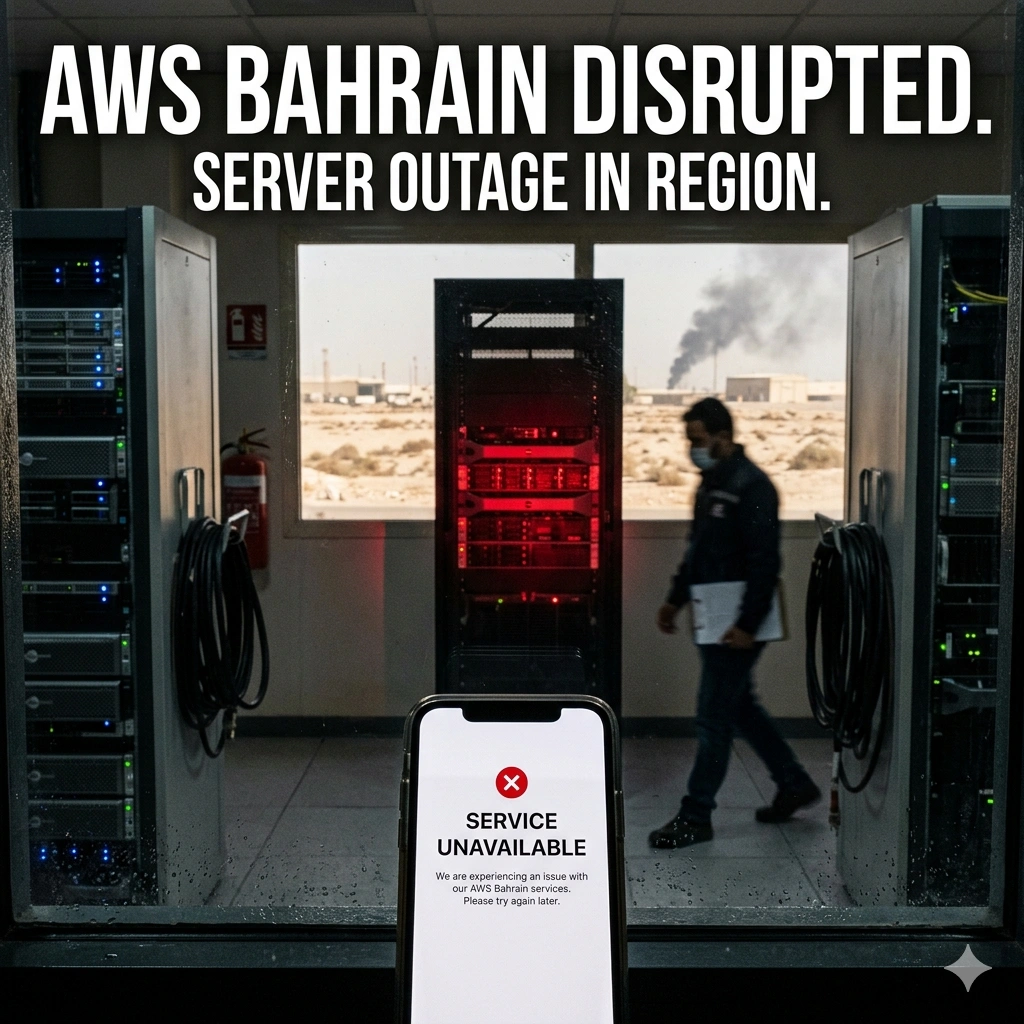
The AWS Bahrain Region Disrupted event, has sent shockwaves through the international financial community as drone strikes continue to plague the Middle East. This latest disruption marks the second time this month that Amazon’s cloud infrastructure in the Gulf has been compromised by regional conflict. Major fintech platforms, most notably SadaPay, have reported total app outages as the digital backbone of the region suffers physical damage. While Amazon has confirmed the service interruption, the extent of the structural impact remains under investigation by technical teams on the ground. Customers are now facing the grim reality of how geopolitical instability can instantly sever access to essential digital financial services.
The Immediate Impact of the AWS Bahrain Region Disrupted Event
The AWS Bahrain Region Disrupted crisis has hit the fintech sector with unprecedented force, leaving millions of users without access to their digital wallets. SadaPay, a leading player in the Pakistani and Middle Eastern markets, saw its entire app interface go offline following the strikes. The company has scrambled to reassure customers that their primary deposits remain secure despite the technical blackout. However, the inability to perform peer-to-peer transfers or check balances has sparked widespread concern among the user base. This incident highlights the extreme vulnerability of relying on a single geographic cloud zone during times of kinetic warfare.
To manage the fallout, Amazon has issued urgent advisories for its enterprise clients to begin immediate workload migrations. The AWS Bahrain Region Disrupted status has forced companies to look toward European or Asian data centers to maintain operational continuity. This shift is not without its challenges, as data residency laws and latency issues complicate the transition for financial institutions. Engineers are working around the clock to establish mirrors in safer jurisdictions, but the physical damage to local nodes makes some data retrieval nearly impossible. The regional instability has turned what was once a “safe” digital hub into a high-risk zone for global commerce.
Furthermore, the disruption has caused a cascade of errors across secondary financial services that rely on AWS for verification. Many users reported “incorrect deductions” and failed transaction logs in the hours leading up to the total shutdown. SadaPay attributed these glitches to a technology partner’s failure, which was exacerbated by the deteriorating security situation in Bahrain. As the U.S.-Israel-Iran conflict spills into the Gulf’s digital infrastructure, the line between physical and cyber warfare has blurred. Financial analysts are now re-evaluating the risk profiles of any company heavily invested in Middle Eastern cloud clusters.
AWS Bahrain Region Disrupted
The technical reality of the AWS Bahrain Region Disrupted scenario involves a massive failure of shared infrastructure that supports hundreds of regional apps. Drone strikes targeting sensitive areas in Bahrain have reportedly caused collateral damage to the power grids and cooling systems essential for server health. While Amazon has not specified if their specific “Availability Zones” were direct targets, the result is a functional collapse of the Bahrain node. This shutdown prevents the AWS Management Console from executing commands within the region, effectively locking out developers from their own hosted environments. It is a stark reminder that the “cloud” still resides in physical buildings vulnerable to conventional weapons.
The AWS Bahrain Region Disrupted status has also halted the rollout of new security patches and updates for regional clients. With the physical site under threat, maintenance crews cannot safely access the facilities to perform necessary hardware swaps or repairs. This creates a secondary risk where existing systems become more susceptible to software vulnerabilities while the physical crisis persists. SadaPay’s reliance on this specific region has exposed a critical flaw in many fintech disaster recovery plans. Most startups prioritize low latency over geographic redundancy, a choice that is now proving costly during this period of regional unrest.
For Gulf Financial Services, the AWS Bahrain Region Disrupted event means a total cessation of real-time trading and settlement activities. The disruption has disconnected local banks from international clearinghouses that require stable, high-speed connections for regulatory compliance. As the drones continue to patrol the skies over Bahrain, the prospect of a quick restoration of services appears slim. Amazon’s recommendation to migrate workloads is a clear signal that they do not expect the region to return to full capacity in the immediate future. This move marks a significant retreat for a cloud provider that has spent years marketing the Gulf as the next big tech frontier.
Geopolitical Tensions and Digital Fragility
The AWS Bahrain Region Disrupted crisis is a direct consequence of the escalating conflict between major regional powers. As drone technology becomes more accessible and precise, infrastructure that was once considered “out of reach” is now on the front lines. The strikes on March 1 and March 25 demonstrate a pattern of targeting the economic and digital heart of the Gulf. By disrupting the cloud, hostile actors can cause more widespread chaos than by hitting a single physical bank branch. This era of “hybrid warfare” uses digital outages to undermine public confidence in the financial system and the government’s ability to protect it.
Engineers at SadaPay and other affected firms are now dealing with the logistical nightmare of “re-homing” millions of user accounts. The AWS Bahrain Region Disrupted environment has made it difficult to verify the integrity of recent backups, as some data packets may have been lost during the strikes. This uncertainty forces companies to perform slow, manual reconciliations to ensure that no funds were lost in the digital ether. The psychological impact on the unbanked and underbanked populations, who rely on apps like SadaPay for daily survival, is profound. Trust, the most valuable currency in fintech, is being eroded by every hour the servers remain dark.
The response from the Bahraini government has been one of heightened security and damage control, but they have little power over cloud routing. The AWS Bahrain Region Disrupted event has shown that even the most advanced “digital strongholds” are at the mercy of physical security. As long as the skies remain contested, the stability of the Bahrain cloud remains a gamble. Tech giants are now being forced to consider “hardened” data center designs that can withstand kinetic impacts. This shift would significantly increase the cost of cloud services in conflict-prone regions, potentially pricing out smaller fintech innovators.
Analyzing the SadaPay Service Blackout
The total app outage for SadaPay during the AWS Bahrain Region Disrupted period has left its users in a precarious position. While the company insists that debit cards still work at ATMs, the inability to use the app means users cannot top up their cards or pay bills online. This “half-functional” state is a nightmare for a platform that markets itself on seamless, all-in-one digital banking. The outage has also blocked the customer support channels that live within the app, leaving users to vent their frustrations on social media. SadaPay’s transparency has been tested, as they must balance the need for honesty with the risk of causing a mass withdrawal of funds.
- Users are unable to perform real-time P2P transfers.
- The “Top-up” feature via bank transfer is currently non-functional.
- Automated bill payments and subscription renewals are failing.
- In-app chat support is completely offline.
The AWS Bahrain Region Disrupted event has exposed the danger of “vendor lock-in” where a company is too deeply integrated with one provider’s specific regional services. To recover, SadaPay will likely need to re-architect its entire backend to support multi-region or even multi-cloud failovers. This is a massive undertaking that could take months of development time and millions in capital. For now, the company is focused on the immediate task of restoring the app’s basic interface via alternate AWS nodes. However, moving “hot” financial data across borders during a crisis is a high-wire act that requires extreme precision.
The Broader Impact on Gulf Financial Services
It isn’t just SadaPay; several other institutions are grappling with the AWS Bahrain Region Disrupted fallout. Regional wealth management firms and insurance providers use the Bahrain region for their data processing and customer portals. The strikes have effectively blinded these companies, preventing them from accessing client records or processing claims. This creates a massive backlog of work that will take weeks to clear even after the servers come back online. The financial cost of this downtime is estimated to be in the hundreds of millions of dollars when considering lost productivity and missed trades.
The AWS Bahrain Region Disrupted situation has forced a rethink of “Cloud First” strategies in the Middle East. Many regulators are now considering mandates that require banks to maintain a local, physical backup of all critical data that is not dependent on international cloud providers. While this goes against the trend of digital globalization, it is a necessary defense against the realities of modern conflict. The Bahrain incident will likely be cited in future policy papers as the turning point for digital sovereignty in the Gulf. Financial institutions can no longer afford to treat the cloud as a magical, invulnerable entity.
Security experts are also concerned about the potential for cyberattacks to follow the physical strikes. During the AWS Bahrain Region Disrupted window, the confusion and diverted resources provide a perfect cover for hackers to attempt to breach weakened systems. Phishing attacks targeting SadaPay users have already been reported, with scammers claiming to offer “fund recovery” services. The combination of physical drone strikes and digital opportunism creates a multifaceted threat environment. Protecting the region’s wealth now requires a unified defense strategy that covers both the sky and the fiber-optic cables.
Migration Strategies and the Future of Cloud
As Amazon urges customers to flee the AWS Bahrain Region Disrupted zone, the logistics of mass migration are becoming clear. Large enterprises with complex architectures are finding it difficult to move their “legacy” cloud setups without causing further service breaks. The process involves re-configuring DNS settings, moving massive databases, and re-validating security certificates across new jurisdictions. For many, the “alternate global regions” suggested by Amazon are in Ireland or Singapore, which introduces significant latency for users physically located in the Middle East. This performance hit is the “tax” companies must pay for safety.
The AWS Bahrain Region Disrupted event will likely lead to a permanent shift in how AWS manages its global footprint. We may see the introduction of “stealth” data centers or more underground facilities to mitigate the risk of drone detection. Furthermore, the use of satellite-based data links, such as Starlink, might become a standard backup for data centers to ensure they stay connected even if local terrestrial lines are cut. The resilience of the internet is being tested, and the results from Bahrain suggest that we are not as prepared as we thought. The cloud must become as mobile and adaptive as the threats it faces.
Future investments in the region will now come with a “war premium.” The AWS Bahrain Region Disrupted incident has proven that even the presence of U.S. and regional military forces cannot fully protect digital assets from cheap, effective drone technology. This realization will impact the valuation of tech startups across the Gulf and Pakistan. Investors who were once bullish on the “Digital Silk Road” are now looking for safer havens. The goal for the next generation of fintech will be to build “stateless” applications that can run anywhere, independent of any single geographic point of failure.
Restoring Trust in Digital Banking
Restoring consumer confidence after the AWS Bahrain Region Disrupted event will be a long and difficult process for SadaPay and its peers. Users who were unable to buy food or pay rent because their money was “locked in the cloud” are unlikely to return to digital-only banking without significant incentives. The “incorrect deductions” reported earlier have only added to the suspicion that the systems are not as robust as advertised. To win back the public, fintech firms will need to prove that they have implemented multi-region redundancy. They must show that a strike in one country will no longer result in a blackout in another.
The AWS Bahrain Region Disrupted timeline shows that even the most reputable tech giants can be brought to their knees by regional instability. Amazon’s brand, while strong, has taken a hit as its “99.99% uptime” promises fail in the face of geopolitical reality. For SadaPay, the road to recovery involves not just technical fixes, but a massive PR campaign to explain the situation to a frustrated public. They must emphasize that the “AWS Bahrain Region Disrupted” status was an external act of war, not an internal failure of their own engineering. However, for the average user, the distinction matters little when the app won’t open.
As we move forward from the events of March 25, 2026, the industry must learn from the AWS Bahrain Region Disrupted crisis. The move toward cloud-based finance is inevitable, but it must be tempered with a realistic understanding of physical risks. The “digital strongholds” of the future will need to be more than just powerful computers; they will need to be resilient, distributed, and capable of operating under fire. The lesson from Bahrain is clear: in the modern world, your bank is only as strong as the cloud it sits on, and that cloud is more fragile than we ever imagined.
Summary of Technical Failures and Solutions
The AWS Bahrain Region Disrupted event has provided a “stress test” that the current infrastructure failed. The reliance on a single geographic region for all critical app functions created a single point of failure that was easily exploited by regional conflict. Moving forward, the industry must adopt “active-active” configurations across different continents to ensure that a local strike does not have a global impact. This requires a fundamental change in how database synchronization and user authentication are handled. It is a complex engineering challenge, but it is the only way to prevent a repeat of the SadaPay blackout.
For more details & sources visit: Dawn News
Read more about Behrain news on 360 News Orbit-Behrain.