
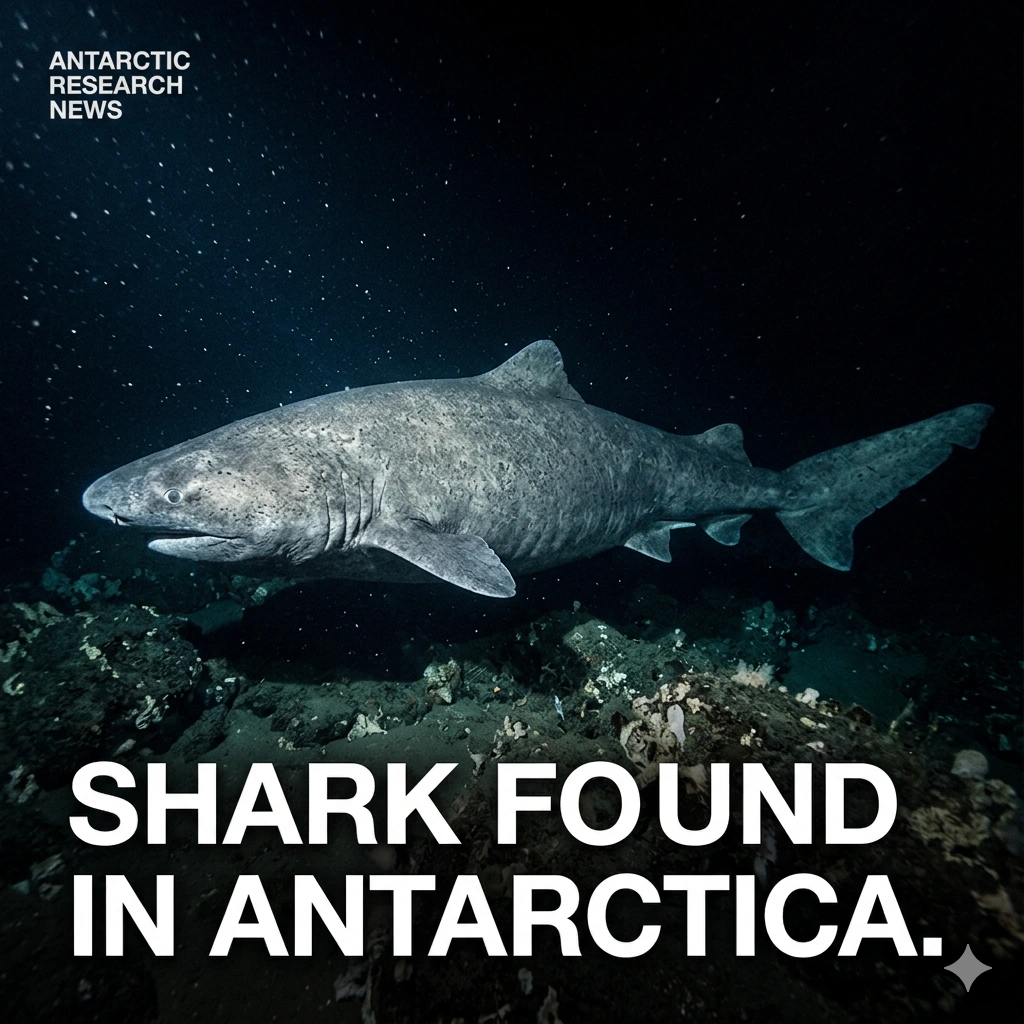
Antarctic Sleeper Shark sightings have officially rewritten the biological rulebook of the Southern Ocean as of March 23, 2026. Researchers from the Minderoo-UWA Deep-Sea Research Centre captured unprecedented video footage of a massive, tank-like creature cruising the frigid depths near the South Shetland Islands. This discovery shatters the long-held scientific “rule of thumb” that the extreme cold of Antarctic waters acted as a natural barrier against large predatory sharks. The presence of such a substantial specimen proves that these resilient giants have adapted to thrive in pitch-black, near-freezing environments previously thought to be shark-free.
The primary significance of the Antarctic Sleeper Shark find lies in its challenge to existing thermal physiology theories. Most marine biologists previously assumed that the metabolic costs of maintaining body heat in the Southern Ocean were too high for large, non-mammalian predators. However, this “substantial” specimen, estimated to be up to four meters in length, appeared perfectly at home on the barren seabed. Lead researcher Alan Jamieson described the animal’s movement as sluggish yet powerful, likening the creature to an “ungainly barrel” or a deep-sea tank.
Breaking the Thermal Barrier in the South
The Antarctic Sleeper Shark is now the focal point of intense study regarding how ectothermic animals survive in extreme sub-zero conditions. Scientists are particularly interested in the specialized proteins and anti-freeze compounds that might exist within the shark’s blood to prevent ice crystal formation. Unlike their tropical cousins, these sharks have evolved to move at a fraction of the speed, conserving every bit of energy in the nutrient-scarce depths. This low-metabolism lifestyle allows them to live for centuries, potentially making them some of the oldest living vertebrates on the planet.
Observations of the Antarctic Sleeper Shark suggest that their “tank-like” build is an evolutionary response to the crushing pressures of the deep. Their flesh is typically soft and lacks the dense muscle structure found in faster predators like the Great White. This buoyant, cartilaginous composition allows them to glide effortlessly across the ocean floor with minimal caloric expenditure. By behaving more like a scavenger-predator hybrid, the sleeper shark can survive long periods between meals in the isolated Antarctic trenches.
The Antarctic Sleeper Shark footage also revealed a surprising lack of fear toward the research team’s baited camera systems. This suggests that these apex predators have had little to no historical interaction with human technology or artificial light sources. The discovery off the South Shetland Islands proves that the “barren” seabed is actually a vibrant, albeit slow-moving, ecosystem. Protecting these newly discovered habitats from future deep-sea mining or industrial fishing is now a top priority for international environmental agencies.
Antarctic Sleeper Shark
The Antarctic Sleeper Shark discovery was made possible by the “Deepsea Power & Light” camera systems used by the Minderoo-UWA team. These advanced units can withstand the immense hydrostatic pressure found at depths exceeding 2,000 meters while capturing high-definition video in near-total darkness. Without this specific technological edge, the presence of the 13-foot “tank” would have remained a myth among sailors and researchers. The successful mission has now paved the way for more permanent monitoring stations to be established across the Antarctic Peninsula.
Under the Antarctic Sleeper Shark research initiative, scientists hope to tag a specimen to track its long-range migration patterns. It is currently unknown whether these sharks remain in the frigid Southern Ocean year-round or if they migrate to slightly warmer waters during the harshest winter months. Understanding their movement is key to determining the overall health of the Antarctic marine environment. If these large predators are present in high numbers, it indicates a much higher biomass of prey fish than previously estimated by sonar surveys.
The Antarctic Sleeper Shark also plays a vital role in the “carbon pump” of the deep ocean. When these massive creatures eventually die, their bodies sink to the seafloor, providing a “whale fall” style feast for thousands of smaller organisms. This process sequesters carbon in the deep sea for thousands of years, helping to regulate the global climate. The discovery of a shark of this size confirms that the Antarctic deep sea is an active participant in the Earth’s biological carbon cycle.
Challenges of Deep-Sea Research in 2026
Capturing the Antarctic Sleeper Shark on film was a logistical nightmare for the Minderoo-UWA Deep-Sea Research Centre. The team had to navigate through shifting ice floes and extreme weather conditions that often halted operations for days at a time. Furthermore, the electronic components of the submersibles had to be shielded against the intense cold, which can cause standard batteries to fail in minutes. This successful mission is a testament to the grit and determination of the modern deep-sea explorer.
- Deployment of autonomous landers in depths exceeding 3,000 meters.
- Management of heavy research vessels in high-latitude storm zones.
- Protection of delicate sensor equipment from abrasive seafloor sediments.
- Processing of massive data sets in remote locations with limited bandwidth.
The Antarctic Sleeper Shark find has spurred a new wave of funding for high-latitude marine biology. Governments are beginning to realize that the “Meeting of Waters” near Brazil or the energy deals in Russia are only part of the global ecological story. The deep sea represents the final frontier of territorial and biological knowledge. By leading this research, the UWA team has established Australia as a global leader in Antarctic science and deep-ocean exploration.
Biological Anomalies and Evolutionary Secrets
The Antarctic Sleeper Shark possesses several physical traits that distinguish it from its Northern Hemisphere relatives, such as the Greenland shark. Preliminary visual analysis suggests a thicker layer of fatty tissue and a slightly different gill structure optimized for high-oxygen, low-temperature water. These subtle differences indicate that the Antarctic population may have been isolated for millions of years, evolving independently from other sleeper shark lineages. This “tank” of the deep is a living time capsule of evolutionary history.
- Unique ocular adaptations for detecting bioluminescence in the abyss.
- Specialized dermal denticles that reduce friction in high-pressure zones.
- A highly developed sense of smell used to detect carrion from miles away.
One of the most fascinating aspects of the Antarctic Sleeper Shark is its potential longevity. If it shares the same biological traits as its cousins, this specific 4-meter individual could be over 200 years old. This means it may have been swimming in the Southern Ocean since the early 19th century, long before the first human explorers reached the Antarctic continent. Studying these “centurions of the deep” provides a unique perspective on how the oceans have changed over the last two centuries.
Protecting the Final Frontier
The news of the Antarctic Sleeper Shark has prompted calls for the immediate expansion of Marine Protected Areas (MPAs) around the South Shetland Islands. Environmentalists argue that we cannot protect what we do not know exists, and this shark is proof that many more species are waiting to be found. Industrial activities like krill fishing or potential seabed mining could devastate these slow-growing populations before we even understand their reproductive cycles. The “tank” of the Antarctic deserves a safe harbor in which to thrive.
The Antarctic Sleeper Shark serves as a charismatic ambassador for the deep-sea conservation movement. Much like the “Amazon Water Pilgrimage” draws attention to river health, this shark draws the world’s eye to the hidden depths of the poles. Its survival is intrinsically linked to the health of the entire global ocean system. If the cold-water currents of the Antarctic are disrupted by climate change, the habitat of the sleeper shark could vanish forever.
International cooperation is essential for the continued study of the Antarctic Sleeper Shark. In a world often divided by “Vietnam Russia Energy” deals or regional “Algeria Niger Strategic” partnerships, science remains a unifying force. Nations must work together under the Antarctic Treaty System to ensure that deep-sea research remains peaceful and focused on the common good. This shark belongs to no single nation; it is a heritage of the entire human race and the planet we share.
Technological Innovations in Shark Tracking
The next phase of the Antarctic Sleeper Shark project involves the use of AI-driven submersibles to follow these animals in real-time. These “smart drones” are capable of recognizing the unique silhouette of a sleeper shark and shadowing it at a distance without disturbing its natural behavior. This technology allows researchers to observe hunting techniques and social interactions that were previously impossible to document. The goal is to move from “snapshots” of life to a continuous “video diary” of the deep.
Data gathered from the Antarctic Sleeper Shark will be shared with global databases to improve our predictive models of marine life distribution. By feeding the shark’s habitat preferences into machine learning algorithms, scientists can predict other areas of the Southern Ocean where these giants might be hiding. This “predictive biology” is the future of oceanography, allowing us to focus our limited research resources on the most promising locations. The “tank” is helping us map the unmappable.
The Antarctic Sleeper Shark has also sparked interest in the field of biomimicry. Engineers are studying the shark’s efficient, low-energy movement to design better underwater vehicles for long-term monitoring. If we can replicate the “sluggish yet powerful” propulsion of the sleeper shark, we can create drones that stay underwater for years on a single charge. Nature has already solved the problems of deep-sea travel; we just need to pay attention to the lessons provided by the Antarctic “barrel.”
Future Missions and the “Deep-Sea Tank”
As we look toward the summer of 2026, more expeditions are being planned to revisit the South Shetland Islands. The team is eager to find out if the Antarctic Sleeper Shark they filmed is part of a larger breeding colony or a solitary wanderer. Finding juvenile sleeper sharks would be a “holy grail” for the research community, as it would confirm that the Southern Ocean is a primary nursery for the species. Every new frame of footage brings us closer to a complete picture of this mysterious predator.
- Installation of acoustic arrays to listen for the “sounds” of the deep.
- Collection of environmental DNA (eDNA) samples from the surrounding water.
- Comparative studies with sleeper shark populations in the Arctic.
The Antarctic Sleeper Shark is more than just a biological curiosity; it is a symbol of resilience. In an era where many species are struggling to adapt to a changing world, this shark remains a steadfast inhabitant of the most hostile environment on Earth. It reminds us that life finds a way, even in the “tank” of the Antarctic abyss. As long as we continue to explore, we will continue to be amazed by the wonders of the deep.
In conclusion, the Antarctic Sleeper Shark discovery is a landmark event that will be studied for decades. It has bridged the gap between theoretical biology and hard evidence, proving that the Southern Ocean is far more diverse than we ever imagined. From the “Tencent OpenClaw AI” developments in China to the “Cricket Australia Schedule” milestones, the world is moving fast—but in the deep Antarctic, the sleeper shark continues its slow, majestic journey. Let us honor this discovery by committing ourselves to the protection of the world’s last great wilderness.
For more details & sources visit: Associated Press (AP)
Read more on Antarctica news: 360 News Orbit – Antarctica.