
The Antarctic glacier acceleration research conducted by the Chinese Academy of Sciences has unveiled a critical link between rising subsurface sea temperatures and the rapid movement of ice sheets. This comprehensive study, led by the Northwest Institute of Eco-Environment and Resources, shifts the scientific focus from surface atmospheric conditions to the hidden thermal energy lurking beneath the waves. By analyzing over a decade of observational data, the team has identified a dangerous feedback loop that threatens the stability of the western Antarctic Peninsula.
This Antarctic glacier acceleration is no longer a theoretical projection but a documented reality with profound implications for global sea-level rise. As the world monitors these changes, the findings provide a vital piece of the puzzle in understanding how the Earth’s most significant ice reserves respond to a warming climate. This research underscores the vulnerability of marine-terminating glaciers and the urgent need for refined climate modeling to predict future environmental shifts with greater accuracy and precision.
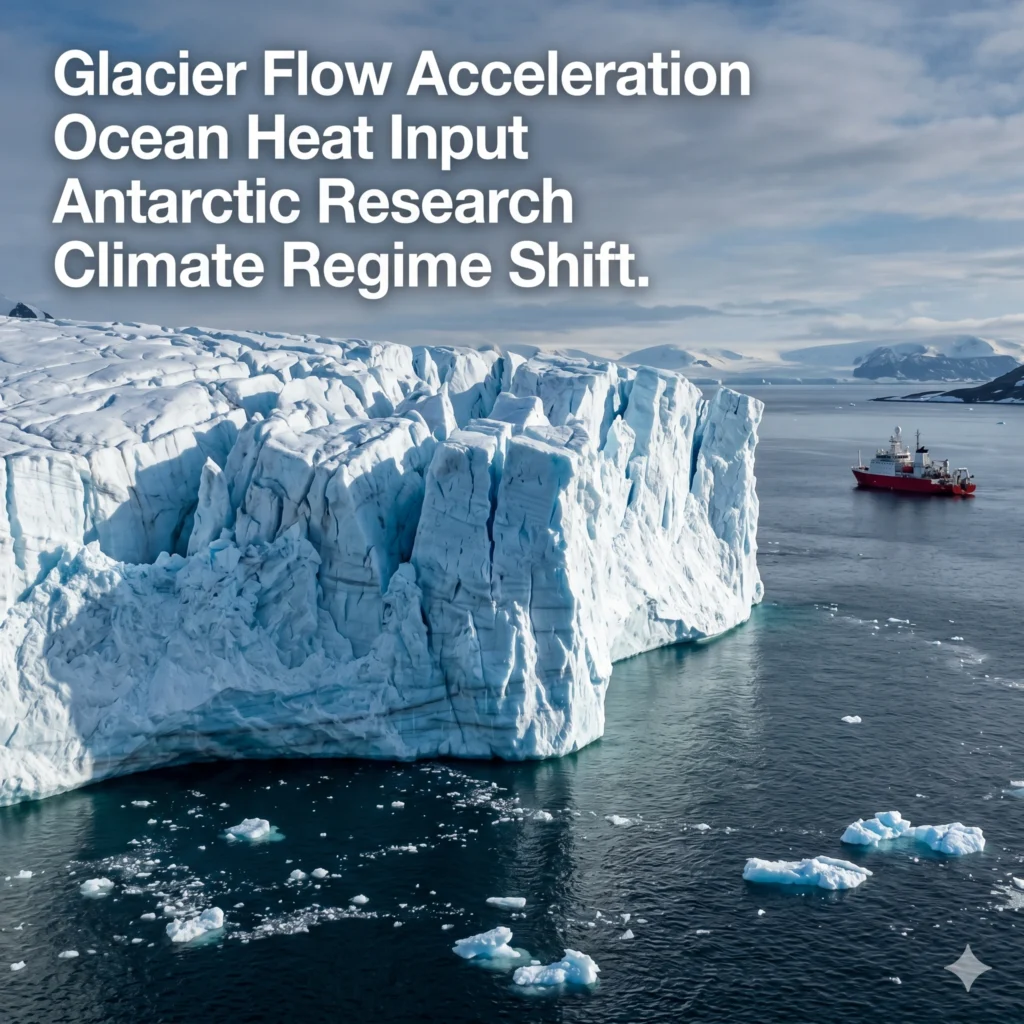
Antarctic Glacier Acceleration and Subsurface Heat
The primary discovery of the decade-long study is that Antarctic glacier acceleration is predominantly driven by heat input in the upper ocean. Specifically, the research team found that thermal energy at depths ranging from zero to three hundred meters acts as the main catalyst for ice movement. Unlike other regions where surface meltwater might lubricate the glacier base, this specific area of the Antarctic Peninsula is reacting to subsurface oceanic warming. The influx of warm water undermines the stability of the ice from below, leading to a noticeable increase in flow velocity.
Scientists monitored the regional climate system to determine why Antarctic glacier acceleration became more pronounced after 2018. They discovered that the heat transfer from the ocean to the glacier termini reduces the friction that typically holds the ice in place. This process, often referred to as basal melting, effectively detaches the glacier from its grounded positions. Consequently, the ice slides more rapidly into the sea, contributing directly to the volume of water in the global oceans. The sensitivity of these glaciers to even minor temperature fluctuations in the water column is a major concern for the research community.
The Antarctic glacier acceleration observed in Beascochea Bay provides a clear example of how marine-terminating glaciers are failing under environmental pressure. By isolating subsurface heat as the primary driver, the Chinese researchers have redirected the focus of future polar expeditions. Understanding the mechanics of this heat transfer is essential for developing mitigation strategies and accurate survival projections for coastal regions worldwide. The data suggests that the “protective” nature of cold polar waters is rapidly diminishing as warmer currents penetrate deeper into the Antarctic bays.
Critical Turning Points in Antarctic Glacier Acceleration
Lead author Kang Yulong has identified the year 2018 as a potential critical turning point for Antarctic glacier acceleration in the western peninsula. Prior to this date, flow velocities exhibited more traditional seasonal variations, but a shift occurred that accelerated the baseline movement. This change suggests that the regional climate system may have crossed a threshold from which recovery is increasingly difficult. The persistent nature of the speed increase since 2018 indicates a fundamental change in the structural integrity of the local ice sheets.
The Antarctic glacier acceleration documented since this turning point shows that summer velocities now consistently exceed winter speeds by a wider margin. This seasonal disparity highlights the increasing sensitivity of the ice to the warming cycles of the Southern Ocean. As the summer months bring warmer waters into contact with the glacier fronts, the rate of calving and flow increases exponentially. The 2018 data point serves as a warning that climate impacts can manifest as sudden shifts rather than slow, linear changes.
By studying one hundred and one different glaciers, the team confirmed that Antarctic glacier acceleration is a widespread regional phenomenon rather than an isolated incident. The consistency of the data across such a large sample size reinforces the validity of the 2018 turning point theory. Researchers are now looking for similar signals in other parts of the continent to see if this trend is expanding. If 2018 was indeed a tipping point, the next decade could see even more dramatic changes in the Antarctic landscape.
Antarctic Glacier Acceleration
The phenomenon of Antarctic glacier acceleration serves as a stark reminder of the fragile balance between the cryosphere and the hydrosphere. This specific H2 section highlights the core focus of the research, emphasizing how the movement of these massive ice bodies is being dictated by external thermal drivers. As the ice speeds up, the risk of significant sea-level rise increases, making the study of Antarctic glacier acceleration a top priority for international climate scientists and policymakers alike.
The high-precision monitoring tools used in the study allowed for the tracking of minute changes in flow patterns over a ten-year period. This level of detail has proven that Antarctic glacier acceleration is not caused by surface meltwater as previously suspected in some models. Instead, the “invisible” warming of the ocean is the silent engine behind the retreating ice. This distinction is vital for creating effective climate policies that address the root causes of polar instability.
As Antarctic glacier acceleration continues, the supporting structures of these glaciers become more fragile and prone to collapse. The research published in the Chinese Academy of Sciences journals provides the evidence needed to refine global projections. Without a clear understanding of Antarctic glacier acceleration, our ability to protect coastal infrastructure and biodiversity is significantly compromised. The ongoing investigation into warm-water driving mechanisms will be the next frontier for the Northwest Institute’s research team.
High-Precision Monitoring of Beascochea Bay
Beascochea Bay served as the primary laboratory for observing Antarctic glacier acceleration due to its unique geographical features. The bay contains over one hundred glaciers, providing a diverse yet contained environment for longitudinal study. Researchers utilized satellite imagery and ground-based sensors to collect high-precision data on ice movement. This multi-method approach ensured that the findings on Antarctic glacier acceleration were robust and resistant to localized data anomalies.
The team monitored the glaciers between 2015 and 2025, a decade that saw some of the highest recorded ocean temperatures in history. During this time, Antarctic glacier acceleration was measured in real-time, allowing scientists to correlate flow speeds with specific oceanic temperature spikes. The results showed a direct relationship between the arrival of warm water masses and the immediate surge in ice velocity. This temporal correlation is some of the strongest evidence to date for the ocean-driven model of ice loss.
- One hundred and one glaciers were tracked with millimeter-level precision throughout the study.
- Thermal sensors were deployed at various depths to map the temperature profile of the bay.
- Flow velocities were recorded monthly to capture both seasonal and annual trends.
- Comparative analysis was performed between the Beascochea Bay data and historical records.
The logistical challenges of conducting such a long-term study in the harsh Antarctic environment cannot be overstated. However, the resulting data on Antarctic glacier acceleration is invaluable for the scientific community. The team’s ability to maintain consistent monitoring over a decade has provided a baseline that will be used for years to come. This study sets a new standard for how polar research should be conducted in the era of rapid climate change.
Implications for Global Sea Level Projections
The data derived from the study of Antarctic glacier acceleration is essential for refining global sea-level rise projections. Current models often struggle to account for the complex interactions between subsurface ocean currents and ice shelf stability. By providing specific figures on Antarctic glacier acceleration, the Chinese Academy of Sciences has helped fill a significant gap in our understanding. These findings suggest that sea levels could rise faster than previously estimated if subsurface warming continues at its current rate.
Future climate models must now incorporate the 0-300 meter ocean heat input as a primary variable. The Antarctic glacier acceleration documented in the study shows that atmospheric temperature alone is an insufficient metric for predicting ice loss. Coastal cities and island nations rely on these models to plan their defenses and relocate vulnerable populations. The precision of the data on Antarctic glacier acceleration directly translates into more reliable safety warnings for millions of people living near the ocean.
Furthermore, the research suggests that the Antarctic Peninsula is becoming increasingly sensitive to external environmental warming. This heightened sensitivity means that even small improvements or regressions in global carbon emissions could have an outsized impact on Antarctic glacier acceleration. The study serves as both a scientific breakthrough and a call to action for the global community. Understanding the mechanics of ice loss is the first step toward slowing the rate of change and preserving the planet’s remaining ice sheets.
Fragility of Marine-Terminating Glaciers
The study emphasizes that the supporting structures of marine-terminating glaciers are becoming increasingly fragile due to Antarctic glacier acceleration. These glaciers are anchored to the seabed, but as they accelerate, the “tether” that keeps them stable is weakened. This fragility leads to more frequent calving events, where massive chunks of ice break off into the ocean. The Antarctic glacier acceleration acts as a self-reinforcing process, where faster flow leads to more instability, which in turn leads to even faster flow.
The physical breakdown of these ice structures is a permanent change that cannot be easily reversed. As Antarctic glacier acceleration strips away the base of the glaciers, the entire ice sheet behind them begins to move more freely. This “unplugging” effect is a major concern for scientists who fear it could lead to the collapse of entire regional ice systems. The fragility identified in the research is a clear indicator that the Antarctic Peninsula is in a state of transition.
By documenting the specific depths at which heat input occurs, the researchers have identified the “Achilles’ heel” of the Antarctic ice sheet. The Antarctic glacier acceleration is the visible symptom of a deep-seated environmental illness. Protecting these marine-terminating glaciers requires a global effort to stabilize ocean temperatures. Without such intervention, the fragility of the ice will only increase, leading to a future defined by rapid and unpredictable geographic shifts.
Expanding Research and Future Investigations
Following the success of their work in Beascochea Bay, the research team plans to expand their investigation of Antarctic glacier acceleration. They aim to apply their high-precision monitoring techniques to other regions of Antarctica, such as the East Antarctic Ice Sheet. This expansion will help determine if the trends of Antarctic glacier acceleration observed in the peninsula are truly continent-wide. The goal is to create a comprehensive map of oceanic heat drivers for the entire Antarctic coastline.
Future investigations will also delve deeper into the specific origins of the warm water currents entering the bays. Understanding where this heat comes from—whether it is a result of shifting wind patterns or broader global current changes—is the next step in the study of Antarctic glacier acceleration. The Chinese Academy of Sciences is collaborating with international partners to share data and resources for these ambitious projects. This collaborative approach is necessary to tackle a problem as vast as polar ice loss.
- Satellite-based radar will be used to monitor inland ice movement in relation to coastal flow.
- Autonomous underwater vehicles will be deployed to take direct measurements at the glacier face.
- Ice core samples will be analyzed to compare modern Antarctic glacier acceleration with prehistoric trends.
- Publicly accessible databases will be created to house the decade’s worth of observational data.
The commitment to ongoing research ensures that the lessons learned about Antarctic glacier acceleration will be refined and updated. As technology improves, the precision of these studies will only get better, providing even clearer insights into the Earth’s changing climate. The Antarctic glacier acceleration study is just the beginning of a new era of polar science that prioritizes ocean-ice interactions.
Comparing Summer and Winter Flow Velocities
A key component of the research was the comparison of summer and winter flow velocities to understand the seasonality of Antarctic glacier acceleration. The findings showed that while flow occurs year-round, the mean summer speeds are significantly higher. This seasonal surge is a direct response to the increased heat capacity of the upper ocean during the warmer months. Understanding this cycle is crucial for predicting the timing of major ice loss events associated with Antarctic glacier acceleration.
The winter months traditionally provided a period of relative stability, but the study shows that even winter speeds are rising as the ocean retains more heat. This “thermal memory” of the ocean means that Antarctic glacier acceleration is becoming a year-long problem. The researchers noted that the gap between summer and winter velocities is narrowing in some areas, suggesting that the “off-season” for ice loss is disappearing. This trend is a worrying sign of the overall warming of the Southern Ocean.
Detailed analysis of the summer peaks in Antarctic glacier acceleration has revealed that they are occurring earlier and lasting longer each year. This extension of the melting season is a classic hallmark of climate change. By documenting these seasonal shifts, the team has provided a more nuanced view of how Antarctic glacier acceleration manifests over time. This information is vital for organizations that manage polar logistics and shipping, as the physical environment becomes more dynamic and dangerous.
Conclusion and Scientific Impact
The research on Antarctic glacier acceleration by the Chinese Academy of Sciences has fundamentally changed our understanding of polar ice dynamics. By proving that subsurface ocean warming is the primary driver of ice loss in the western Antarctic Peninsula, the study has provided a new framework for climate science. The Antarctic glacier acceleration documented over the last decade serves as a powerful piece of evidence for the reality of global warming and its far-reaching consequences. This work will influence sea-level projections and climate policy for years to come.
As the scientific community digests these findings, the focus must remain on the fragility of the Antarctic ecosystem. The Antarctic glacier acceleration is a clear warning that our planet’s natural defenses are being eroded from within. The dedication of the Northwest Institute of Eco-Environment and Resources to this decade-long project has provided a treasure trove of data for future generations. The study of Antarctic glacier acceleration is no longer just about ice; it is about the future of our global environment and the stability of our coastal civilizations.
Ultimately, the Antarctic glacier acceleration study proves that the ocean holds the key to the future of the cryosphere. As we move forward, the lessons learned in Beascochea Bay must be applied globally to mitigate the impacts of a warming world. The research team’s plans to expand their work provide hope that we can continue to gain the knowledge necessary to face these challenges. Antarctic glacier acceleration is a formidable foe, but with precise data and international cooperation, we can better understand and prepare for the changes ahead.
For more details & sources visit: China Daily
Read more on Antarctica news: 360 News Orbit – Antarctica.