
Malaysia Tech Salaries have experienced a historic surge, officially surpassing those in Japan for several high-level leadership roles in the engineering and software sectors. This unprecedented shift is the direct result of a severe mismatch between the rapid expansion of the local digital economy and the available pool of experienced professionals. As global semiconductor giants and cloud providers pour billions into the region, the competition for human capital has reached a fever pitch. Consequently, multinational corporations are being forced to offer record-breaking compensation packages to attract and retain the specialized expertise required to operate complex industrial facilities.
The rise in Malaysia Tech Salaries reflects the country’s evolving status as a critical node in the global technology supply chain, particularly in Southeast Asia. Industry reports indicate that Chief Technology Officers (CTOs) in Kuala Lumpur and Penang now command annual packages worth up to 28 million yen, exceeding the average benchmarks found in Tokyo. This wage inflation is not limited to the C-suite, as research and development directors in the electronics sector are also earning significantly higher premiums. The trend highlights a fundamental transformation where the region is no longer just a low-cost manufacturing hub but a competitive destination for high-value technical talent.
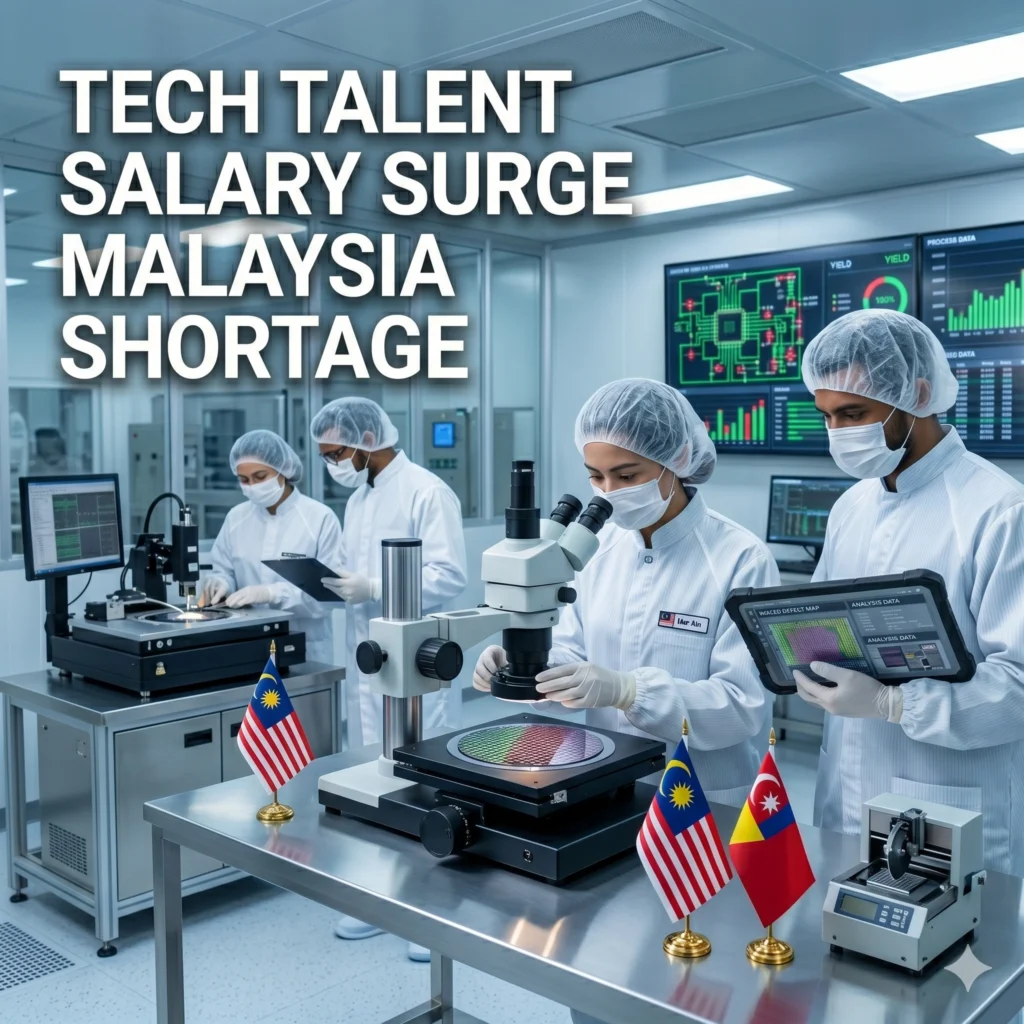
Malaysia Tech Salaries
The primary driver behind the spike in Malaysia Tech Salaries is the acute talent shortage that currently plagues the nation’s high-tech industrial base. Government estimates suggest that the country needs a workforce of at least 50,000 skilled engineers to sustain its current growth trajectory in semiconductors and data centers. However, local universities are only producing approximately 5,000 engineering graduates each year, creating a massive tenfold shortfall. This scarcity has created a “seller’s market” for employees, where those with the right technical skills can negotiate salaries that were previously unimaginable in the local market.
Furthermore, Malaysia Tech Salaries are being pushed higher by the entry of global semiconductor firms that are fleeing geopolitical tensions elsewhere to establish a presence in the ASEAN region. These companies often engage in aggressive employee poaching, offering substantial raises to lure experienced engineers away from competitors. For a local engineer with five to ten years of experience, a job change can now result in a 30% to 50% increase in total compensation. This fierce war for talent has made payroll management a significant operational challenge for both domestic startups and established multinational entities.
The Impact of the National Semiconductor Strategy
The government’s National Semiconductor Strategy aims to move the country up the value chain into integrated circuit (IC) design and advanced packaging, but it faces a steep uphill battle. While the ambition is clear, the actual number of individuals trained in these advanced disciplines remains in the low thousands. This lack of specialized training centers has further fueled the growth of Malaysia Tech Salaries as companies compete for the few individuals who possess these niche skills. Without a more robust domestic training pipeline, the reliance on a small circle of elite professionals will continue to drive up costs.
The disparity between the strategic goals of the country and the current workforce capabilities is the core reason for the skyrocketing Malaysia Tech Salaries. While the government is encouraging investment, the industry is struggling to find the middle-management and senior-level staff needed to lead these projects. This has led to a situation where experienced professionals are being promoted rapidly, often with massive salary bumps that reflect their scarcity value rather than their years of service. The focus must now shift toward scaling the education system to meet these high-tech demands.
Regulatory Changes and Foreign Worker Passes
In response to the domestic talent crisis, the Home Affairs Ministry has proposed new regulatory changes that could further impact Malaysia Tech Salaries. These proposals include doubling the minimum salary thresholds for foreign worker employment passes to ensure that local employees are not undercut by cheaper foreign labor. Category 1 executive passes may soon require a minimum monthly salary of RM20,000, which represents a significant increase in the cost of hiring expatriates. This move is designed to force companies to prioritize local hiring, but it may also inadvertently drive up the market rate for qualified Malaysian citizens.
The introduction of stricter rules for Category 2 and 3 workers will require firms to implement formal succession plans to ensure knowledge transfer to local staff. This means that for every foreign expert hired, there must be a clear path for a Malaysian employee to eventually take over that role. While this is a positive step for long-term national development, it adds a layer of administrative complexity and cost for firms already struggling with the talent war. The interplay between these new regulations and the existing shortage will likely keep upward pressure on all tech-related compensation for the foreseeable future.
- Minimum salary for Category 1 passes could soon reach RM20,000 per month.
- Succession plans will be mandatory for most foreign engineering hires.
- Knowledge transfer clauses are being integrated into new industrial permits.
Competition with the Japanese Market
The fact that Malaysia Tech Salaries have overtaken Japan’s average for certain roles is a psychological milestone for the Southeast Asian region. Historically, Japan was seen as the undisputed leader in high-paying technical roles in Asia, but stagnant wage growth in Tokyo has allowed more dynamic markets to catch up. Malaysian R&D directors in the electronics field are now reporting earnings nearly twenty percent higher than their counterparts in the Japanese market. This shift is causing some regional talent to reconsider Malaysia as a primary career destination, reversing the traditional “brain drain” to more developed nations.
This regional competition for talent is forcing Japanese firms to reconsider their own compensation structures to remain competitive in the global market. As Malaysia Tech Salaries continue to rise, the country is becoming a more attractive option for expatriates from across the globe, not just from within the region. However, this high-wage environment also presents a risk to the country’s competitiveness if productivity does not keep pace with the rising costs. Balancing high pay with high output will be the primary challenge for the Malaysian tech sector over the next decade.
Data Center and Cloud Computing Growth
Beyond semiconductors, the explosion of data center investments in Johor and the Klang Valley has further complicated the labor market. These facilities require specialized cooling experts, cloud architects, and cybersecurity professionals who are in even shorter supply than traditional electronics engineers. The specialized nature of these roles means that Malaysia Tech Salaries in the cloud sector are among the fastest-growing in the entire economy. Major players like Amazon Web Services and Google are setting the pace for compensation, leaving smaller local firms struggling to keep up.
The rapid growth of the cloud sector is a double-edged sword for the local economy. While it brings high-tech infrastructure and investment, it also drains the existing pool of talent from other sectors like telecommunications and software development. To combat this, some firms are turning to “upskilling” programs to transition traditional IT workers into cloud-focused roles. However, these programs take time, and the immediate need for experienced staff remains the primary driver of the current salary surge. The data center boom is effectively acting as an accelerant on an already overheated labor market.
- Cloud architect roles have seen a 40% year-on-year increase in base pay.
- Johor is emerging as a regional hub for data center expertise.
- Cybersecurity specialists are commanding massive signing bonuses to switch firms.
Challenges for Small and Medium Enterprises
While multinational corporations can afford to pay premium Malaysia Tech Salaries, the local small and medium enterprise (SME) sector is feeling the squeeze. Many homegrown tech companies are finding it impossible to compete with the deep pockets of global giants, leading to a loss of their most experienced developers and engineers. This “talent drain” from local firms to multinationals could stifle domestic innovation if not addressed through targeted government support or tax incentives for SME payrolls.
SME leaders have warned that the high-wage environment is making it difficult for them to scale their operations or invest in their own R&D. Without a more balanced approach to talent management, the gap between the foreign-owned high-tech sector and the domestic tech industry will continue to widen. Some experts suggest that the government should provide wage subsidies for local firms that hire and train fresh graduates, helping to build the talent pipeline from the bottom up while the seniors are preoccupied with the multinationals.
The Role of Foreign Training Centers
A significant concern raised by industry leaders is that new regulatory barriers might discourage foreign educational firms from establishing much-needed training centers in Malaysia. These centers are vital for closing the skills gap and moderating the extreme growth of Malaysia Tech Salaries by increasing the supply of qualified workers. If the cost of bringing in foreign instructors becomes too high due to the new employment pass rules, the country may miss out on critical knowledge transfer opportunities.
The government must strike a delicate balance between protecting local wages and ensuring the country remains an attractive place for international technical trainers. By offering exemptions or incentives for educational institutions, Malaysia can ensure that it continues to import the “soft knowledge” needed to build a sustainable tech ecosystem. A massive influx of technical expertise is required to fulfill long-term ambitions in advanced packaging and IC design, and education is the only way to achieve this without permanently inflating the cost of labor beyond competitive levels.
Long-Term Ambitions in Advanced Packaging
The ultimate success of Malaysia’s high-tech goals depends on its ability to move into “Advanced Packaging”—a complex part of the semiconductor process that requires highly specialized skills. To achieve this, the country cannot rely solely on its existing workforce. The current level of Malaysia Tech Salaries is a symptom of a transition phase where demand has outpaced the domestic ability to supply expert labor. Over the long term, the country must focus on becoming a net exporter of tech talent rather than a desperate importer.
Advanced packaging facilities are already being built in Penang, but the personnel to run them are often being flown in from overseas at great expense. For Malaysia to truly own this segment of the market, it must develop its own experts who can command these high Malaysia Tech Salaries while contributing to national intellectual property. This requires a multi-generational commitment to STEM education and a closer alignment between industry requirements and university curricula.
- Advanced packaging is the next frontier for the Penang semiconductor cluster.
- Integrated circuit (IC) design requires a new tier of engineering expertise.
- Collaboration with global universities is seen as a key solution to the shortage.
Impact on the Broader Malaysian Economy
The rising tide of Malaysia Tech Salaries is having a ripple effect on the broader economy, particularly in the real estate and service sectors of tech hubs. In cities like Penang and Cyberjaya, the influx of high-earning tech workers is driving up demand for premium housing and high-end services. While this is a boost for local businesses, it also raises the cost of living for those outside the tech sector, creating a dual-speed economy.
Policy makers are watching these developments closely to ensure that the benefits of the tech boom are distributed as widely as possible. Higher tax revenues from these top-tier salaries can be used to fund social programs and infrastructure projects that benefit all Malaysians. However, the immediate challenge remains the stability of the tech sector itself, which cannot continue to grow if the cost of labor becomes its primary bottleneck. The high-wage phenomenon is a sign of success, but also a warning of the work that remains to be done.
Strategic Recommendations for Tech Firms
In an environment where Malaysia Tech Salaries are at an all-time high, firms must think creatively about how they attract talent beyond just the monthly paycheck. Employee experience, flexible work arrangements, and clear paths to leadership are becoming just as important as the base salary. Companies that invest in a strong corporate culture are often able to retain staff even when competitors offer slightly higher wages. This holistic approach to talent management is essential for long-term survival in an overheated market.
Furthermore, firms should look toward “talent-sharing” models and collaborations with local technical colleges to build their own pipelines. By providing internships and scholarships, companies can secure the loyalty of young engineers before they are even on the market. This long-term investment is often more cost-effective than participating in the endless cycle of employee poaching and salary inflation. The goal should be to create a sustainable ecosystem where talent is grown and nurtured within the country.
Conclusion and Future Outlook
The current surge in Malaysia Tech Salaries is a powerful indicator of the country’s rising importance in the global technology landscape. While the talent shortage presents immediate challenges, it also provides an incredible opportunity for Malaysian professionals to reach new heights of prosperity. By addressing the education gap and fine-tuning labor regulations, the government can ensure that this high-wage environment leads to a more robust and innovative national economy.
As we look toward the end of the decade, the ability of Malaysia to fulfill its high-tech ambitions will depend on how it manages this transition. The “Japan-surpassing” salaries are a badge of honor for the nation’s development, but they must be backed by a commitment to excellence and a massive expansion of the domestic talent pool. If the country can successfully train the next 50,000 engineers, it will not only sustain its current growth but become a global leader in the next generation of digital and industrial technology.
For more details & sources visit: The Diplomat
Read more about Malaysia news on 360 News Orbit – Malaysia.