
The WHCD Shooting has sent shockwaves through the nation after a 31-year-old California man was apprehended following a violent gunfire exchange at a security checkpoint. During the high-profile White House Correspondents’ Association Dinner, the annual gala was transformed into a scene of chaos as security details rushed to protect the President and high-ranking guests. Authorities have identified the suspect as Cole Tomas Allen, a resident of Torrance, California, who allegedly charged the security perimeter with a long gun. This disruption has raised serious questions about the safety of large-scale political gatherings in the current social and political climate.
President Donald Trump and the first lady were safely evacuated from the premises immediately after the initial shots were fired. While the atmosphere inside the hotel was one of celebration, the exterior quickly became a combat zone as law enforcement officers engaged the suspect. One Secret Service agent was shot at close range during the confrontation but was miraculously saved by his protective bulletproof vest. This harrowing encounter highlights the constant danger faced by those tasked with protecting the nation’s leaders during public appearances and formal events.
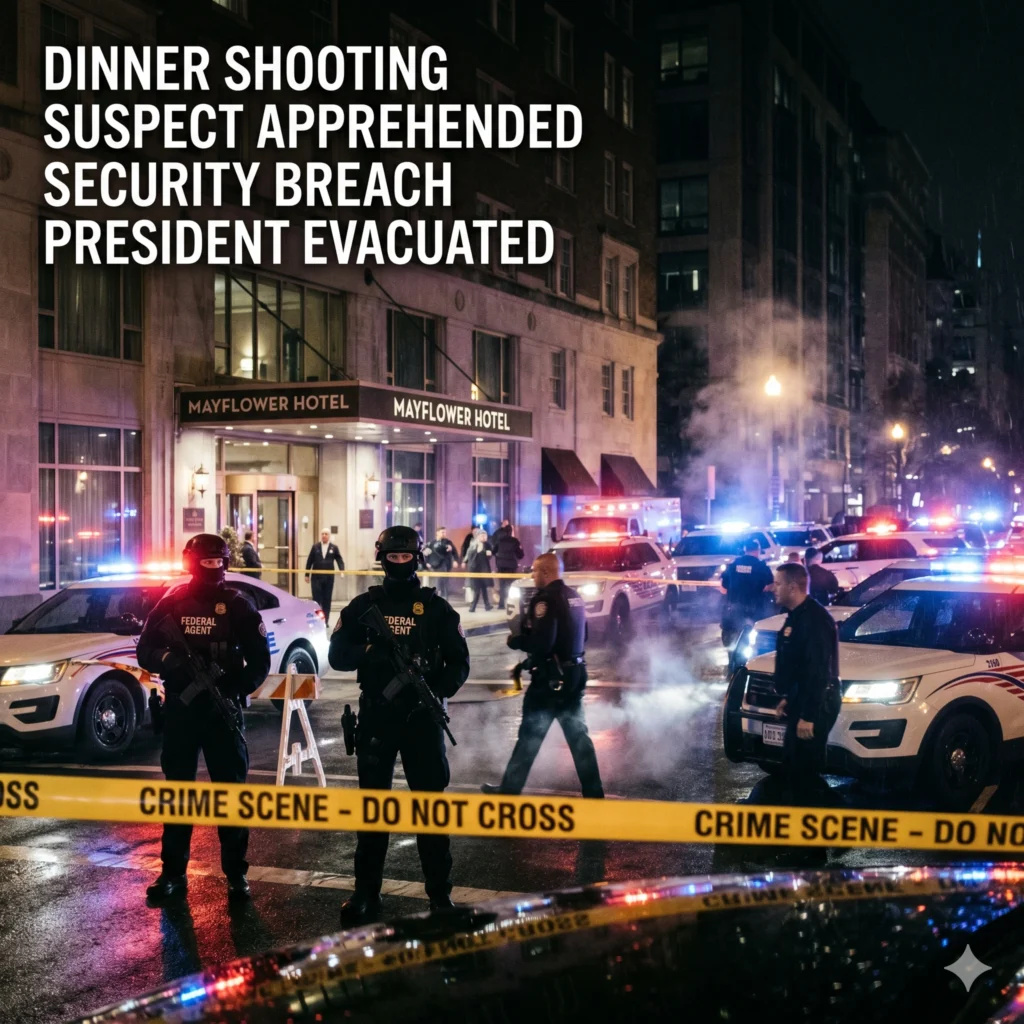
WHCD Shooting
The WHCD Shooting occurred at the same historic hotel where an assassination attempt on Ronald Reagan took place in 1981. This chilling historical parallel was not lost on investigators as they cordoned off the area to collect evidence. FBI Director Kash Patel stated that agents acted with incredible speed to subdue the shooter after he breached the primary security perimeter. Multiple shell casings and a long gun were recovered at the scene, providing critical evidence for the ongoing criminal investigation into the suspect’s motives.
Following the containment of the threat, the event was officially halted to ensure the safety of all attendees and staff. U.S. Attorney Jeanine Pirro announced that Cole Tomas Allen will be officially arraigned on at least two major charges this Monday. The joint investigation between the FBI and the Secret Service is currently focusing on the suspect’s background and any potential radicalization. As the legal process begins, the nation remains on high alert regarding the security of its democratic institutions and public ceremonies.
Presidential Response and Briefing
President Donald Trump praised the courage of law enforcement during a subsequent briefing at the White House shortly after the evacuation. He emphasized that the bravery of the Secret Service prevented a potential tragedy from becoming a national catastrophe. The President confirmed he personally spoke with the injured officer, reporting that the agent was in high spirits despite the close call. This public show of support aims to reassure the citizenry that the executive branch remains functional and secure despite the targeted attack.
The WHCD Shooting serves as a stark reminder of the volatility surrounding modern political discourse. Trump’s administration has signaled that security protocols for all future public engagements will undergo a rigorous and comprehensive review. Law enforcement agencies are now under pressure to enhance their screening processes to prevent similar breaches. The briefing concluded with a call for national unity and a firm stance against any form of political violence or domestic terrorism.
Security Breach at the Hotel
Witnesses described a scene of total confusion as the WHCD Shooting began near the hotel’s main entrance. The suspect allegedly bypassed initial thermal scanners before being confronted by the Secret Service at a secondary checkpoint. It was at this juncture that the exchange of gunfire occurred, leading to the injury of the agent and the eventual arrest of the suspect. The breach has prompted an internal audit of the private security firm hired to assist with the gala’s logistics.
Law enforcement sources are investigating how a long gun was transported to such a high-security area without detection. The WHCD Shooting has exposed potential vulnerabilities in the “soft perimeter” of major hotels during high-stakes events. Experts suggest that the suspect may have conducted prior surveillance of the venue to identify weaknesses in the patrol routes. Correcting these security flaws is now a top priority for federal agencies ahead of the upcoming summer political season.
Historical Context of the Venue
The location of the WHCD Shooting holds a dark place in American history due to the 1981 Reagan incident. Security at this specific hotel has traditionally been some of the tightest in Washington D.C., making this breach even more concerning for officials. The fact that another shooting has occurred at this site reinforces the need for permanent, high-intensity security upgrades. Many commentators are noting that the hotel’s layout presents unique challenges for modern protection details.
By revisiting the security failures of the past, the Secret Service hopes to refine its current strategies for the future. The WHCD Shooting will likely lead to the implementation of new exclusion zones around the hotel during presidential visits. Historians and security analysts are already drawing comparisons between the two events to see if any patterns emerge. Understanding the legacy of this venue is crucial for preventing a third such incident from occurring in the years to come.
Arraignment of Cole Tomas Allen
Cole Tomas Allen is expected to face a federal judge this Monday to answer for his role in the WHCD Shooting. U.S. Attorney Jeanine Pirro has indicated that the charges will include attempted murder of a federal officer and weapons violations. Given the high-profile nature of the crime, the prosecution is expected to seek the maximum penalties allowed under federal law. The arraignment will be closely watched by the media and the public as the first step in the legal reckoning.
Legal experts believe that the defense may attempt to raise questions about the suspect’s mental state at the time of the attack. However, the recovery of a long gun suggests a level of premeditation that may complicate such a defense strategy. The WHCD Shooting has sparked a debate about the adequacy of existing laws regarding attacks on government functions. For now, the suspect remains in federal custody without bond pending his initial court appearance.
Investigation into Suspect’s Motive
The FBI is currently combing through the digital footprint of the suspect involved in the WHCD Shooting. Investigators are looking for manifestos, social media posts, or encrypted communications that might explain why he targeted the gala. Cole Tomas Allen’s residency in Torrance, California, is also being scrutinized to see if he had any local accomplices. Determining whether he acted alone or as part of a larger group is the primary goal of the current intelligence gathering.
Early reports from the suspect’s neighborhood describe him as a quiet individual, which has surprised many who knew him. The WHCD Shooting has led to a wider discussion about the “lone wolf” threat in the United States. Federal agents are interviewing family members and former associates to build a comprehensive psychological profile of the shooter. This deep dive into his life is essential for understanding the root causes of such violent outbursts.
Impact on Future Political Events
The immediate aftermath of the WHCD Shooting will see a drastic change in how political events are managed. Organizers of upcoming rallies and dinners are already coordinating with the Secret Service to double their security presence. There is a palpable sense of unease among journalists and politicians who frequently attend these high-profile gatherings. The WHCD Shooting has essentially ended the era of “relaxed” security at social-political mixers.
Some advocacy groups are calling for a temporary moratorium on large indoor political events until security can be fully guaranteed. However, the administration has expressed a desire to continue with its scheduled engagements to show that the government cannot be intimidated. The WHCD Shooting has therefore created a difficult balancing act between public accessibility and personal safety. The decisions made in the coming weeks will set the tone for the 2026 political cycle.
Secret Service Heroism Under Fire
The agent who survived the WHCD Shooting is being hailed as a hero for his split-second reactions. By standing his ground at the checkpoint, he prevented the suspect from reaching the main ballroom where the President was seated. His survival, thanks to his bulletproof vest, has become a rallying point for law enforcement across the country. This incident underscores the importance of high-quality protective equipment for all front-line officers.
President Trump has indicated that a formal commendation ceremony will be held for the officers involved in subduing the suspect. The WHCD Shooting could have been a much darker day if not for the professionalism of the Secret Service detail. Training exercises will now incorporate the lessons learned from this specific breach to ensure that other agents are equally prepared. The bravery displayed during the crisis remains the one bright spot in an otherwise tragic event.
Recovery of Evidence at the Scene
Forensic teams spent several hours at the hotel following the WHCD Shooting to document the scene. Every shell casing was mapped and collected to help ballistics experts recreate the sequence of the exchange. The long gun used by Cole Tomas Allen is currently being analyzed for fingerprints and trace DNA. This meticulous approach to evidence gathering is necessary for building an airtight case for the prosecution.
Additional evidence, including security camera footage from the hotel and surrounding streets, is being reviewed by the FBI. The WHCD Shooting was captured from multiple angles, providing a clear picture of the suspect’s movements. This visual evidence will be crucial during the trial to refute any claims of self-defense or accidental discharge. The sheer volume of data collected makes this one of the most documented shooting incidents in recent D.C. history.
Public Reaction and National Security
The WHCD Shooting has dominated national news cycles, leading to a surge in public concern over domestic stability. Citizens are calling for more transparency regarding the security measures used at high-profile events involving the President. National security analysts are debating whether the current threat level should be officially raised in light of the attack. The WHCD Shooting has effectively shifted the national conversation toward safety and law enforcement.
Social media has been flooded with messages of support for the injured agent and his family. At the same time, the WHCD Shooting has triggered intense political debates over gun control and mental health. These discussions reflect a deeply divided nation searching for solutions to prevent further violence. The impact of the shooting is being felt far beyond the confines of the hotel where it occurred.
Role of the FBI in Subduing the Shooter
The FBI’s Rapid Deployment Teams were instrumental in ending the WHCD Shooting before more people were hurt. Director Kash Patel’s leadership during the crisis has been praised by both sides of the aisle for its efficiency. The coordination between the FBI and local D.C. police was seamless, allowing for a swift perimeter lockdown. The WHCD Shooting demonstrated the effectiveness of modern inter-agency cooperation.
Special agents are now leading the interrogation of Cole Tomas Allen to see if he will provide any insights into his planning process. The FBI’s role in the WHCD Shooting investigation will continue for months as they track the origin of the suspect’s weapon. This high-stakes detective work is aimed at uncovering any potential underground networks that may have assisted the shooter. The Bureau’s commitment to the case is unwavering as they seek justice for the targeted officers.
Media Coverage and Responsibility
Journalists who were inside the hotel during the WHCD Shooting found themselves reporting on a crisis they were personally experiencing. This unique perspective has led to a flood of first-hand accounts and dramatic footage of the evacuation. However, the WHCD Shooting has also raised questions about the ethics of live-streaming during an active shooter situation. Media outlets are reviewing their protocols for reporting on events where their own staff are at risk.
The irony of a shooting at a dinner dedicated to the press has not been lost on the media community. Many are calling the WHCD Shooting an attack on the First Amendment as much as the President himself. This sentiment has led to a renewed sense of purpose among the D.C. press corps. They remain dedicated to covering the news, even when the news involves a direct threat to their lives.
Medical Status of the Injured Agent
Following the WHCD Shooting, the injured agent was transported to a nearby trauma center for observation. While the bulletproof vest prevented the round from penetrating his chest, the force of the impact caused significant bruising and internal trauma. Doctors expect him to make a full recovery, but he will remain under medical care for several days. The WHCD Shooting has highlighted the physical toll that even “non-fatal” injuries can take on law enforcement.
The Secret Service has requested privacy for the agent and his family during his recovery process. Support from fellow officers has been overwhelming, with many visiting the hospital to offer their best wishes. The WHCD Shooting has forged an even tighter bond within the protective details assigned to the President. His return to duty will be a significant milestone for the agency and the nation.
Legislative Proposals After the Shooting
In the wake of the WHCD Shooting, several lawmakers are proposing new security legislation. These bills aim to provide more funding for the Secret Service and enhance the penalties for breaching presidential perimeters. The WHCD Shooting has acted as a catalyst for bipartisan cooperation on the issue of dignitary protection. Whether these proposals will pass in a divided Congress remains to be seen.
Some members of Congress are also suggesting a permanent federal task force to monitor threats against the White House Correspondents’ Association events. The WHCD Shooting has proven that these “non-government” functions are just as vulnerable as official state visits. Protecting the participants of these events is now seen as a matter of national security. The legislative response will likely define the security landscape for years to come.
Logistics of the Secret Service Evacuation
The evacuation during the WHCD Shooting was a textbook example of protective logistics under pressure. The President was moved through a pre-planned route that avoided the area of the confrontation entirely. The WHCD Shooting tested every aspect of the emergency response plan, from communication encryption to vehicle positioning. The fact that the First Family was off-site within minutes is a testament to the detail’s preparedness.
Armored motorcades were used to transport the President back to the White House under heavy guard. During the WHCD Shooting, the streets of Washington D.C. were cleared by police to ensure a smooth transition. This massive logistical operation was executed without a single flaw, proving that the Secret Service remains the gold standard for protection. The success of the evacuation has provided some comfort to a shaken public.
Summary of the Incident and Arrest
The WHCD Shooting remains the most significant security breach of 2026 thus far. The arrest of Cole Tomas Allen has provided some immediate relief, but the investigation is far from over. The WHCD Shooting has left a lasting mark on the hotel and the city of Washington D.C. As the legal case moves forward, the focus will remain on the bravery of those who prevented a tragedy.
- The suspect charged a security checkpoint with a long gun.
- One agent was saved by his vest during the close-range exchange.
- The President and First Lady were safely evacuated within minutes.
- Federal charges against the suspect will be filed this Monday.
Community Impact in Torrance, California
Back in Torrance, the local community is reeling from the news that one of their residents was involved in the WHCD Shooting. Local police are assisting federal agents in searching the suspect’s home for any additional evidence. The WHCD Shooting has put this quiet California town in the national spotlight for all the wrong reasons. Neighbors are struggling to understand how a member of their community could commit such a violent act.
Community leaders are calling for calm and reminding the public not to judge an entire city by the actions of one individual. The WHCD Shooting has prompted local discussions about mental health and community vigilance. Many are hoping that the investigation will provide the answers they so desperately need. For now, Torrance remains a city in shock as the details of the attack continue to emerge.
Conclusion and Path Forward
The WHCD Shooting is a tragedy that was narrowly avoided through the skill and bravery of law enforcement. As the investigation into Cole Tomas Allen continues, the nation must reflect on the security of its leaders and the state of its social fabric. The WHCD Shooting will be remembered as a turning point in the way high-profile events are secured. The commitment to protecting democracy remains stronger than ever despite the threats it faces.
Moving forward, the lessons learned from the WHCD Shooting will be integrated into every level of security planning. The President’s resilience and the agent’s survival are symbols of a nation that will not be deterred by violence. The WHCD Shooting is a somber reminder of the stakes involved in public service. The path forward is one of increased vigilance, justice, and an unwavering dedication to safety.
For more details & sources visit: USA TODAY
For the latest updates from the United States, visit our U.S. news page.