
Russia India Logistics Pact signifies a profound shift in the geopolitical landscape of the Indo-Pacific and the Arctic. This historic bilateral agreement, formally known as the Reciprocal Exchange of Logistics Support (RELOS), marks a transformative phase in the strategic partnership between Moscow and New Delhi. For the first time in its modern history, India has permitted a foreign military to station soldiers temporarily on its sovereign territory. This movement beyond mere hardware sales toward operational interoperability highlights a growing trust between the two nations despite a volatile global environment.
The pact provides a legal framework for both militaries to access each other’s naval ports, airfields, and logistics hubs during both peace and wartime scenarios. Russian President Vladimir Putin recently ratified the specific details of the agreement, which is scheduled for an initial five-year duration. Under the terms of the Russia India Logistics Pact, both nations can now station up to 3,000 troops and ten military aircraft on the other’s soil at any given time. Furthermore, the agreement allows for the deployment of up to five warships within each other’s maritime infrastructure, drastically expanding the operational reach of both navies.
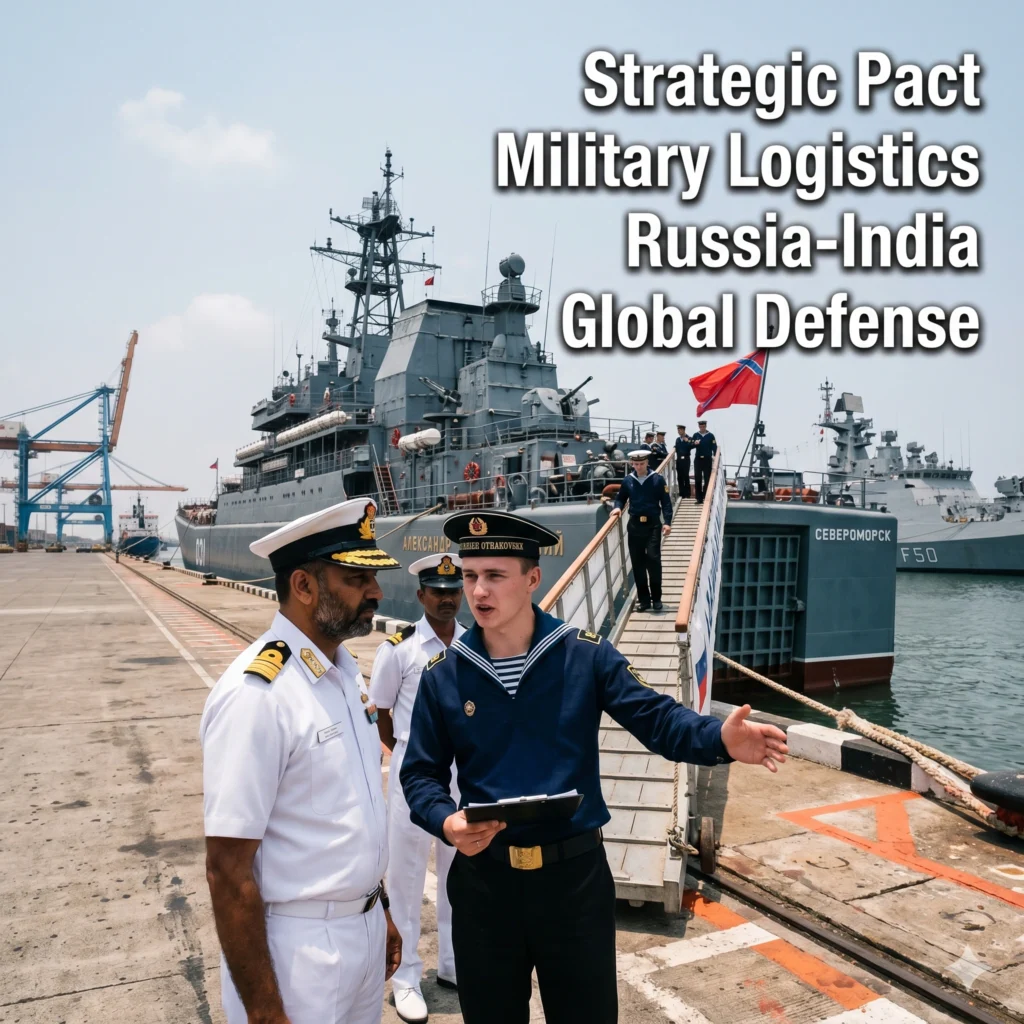
Russia India Logistics Pact
The Russia India Logistics Pact is designed to facilitate the smooth exchange of supplies, including fuel, food, and spare parts for military hardware. By establishing standardized procedures for logistics support, both nations can reduce the administrative burden of international deployments and joint exercises. The pact is seen as a necessary evolution of the “Special and Privileged Strategic Partnership” that has existed between the two countries for decades. The Russia India Logistics Pact ensures that Russian warships can now dock in Indian ports for maintenance with minimal diplomatic friction or delay.
Strategic analysts believe that the pact is a direct response to the changing security dynamics in the Eastern Hemisphere. As India navigates a delicate balancing act with the United States regarding trade tariffs, the Russia India Logistics Pact provides a significant geopolitical hedge. It allows New Delhi to diversify its security dependencies while strengthening its indigenous maintenance capabilities for Russian platforms. The inclusion of joint humanitarian assistance and disaster relief missions within the framework also adds a cooperative, non-combat layer to the military relationship.
The ability to station up to 3,000 troops under the Russia India Logistics Pact represents a massive departure from India’s traditional policy of non-alignment. This shift suggests that the perceived benefits of a deeper Russian tie outweigh the potential diplomatic blowback from Western allies. The troop limit allows for significant cross-training opportunities, where personnel can learn the nuances of each other’s operational doctrines. This level of intimacy in defense relations has previously been reserved only for India’s closest partners, making the Russia India Logistics Pact a truly landmark achievement.
Strategic Access to the Arctic and Indian Ocean
One of the most significant components of the Russia India Logistics Pact is the access it provides to the Arctic region. As the Northern Sea Route becomes increasingly viable for trade and resource extraction, India is keen to establish a presence in the Far North. Accessing Russian Arctic bases through the Russia India Logistics Pact gives Indian scientists and military planners a front-row seat to this emerging frontier. This move complements India’s broader energy strategy, which includes significant investments in Russian oil and gas fields located in these remote areas.
Conversely, the Russia India Logistics Pact offers Russia a permanent foothold in the Indian Ocean, a region traditionally dominated by Western and local navies. For Moscow, this access is a critical countermeasure to the economic and diplomatic isolation attempted by the West through ongoing sanctions. By utilizing Indian naval infrastructure, Russian fleets can conduct longer patrols and maintain a presence in the Bay of Bengal and the Arabian Sea. The Russia India Logistics Pact thus provides a vital “southern valve” for Russian maritime power during periods of tension in the Atlantic or Pacific.
- India gains use of Russian airfields in the Far East for regional reconnaissance.
- Russian warships can now refuel at Indian ports during long-range Indian Ocean deployments.
- The pact facilitates the joint protection of energy shipping lanes between the two countries.
- Mutual access to Arctic ports supports India’s long-term polar research and energy goals.
Enhancing Operational Interoperability
The Russia India Logistics Pact moves the relationship from a “buyer-seller” dynamic to one of true operational partners. Interoperability is the key to modern warfare, and this pact allows both sides to practice the logistics of shared combat environments. Joint exercises will now become more frequent and complex, as the Russia India Logistics Pact simplifies the movement of heavy armor and support aircraft. This deepening of ties is evidenced by the shared commitment to maintaining the Su-30MKI and T-90 tank fleets that form the backbone of the Indian military.
Technicians from both countries will work side-by-side in repair facilities, sharing best practices and technical data. This level of integration, enabled by the Russia India Logistics Pact, ensures that India’s Russian-origin hardware remains combat-ready for longer periods. It also opens the door for potential joint development of future platforms, such as fifth-generation fighters or advanced hypersonic missiles. The Russia India Logistics Pact is the foundational document that makes these high-level technical collaborations logistically feasible in the long term.
Beyond the technical aspects, the Russia India Logistics Pact fosters a shared culture of disaster response and humanitarian aid. In the event of a natural disaster in the Indian Ocean region, the two nations can now respond as a unified force using the closest available bases. This “soft power” application of the Russia India Logistics Pact helps to legitimize the increased military presence in the eyes of smaller neighboring states. It demonstrates that the pact is not just about power projection, but also about regional stability and crisis management.
Diplomatic Balancing and Global Sanctions
The activation of the Russia India Logistics Pact comes at a time of extreme sensitivity in global trade and diplomacy. India’s decision to operationalize the deal while facing trade tariffs from the United States shows a fierce commitment to strategic autonomy. The Russia India Logistics Pact is a signal that New Delhi will not let external pressure dictate its choice of defense partners. This move requires a sophisticated diplomatic strategy to ensure that relations with the West remain functional while the Russian partnership deepens.
For Russia, the Russia India Logistics Pact is a major victory in its “pivot to the East” strategy, which seeks to bypass Western financial and logistical systems. By trading in national currencies and utilizing bilateral logistics pacts, Russia and India are building a parallel security architecture. The Russia India Logistics Pact is a centerpiece of this effort, providing the physical infrastructure to support a sanctions-proof military relationship. The world is watching closely to see if other nations in the Global South follow this blueprint for non-Western security cooperation.
- The pact helps India bypass logistical hurdles caused by Western-led sanctions on Russia.
- New Delhi uses the agreement to maintain its “Strategic Autonomy” in a polarized world.
- Moscow views the Indian Ocean access as a way to circumvent maritime “choke points.”
- The troop stationing limit of 3,000 ensures a visible but controlled military presence.
Technical Maintenance and Hardware Servicing
The Russia India Logistics Pact is a practical solution to the aging hardware issues faced by the Indian Army and Navy. With more than 60 percent of India’s equipment being of Russian or Soviet origin, the need for constant servicing is a major logistical headache. Under the Russia India Logistics Pact, specialized Russian repair teams can now be stationed at Indian bases for extended periods. This drastically reduces the downtime for critical platforms, as equipment no longer needs to be shipped back to Russia for major overhauls.
This localized maintenance approach is expected to save the Indian government billions of dollars in transport and logistics costs over the next five years. The Russia India Logistics Pact also encourages the local production of spare parts under the “Make in India” initiative, with Russian technical support. By having Russian experts on-site, Indian engineers can gain the knowledge required to eventually take over the full maintenance cycle. This aspect of the Russia India Logistics Pact is a key pillar of India’s goal to become a self-reliant defense manufacturing hub.
- Localized servicing of T-90 tanks increases the operational readiness of border units.
- Refueling of Russian aircraft at Indian airfields extends the range of joint patrols.
- Shared warehouses for spare parts reduce the time required for aircraft repairs.
- The pact allows for the emergency transfer of hardware between bases during crises.
Projecting Power in the Indo-Pacific
The Russia India Logistics Pact changes the math for other regional powers who monitor the Indian Ocean. A combined Indo-Russian presence creates a new maritime reality that cannot be ignored by the Quad or China. The Russia India Logistics Pact allows the two nations to conduct more frequent “Freedom of Navigation” operations and joint anti-piracy patrols. This increased activity serves to protect the vital trade routes that connect the Middle East, Africa, and East Asia. The pact effectively makes Russia a permanent stakeholder in the security of the Indo-Pacific.
India’s gain of access to the Far East through the Russia India Logistics Pact is equally significant for its eastern strategy. By having a footprint in Vladivostok and other Russian Pacific ports, India can better monitor developments in the North Pacific. This northern access complements India’s “Act East” policy, which aims to strengthen ties with Southeast and East Asian nations. The Russia India Logistics Pact provides the logistical “anchor” for a more expansive Indian foreign policy that reaches from the Antarctic to the Arctic.
- The pact enhances the “strategic depth” of both the Indian and Russian navies.
- Joint patrols in the Indian Ocean are now logistically sustainable for the long term.
- Russia’s Far East serves as a critical training ground for Indian mountain troops.
- The Russia India Logistics Pact sets a precedent for other “reciprocal” deals in the region.
Humanitarian Assistance and Disaster Relief
A major feature of the Russia India Logistics Pact is the framework for Joint Humanitarian Assistance and Disaster Relief (HADR). The Indian Ocean is prone to cyclones, tsunamis, and other natural disasters that require a rapid and large-scale military response. The Russia India Logistics Pact allows Russian assets already in the region to deploy immediately using Indian logistics. This cooperation builds goodwill and demonstrates the constructive side of the bilateral military relationship. It also allows both navies to practice complex coordination in a non-combat, high-stakes environment.
By working together on HADR missions, the two militaries can improve their communication systems and command structures. The Russia India Logistics Pact provides the legal basis for these operations to take place without the need for emergency diplomatic clearances. This “plug-and-play” capability is essential for saving lives when every hour counts following a major disaster. The success of these missions will likely become a key metric for the effectiveness of the Russia India Logistics Pact in the years to come. Both nations are committed to making the Indian Ocean a safer place through this partnership.
- Pre-positioned supplies at shared bases allow for faster disaster response.
- Joint training for HADR missions improves the “interoperability” of the two forces.
- The pact simplifies the movement of medical teams and emergency hardware across borders.
- Cooperative disaster relief helps balance the “power projection” perception of the pact.
The Arctic Frontier and Energy Security
The Russia India Logistics Pact is the key that unlocks the Arctic for New Delhi’s strategic planners. As India looks for long-term energy security, the vast oil and gas reserves of the Russian North are increasingly attractive. The Russia India Logistics Pact allows the Indian Navy to escort energy tankers through the Northern Sea Route, ensuring a steady supply of fuel. This northern presence is a vital part of India’s plan to reduce its dependence on the volatile Middle Eastern energy market. The pact makes the “Arctic-Indian Ocean” corridor a reality for global trade.
Russia’s Far East and Arctic regions also provide unique training environments that are not available in India. The Russia India Logistics Pact allows Indian specialized units to train in extreme cold weather conditions, which is relevant for their deployments in the Himalayas. This “climate-specific” training is a highly valued byproduct of the bilateral agreement. In return, Russian troops can gain experience in tropical and maritime environments through their deployments in India. The Russia India Logistics Pact thus offers a diverse range of training opportunities for both world powers.
- Access to Arctic bases supports India’s goal of becoming a “Polar Power.”
- The pact facilitates the protection of the Chennai-Vladivostok Maritime Corridor.
- Joint research on polar ice and climate change is enabled by the logistics deal.
- Energy tankers gain a “security umbrella” through the shared use of naval ports.
Conclusion and the Road to 2031
The activation of the Russia India Logistics Pact in 2026 is a watershed moment that will define the next decade of defense relations. By operationalizing this historic deal, Russia and India have sent a clear message about their mutual trust and shared strategic vision. The Russia India Logistics Pact is a robust and flexible tool that can adapt to the shifting sands of global politics. As the initial five-year term progresses, the world will see a higher level of integration between these two massive militaries. This partnership is no longer just about buying and selling; it is about working and winning together.
The Russia India Logistics Pact is a record of a strong partnership that has stood the test of time and external pressure. We look forward to seeing the growth in joint exercises and the successful deployment of warships and troops under this framework. The legacy of this pact will be a more stable and multipolar world where regional powers take the lead in their own security. Congratulations to the leadership of both nations for reaching this milestone and operationalizing the Russia India Logistics Pact. The future of Indo-Russian relations is now firmly anchored in the ports and airfields of both countries.
For more details & sources visit: Al Jazeera
Read more about India news on 360 News Orbit – India.