
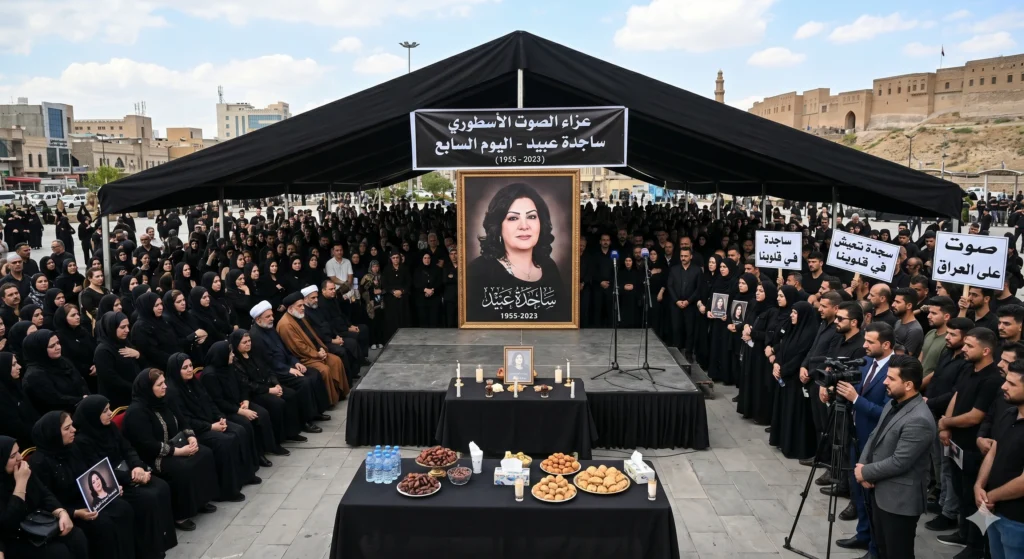
Sajida Obaid funeral mourning ceremonies have brought together hundreds of Iraqi women in the northern city of Irbil to honor a true cultural icon. The seventh day of mourning concluded, marking a traditional milestone in the grieving process for the legendary singer. Sajida Obaid, who passed away at the age of 68, was more than just a musical figure; she was a symbol of freedom for many women across the nation. The gathering served as a powerful testament to her enduring legacy and the profound impact she had on Iraqi social life.
The atmosphere in Irbil was one of deep solemnity and shared grief as fans traveled from various provinces to pay their respects. For decades, the singer provided a unique voice that resonated with the daily struggles and joys of Iraqi families. Her death, following a difficult battle with lung cancer, has left a void in the hearts of those who looked to her music for comfort during times of war and uncertainty. This final public gathering highlighted how her influence transcended the entertainment industry to become a movement of female solidarity.
The Cultural Significance of Sajida Obaid Funeral Mourning
The Sajida Obaid funeral mourning process follows strict Iraqi traditions that emphasize community support and collective remembrance. In Irbil, women gathered at the family residence, dressed in traditional black abayas and veils to signify their loss. The serving of bitter black coffee and the presence of the daf instrument outside the home created a space where cultural identity and personal grief intertwined. These rituals are essential in Iraqi society for providing the family with the strength to move forward after a significant loss.
The seventh-day tradition is particularly important as it represents the transition from communal mourning to the private acceptance of death. For Sajida Obaid, this day was a celebration of a woman who defied social norms to create her own path in the arts. Mourners spoke of her music as the soundtrack to their private celebrations, often occurring behind closed doors where women could be themselves. The Sajida Obaid funeral mourning events have allowed these women to publicly acknowledge the woman who championed their right to joy.
Sajida Obaid funeral mourning
The Sajida Obaid funeral mourning period was marked by stories of her revolutionary approach to performance and female privacy. Throughout her career, she became famous for hosting exclusive all-female parties where guests could remove their hijabs and dance without fear of judgment. To ensure this level of safety, Obaid insisted on an all-female staff, including security and hospitality teams. This dedication to her audience’s comfort was a hallmark of her professional life and a reason why she was so deeply loved.
By strictly prohibiting mobile phones and electronic devices at her events, she protected the reputations of thousands of women in a conservative society. This level of trust between an artist and her fans is rare and contributed to the intense emotion seen during the Sajida Obaid funeral mourning ceremonies. Women felt they had lost a protector who understood the nuances of their lives. Her voice served as a medium of liberation, allowing them to experience a sense of freedom that was often restricted in the public sphere.
Legacy of Female Empowerment in Iraqi Music
The impact of Sajida Obaid on the Iraqi music scene was profound, especially regarding the empowerment of female artists. She proved that a woman could achieve massive commercial success while maintaining her principles and protecting her community. During the Sajida Obaid funeral mourning gatherings, younger musicians discussed how she paved the way for them to enter the industry. Her career was a masterclass in navigating the complexities of fame within a traditional framework.
Her ability to generate success during periods of regional instability further demonstrated her resilience. Even when the news of her passing was initially obscured by regional conflicts, her fans ensured her story was told. The Sajida Obaid funeral mourning activities have sparked a renewed interest in her early recordings and her contributions to folk music. She managed to keep traditional rhythms alive while infusing them with a modern sensibility that appealed to multiple generations of Iraqi women.
Fighting the Silent Battle Against Lung Cancer
While she was known for her powerful voice and energetic performances, her final years were spent fighting a private battle with lung cancer. She sought treatment in specialized hospitals, but the disease ultimately proved too aggressive. Throughout this period, she remained mostly out of the public eye, preferring to be remembered for her vibrant stage presence rather than her illness. The Sajida Obaid funeral mourning reports revealed the dignity with which she handled her health struggles, further endearment her to the public.
- She was diagnosed during a time of significant regional upheaval.
- Her family remained by her side throughout the prolonged hospital stay.
- Fans organized prayer circles across social media during her final days.
- Her passing on April 4 led to a global outpouring of grief from the Iraqi diaspora.
The strength she showed in her private life mirrored the strength she projected on stage. Many mourners at the Sajida Obaid funeral mourning event shared that her resilience gave them hope in their own lives. Her journey from a local singer to a national treasure is a story of grit and determination. Even as her health declined, her influence continued to grow, proving that her spirit was far stronger than the physical challenges she faced.
The Role of Tradition in the Irbil Ceremony
The choice of Irbil for the mourning ceremony was significant, as the city has become a hub for cultural preservation. The use of the daf, a traditional frame drum, during the Sajida Obaid funeral mourning process linked her death to centuries of Mesopotamian heritage. These drums provided a rhythmic backdrop to the tears and prayers of the women gathered inside. The sound of the daf is often associated with both celebration and spiritual mourning, making it the perfect tribute for a singer of her stature.
The solemnity of the event was balanced by a sense of shared pride in her achievements. Women shared memories of their first time hearing her voice at a wedding or a private gathering. The Sajida Obaid funeral mourning process allowed these individual memories to coalesce into a collective narrative of a woman who changed the cultural landscape. The presence of so many women from diverse backgrounds showed that her music acted as a bridge across sectarian and social divides.
Music as a Source of Freedom and Identity
For many Iraqi women, the music of Sajida Obaid was a primary source of cultural identity. In a society that often monitors women’s public behavior, her songs offered a private language of emotion and desire. During the Sajida Obaid funeral mourning gatherings, fans described her voice as “the sound of our true selves.” Her lyrics often touched on themes of love, loss, and the strength of the female spirit, providing a sense of validation for her listeners.
The exclusivity of her performances created a sacred bond between the singer and her audience. This bond was visible in the way the mourners cared for one another during the Sajida Obaid funeral mourning ceremony. There was a sense of sisterhood that had been nurtured by decades of her music. By creating safe spaces for women to express themselves, she helped to build a more resilient female community that could withstand the pressures of external conflict.
Impact of Regional Instability on Cultural Icons
The timing of Sajida Obaid’s death coincided with a period of intense regional instability, which affected how the public could grieve. Initially, the news was secondary to reports of military movements and political shifts. However, the Sajida Obaid funeral mourning events eventually took center stage as people sought a way to connect with their humanity amidst the chaos. The singer’s death served as a reminder of the cultural beauty that exists even in difficult times.
- Local media shifted focus to her life story after the initial shock.
- Online tributes reached millions of views within a few days.
- International music critics recognized her as a pioneer of female-only spaces.
- Her death highlighted the need for better support for artists in conflict zones.
The resilience of her fans in organizing the mourning ceremonies despite the regional situation is a testament to her importance. The Sajida Obaid funeral mourning process was not just about saying goodbye; it was about asserting the importance of art and culture in a world often dominated by politics. Her legacy serves as a beacon for other artists who strive to make a difference in their communities.
Reflections on a Decades-Long Career
As the seventh day of the Sajida Obaid funeral mourning period ends, the focus shifts to the long-term preservation of her work. Her family and supporters are already discussing the creation of a foundation to support young female singers in Iraq. This would ensure that the doors she opened remain open for future generations. Her decades of influence on the Iraqi music scene are now being documented by historians and cultural researchers who recognize her as a key figure in modern Iraqi history.
From her early days performing at small events to her status as a legendary figure, her path was marked by a commitment to her craft. The Sajida Obaid funeral mourning period has allowed for a comprehensive review of her discography, revealing the depth and variety of her talent. She was a master of improvisation and a guardian of folk traditions that might have otherwise been lost. Her recordings will continue to be a source of inspiration and education for years to come.
A Significant Loss for the Entertainment Industry
The Iraqi entertainment industry has lost one of its most authentic voices, a fact that was emphasized repeatedly during the Sajida Obaid funeral mourning sessions. She was an artist who did not rely on modern marketing gimmicks but on the raw power of her voice and her connection to her audience. Her loss is felt not just in Iraq but across the Middle East, where her unique performance style had gained a following. The industry now faces the challenge of finding a new voice that can speak for women with the same clarity and courage.
- Her death marks the end of an era for traditional Iraqi folk music.
- The industry is calling for more protections and healthcare for aging artists.
- Tributes have been planned by major cultural institutions in Baghdad and Basra.
- Her life story is being considered for a biographical film project.
The mourning in Irbil was a fitting tribute to a woman who lived her life with passion and purpose. The Sajida Obaid funeral mourning ceremonies provided a moment of unity in a fragmented world. As the black veils are put away and the bitter coffee is finished, the music of Sajida Obaid will continue to play in the homes and hearts of the women she loved so much. Her legacy is one of joy, safety, and the unyielding power of the female voice.
Conclusion: Honoring the Voice of a Generation
The seventh day of the Sajida Obaid funeral mourning process has concluded, but the impact of her life is far from over. She will be remembered as the woman who gave Iraqi women a place to be free, a voice to represent them, and a spirit to inspire them. Her journey from a local performer to a national hero is a classic story of success built on integrity. The women who gathered in Irbil are the living proof of her success, carrying her lessons of empowerment into the future.
As Iraq moves forward, the memory of Sajida Obaid will remain a cornerstone of its cultural heritage. The Sajida Obaid funeral mourning period has shown that even in death, she can bring people together in a spirit of peace and remembrance. Her songs will continue to be sung at weddings and celebrations, ensuring that her voice never truly falls silent. The singer who gave so much to her country has finally found her own peace, leaving behind a legacy that will never be forgotten.
The strength of the Iraqi women who stood in Irbil to honor her is the greatest tribute she could have received. They are her legacy, and through them, her music and her message of freedom will live on. The Sajida Obaid funeral mourning ceremony was a final, beautiful performance for a woman who spent her life making others feel seen and heard.
For more details & sources visit: Midland Daily News
Read more about Iraq news on 360 News Orbit – Iraq.