
The Qatari foreign ministry has officially moved to silence growing rumors regarding secretive Iranian attack payment negotiations. Spokesperson Majed Al-Ansari clarified that the nation has not engaged in any discussions aimed at paying off Tehran to halt ongoing military strikes. This strong denial comes at a time when the Middle East is navigating its most volatile security crisis in decades, following large-scale regional hostilities.
Despite the intensity of the situation, Qatar remains firm in its diplomatic principles, rejecting any notion of financial settlements for protection. The state has emphasized that its role is that of a mediator and a stabilizer, rather than a participant in transactional security deals. This stance is critical for maintaining the integrity of Gulf diplomatic efforts as several nations face similar demands for reparations from the Iranian government.
While the region watches for the next move from Tehran, the clarity from Doha provides a necessary counterbalance to misinformation. By publicly dismissing the idea of Iranian attack payment negotiations, Qatar is signaling its commitment to a rules-based international order. This development is essential for understanding the current geopolitical landscape and the challenges of achieving a lasting peace in West Asia.
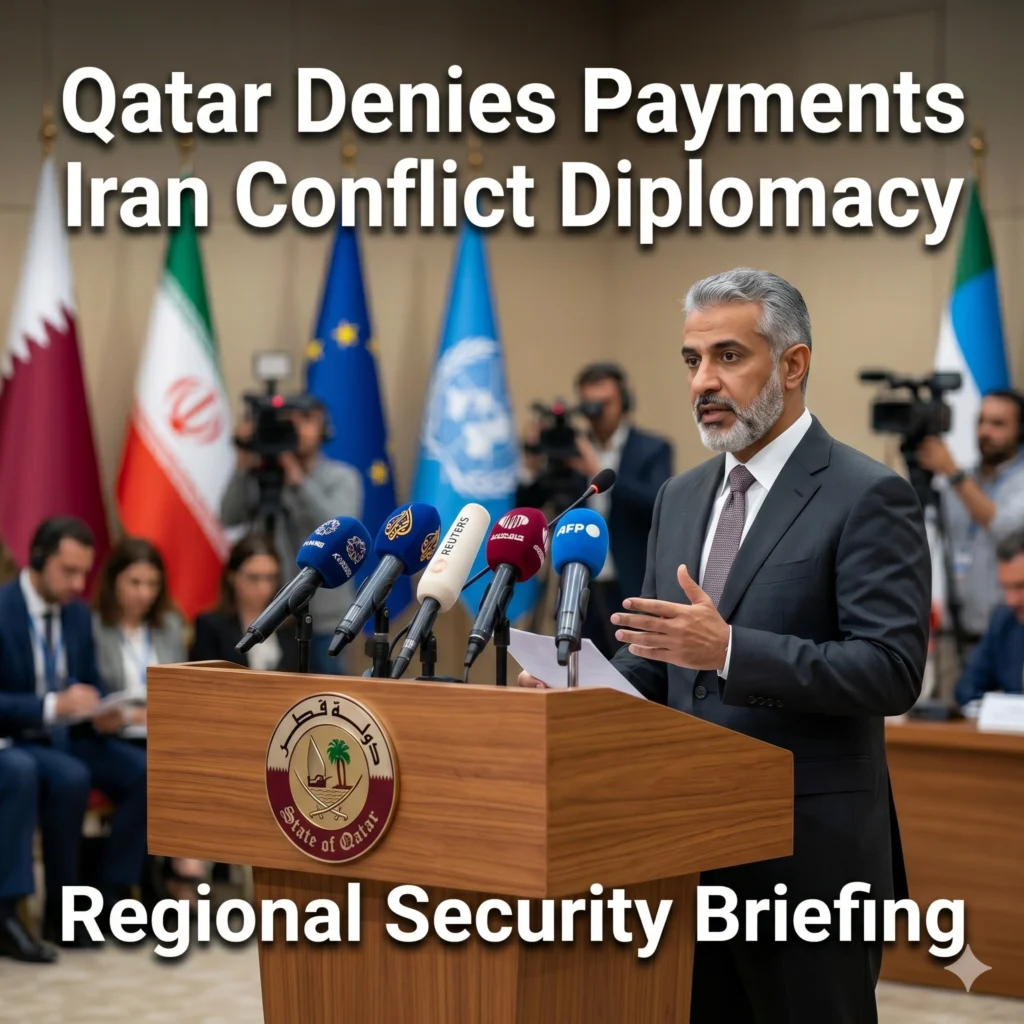
Iranian UN Envoy Demands Compensation
The rumors of Iranian attack payment negotiations were largely fueled by recent statements from Iran’s UN Envoy, Amir Saeid Iravani. He formally demanded compensation from five Arab nations, including Qatar and Saudi Arabia, for their alleged involvement in regional military escalations. Tehran claims that these countries enabled US-Israeli operations by allowing the use of their airspace or hosting foreign military assets.
These allegations have significantly strained relations within the Gulf Cooperation Council (GCC). Iran argues that by providing logistical support to the United States, these neighboring states have breached their international obligations. This legalistic approach to the conflict has put several Gulf capitals on high diplomatic alert, as they move to defend their sovereign decisions and security partnerships.
Qatar’s rejection of these claims is a pivotal moment in the current dispute. By denying any Iranian attack payment negotiations, Doha is effectively rejecting the premise that it bears financial responsibility for the conflict’s outcome. This sets the stage for a prolonged legal and diplomatic battle at the United Nations and other international forums.
Background of the US-Israeli Strikes
To understand the context behind the alleged Iranian attack payment negotiations, one must look back to the events of February 28. On this date, the United States and Israel launched a series of joint military strikes that targeted various strategic locations within Iran. This operation was described as a defensive measure intended to neutralize immediate threats to regional stability.
The fallout from these strikes was immediate and devastating, leading to thousands of casualties and widespread destruction. Iran responded with a wave of retaliatory strikes, not just against Israel, but also against Gulf nations hosting American bases. This cycle of violence pushed the region to the brink of a total war, displacing millions of civilians in the process.
In the aftermath, the Iranian government began seeking “war reparations” as a condition for de-escalation. It was this specific demand that gave rise to the false reports of Iranian attack payment negotiations. Qatar has been caught in the middle of this narrative, necessitating the recent high-level denials from the foreign ministry.
Iranian attack payment negotiations
The spokesperson for the Ministry of Foreign Affairs was very clear that there are absolutely no Iranian attack payment negotiations occurring at this time. Majed Al-Ansari stressed that Qatar’s diplomatic energy is focused on humanitarian aid and the preservation of the current ceasefire. Any report suggesting that Doha is preparing a financial package for Tehran is a complete fabrication intended to cause regional discord.
Instead of engaging in private financial deals, Qatar is working through established international channels to address Iranian grievances. This includes participating in multilateral talks hosted by neutral third parties. The goal is to reach a diplomatic settlement that respects the sovereignty of all nations involved without resorting to “hush money” tactics.
Maintaining this transparent approach is vital for Qatar’s reputation as a reliable international partner. If the state were to engage in secret Iranian attack payment negotiations, it would undermine its relationship with Western allies and other GCC members. The official denial serves as a reaffirmation of Qatar’s long-standing foreign policy of transparency and mediation.
The Role of Pakistan and the United States
Qatar has maintained a high level of diplomatic coordination with both Pakistan and the United States to manage the crisis. Islamabad recently hosted intense 21-hour negotiations between American and Iranian delegations in an attempt to reach a permanent agreement. While those specific talks ended without a breakthrough, they highlighted the importance of a coordinated regional response.
The United States continues to provide a security umbrella for its partners in the Gulf, which complicates any potential Iranian attack payment negotiations. Doha must balance its role as a host to major US military assets with its desire to maintain a functional relationship with Iran. This delicate balancing act is the primary focus of Qatar’s current foreign policy efforts.
- Weekly security briefings between Qatari and US military officials.
- High-level diplomatic visits to Islamabad to support regional mediation.
- Coordination with Saudi Arabia to ensure a unified GCC response to Iranian demands.
- Continuous dialogue with the UN to monitor the status of the two-week ceasefire.
These collaborative efforts are designed to create a unified front against coercion. By working with global powers, Qatar ensures that it does not have to resort to independent Iranian attack payment negotiations to secure its borders. The strength of these alliances is the region’s best defense against further military escalation.
Impact of the Recent Two-Week Ceasefire
A temporary two-week ceasefire was announced last week, providing a much-needed window for diplomatic intervention. This pause in hostilities has allowed humanitarian aid to reach some of the most affected areas. However, the ceasefire remains fragile, and the absence of Iranian attack payment negotiations has led to concerns that Tehran may resume its strikes.
The ceasefire was intended to be a cooling-off period where both sides could discuss the terms of a permanent peace. Unfortunately, the demand for compensation has become a major sticking point in these negotiations. While the Arab nations have rejected the demand, they are searching for other ways to provide regional stability and reconstruction.
If a permanent agreement is not reached before the ceasefire expires, the region could see a return to open conflict. This is why the rumors of Iranian attack payment negotiations were so sensitive; they suggested a lack of faith in the formal peace process. Qatar’s denial helps to refocus the international community’s attention on the legitimate diplomatic path.
Infrastructure Damage and Humanitarian Crisis
The conflict has left a trail of destruction across West Asia, with significant damage to energy infrastructure and civilian housing. This physical devastation is one of the primary reasons Iran is seeking financial compensation. However, the targeted nations argue that the damage was a direct result of Tehran’s own military actions and regional policies.
The humanitarian crisis is equally severe, with thousands of families still lacking access to clean water and medical supplies. International aid groups are working around the clock, but their efforts are hampered by the constant threat of renewed violence. The lack of Iranian attack payment negotiations means that funding for reconstruction must come from broader international appeals.
- Total destruction of key electrical grids in several border provinces.
- Over 500,000 homes damaged or destroyed during the retaliatory strikes.
- Severe disruption to the region’s oil and gas export capabilities.
- Massive displacement of civilians seeking safety in neighboring neutral states.
Addressing these issues will require a global effort that goes far beyond the scope of any private Iranian attack payment negotiations. Qatar has already pledged significant funds for humanitarian relief, but it insists that this aid is separate from any political or military compensation demands. The focus remains on the people, not the politics of the war.
Rejection of War Reparations by GCC Members
Qatar is not alone in its refusal to entertain Iranian attack payment negotiations; other members of the GCC have taken a similar stance. Saudi Arabia, the United Arab Emirates, and Kuwait have all largely rejected the idea of paying for war-related damages. This collective resistance is a significant obstacle for Iran’s diplomatic and economic strategy.
The GCC nations view these demands as an attempt to shift the blame for the conflict away from those who initiated the escalations. They argue that providing such payments would set a dangerous precedent, encouraging future aggression and financial extortion. By standing together, these nations are presenting a formidable wall against Tehran’s financial pressure.
The rejection of Iranian attack payment negotiations is also a matter of national honor and sovereignty for these states. Paying such funds would be seen as an admission of guilt for supporting their allies. Qatar’s public denial is a key part of this unified regional narrative, reinforcing the idea that the Gulf will not be intimidated.
Diplomatic Stalemate in Islamabad
The recent talks in Islamabad were seen as the best chance for a diplomatic breakthrough, but the 21-hour session ended in a stalemate. The core issue remains the gap between Iran’s demands for compensation and the US-GCC refusal to pay. Without any Iranian attack payment negotiations, the delegations were unable to find a middle ground on the financial aspects of a peace deal.
Despite the lack of an agreement, the fact that the two sides met for such an extended period is a positive sign. It suggests that there is still a desire to avoid a total regional collapse. Qatar has been instrumental in facilitating these communications, even as it denies the specific rumors regarding Iranian attack payment negotiations.
Future talks are expected to take place, possibly in a different neutral capital. The focus of these sessions will likely shift toward security guarantees and the establishment of a more permanent monitoring mechanism for the borders. As long as the idea of Iranian attack payment negotiations is off the table, the parties can focus on more realistic solutions.
The Role of International Law
Qatar’s foreign ministry has repeatedly pointed to international law as the proper framework for resolving the dispute. Rather than engaging in Iranian attack payment negotiations, Doha is preparing to defend its actions before the international community. This includes proving that its security arrangements with the US are consistent with global treaties.
The use of legal channels provides a level of legitimacy that private payments cannot offer. It allows for a transparent examination of the facts and a fair assessment of responsibility. Qatar believes that an objective review will vindicate its position and show that it acted within its rights as a sovereign state.
Furthermore, relying on international law helps to stabilize the region’s legal environment. It discourages the use of military force as a tool for financial gain. By refusing to participate in Iranian attack payment negotiations, Qatar is upholding the principles that govern the modern world. This approach is essential for the long-term health of regional diplomacy.
Media Misinformation and Regional Tensions
The spread of false reports about Iranian attack payment negotiations has only added to the tension in the Middle East. In a digital age, rumors can travel faster than official statements, leading to panic in the markets and among the public. Qatar’s quick response was necessary to prevent these rumors from causing actual diplomatic damage.
Officials believe that some of these reports may have been intentionally planted to weaken the unity of the GCC. By suggesting that one nation was secretly negotiating, the rumors aimed to create suspicion and distrust among allies. The clear denial of Iranian attack payment negotiations serves to repair any potential cracks in the regional alliance.
Media literacy has become a key part of the region’s defense strategy. Governments are urging the public to rely only on official sources for information regarding the conflict. The case of the alleged Iranian attack payment negotiations is a textbook example of how a single false story can complicate high-stakes international diplomacy.
Future Outlook for Regional Stability
The absence of Iranian attack payment negotiations does not mean that the region is doomed to further conflict. On the contrary, it may lead to a more honest and sustainable peace process. When the focus is on security and cooperation rather than money, the resulting agreements are often more durable.
Qatar’s role in the coming months will be critical. As a bridge between the West and the Islamic world, it is uniquely positioned to lead the region out of the current crisis. The state’s commitment to dialogue and humanitarian aid, without the distraction of Iranian attack payment negotiations, is a source of stability for all.
- Strengthening of regional security pacts to prevent future strikes.
- Increased investment in domestic defense capabilities across the GCC.
- Expanding humanitarian corridors to provide a permanent safety net for civilians.
- Continued support for the UN-led peace initiatives and border monitoring.
If the ceasefire can be extended, there is a real chance for a diplomatic “reset” in the Gulf. This would involve a new set of rules for regional engagement that avoids the pitfalls of the past. The rejection of Iranian attack payment negotiations is just the first step in this long and difficult journey toward a peaceful Middle East.
Global Economic Implications
The ongoing conflict and the uncertainty surrounding Iranian attack payment negotiations have significant implications for the global economy. As a major exporter of natural gas, Qatar’s stability is essential for energy markets in Europe and Asia. Any escalation of the conflict could lead to a sharp increase in energy prices worldwide.
Investors are closely watching the diplomatic situation, looking for signs of a permanent de-escalation. The clarity provided by Qatar regarding the lack of Iranian attack payment negotiations is a welcome signal for the markets. It suggests that the regional powers are not being coerced and are maintaining their strategic autonomy.
The global community has a vested interest in the success of the peace talks. A stable Middle East is a prerequisite for global economic growth and energy security. By refusing to engage in Iranian attack payment negotiations, Qatar is also protecting the interests of its global customers and partners. It is a stance that has far-reaching consequences beyond the borders of the Gulf.
Conclusion of the Diplomatic Denial
In summary, the Qatari foreign ministry has been absolute in its denial of any Iranian attack payment negotiations. The nation stands by its commitment to diplomacy, international law, and regional cooperation. This firm position is a necessary defense against the pressure and misinformation that have characterized the current conflict.
The road ahead is certainly challenging, but the path of transparency is the only one that leads to a genuine peace. As the two-week ceasefire continues, all eyes will be on Doha and its neighbors to see if a permanent solution can be found. Without the shadow of Iranian attack payment negotiations, the parties can now move forward with more meaningful discussions.
The people of the region deserve a future free from the threat of military strikes and the burden of war. Qatar’s leadership is dedicated to making that future a reality through principled and patient diplomacy. The story of the Iranian attack payment negotiations may end here, but the story of Middle Eastern peace is just beginning.
For more details & sources visit: The Express Tribune
Read more about Qatar news on 360 News Orbit – Qatar.