
Sudan civil war atrocities have reached a catastrophic peak as journalist Mohamed Suleiman breaks a three-year silence following his escape from the besieged city of el-Fasher. His harrowing testimony provides a rare, unfiltered look into a conflict that has largely been obscured by systematic communications blackouts and deliberate targeting of media personnel. As he reached the relative safety of Port Sudan, Suleiman described a landscape of utter devastation where the basic foundations of human society have completely crumbled under the weight of relentless violence.
The timeline of the Sudan civil war has now crossed the grim three-year mark, leaving a trail of de-facto partitions and millions of displaced souls. Suleiman’s account is particularly vital because it chronicles the fall of el-Fasher, a city that served as a final refuge for hundreds of thousands before the Rapid Support Forces (RSF) tightened their deadly grip. The lack of internet and cellular service in the region meant that for months, the world remained blind to the scale of the carnage occurring within the city walls.
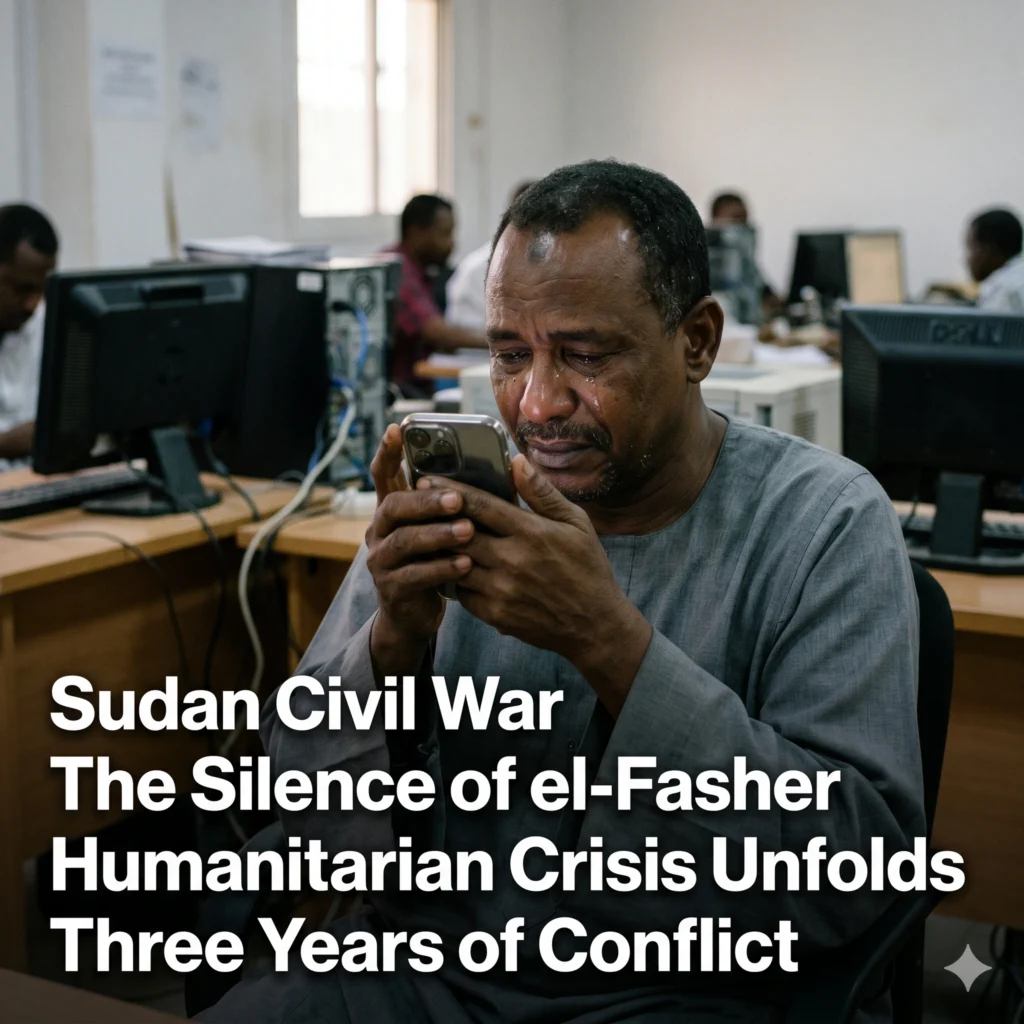
The Siege of el-Fasher and the Communications Blackout
The Sudan civil war saw one of its most brutal chapters during the eighteen-month siege of el-Fasher, where paramilitary forces cut off all exit routes. During this period, a total communications blackout was enforced, preventing residents from documenting the daily horrors or reaching out for medical assistance. Suleiman describes this isolation as a psychological torture that amplified the physical danger, leaving the population feeling entirely abandoned by the outside world.
Without phone service, the victims of the Sudan civil war in el-Fasher could not call for ambulances or warn neighbors of incoming drone strikes. Suleiman recounted witnessing systematic killings where bombs fell on residential blocks, and the only sound that followed was the silence of a disconnected city. This tactical use of technology suppression has been a hallmark of the paramilitary strategy to avoid international scrutiny and accountability for their actions on the ground.
The journalist noted that the blackout also served to facilitate the Sudan civil war by spreading misinformation and fear among the trapped civilians. With no way to verify news, rumors of impending massacres caused stampedes and chaos, leading to even more casualties. Suleiman’s escape to Port Sudan marks the first time many of these specific incidents have been confirmed by a professional observer who survived the entirety of the siege.
Sudan Civil War
The Sudan civil war has transformed once-thriving urban centers into skeletal remains of their former selves, with el-Fasher serving as the ultimate example of this decay. Suleiman described the final days of the city’s defense as an “apocalyptic event,” where the sheer volume of fire made it impossible to bury the dead. Bodies were left in the streets for days, creating a secondary health crisis as the remaining population struggled to find clean water or food.
During the Sudan civil war, the distinction between combatant and civilian has been intentionally blurred by both warring factions. Suleiman reported stepping over the bodies of children and the elderly while fleeing toward Tawila, noting that the strikes seemed to target areas with the highest density of displaced persons. This indiscriminate nature of the fighting has led to what many now consider the most severe humanitarian disaster of the 21st century.
The Sudan civil war has also seen the collapse of the local economy, with markets being looted and burned as a matter of course. For those trapped in el-Fasher, the currency became worthless as food supplies dwindled to nothing, leading to the official declaration of famine by UN-backed monitors. Suleiman’s testimony details the agonizing choices made by families who had to decide which members would receive the last scraps of nourishment available.
Famine and the Heartbreaking Choice of Mothers
The Sudan civil war has induced a famine of such scale that mothers are reportedly being forced to abandon their infants. Suleiman shared stories of women who, weakened by months of starvation and the inability to produce milk, were left with no choice but to leave their children behind during the forced marches out of the city. This level of desperation highlights the total failure of humanitarian corridors that were supposedly guaranteed by the warring parties.
- Famine conditions have been officially confirmed in North Darfur due to the prolonged siege.
- Displaced civilians are surviving on boiled leaves and contaminated water sources.
- International aid convoys are frequently hijacked or blocked by paramilitary checkpoints.
- Malnutrition rates among children under five have surpassed emergency thresholds.
The impact of the Sudan civil war on the next generation is perhaps its most lasting and tragic legacy. Suleiman observed that even those who survived the initial violence are often too weak to reach the safety of refugee camps in neighboring provinces. The systematic denial of food as a weapon of war has turned the region into a graveyard for the most vulnerable members of Sudanese society.
The De-Facto Partition and National Instability
After three years of the Sudan civil war, the country has effectively been split into territories controlled by the national army and the RSF. This partition has created a chaotic patchwork of governance where no central authority can provide for the needs of the citizens. Suleiman’s journey from el-Fasher to Port Sudan required navigating dozens of rival checkpoints, each representing a different faction of the fractured military landscape.
The Sudan civil war has dismantled the infrastructure required for a functioning state, from power grids to banking systems. In the areas held by paramilitary forces, Suleiman noted a complete absence of civil administration, replaced by a rule of the gun that prioritizes the enrichment of commanders over the survival of the people. This lawlessness has made it nearly impossible for international diplomats to broker any meaningful ceasefire or peace agreement.
The Sudan civil war continues to bleed into neighboring countries, threatening the stability of the entire Horn of Africa. As millions flee across borders into Chad and Egypt, the regional resource strain is reaching a breaking point. Suleiman’s account emphasizes that without a massive and immediate international intervention, the partition of Sudan may become a permanent and bloody fixture of the map.
Accusations of War Crimes and Lack of Accountability
Both sides involved in the Sudan civil war are now facing serious accusations of war crimes and crimes against humanity. Suleiman’s eyewitness testimony includes accounts of drone strikes hitting crowded marketplaces and the deliberate execution of non-combatants. While the RSF leadership claims these are isolated incidents by “rogue elements,” the frequency and scale reported by Suleiman suggest a more coordinated policy of terror.
The Sudan civil war has been characterized by a complete lack of accountability for those in command positions. Despite numerous sanctions from the United States and the European Union, the flow of weapons into the country has not ceased. Suleiman pointed out that the sophisticated nature of the drones used in the siege of el-Fasher indicates that external actors are still fueling the conflict for their own strategic gains.
Efforts to document the Sudan civil war atrocities are hampered by the constant threat to journalists and human rights defenders. Suleiman himself survived multiple near-misses and had to hide his professional identity to avoid execution during his escape. His decision to come forward now is a courageous act intended to force the International Criminal Court to take more aggressive action against the architects of this violence.
Survival and the Flight Toward Port Sudan
The trek across the desert to escape the Sudan civil war is a journey that few survive without severe trauma or injury. Suleiman described the path toward Port Sudan as being lined with the belongings of those who came before him—discarded suitcases, shoes, and makeshift stretchers. The physical toll of the journey is immense, with many displaced persons succumbing to heatstroke or dehydration before they can find medical help.
- Thousands of refugees are currently arriving in Port Sudan every week seeking passage abroad.
- Temporary shelters are overcrowded, with minimal access to sanitation or clean water.
- Humanitarian agencies are struggling to keep up with the influx of severely traumatized survivors.
- Many escapees report being robbed of their final possessions at paramilitary checkpoints.
Upon reaching Port Sudan, many survivors of the Sudan civil war find that their ordeal is far from over. The city is a bottleneck of human misery, where families wait for months in the hope of being evacuated to safer countries. Suleiman noted that while the sound of bombs has been replaced by the hum of the city, the psychological scars of the siege remain a constant presence for everyone he encountered.
The Failure of International Diplomacy and Peace Talks
Despite several rounds of high-level negotiations, the Sudan civil war shows no signs of reaching a peaceful conclusion. Diplomatic efforts led by the United States and Saudi Arabia have repeatedly collapsed as neither side is willing to make the necessary concessions for a lasting truce. Suleiman’s perspective is that the warring generals are more interested in total victory than in the survival of the Sudanese people.
The Sudan civil war has highlighted the limitations of traditional diplomacy in the face of decentralized paramilitary groups. Because the RSF operates as a collection of militias with varying loyalties, a signature on a peace treaty in Geneva does not always translate to a ceasefire on the ground in Darfur. This disconnect has led to a cycle of broken promises and renewed escalations that have defined the last three years of the conflict.
Suleiman argues that the international community must move beyond statements of concern and take more direct action to halt the Sudan civil war. This could include a more robust arms embargo and the deployment of a neutral peacekeeping force to protect civilian corridors. Without such measures, he fears that his account of el-Fasher will soon be repeated in every other major city across the country.
The Role of Technology in Documenting Atrocities
One of the most chilling aspects of the Sudan civil war is how technology has been used to both commit and conceal crimes. While drones are used for indiscriminate bombing, the cutting of fiber-optic cables has been used to silence the victims. Suleiman’s ability to finally share his story is a victory for truth-telling, but he reminds us that thousands of other stories remain buried under the weight of the blackout.
During the Sudan civil war, the few snippets of footage that did leak out often came at a high price for those who filmed them. Suleiman mentioned colleagues who were detained and tortured for simply possessing a smartphone with photos of the destruction. This war on information is a central component of the strategy to ensure that the perpetrators can claim the scale of reported atrocities is “exaggerated” without fear of immediate contradiction.
As the Sudan civil war continues, there is a growing movement to use satellite imagery to monitor the destruction of villages and the movement of mass graves. While these tools cannot replace the depth of an eyewitness account like Suleiman’s, they provide a layer of objective evidence that is harder to ignore. The hope is that the combination of high-tech monitoring and brave journalism will eventually lead to a day of reckoning for those responsible.
Humanitarian Horrors and the Path Forward
The humanitarian horrors of the Sudan civil war are so vast that they defy easy categorization. From the children dying of thirst in the streets of el-Fasher to the systemic rape used as a tool of ethnic cleansing, the depravity of the conflict has shocked even veteran war correspondents. Suleiman’s report is a reminder that behind every statistic of displacement is a human life that has been irrevocably shattered.
Looking ahead, the resolution of the Sudan civil war will require a fundamental restructuring of the Sudanese state. The current military-paramilitary rivalry cannot be solved by simply returning to the status quo that existed before April 2023. Suleiman believes that any future peace must include a mechanism for transitional justice, ensuring that the victims of the siege of el-Fasher receive the recognition and reparations they deserve.
In the final sections of his testimony, Suleiman called for an immediate surge in global aid to address the famine. He stressed that while the political solution to the Sudan civil war may take years, the feeding of the hungry cannot wait another day. His voice serves as a bridge between the silence of the besieged and the conscience of the world, demanding that the horrors of el-Fasher never be forgotten.
Final Reflections on a Nation in Crisis
The Sudan civil war has proven to be a test of the world’s commitment to the principle of “never again.” As the death toll continues to rise and the famine spreads, the answer to that test remains deeply troubling. Suleiman’s journey is a testament to the resilience of the human spirit, but it is also a somber warning of what happens when the international community fails to act in the face of obvious evil.
As he prepares to continue his work from Port Sudan, Suleiman remains focused on those he left behind. He knows that for every journalist who escapes the Sudan civil war, there are thousands of civilians who remain trapped in the darkness. His mission now is to ensure that their names and their suffering are kept in the public eye until the guns finally fall silent and the healing can begin.
The legacy of the Sudan civil war will be written in the stories of survivors like Mohamed Suleiman. It is a story of profound loss, but also one of incredible courage in the face of absolute terror. As the conflict enters its fourth year, the global community must decide whether it will continue to be a spectator to this tragedy or if it will finally take the steps necessary to bring the nightmare to an end.
For more details & sources visit: BBC News
Read more on Sudan news: 360 News Orbit – Sudan.