
BMW Group Mexico Strategy is currently undergoing a massive transformation as the company prepares its San Luis Potosí facility for the upcoming Neue Klasse electric vehicle production. This strategic shift represents a significant milestone in the automaker’s commitment to the North American market and its broader global sustainability goals. By integrating advanced manufacturing techniques with a robust environmental framework, the organization is positioning itself as a leader in the regional automotive landscape. The focus remains on blending high-tech innovation with a deep-rooted responsibility toward the local workforce and the surrounding ecosystem.
The recent announcements regarding operational expansions demonstrate that the BMW Group Mexico Strategy is not just about increasing production volume but also about enhancing the quality of industrial output. As the automotive industry moves toward a greener future, the Mexican operations are becoming a central hub for high-voltage battery assembly and sustainable assembly lines. This evolution is supported by a stable regulatory environment and the logistical advantages provided by the USMCA trade agreement. Investors and industry analysts are closely watching how these developments will influence the competitive dynamics of the electric vehicle sector in Latin America.
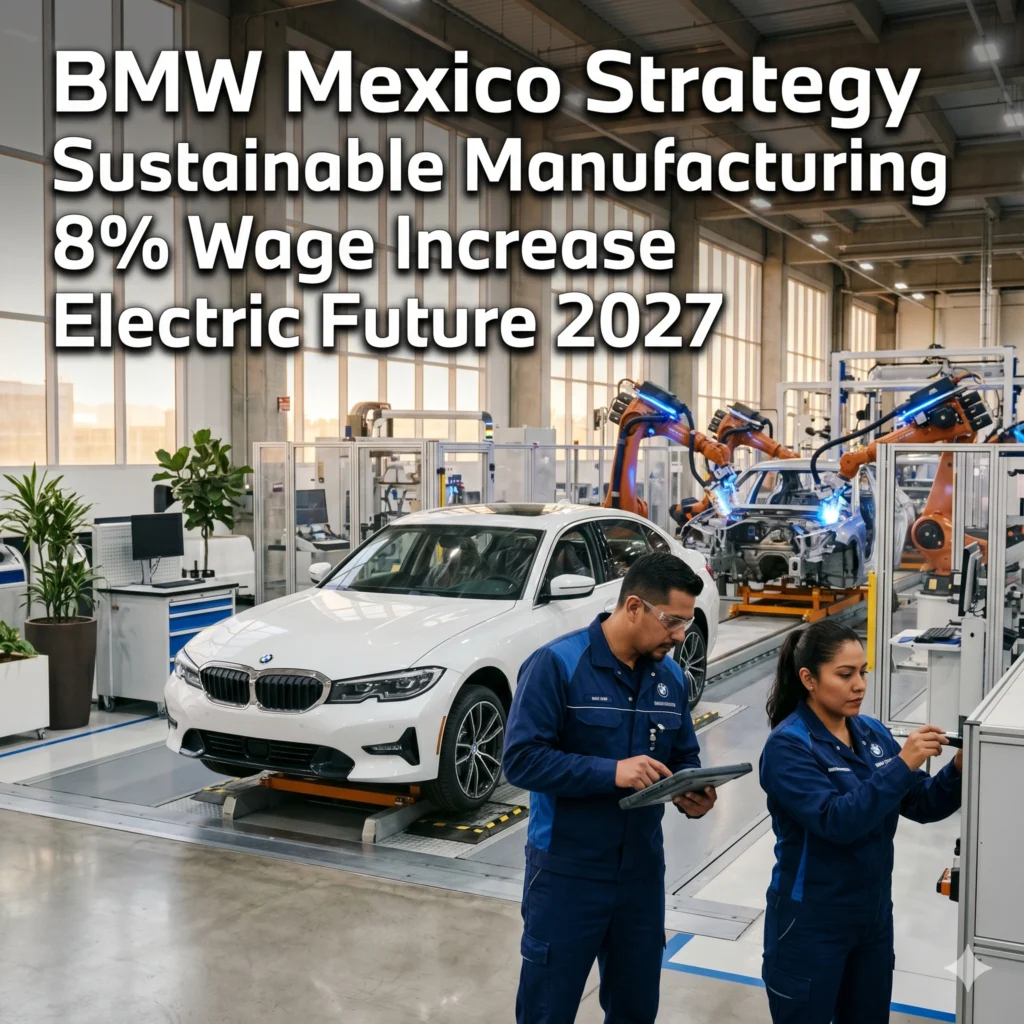
BMW Group Mexico Strategy
The implementation of the BMW Group Mexico Strategy has reached a critical turning point with the release of the 2025 sustainability report. This document highlights the plant’s success in treating 100% of its process wastewater, a feat that sets a new benchmark for industrial water conservation in arid regions. By utilizing closed-loop systems, the facility has managed to save over 13,000 square meters of water within its cooling infrastructure. Such efficiency is vital for maintaining long-term operations without depleting local resources, ensuring that the company remains a welcome partner in the San Luis Potosí community.
Beyond environmental metrics, the BMW Group Mexico Strategy emphasizes a sophisticated approach to supply chain management and regional sourcing. The proximity to key suppliers allows for a reduction in logistics-related carbon emissions while fostering a resilient manufacturing network. This localized focus is a direct response to the global shift toward nearshoring, where companies prioritize regional stability over distant low-cost manufacturing. Consequently, the Mexico site is now a cornerstone of the brand’s global production network, capable of adapting to rapid changes in consumer demand and technological advancements.
To maintain this momentum, the BMW Group Mexico Strategy incorporates a heavy emphasis on digital twin technology and smart factory solutions. These tools allow engineers to simulate production processes before they are physically implemented, reducing waste and optimizing energy consumption across the assembly floor. As the facility prepares for the 2027 launch of the Neue Klasse platform, these digital capabilities will be essential for integrating complex battery modules into the vehicle architecture. The transition is expected to create a ripple effect, encouraging local suppliers to upgrade their own technological standards to meet the brand’s rigorous requirements.
Securing the Workforce Through New Labor Agreements
A fundamental component of the BMW Group Mexico Strategy involves fostering a harmonious relationship with the labor force that drives daily operations. Recently, the company successfully negotiated a new contract that provides workers with an 8% salary increase and a 0.5% annual bonus. This agreement was reached after weeks of careful dialogue, effectively preventing potential industrial action and ensuring continuity in production schedules. By prioritizing fair compensation, the automaker reinforces its reputation as a preferred employer in a highly competitive regional job market.
The human element of the BMW Group Mexico Strategy is further evidenced by the diversity and inclusion metrics reported in the latest fiscal cycle. Currently, the plant employs approximately 3,700 people, with women representing a significant 36% of the total workforce, a figure that exceeds industry averages in the region. This inclusive approach is seen as a key driver of innovation, bringing varied perspectives to the manufacturing process. The management believes that a diverse team is better equipped to handle the challenges of transitioning from internal combustion engines to complex electric drivetrains.
Furthermore, the BMW Group Mexico Strategy relies on a long-term vision for employee retention and career development. The newly signed labor deal is not merely a financial arrangement but a commitment to the well-being and professional growth of every staff member. Educational subsidies, health programs, and safety initiatives are integrated into the corporate culture to ensure that the workforce remains motivated and healthy. This stability is crucial as the plant enters a high-intensity phase of retooling and equipment installation for the next generation of luxury automobiles.
Advancing Technical Education and the Dual Training Model
Education serves as a pillar of the BMW Group Mexico Strategy, particularly through the successful implementation of the dual training model. Developed in partnership with the Mexican-German Chamber of Commerce, this program combines classroom theory with hands-on vocational experience at the manufacturing site. Over the past decade, more than 570 apprentices have graduated from these technical programs, many of whom have transitioned into permanent roles within the company. This pipeline of skilled talent ensures that the facility has the expertise required to manage sophisticated robotic systems and high-voltage electronics.
The BMW Group Mexico Strategy recognizes that the shift to electromobility requires a specialized set of skills that are often in short supply. By investing in local education, the company is effectively building its own future-proof workforce from the ground up. Apprentices are trained in disciplines such as mechatronics, automotive mechanics, and industrial electricity, providing them with globally recognized certifications. This focus on high-level technical training not only benefits the individual workers but also elevates the overall industrial capability of the San Luis Potosí region.
In addition to apprentice programs, the BMW Group Mexico Strategy includes continuous learning opportunities for existing employees. As new technologies are introduced for the Neue Klasse platform, staff members undergo intensive retraining to master the assembly of high-voltage battery modules. This culture of lifelong learning ensures that the plant remains at the cutting edge of automotive manufacturing. By empowering workers with new skills, the company minimizes the risk of displacement during the transition to automation and electrification, fostering a sense of job security and pride.
- Over 570 apprentices have completed the dual training program since its inception.
- The curriculum is designed in collaboration with German technical standards for global parity.
- Specialized training centers within the plant allow for real-time practice on assembly equipment.
- Graduates receive a certification from the Mexican-German Chamber of Commerce.
Leadership Milestones and Regional Management Shifts
A major highlight in the evolution of the BMW Group Mexico Strategy is the appointment of Maru Escobedo as the first Mexican President and CEO of BMW Latin America. Based in the Mexico City headquarters, Escobedo now oversees regional operations across 27 different countries, bringing a wealth of local insight and international experience to the role. Her leadership is expected to strengthen the bond between the Mexican manufacturing hub and the diverse markets throughout Central and South America. This move signals the brand’s confidence in local leadership to drive its ambitious growth agenda.
The BMW Group Mexico Strategy benefits from this localized leadership by enabling faster decision-making and a more nuanced understanding of regional market trends. Escobedo’s deep knowledge of the Mexican business environment is particularly valuable as the company navigates the complexities of the USMCA and local environmental regulations. Under her guidance, the company aims to synchronize its sales strategies with its production capabilities, ensuring that the vehicles built in San Luis Potosí meet the specific needs of Latin American consumers.
This leadership transition is a vital part of the BMW Group Mexico Strategy to decentralize authority and empower regional offices. By having a CEO who understands the cultural and economic nuances of the territory, the company can better navigate the political landscapes of the 27 countries it serves. This strategic alignment is essential for expanding the charging infrastructure required for electric vehicles across the continent. Escobedo’s vision includes not only selling luxury cars but also building the ecosystem that makes electric mobility a viable reality for thousands of drivers.
Preparing for the Neue Klasse and Electromobility
The most ambitious aspect of the BMW Group Mexico Strategy is the massive retooling of the San Luis Potosí plant to accommodate the Neue Klasse platform. Starting in 2027, the facility will become a global powerhouse for electric vehicle production, integrating high-voltage battery assembly directly into the manufacturing flow. This transition involves the construction of new specialized buildings and the installation of state-of-the-art battery production lines. The investment reflects a firm belief that Mexico will play a central role in the global shift away from fossil fuels in the luxury automotive segment.
As part of the BMW Group Mexico Strategy, the integration of battery production on-site is a logistical masterstroke. It reduces the risks associated with transporting heavy battery packs over long distances and allows for tighter quality control during the assembly process. The Neue Klasse vehicles themselves are designed with a “circular” philosophy, emphasizing the use of recycled materials and easy disassembly at the end of the vehicle’s life. This aligns perfectly with the sustainability goals outlined in the plant’s recent environmental reports, creating a holistic cycle of green manufacturing.
To support this transition, the BMW Group Mexico Strategy also involves collaborating with local utility providers to ensure a stable supply of renewable energy. The goal is to power the production of the Neue Klasse using CO2-free electricity, further reducing the carbon footprint of each vehicle produced. This commitment to carbon neutrality is a key selling point for modern consumers who demand transparency and environmental responsibility from luxury brands. The San Luis Potosí plant is thus becoming a blueprint for how a legacy automaker can successfully pivot to a sustainable, electric future.
- Production of the Neue Klasse electric platform is scheduled to commence in early 2027.
- New facilities are being built specifically for high-voltage battery pack assembly.
- The platform focuses on increased energy density and faster charging capabilities.
- Regional suppliers are being integrated into the electric vehicle component ecosystem.
Environmental Stewardship and Resource Management
The success of the BMW Group Mexico Strategy is deeply tied to its performance in resource management and environmental protection. The 2025 report showcases that the plant has achieved a remarkable level of efficiency in its painting and assembly processes, which are traditionally water-intensive. By implementing advanced filtration and recycling technologies, the facility has virtually eliminated the discharge of untreated wastewater. This proactive stance on water security is essential for the long-term viability of the plant in a region that faces periodic drought conditions.
In addition to water conservation, the BMW Group Mexico Strategy focuses on waste reduction and the circular economy. The plant has implemented rigorous sorting and recycling programs that aim to divert as much waste as possible from landfills. Scrap metal from the stamping shop is returned to suppliers for reprocessing, while plastic packaging is recycled into new industrial components. These efforts not only reduce the environmental impact of the facility but also result in significant cost savings, proving that sustainability and profitability can go hand in hand.
Energy efficiency is another cornerstone of the BMW Group Mexico Strategy, with the plant utilizing intelligent LED lighting and high-efficiency motors across its assembly lines. The installation of solar panels and the procurement of wind energy have significantly reduced the site’s reliance on the national power grid. As the facility prepares for the increased energy demands of battery production, these renewable energy sources will become even more critical. The company’s goal is to set a global standard for how automotive plants can operate with minimal impact on the local climate and atmosphere.
- 100% of process wastewater is treated and reused within the facility’s operations.
- Over 13,000 square meters of water were saved in 2025 through cooling system upgrades.
- The plant is moving toward a zero-waste-to-landfill goal through intensive recycling.
- Renewable energy procurement is a primary focus for the 2027 production ramp-up.
Strategic Importance of the USMCA and Nearshoring
The BMW Group Mexico Strategy is heavily influenced by the trade dynamics of North America, particularly the USMCA agreement. This treaty provides the necessary framework for duty-free trade between Mexico, the United States, and Canada, provided that strict rules of origin are met. By producing vehicles and batteries in San Luis Potosí, the company ensures that its products remain competitive in the lucrative US market. The strategic location of the plant allows for rapid shipping to major ports and rail hubs, facilitating a seamless distribution network across the continent.
Nearshoring has become a dominant trend that bolsters the BMW Group Mexico Strategy, as global companies seek to shorten their supply chains and reduce exposure to geopolitical volatility. Mexico’s growing ecosystem of automotive suppliers makes it an ideal location for this “regional-for-regional” production approach. The presence of a highly skilled workforce and specialized engineering firms further enhances the attractiveness of the region. As the company expands its Mexico operations, it acts as a magnet for Tier 1 and Tier 2 suppliers, creating a dense cluster of industrial innovation.
The BMW Group Mexico Strategy also leverages the country’s extensive network of free trade agreements with other global regions. While the USMCA is the primary driver, Mexico’s trade deals with Europe and various Asian nations provide the automaker with a versatile export platform. This global connectivity ensures that the San Luis Potosí plant can serve as a backup or primary source for various international markets if needed. This flexibility is a key advantage in an era characterized by unpredictable trade shifts and changing economic alliances.
Conclusion and Future Outlook for Mexico Operations
As we look toward the end of the decade, the BMW Group Mexico Strategy appears set to deliver transformative results for both the company and the regional economy. The combination of a satisfied, well-compensated workforce and a state-of-the-art, sustainable manufacturing facility creates a powerful engine for growth. The upcoming launch of the Neue Klasse will solidify the plant’s status as a premier location for electric vehicle excellence. With a clear vision and strong local leadership, the organization is well-prepared to navigate the challenges of the next generation of mobility.
The continued investment in the BMW Group Mexico Strategy serves as a testament to the country’s enduring importance in the global automotive sector. By balancing industrial expansion with a deep commitment to environmental stewardship and social responsibility, the brand is building a legacy that goes beyond mere car manufacturing. The lessons learned in San Luis Potosí regarding water conservation, technical education, and labor relations will likely influence the company’s operations worldwide. The future of the Mexican automotive industry is bright, and this strategic roadmap is a primary reason for that optimism.
In summary, the BMW Group Mexico Strategy is a multifaceted approach that addresses the economic, social, and environmental dimensions of modern industry. From securing 8% wage increases for workers to treating every drop of wastewater, the company is demonstrating that a holistic strategy is the only way to thrive in the 21st century. As the first Neue Klasse vehicles roll off the assembly line in 2027, they will represent the culmination of years of planning and a steadfast belief in the potential of the Mexican people and their industrial landscape.
For more details & sources visit: Mexico Business News
Read more on Mexico news: 360 News Orbit – Mexico