
Australia Diplomacy Crisis is the central focus of the current international landscape as Penny Wong delivers a stern message to global powers. The Australian Foreign Minister recently issued a formal statement urging both the United States and Iran to maintain their fragile ceasefire following a stalemate in Islamabad. This diplomatic intervention highlights the grave concern Australia feels regarding the potential for military escalation that could devastate regional stability and the global economy.
The Australian government continues to emphasize that the immediate priority for the international community must remain the continuation of the existing ceasefire. Minister Wong expressed deep disappointment that the Islamabad Talks concluded without a formal agreement between the two powerful nations. Consequently, Australia remains committed to seeking a swift and peaceful resolution to this ongoing conflict before any further escalation occurs.
The statement issued by the Australian Foreign Minister warned that any further escalation of hostilities would result in severe human costs across the region. Regional stability remains a primary concern for Australian officials as they coordinate with international partners to ensure safety. Therefore, the appeal for restraint comes amid heightened tensions and growing fears of a broader confrontation in the Middle East.
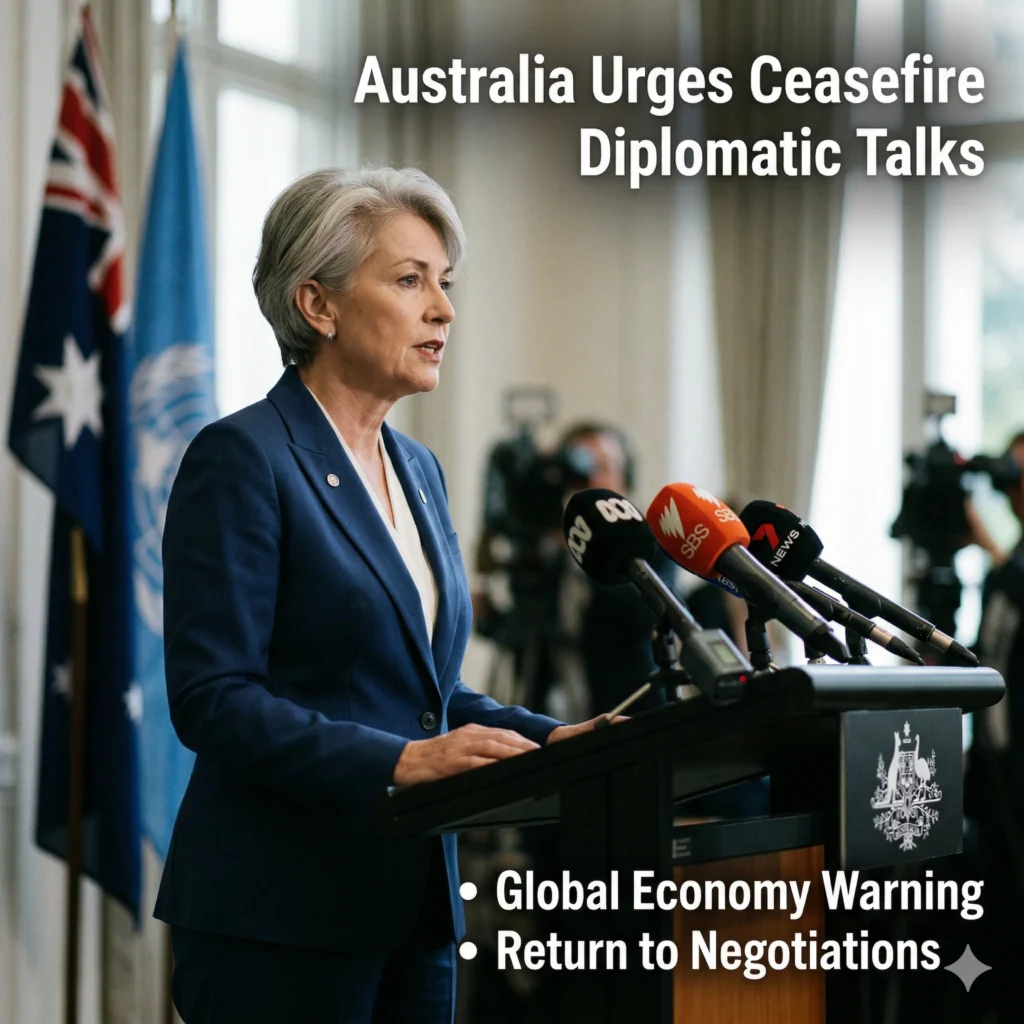
Australia Diplomacy Crisis
The current Australia diplomacy crisis reflects a significant shift in how middle powers are responding to the friction between the United States and Iran. Minister Wong’s direct approach signals that Australia is no longer willing to sit on the sidelines while global trade routes and human lives are placed at risk. This proactive stance is designed to pressure both parties back to the negotiating table immediately.
Furthermore, the Australian government has been monitoring the diplomatic developments in Islamabad closely over the recent weeks with a sense of urgency. Officials are concerned that the lack of progress in Pakistan could lead to a vacuum where military aggression becomes more likely. Australia is using its diplomatic weight to ensure that the dialogue remains the primary tool for conflict resolution.
By advocating for a return to the negotiating table, Penny Wong is addressing the underlying issues that have long plagued the relationship between Washington and Tehran. The Australian government believes that only through transparent communication can a long-term security framework be established. This vision for peace is shared by many neighboring nations who fear the ripple effects of a potential war.
Impact on Global Economic Stability
The potential for significant negative impacts on the global economy is a driving force behind the recent warnings from the Australian Department of Foreign Affairs. If the Australia diplomacy crisis deepens, the volatility in oil prices could trigger a worldwide recession. Markets are already showing signs of nervousness as investors await the next move from the United States or Iran.
Supply chains that rely on the stability of the Middle East are particularly vulnerable to any military disruption in the region. Australia, as a major exporter, understands that a surge in shipping costs and insurance premiums would affect consumers globally. Thus, maintaining the ceasefire is not just a moral imperative but a crucial economic necessity for all nations.
The Foreign Minister’s comments were widely reported by Australian media outlets following the conclusion of the diplomatic summit in Islamabad. These reports emphasize that Australia continues to urge all parties to prioritize diplomatic channels over military action. This consistent messaging is intended to provide a sense of direction for international markets and allied governments.
Humanitarian Concerns in the Middle East
Beyond the financial implications, the Australia diplomacy crisis focuses heavily on the potential for mass casualties in the event of a kinetic conflict. Penny Wong has highlighted that the human cost of war would be unbearable for the local populations in Iran and surrounding territories. Australia’s commitment to humanitarian values necessitates this strong call for a peaceful path forward.
Refugee crises and the destruction of critical infrastructure are outcomes that Australia desperately wants to help the international community avoid. By urging the United States and Iran to maintain their ceasefire, Australia is advocating for the protection of civilian lives. This perspective is a cornerstone of Australian foreign policy under the current leadership in Canberra.
The ongoing tension requires a sophisticated diplomatic response that accounts for the historical grievances of both the United States and Iran. Australia’s role as a mediator and a voice of reason is becoming increasingly vital as other channels of communication fail. Minister Wong’s statement serves as a reminder that the stakes involve real people and vulnerable communities.
Strategic Role of the Islamabad Talks
The Islamabad Talks were seen as a rare opportunity for a breakthrough, yet their failure has exacerbated the Australia diplomacy crisis. Australia had hoped that the neutral ground provided by Pakistan would allow for a more constructive exchange of ideas. The disappointment expressed by Minister Wong reflects the high expectations the international community had for this specific summit.
- The talks focused on nuclear enrichment limits and the lifting of economic sanctions.
- Negotiators struggled to find common ground on the timeline for reciprocal actions.
- Security guarantees for regional allies remained a major sticking point during the sessions.
- The absence of a formal agreement has left the existing ceasefire in a precarious position.
Despite the setback, Australia believes that the framework established in Islamabad can still serve as a foundation for future discussions. The Foreign Minister is calling for both sides to review their positions and return with more flexible mandates. Australia is ready to support any initiative that leads to a sustainable and verifiable peace agreement.
Australia and Regional Security Partners
As part of the response to the Australia diplomacy crisis, the government is intensifying its consultations with regional partners in the Indo-Pacific. Canberra recognizes that a conflict in the Middle East would draw resources away from other critical security theaters. Therefore, maintaining peace between Iran and the U.S. is a strategic priority for Australian national interests.
Coordinating with partners like Japan, South Korea, and Singapore allows Australia to present a united front against military escalation. These nations all share a common interest in the free flow of trade and the adherence to international law. Penny Wong’s advocacy is strengthened when it is backed by a coalition of like-minded regional powers.
The Australian government is also engaging with the United Nations to ensure that the ceasefire is monitored and respected. This multi-lateral approach is essential for preventing accidental skirmishes that could lead to a full-scale war. Australia’s diplomatic strategy is focused on building layers of protection around the current peace to prevent any sudden collapse.
Future of Transpacific and Middle Eastern Relations
The Australia diplomacy crisis will likely redefine Australia’s relationship with both the United States and Iran for the foreseeable future. Australia is demonstrating that while it remains a loyal ally to the U.S., it will not hesitate to speak out when it perceives a threat to global peace. This balanced approach is intended to foster a more stable international environment.
For Iran, the message from Australia is clear: the international community expects a commitment to diplomatic norms and de-escalation. By engaging in this way, Australia hopes to encourage Tehran to stay within the bounds of international agreements. The goal is to create a pathway where Iran can reintegrate into the global economy through peaceful cooperation.
As we move past April 2026, the success of these diplomatic efforts will depend on the willingness of the primary actors to compromise. Australia will continue to provide a platform for dialogue and remain a persistent advocate for the ceasefire. The world watches closely as the Australia diplomacy crisis unfolds, hoping for a resolution that avoids the horrors of war.
Conclusion and Strategic Outlook
In conclusion, the Australia diplomacy crisis serves as a critical warning to the world about the fragility of peace in a polarized era. Penny Wong’s leadership in this matter has brought the issues of economic stability and humanitarian protection to the forefront of the conversation. Australia remains a steadfast proponent of the idea that diplomacy is the only viable solution to complex international disputes.
- The ceasefire must be upheld to prevent immediate military confrontation and loss of life.
- Both the United States and Iran need to return to the negotiating table without preconditions.
- Global markets require certainty, which can only be provided by a formal diplomatic agreement.
- Middle powers like Australia play a vital role in mediating between the world’s superpowers.
The Australian government will not waver in its commitment to these principles as it navigates the challenges of the coming months. By prioritizing the Australia diplomacy crisis in its foreign policy agenda, Canberra is working to secure a safer and more prosperous future for everyone. The hope is that the lessons learned from the Islamabad Talks will eventually lead to a lasting peace.
Historical Context of the Conflict
To understand the Australia diplomacy crisis, one must look at the decades of tension that have led to this current impasse. The relationship between the United States and Iran has been defined by periods of intense hostility and brief windows of diplomatic engagement. Australia has often played the role of a bridge-builder, trying to facilitate communication when direct ties were severed.
The collapse of previous nuclear agreements created the vacuum that the Islamabad Talks were meant to fill. Australia’s involvement is a testament to its long-standing interest in non-proliferation and regional security. By addressing the Australia diplomacy crisis now, the government is attempting to prevent history from repeating itself in a more violent manner.
The Foreign Minister’s statement also reflects a modern Australian foreign policy that is more assertive on the global stage. No longer just a follower of great power politics, Australia is actively shaping the discourse around peace and security. This evolution is crucial for maintaining the country’s influence in an increasingly complex and multi-polar world.
Australia Diplomacy Crisis and Public Sentiment
Public sentiment within Australia is also a significant factor in how the government handles the Australia diplomacy crisis. Many Australians are concerned about the domestic impact of an overseas war, particularly regarding fuel prices and the safety of citizens abroad. Penny Wong’s focus on diplomacy resonates with a public that favors peaceful solutions over military intervention.
The media coverage of the Islamabad Talks has kept the Australian public informed about the high stakes involved in these negotiations. This transparency helps build a national consensus for the government’s diplomatic strategy and reinforces Australia’s position internationally. The Australia diplomacy crisis is thus a matter of both foreign and domestic importance.
- Community leaders have called for increased humanitarian aid to the region.
- Business groups have expressed concern over potential disruptions to trade routes.
- Academic experts suggest that Australia should host the next round of peace talks.
- Younger generations are advocating for a focus on global stability and climate security.
As the situation evolves, the Australian government will need to continue balancing these various interests. The Australia diplomacy crisis is a multifaceted problem that requires a comprehensive and thoughtful response. By staying true to its values, Australia can help guide the world away from the brink of conflict.
Final Summary of Diplomatic Goals
Ultimately, the resolution of the Australia diplomacy crisis hinges on the ability of the United States and Iran to see the mutual benefits of peace. Australia’s role is to keep the pressure on and provide the necessary support for a breakthrough. The Foreign Minister’s call for a resume in diplomacy is the most logical path forward for all parties involved.
The international community must not lose sight of the progress that has been made, even if a final agreement remains elusive. The current ceasefire is a valuable asset that must be protected at all costs to provide the time needed for a permanent solution. Australia will remain at the center of these efforts, working tirelessly to resolve the Australia diplomacy crisis.
With the eyes of the world on Canberra, the actions taken in the coming weeks will be decisive. Australia has shown it is ready to lead with clarity and purpose in the face of international uncertainty. The pursuit of peace between the United States and Iran remains the most pressing challenge of our time, and Australia is committed to seeing it through.
For more details & sources visit: Islam Times
Read more about Australia news on 360 News Orbit – Australia.