
Gaza Economic Crisis is currently the most pressing humanitarian and financial catastrophe in the modern world, as the region experiences a total paralysis of its fiscal and social infrastructure. New data reveals that the Strip has moved beyond mere recession into a state of absolute structural disintegration. While the physical destruction of buildings often captures global headlines, the internal erosion of the financial system and the labor market represents a far more permanent threat to the Palestinian people.
The collapse has resulted in a GDP contraction of over 87% within a shockingly short timeframe, leaving the local economy in a state of primitive survivalism. This downturn is not merely a byproduct of conflict but a systemic dismantling of the means of production, trade, and education that once sustained two million people.
The Magnitude of the Financial Disaster in 2026
The sheer scale of the fiscal decline can be understood through the lens of the Palestinian Central Bureau of Statistics, which reports that the annual GDP has withered to a mere $362 million. To put this into perspective, the per capita GDP has fallen to approximately $161, a figure that places the region among the most impoverished territories on the planet. This fiscal freefall has effectively wiped out two decades of slow, arduous economic growth in a matter of months.
Every sector of the local market, from agriculture to the small service industry, has been shuttered by the ongoing blockade and kinetic destruction of facilities. Consequently, the hardship is no longer just a statistic found in academic journals; it is the daily reality for families who can no longer afford the most basic caloric requirements for survival. The lack of liquidity in the market further complicates the situation, as the banking sector struggles to operate under siege conditions.
Markets that once bustled with activity in Gaza City and Khan Younis are now ghost towns or makeshift camps for the displaced. The Gaza Economic Crisis has essentially forced the population back into a barter system, where physical labor or the trading of meager aid supplies has replaced traditional currency transactions. This regression into a pre-modern economic state highlights the total failure of international protection mechanisms for civilian infrastructure.
Gaza Economic Crisis
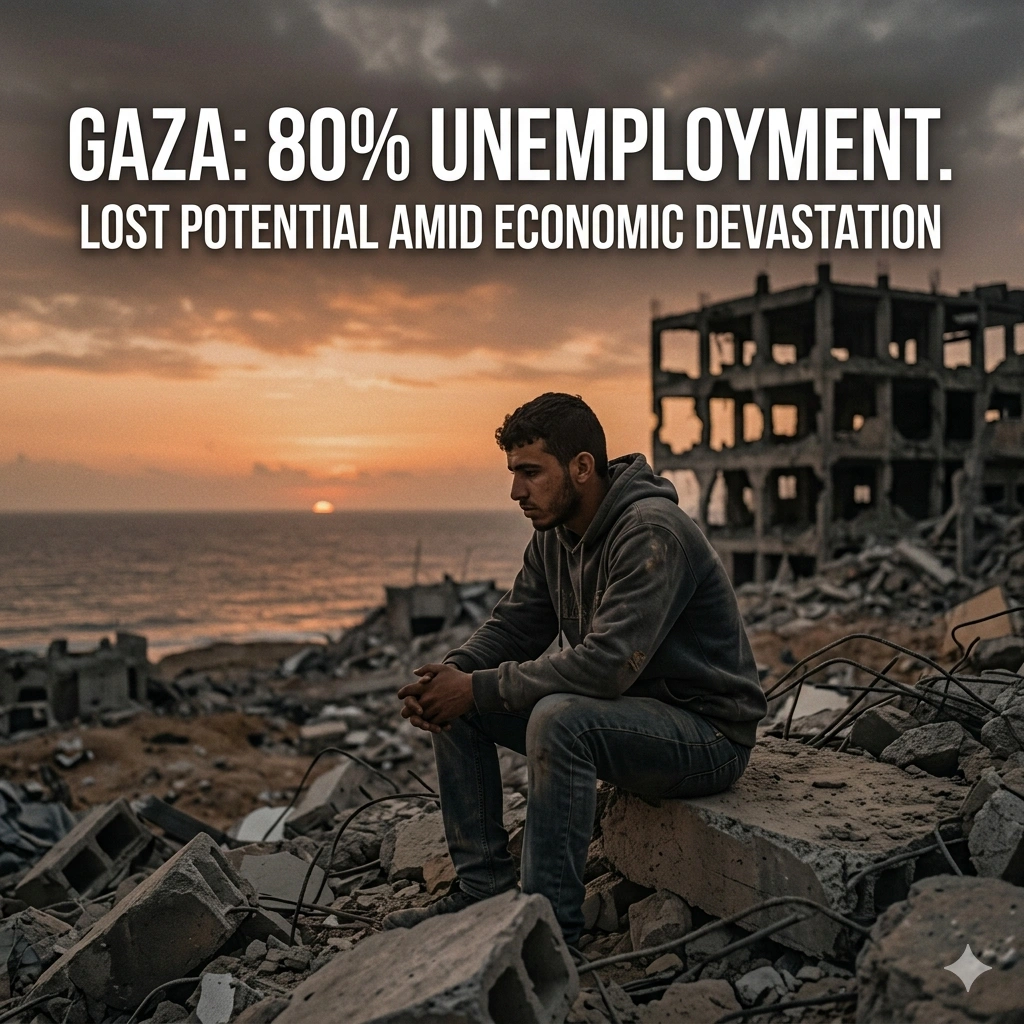
The most devastating pillar of the current situation is the unprecedented 80% unemployment rate that has gripped the territory since the escalation of hostilities. For the majority of the population, the concept of a “job” has become a relic of the past, replaced by an endless cycle of searching for clean water and fuel. This joblessness has hit the private sector with such force that nearly every business, regardless of size, has ceased operations.
Without a functioning labor market, the social fabric of the community is fraying at the edges. Young men and women who were once the primary breadwinners for extended families are now dependent on irregular aid shipments that barely meet the threshold for survival. The Gaza Economic Crisis is characterized by this total loss of agency, where the ability to earn a living has been stripped away by forces far beyond the control of the individual worker.
Economists warn that even if a permanent ceasefire were enacted tomorrow, the financial scars would persist for generations. The loss of human capital, combined with the destruction of industrial tools and office spaces, means there is no immediate “restart” button for the economy. This prolonged state of joblessness is creating a psychological toll that is just as damaging as the physical hunger experienced by the masses.
Impact on Higher Education and Intellectual Capital
Education was once the primary vehicle for upward mobility in Palestine, but the conflict has effectively demolished the entire academic infrastructure. All major universities in the Strip have sustained significant damage or complete destruction, leaving hundreds of thousands of students without a path to completion. The Gaza Economic Crisis has turned a generation of scholars into a generation of displaced refugees, mourning the loss of their intellectual futures.
Graduates who spent years studying engineering, medicine, or law now find themselves scavenging for firewood to cook simple meals. This aspect of the struggle is perhaps the most tragic, as the “brain drain” is occurring not through migration, but through the systematic erasure of the institutions that foster knowledge. The loss of these educational landmarks means that the intellectual reconstruction will take far longer than the physical rebuilding of its roads.
Furthermore, the Gaza Economic Crisis has halted the flow of international scholarships and research grants that once connected Gaza to the global community. Students are trapped in a “deadly routine” where their only objective is to survive until the next morning. This intellectual stagnation ensures that the territory remains underdeveloped even after the dust of conflict eventually settles.
Infrastructure Destruction and Local Commerce
The physical manifestation of the decline is visible in the ruins of the industrial zones that once provided textiles, processed food, and construction materials. Heavy machinery, solar arrays, and water desalination plants have been targeted or collateralized in the violence, exacerbating the poverty levels. Without these critical utilities, the cost of doing business has risen to impossible heights, preventing any form of recovery.
Logistical chains have been completely severed, meaning that even if raw materials could reach the borders, there are no functional roads to transport them. The Gaza Economic Crisis is deepened by the destruction of the energy grid, which has left the territory in a state of perpetual darkness. Businesses that relied on digital infrastructure or refrigeration have been permanently liquidated, adding to the growing list of economic casualties.
The downturn also extends to the maritime sector, as fishing fleets have been restricted or destroyed, removing a vital source of income for coastal communities. The cumulative effect of this destruction is a landscape where the primary economic activity is the demolition of rubble. This cycle of ruin is the defining image of the Gaza Economic Crisis in 2026, a year marked by historic hardship.
Demographic Catastrophe and Youth Prospects
With 70% of the population under the age of 30, the current instability is primarily a crisis of youth. This demographic is currently facing a future that offers no employment, no education, and no stable housing. The Gaza Economic Crisis has created a massive population of “aimless and hopeless” young people who have been denied the basic right to build a life. This is not just a financial issue; it is a demographic time bomb.
The hardship has forced many young people to delay marriage and family formation, which will have long-term effects on the birth rate and social structure. As the Gaza Economic Crisis drags on, the sense of desperation among the youth continues to mount, leading to a profound sense of alienation from the rest of the world. International observers note that this level of youth disenfranchisement is unprecedented in modern history.
In many ways, the situation is a war on the future, targeting the most productive years of the next generation. Young professionals who once dreamed of teaching are now the faces of the Gaza Economic Crisis, illustrating the chasm between their potential and their current reality. The world must recognize that the destruction is erasing the very people who would be responsible for rebuilding the society.
The Role of International Aid and Relief
While international aid is a lifeline, it is currently insufficient to address the structural depth of the fiscal collapse. Humanitarian assistance focuses on immediate caloric needs, but it cannot replace a functioning macroeconomy or provide long-term employment. The Gaza Economic Crisis has created a dependency on aid that is both precarious and unsustainable given the political climate surrounding the borders.
The situation is worsened by the fact that aid delivery is frequently hampered by logistical bottlenecks and security concerns. Even when aid does arrive, it does not stimulate the local market in the same way that trade and production would. To truly solve the Gaza Economic Crisis, there must be a shift from temporary relief to a comprehensive economic Marshall Plan for the Palestinian people.
However, the political hurdles to such a plan are immense, leaving the region to fester in a vacuum of international inaction. Donor fatigue is also becoming a factor, as the Gaza Economic Crisis continues year after year without a clear political resolution. Without a massive influx of capital and the lifting of trade restrictions, the misery will remain the dominant narrative of the region.
Healthcare System Collapse and Medical Costs
The financial ruin has directly led to the near-total collapse of the healthcare sector, as hospitals lack the funds to pay staff or purchase essential medicines. Doctors and nurses are working for months without salaries, driven only by a sense of duty amidst the Gaza Economic Crisis. This fiscal shortage means that even treatable conditions are becoming fatal, as the economic cost of medical care is now beyond reach.
Equipment that breaks down cannot be repaired because the Gaza Economic Crisis has prevented the import of spare parts and technical expertise. Furthermore, the lack of resources has resulted in a shortage of fuel for hospital generators, leading to frequent power outages during critical surgeries. The health of the population is intrinsically linked to the financial stability of the territory.
Public health officials warn that the long-term effects of the Gaza Economic Crisis on children will include stunted growth and developmental delays. These are economic costs that will be paid for decades to come, as the future workforce will be less healthy and less productive. The current situation is therefore a slow-motion disaster for the physical well-being of the Palestinian people.
Urban Planning Challenges in a Ruined State
Rebuilding will require more than just money; it will require a complete reimagining of urban spaces that have been leveled by conflict. Currently, millions of tons of debris litter the streets, and the cost of clearing this rubble adds to the Gaza Economic Crisis. Without a coordinated plan, the haphazard reconstruction will only lead to further economic inefficiencies in the future.
The instability has also displaced hundreds of thousands of people, creating a housing shortage that has driven up the cost of any remaining shelter. This internal displacement is a major factor in the Gaza Economic Crisis, as families spend what little money they have on temporary tents or overcrowded apartments. The lack of property rights and clear titles following the destruction adds another layer of complexity to the recovery.
Urban planners suggest that the Gaza Economic Crisis can only be mitigated if there is a centralized authority capable of managing the reconstruction. However, the current political fragmentation makes this a difficult prospect, further entrenching the financial ruin. The physical environment of Gaza has become a barrier to its own recovery, a tragic irony of the current situation.
Long-term Projections for the Region
Looking ahead to the next decade, the financial depression is expected to cast a long shadow over the entire Eastern Mediterranean. Economists predict that it will take at least thirty years for the region to return to its pre-2023 levels, provided that the Gaza Economic Crisis is addressed immediately. The “lost decade” of growth is already a reality.
There is a risk that the Gaza Economic Crisis will lead to permanent depopulation as those with the means to leave seek opportunities elsewhere. This “brain drain” would leave the territory even more vulnerable to further decline, as the most capable individuals are no longer present to lead the recovery. The Gaza Economic Crisis is thus a self-reinforcing cycle of decline that requires a massive external intervention to break.
Ultimately, the fall is a reminder of the fragility of modern economic systems when faced with total conflict. The world has watched the Gaza Economic Crisis unfold in real-time, but the response has yet to match the scale of the suffering. As we move further into 2026, the fiscal ruin remains a testament to the devastating intersection of politics, war, and finance.
Summary of Economic Indicators
The situation is a multifaceted disaster that requires a holistic approach to solve. From the rubble of the universities to the empty stalls of the markets, the Gaza Economic Crisis is everywhere. Addressing the ruin is not just a matter of economics; it is a matter of basic human rights and dignity for the millions trapped in its wake.
As the international community debates the next steps, the people continue to live through the Gaza Economic Crisis every single day. The struggle is the story of a people’s resilience being tested to its absolute limit. Whether the current state will be the final chapter for the territory’s economy or a turning point toward recovery remains to be seen.
The Gaza Economic Crisis is an urgent call to action for global leaders and financial institutions. Ignoring the collapse will only lead to more instability and human suffering in the years to come. The time to address the Gaza Economic Crisis is now, before the damage becomes truly irreversible and the youth are lost forever.
Strategies to Mitigate the Current Downfall
To effectively combat the Gaza Economic Crisis, there must be an immediate opening of trade corridors to allow for the movement of goods and people. This is the only way to inject liquidity back into the system and start reversing the trend. Furthermore, debt relief and direct cash transfers to families could help stabilize the immediate effects of the Gaza Economic Crisis on the most vulnerable.
Investment in digital infrastructure could also provide a way around the physical blockades, allowing some residents to participate in the global gig economy despite the Gaza Economic Crisis. However, this requires a stable power supply, which is currently a casualty of the conflict. Innovations in solar energy might offer a decentralized solution to the energy problems.
Ultimately, the Gaza Economic Crisis is a political problem with economic consequences. Solving the crisis requires a political settlement that guarantees the safety and sovereignty of the Palestinian people. Without such a settlement, the Gaza Economic Crisis will continue to be a recurring nightmare for everyone involved.
The world must not look away from the Gaza Economic Crisis as it enters this critical phase. Every day that passes without a solution is a day where more lives are ruined and more opportunities are lost. The Gaza Economic Crisis is a global responsibility that demands a global response and immediate fiscal intervention.
For more details & sources visit: Al Jazeera
Read more about Palestine news on 360 News Orbit – Palestine.