
Islamabad Peace Talks are set to commence this Friday as Pakistan prepares to host the most significant diplomatic summit of the decade between Washington and Tehran. This historic meeting follows a dramatic de-escalation period where President Donald Trump authorized a two-week ceasefire to allow for high-level negotiations on neutral ground.
The selection of the Pakistani capital signifies a major shift in regional dynamics, providing a secure environment for both parties to discuss the “definitive” peace framework. These Islamabad Peace Talks represent a critical opportunity to finalize the 10-point proposal that has been floating between the two nations since the conflict intensified.
Security in the capital has been heightened to the highest level to ensure the safety of all arriving delegations and international observers. The world’s eyes are now fixed on the Islamabad Peace Talks, hoping that this dialogue will prevent the catastrophic military strikes that were previously threatened by the White House.
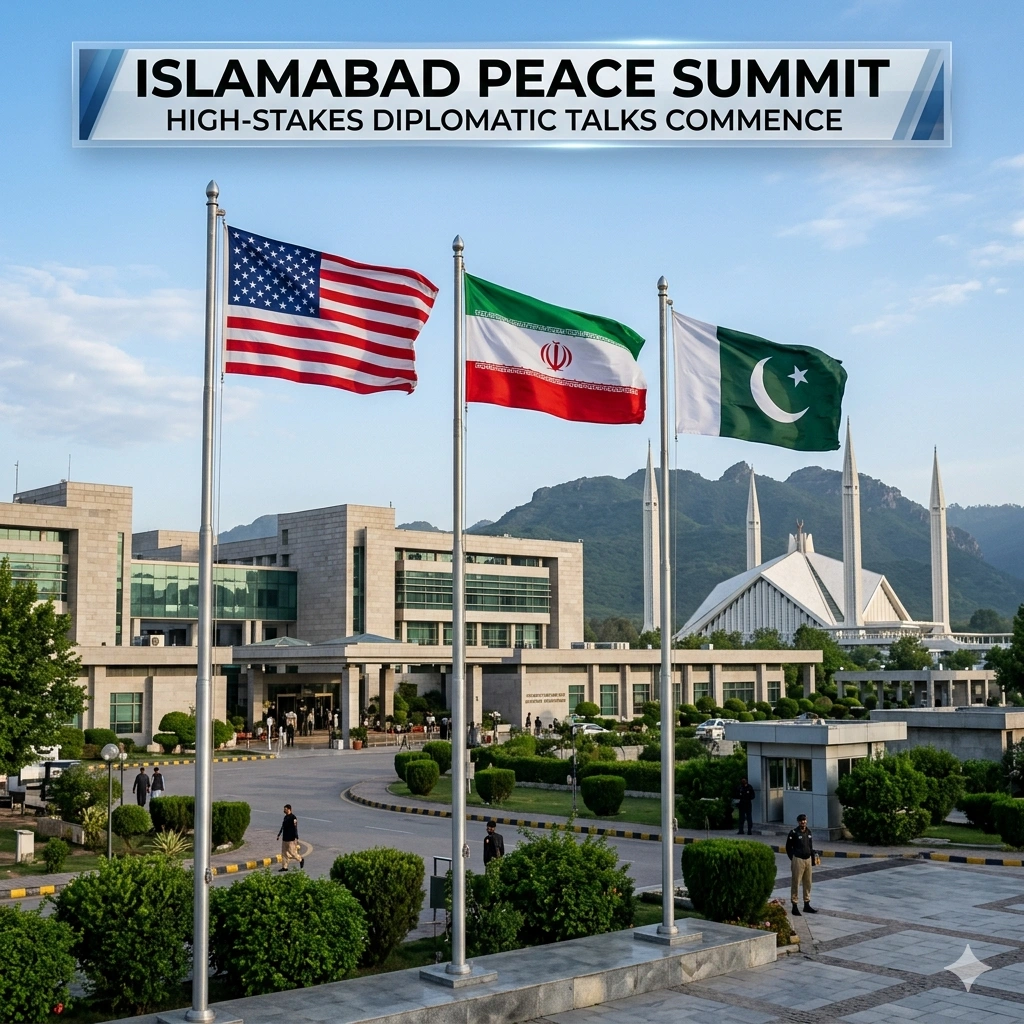
Islamabad Peace Talks
The official schedule for the Islamabad Peace Talks includes three days of intensive closed-door sessions followed by a joint press conference at the end of the weekend. Both the U.S. State Department and the Iranian National Security Council have confirmed their senior-level attendance for this pivotal event.
Diplomatic sources indicate that the Islamabad Peace Talks will focus primarily on the permanent reopening of the Strait of Hormuz and the withdrawal of localized blockades. This summit is the culmination of secret back-channel communications that have been occurring throughout the two-week ceasefire agreement.
While tensions remain high, the very existence of the Islamabad Peace Talks is seen as a victory for those advocating for a non-military resolution to the crisis. Many experts believe that if an agreement is reached here, it could set a new standard for Middle Eastern diplomacy for the next fifty years.
The Role of Pakistan as a Neutral Mediator
Pakistan’s role in hosting the Islamabad Peace Talks highlights its strategic importance as a bridge between the Western world and the Islamic Republic of Iran. The Prime Minister of Pakistan has expressed his full support for the process, offering every resource to ensure the summit’s success.
By facilitating the Islamabad Peace Talks, Pakistan is positioning itself as a key player in global peace-making efforts, moving beyond its traditional regional focus. This mediation is seen as a necessary component for bringing two such diametrically opposed rivals to the same physical table.
Local officials in the capital have worked tirelessly to coordinate the logistics of the Islamabad Peace Talks, including the arrival of hundreds of international journalists. The city has become a temporary hub for the world’s most influential diplomats, all working toward a common goal of regional stability.
Key Points of the 10-Point Proposal
At the heart of the Islamabad Peace Talks is Iran’s 10-point proposal, which President Trump has surprisingly characterized as a “workable basis” for a deal. This document covers everything from nuclear enrichment limits to the cessation of proxy warfare in neighboring countries.
During the Islamabad Peace Talks, negotiators will go through each point line-by-line to find common ground that satisfies both U.S. security interests and Iranian sovereignty. The goal is to transform these bullet points into a legally binding treaty that can withstand the test of political changes in both countries.
Expectations for the Islamabad Peace Talks are high, but officials warn that the most difficult points regarding sanctions relief are yet to be fully resolved. However, the willingness to discuss these issues in a formal setting is a major departure from the rhetoric of the past several months.
Economic Implications for Global Markets
Global markets have already begun to stabilize in anticipation of the Islamabad Peace Talks, with energy futures showing a downward trend in volatility. Investors are betting that a successful outcome in Pakistan will lead to a long-term drop in the price of crude oil.
The Islamabad Peace Talks are particularly important for the shipping industry, which has faced astronomical insurance rates since the blockade of the Strait of Hormuz began. A finalized peace agreement would restore confidence in maritime trade routes that are essential for the global economy.
Financial analysts suggest that the Islamabad Peace Talks could spark a massive rally in international equities if a definitive ceasefire extension is announced. The potential for a “peace dividend” is driving positive sentiment across the major financial districts from New York to Tokyo.
Logistics of the High-Level Summit
The logistics of the Islamabad Peace Talks involve a complex coordination between the Pakistani military and the security details of the visiting dignitaries. A “Green Zone” has been established around the summit venue to prevent any disruptions from outside groups or protesters.
Every detail of the Islamabad Peace Talks, from the seating arrangements to the translation services, has been meticulously planned to avoid any diplomatic slights. The hospitality of the host nation is being used to create an atmosphere conducive to honest and productive dialogue.
Technicians have installed secure communication lines for the Islamabad Peace Talks, allowing the negotiators to consult with their respective heads of state in real-time. This connectivity is vital for making the rapid decisions required when dealing with such high-stakes international security matters.
Regional Reactions to the Negotiations
Neighboring countries are closely monitoring the progress of the Islamabad Peace Talks, as any agreement will have a profound impact on their own security. Some regional actors have expressed concerns about being left out of the final decision-making process.
To address these concerns, the Islamabad Peace Talks may include a secondary session where regional stakeholders are briefed on the progress of the primary negotiations. Maintaining a broad coalition of support is essential for the longevity of any peace deal struck in Pakistan this week.
The Islamabad Peace Talks have the potential to realign alliances throughout the Middle East and South Asia, creating new opportunities for trade and cooperation. Many hope that this summit marks the end of the “perpetual conflict” model that has dominated the region for decades.
Humanitarian Impact and Sanctions Relief
A major topic during the Islamabad Peace Talks will be the potential for humanitarian aid to reach civilian populations that have been hit hard by the recent escalation. Easing certain sanctions as a show of good faith is currently being debated by the U.S. delegation.
The Islamabad Peace Talks aim to create a corridor for essential medicines and food supplies to enter Iran in exchange for verified military de-escalation. This human-centric approach is designed to build trust between the two nations at a grassroots level.
Negotiators at the Islamabad Peace Talks understand that without tangible benefits for the people, any political agreement may be seen as illegitimate. Therefore, the economic welfare of the general population is a cornerstone of the ongoing diplomatic efforts in the capital.
Monitoring and Verification Protocols
One of the most technical aspects of the Islamabad Peace Talks involves the establishment of monitoring protocols to ensure neither side cheats on the agreement. This includes the use of satellite technology and on-site inspections by neutral third-party organizations.
The Islamabad Peace Talks will likely produce a framework for a joint monitoring commission that can investigate alleged violations of the ceasefire. Having a clear mechanism for dispute resolution is critical for preventing a return to open hostilities.
Experts in arms control are present at the Islamabad Peace Talks to provide guidance on the technicalities of military withdrawals. These specialists ensure that the language used in the final agreement is precise and leaves no room for dangerous misinterpretation.
Future of U.S. Foreign Policy
The Islamabad Peace Talks are being viewed as a significant test of the current administration’s “maximum pressure” strategy and its ability to pivot to diplomacy. Success in Pakistan would validate this controversial approach to international relations for many supporters.
Conversely, if the Islamabad Peace Talks fail to produce a result, it could lead to an even more intense military standoff than before. The stakes for U.S. foreign policy could not be higher as the Friday deadline for the start of the talks rapidly approaches.
Historians may look back at the Islamabad Peace Talks as the moment when the U.S. successfully transitioned from a era of interventionism to one of strategic negotiation. The outcome of this summit will define the President’s legacy on the world stage for the remainder of his term.
Summary of Summit Objectives
The primary objectives of the Islamabad Peace Talks are clear: secure the Strait of Hormuz, establish a permanent ceasefire, and finalize the 10-point peace plan. Each of these goals is interconnected and requires a high level of compromise from both Washington and Tehran.
- Establishment of a permanent non-aggression pact between the U.S. and Iran.
- Full restoration of international shipping rights through the Strait of Hormuz.
- Agreement on a timeline for the phased lifting of economic sanctions.
- Creation of a joint security council to oversee regional stability.
The Islamabad Peace Talks represent a historic “window of opportunity” that neither side can afford to waste. The alternative to a successful negotiation is a return to the brink of a war that would have no true winners.
Public Support and Global Advocacy
Public sentiment regarding the Islamabad Peace Talks is overwhelmingly positive, with peace rallies occurring in major cities across the globe. People are demanding that their leaders prioritize dialogue over destruction to protect the future of the planet.
Social media campaigns have helped keep the Islamabad Peace Talks in the public eye, ensuring that the negotiators feel the weight of global expectation. This transparency is a new element in high-stakes diplomacy that could help push the parties toward a final agreement.
The Islamabad Peace Talks have become a symbol of hope for a generation that has grown up in the shadow of constant conflict in the Middle East. Achieving a breakthrough in Pakistan would be a powerful message that peace is always possible through persistent effort.
Conclusion and Final Thoughts
As the delegations arrive for the Islamabad Peace Talks, there is a palpable sense of history in the making. The road to this summit has been long and dangerous, but the destination offers a chance for a much brighter future for all parties.
The Islamabad Peace Talks are the final hurdle in a process that began with a simple ceasefire and has grown into a comprehensive peace movement. Whether the negotiators can overcome their deep-seated distrust remains the ultimate question for the coming weekend.
In the end, the Islamabad Peace Talks will be judged by the results they produce on the ground and at sea. The world waits with hope and anxiety, praying that the “City of Peace” lives up to its name during these critical negotiations.
The Islamabad Peace Talks are not just a meeting between two governments; they are a meeting of two different visions for the future of the Middle East. It is time for the vision of peace to finally prevail over the vision of war.
Every participant in the Islamabad Peace Talks carries the responsibility of millions of lives on their shoulders. We can only hope that they find the wisdom and the strength to sign a deal that ensures a lasting and definitive stability.
For more details & sources visit: Al Jazeera
Read more about Pakistan news on 360 News Orbit – Pakistan.