
President Donald Trump has dramatically reversed his stance on an imminent military escalation, signaling a major shift in global security as a two-week ceasefire begins today. This 11th-hour diplomatic breakthrough comes just moments before a self-imposed deadline that threatened to dismantle Iran’s civilian infrastructure and plunge the world into a total war. The resolution, which includes the strategic reopening of the Strait of Hormuz, has provided the global economy with a much-needed reprieve from skyrocketing energy costs. Consequently, the fact that a two-week ceasefire is now in effect has prevented what many feared was an irreversible humanitarian catastrophe.
The tension reached a breaking point this morning when the White House prepared to execute a massive strike on Iranian power plants and bridges. However, following intensive mediation by Pakistani officials, a bilateral framework was established to halt hostilities for a 14-day window. This cooling-off period is designed to facilitate high-level negotiations in Islamabad starting this Friday. As the two-week ceasefire holds, the immediate focus shifts from military maneuvers to the complex task of drafting a long-term peace treaty.
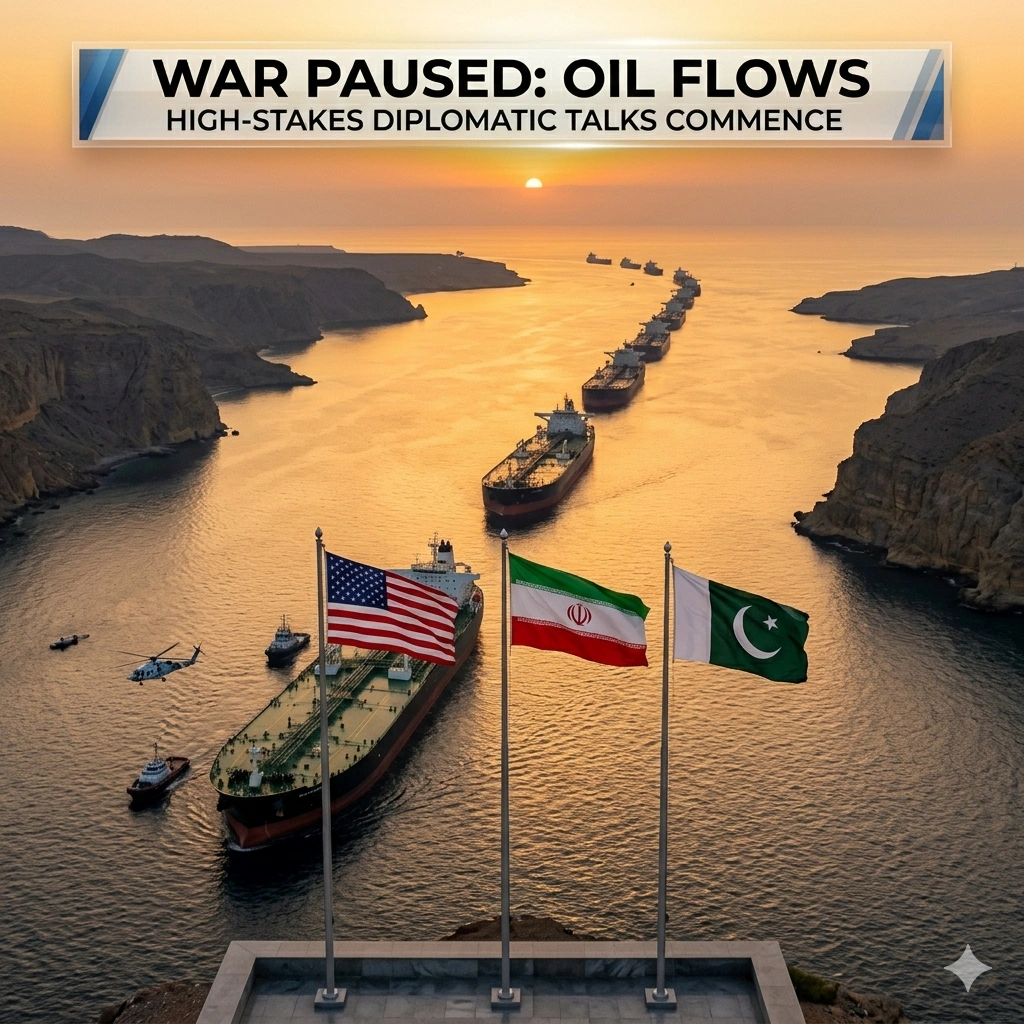
The Economic Impact of the Two-Week Ceasefire
The global financial markets reacted with unprecedented volatility to the news of the truce and a maritime reopening. For weeks, the blockade of the Strait of Hormuz had strangled global trade, leading to a critical shortage of fuel and industrial materials. Within minutes of the announcement, U.S. crude futures plummeted by 17%, marking one of the largest single-day drops in history. This sudden shift suggests that investors see the two-week ceasefire as a credible path toward normalizing international oil supplies.
Despite the positive market reaction, economists remain cautious about the long-term sustainability of this price drop. The 14-day window is relatively short given the depth of the grievances between the involved nations. If the Islamabad talks fail to produce a permanent solution, the risk of a secondary price surge remains extremely high. Nevertheless, for the millions of consumers facing an energy crisis, the news of the two-week ceasefire offers temporary but vital relief.
Two-Week Ceasefire
President Trump’s decision to rescind his “apocalyptic threat” has been met with a mix of relief and skepticism by the international community. While the White House insists that its military objectives have been “met and exceeded,” critics argue that the administration was forced into a diplomatic corner. The president utilized social media to announce the stand-down, emphasizing that the reopening of the Strait of Hormuz was his primary condition. This development confirms that the two-week ceasefire was achieved largely because of the immense economic pressure generated by the naval blockade.
In Israel, the reaction has been more measured, with security officials warning that skirmishes may continue on the periphery of the main conflict zones. The Israeli Defense Forces (IDF) have maintained a high state of alert, particularly along the maritime borders where Iranian proxies remain active. For the residents of the region, the hope is that the two-week ceasefire will lead to a cessation of the missile barrages that have characterized the last six weeks.
Negotiating the Iranian 10-Point Proposal
The upcoming summit in Islamabad will center on a 10-point plan presented by Tehran, which demands significant concessions from the West. These include the total lifting of primary and secondary sanctions and the recognition of Iran’s right to specific nuclear technologies. While the U.S. has labeled the plan a “workable basis,” the specific details regarding war reparations remain a significant sticking point. As the two-week ceasefire continues, the role of Pakistan as a neutral arbiter has become a central element of the narrative.
- Iran demands financial compensation for the destruction of oil terminals and transport hubs.
- The U.S. seeks a permanent end to Iranian maritime interference in the Persian Gulf.
- Israel requires verifiable guarantees that Iranian-backed militias will withdraw from its northern border.
The Human Cost of the Six-Week Conflict
The truce provides a grim opportunity for humanitarian organizations to assess the total damage caused by the six-week-old war. Official reports indicate that over 5,000 lives have been lost, with tens of thousands more displaced across the Middle East. The destruction of civilian infrastructure has left millions without consistent access to clean water or electricity in the peak of the spring heat. This humanitarian crisis is a primary reason why a two-week ceasefire was prioritized at this critical juncture.
- Hospitals in the conflict zones are currently operating at 300% capacity.
- International aid convoys are being prepared to enter both Israeli and Iranian territories.
- Temporary shelters are being constructed for refugees fleeing the most heavily bombarded urban centers.
Managing the Volatile Maritime Reopening
The restoration of safe passage through the Strait of Hormuz is the most tangible result of the current truce. The Iranian military has committed to pausing its blockade, which had effectively cut off 20% of the world’s oil supply. This reopening is a complex logistical operation that requires coordination between the U.S. Navy and the Iranian Revolutionary Guard. Because of the two-week ceasefire, the risk of accidental naval engagements has significantly decreased, allowing commercial shipping to resume.
However, the maritime situation remains fragile due to the presence of thousands of sea mines and debris from sunken vessels. Specialized mine-clearing teams will need to work around the clock to ensure the safety of the oil tankers now congregating at the entrance of the strait. The success of this operation is a prerequisite for any further diplomatic progress. If a single commercial vessel is struck, the two-week ceasefire could collapse instantly.
Islamabad: The New Center of Global Diplomacy
All eyes are now on Pakistan’s capital as it prepares to host the most important peace summit of the decade. The choice of Islamabad reflects the shifting geopolitical alliances in the East, as traditional Western mediators have lost influence with Tehran. Pakistani officials have expressed confidence that they can provide a neutral ground where the two-week ceasefire can be transformed into a lasting peace. The success of these talks will define the future of the Middle East for the next generation.
Future Security and Regional Stability
As we look beyond the 14-day window, the question remains whether the fundamental ideological differences can ever be truly resolved. The two-week ceasefire is a tactical pause, but it does not address the underlying rivalries that led to the conflict in the first place. For this truce to be more than a footnote, there must be a genuine commitment to regional non-aggression. This will require unprecedented transparency regarding military movements and nuclear development across the region.
The diplomatic community is calling for a multi-layered verification system to monitor the terms of the truce. This would include satellite surveillance and ground-level inspectors to ensure that no side is utilizing the pause to fortify their positions for a future strike. The fact that a two-week ceasefire is in place is only the beginning of a long and difficult road toward reconciliation. Every day without a missile launch is a victory for the civilians caught in the crossfire.
Conclusion: A Fragile Moment of Peace
The announcement on April 8, 2026, marks a day of profound relief for a world that was on the edge of the abyss. President Trump’s reversal and the subsequent truce have bought the international community 14 days of precious time. With the two-week ceasefire holding, the burden of proof now rests on the diplomats in Islamabad. They must turn this temporary cessation of violence into a permanent framework for stability and cooperation.
In the final assessment, the events of the last 24 hours demonstrate that even in the most apocalyptic scenarios, diplomacy remains a viable tool. The human and economic costs of the war have been too high for any side to ignore. We can only hope that the spirit of compromise seen in the two-week ceasefire will prevail in the coming weeks. The alternative is a return to a conflict that the world simply cannot afford to endure any longer.
For more details & sources visit: The Korea Times.
Read more on global developments: 360 News Orbit – Extended Orbit