
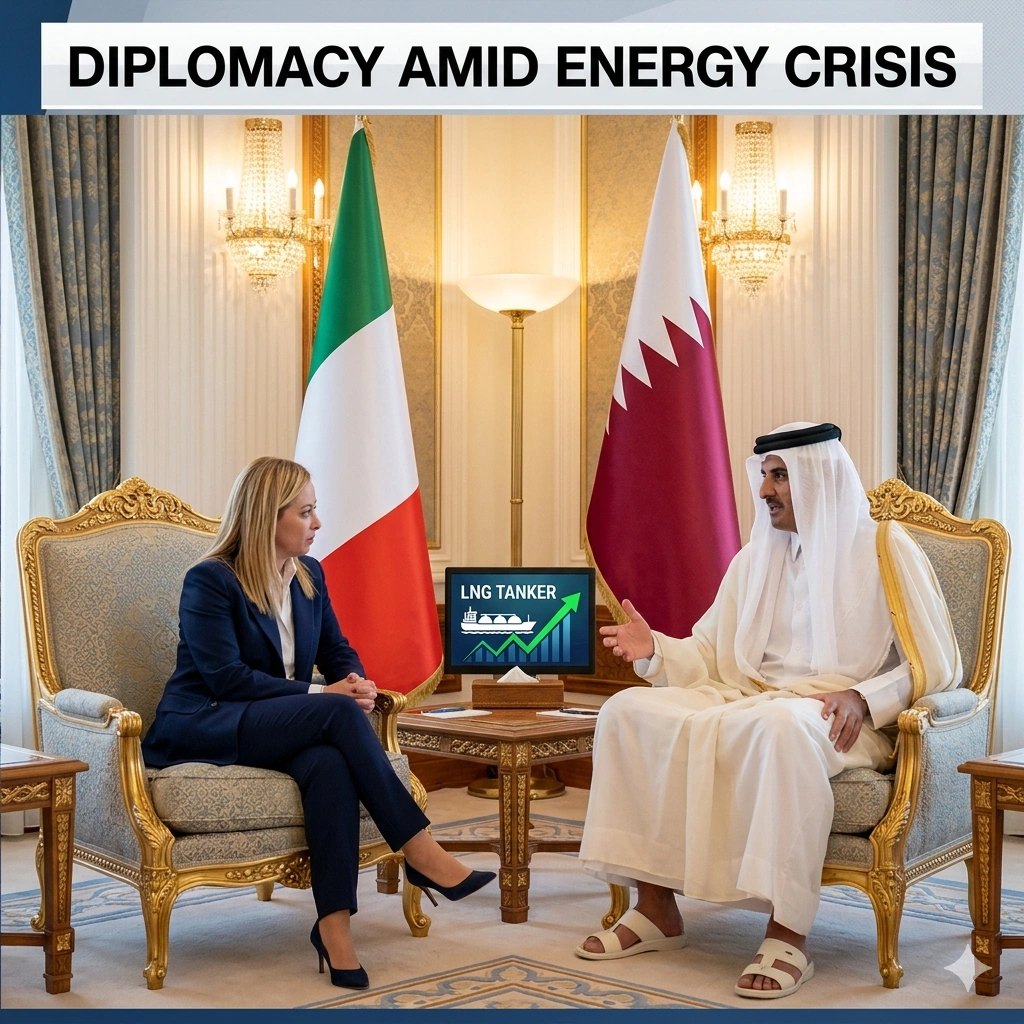
Italian Prime Minister Giorgia Meloni’s arrival in Doha marks a pivotal moment as the Meloni Qatar Energy Summit seeks to insulate Europe from the catastrophic effects of the Middle East war. This high-level diplomatic mission, is driven by the urgent need to bypass the paralyzed Strait of Hormuz. With 20% of the world’s liquefied natural gas and oil currently blocked by the ongoing conflict, Italy is positioning itself as a primary partner for Qatari exports.
The discussions between Meloni and Emir Sheikh Tamim bin Hamad Al Thani represent a desperate search for stability in a volatile global market. As fuel prices spike to historic levels, the success of these talks is seen as essential for Italy’s domestic economic survival. Both leaders have expressed a shared commitment to maintaining the flow of energy despite the regional chaos. The meeting underscores the shift in European foreign policy toward deep, strategic energy alliances with Gulf monarchies.
The Strategic Importance of the Meloni Qatar Energy Summit
The Meloni Qatar Energy Summit is a direct response to the maritime blockade that has crippled traditional supply routes through the Persian Gulf. Italy, which relies heavily on external energy sources, views Qatar as a lifeline during this period of extreme Middle East volatility. The mission is part of a broader regional tour that includes stops in Saudi Arabia and the United Arab Emirates.
Prime Minister Meloni has emphasized that the current energy crisis requires “extraordinary diplomatic agility” to prevent a total industrial standstill in Europe. By engaging directly with the Qatari Emir, Italy is attempting to secure long-term contracts that are not subject to the whims of the current conflict. This strategy is central to Meloni’s “Mattei Plan” for energy independence and regional cooperation.
Furthermore, the summit serves as a platform for Italy to offer technical expertise in exchange for guaranteed supplies. Italian firms specialize in high-tech infrastructure rehabilitation, which Qatar needs to modernize its extraction and export facilities. This symbiotic relationship is the cornerstone of the new bilateral agreement being drafted in Doha.
Rehabilitating Qatari Energy Infrastructure
A key outcome of the Meloni Qatar Energy Summit is the proposed Italian assistance in the rehabilitation of Qatari energy infrastructure. Italy is offering its world-class engineering capabilities to help Qatar optimize its LNG production and export terminals. This technical cooperation is designed to increase the efficiency of current operations to offset losses elsewhere.
The Italian state-owned energy giant ENI is expected to play a lead role in these infrastructure projects. By integrating Italian technology into Qatari plants, both nations hope to create a more resilient energy network. This move is particularly important as regional infrastructure, including petrochemical zones and nuclear sites, faces increasing threats from the ongoing war.
Emir Sheikh Tamim bin Hamad Al Thani has welcomed the Italian proposal, noting that modernization is essential for global energy security. The partnership extends beyond mere sales into deep industrial integration, which provides Italy with a unique competitive advantage. This collaborative model is being watched closely by other European nations facing similar shortages.
Meloni Qatar Energy Summit
The Meloni Qatar Energy Summit highlights the critical role of Doha as a stabilizing force in a world where energy has become a primary weapon of war. While the U.S. and Iran remain locked in a dangerous standoff, Italy is carving out a neutral space for commercial and energetic survival. The summit is a testament to Italy’s proactive stance in securing its national interests during a global emergency.
The discussions in Doha also touched upon the necessity of reopening global shipping lanes that have been closed for six weeks. Meloni has been a vocal advocate for international intervention to protect maritime trade, but the focus in Qatar is on creating alternative logistics. This includes looking into rail and pipeline options that could eventually supplement sea-based transport.
As the war enters its second month, the diplomatic weight of the Meloni Qatar Energy Summit continues to grow. It is not just about Italy’s needs but about creating a template for how European nations can engage with the Gulf. The success of this summit could determine the economic trajectory of the Mediterranean region for the rest of 2026.
Diversifying Energy Sources Amid Middle East War
The Meloni Qatar Energy Summit is a cornerstone of Italy’s broader strategy to diversify its energy portfolio away from conflict-ridden zones. Before the war, Italy had already begun shifting its focus, but the current crisis has accelerated this transition. Qatar’s massive LNG reserves make it the most logical partner for a nation looking to replace blocked Persian Gulf supplies.
- Italy is seeking to increase its annual LNG imports from Qatar by at least 15% over the next two years.
- New agreements include clauses for emergency supply surges in the event of further regional escalations.
- Italian banks are providing credit lines to facilitate the rapid expansion of Qatari export terminals.
- Both nations are exploring joint investments in green hydrogen projects to future-proof their partnership.
The diversification effort is not limited to gas; it also includes a focus on stabilizing oil prices through coordinated market actions. Meloni’s visit to Saudi Arabia and the UAE prior to Qatar was designed to create a unified energy front. This regional approach is essential for mitigating the “supply shocks” that have plagued the Italian economy since February.
Diplomacy and De-escalation Efforts in Doha
A major theme of the Meloni Qatar Energy Summit was the urgent need for political dialogue to contain the regional conflict. The Qatari Emir’s office emphasized that while energy supply is important, permanent stability can only be achieved through diplomacy. Qatar has long played the role of a regional mediator, and Meloni is keen to utilize this influence.
Italy has expressed readiness to support Qatari-led mediation efforts between the U.S., Israel, and Iran. The goal is to establish “safe zones” for energy transport that are respected by all combatant parties. This diplomatic initiative is being run in parallel with the technical and economic discussions held during the summit.
The human cost of the war and the impact on global supply chains were also high on the agenda. Meloni noted that the sustained maritime blockade is hurting the world’s most vulnerable populations by driving up the cost of food and heating. This moral argument is being used to pressure regional powers toward a ceasefire or at least a humanitarian pause.
Impact of the Strait of Hormuz Blockade
The Meloni Qatar Energy Summit is happening against the backdrop of a paralyzed Strait of Hormuz, which has thrown global markets into a frenzy. With the 48-hour deadline issued by Washington looming, the stakes for the Doha talks could not be higher. If the blockade continues, the agreements made in Qatar will become the primary source of fuel for the Italian people.
The closure of the Strait has forced tankers to take much longer and more expensive routes around the African continent. This has added significant “war premiums” to every barrel of oil and cubic meter of gas arriving in Europe. Meloni is working to secure price caps or direct government-to-government deals to bypass these market spikes.
- Increased shipping times have led to a 30% rise in logistics costs for Italian importers.
- Domestic energy bills in Italy have climbed by nearly 40% since the start of the conflict.
- Several Italian industrial sectors have had to reduce output due to energy rationing.
- The blockade has highlighted the fragility of global “just-in-time” energy supply chains.
By focusing on the Meloni Qatar Energy Summit, the Italian government is trying to provide a sense of certainty to its citizens and businesses. The message is clear: while the world is at war, Italy is working tirelessly to keep the lights on and the factories running. This proactive stance is a hallmark of Meloni’s leadership during international crises.
Italian Technical Expertise in the Gulf
One of the unique aspects of the Meloni Qatar Energy Summit is the emphasis on Italian “know-how” in the energy sector. Italy is not just a customer but a high-tech partner capable of improving Qatar’s domestic production. This includes the deployment of advanced sensor technology for leak detection and digital twins for plant management.
The rehabilitation of infrastructure is a massive project that could provide billions of euros in contracts for Italian firms. This economic boost comes at a critical time for Italy’s domestic manufacturing sector, which is struggling with high energy costs. The summit therefore serves a dual purpose: securing energy for the nation and securing work for its industries.
Emir Al Thani has expressed interest in Italian innovations in carbon capture and storage (CCS). As Qatar seeks to make its LNG exports “greener” for the European market, Italian technology provides a clear path forward. This alignment of environmental goals and energy needs is a significant outcome of the Doha discussions.
Regional Tour: Saudi Arabia, UAE, and Qatar
The Meloni Qatar Energy Summit was the final and most critical stop on Prime Minister Meloni’s regional tour. Each stop was designed to address a different piece of the energy puzzle. In Saudi Arabia, the focus was on crude oil stability, while in the UAE, the discussions centered on renewable energy investments.
The stop in Qatar, however, was about the most immediate and pressing need: liquefied natural gas. The coordinated nature of this tour shows that Italy is treating the Middle East crisis as a single, complex challenge that requires a unified response. Meloni’s ability to move between these different regional powers demonstrates Italy’s growing diplomatic clout.
By visiting these three nations in quick succession, Meloni has secured a “triple-layer” energy security net for Italy. This comprehensive approach is designed to ensure that if one source is disrupted, others can compensate. The regional tour is being hailed as a major success for Italian foreign policy in 2026.
Economic Repercussions for Italy and Europe
The Meloni Qatar Energy Summit is taking place as the Eurozone faces its most significant economic challenge in decades. The combination of high inflation and energy shortages has put intense pressure on the European Central Bank and national governments. Italy, as a major manufacturing hub, is particularly sensitive to these fluctuations.
Meloni’s discussions in Doha are intended to provide a “shock absorber” for the Italian economy. By locking in stable energy prices, the government can better manage inflation and protect consumer purchasing power. The economic ripple effects of a successful summit will be felt across all sectors of the Italian economy.
- Stabilizing energy costs is seen as the primary way to prevent a deep recession in late 2026.
- The agreements in Qatar will help maintain the competitiveness of “Made in Italy” exports.
- Energy security is now being treated as a matter of national security and social stability.
- The summit has strengthened Italy’s position within the EU as a leader in Mediterranean energy policy.
For the average Italian citizen, the Meloni Qatar Energy Summit means more predictable heating costs and more stable jobs. The Prime Minister has linked the success of these talks directly to the well-being of the Italian family. This political framing has helped build domestic support for her assertive foreign policy.
Security of Petrochemical and Nuclear Zones
During the Meloni Qatar Energy Summit, significant concern was raised regarding the targeting of energy infrastructure in the wider region. The recent strikes on petrochemical zones and threats to nuclear facilities have made energy transport even more hazardous. Italy and Qatar have agreed to share intelligence on maritime security to protect their joint interests.
The “rehabilitation” of infrastructure mentioned in the talks also includes improving the physical and cyber security of these sites. Italian defense firms may eventually be involved in providing protective systems for Qatari gas fields. This security dimension is a necessary response to the evolving nature of the Middle East conflict.
Both leaders agreed that a “blackout” of energy infrastructure in the Gulf would be a global catastrophe. They have called on all parties in the conflict to treat energy facilities as “off-limits” for military targeting. This humanitarian and economic plea is a core part of the joint statement issued after the summit.
The Role of LNG in Italy’s Transition
The Meloni Qatar Energy Summit reinforces the idea that LNG is the “bridge fuel” for Italy’s long-term energy transition. While the country is investing heavily in renewables, gas remains essential for providing a base load of electricity. Qatar’s role as the world’s leading LNG exporter makes it the indispensable partner in this transition.
The agreements signed in Doha include provisions for the eventual transition to cleaner gases, such as bio-LNG and synthetic gas. This shows that while the current focus is on the 2026 crisis, both nations are looking toward 2030 and beyond. The partnership is built on a foundation of current necessity and future innovation.
By securing a steady flow of Qatari gas, Italy can more effectively manage the decommissioning of older, dirtier coal plants. This allows the country to meet its climate targets while still ensuring energy reliability. The Meloni Qatar Energy Summit is therefore a win for both the economy and the environment.
Conclusion: Securing Italy’s Future in 2026
The Meloni Qatar Energy Summit concludes with a sense of cautious optimism for Italy’s energy future. Prime Minister Meloni’s bold diplomatic move has secured critical supplies and opened new doors for Italian industrial cooperation. While the Middle East war continues to rage, Italy has taken decisive steps to protect its national interests.
The partnership with Qatar is now more than just a buyer-seller relationship; it is a strategic alliance built on mutual respect and technical integration. As the world navigates the volatility of 2026, this connection will be a vital source of stability for the Mediterranean. The “Kitchenware Mecca” of energy has been found in Doha.
The coming months will test the implementation of these agreements as the conflict in the Persian Gulf evolves. However, for now, the Meloni Qatar Energy Summit has provided Italy with a much-needed shield against the storm. The world watches to see if this diplomatic success can lead to a broader de-escalation in the region.
For more details & sources visit: Al Jazeera
Read more about Italy news on 360 News Orbit – Italy.