
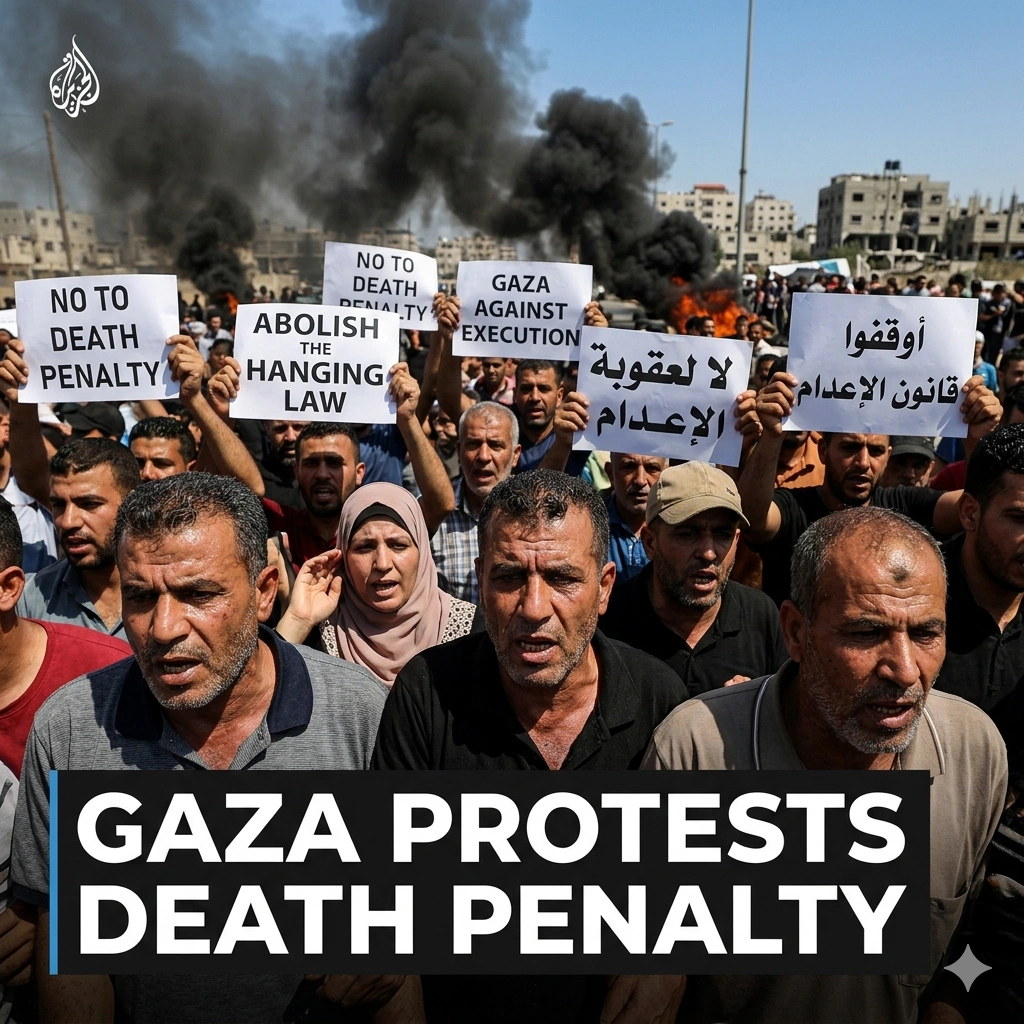
Israeli Death Penalty Law has sparked a massive wave of civil unrest across the Gaza Strip following its official ratification. Thousands of Palestinians took to the streets to voice their outrage against what many international observers are calling a tiered justice system. The legislation specifically targets individuals convicted of killing Israeli citizens in acts defined by the state as terrorism. However, the absence of similar punishments for Jewish Israelis has led to accusations of systemic bias and state-sponsored discrimination.
The protests intensified in central Gaza as demonstrators carried placards denouncing the Israeli Death Penalty Law as a blatant violation of international human rights standards. Many protesters view this legal development not as a deterrent for violence, but as a tool for political persecution and demographic control. Global rights organizations have joined the outcry, warning that such a disparity in capital punishment could lead to an irreversible breakdown of judicial equality. This legal shift marks a significant escalation in the legislative tension between the two conflicting populations.
The Approval of Discriminatory Capital Punishment
The journey toward the current Israeli Death Penalty Law has been marked by years of intense political debate and controversial legislative sessions. On April 2, the final approval was granted, setting a precedent that specifically isolates Palestinian defendants for the highest form of punishment. Advocates for the law argue that it is a necessary measure to ensure national security and provide justice for victims of terror. However, the selective nature of the law has made it a focal point for global criticism and local resistance.
Critics point out that the Israeli Death Penalty Law creates two distinct classes of citizens and residents under the same governing authority. By excluding Jewish Israelis from the possibility of a death sentence for similar homicidal offenses, the law undermines the principle of “equality before the law.” This perceived racism has galvanized the Palestinian public, leading to some of the largest demonstrations seen in Gaza in recent years. The legislative move is widely seen as a reflection of the current government’s hardline nationalist agenda.
Human Rights Concerns and International Reaction
International bodies and human rights advocates have expressed deep alarm over the potential consequences of the Israeli Death Penalty Law. Organizations like Amnesty International and Human Rights Watch have issued statements condemning the move as a regressive step for the region’s legal framework. They argue that the death penalty is an inhumane punishment in any context, but its discriminatory application makes it even more egregious. The global community is now facing calls to intervene and pressure the Israeli government to reconsider the measure.
The Israeli Death Penalty Law is viewed by many legal experts as a breach of the Fourth Geneva Convention, which governs the treatment of people in occupied territories. Diplomats from several European and Arab nations have warned that this legislation will only serve to fuel further escalations in the ongoing conflict. There is a growing fear that the implementation of this law will result in a cycle of retaliatory violence that could engulf the entire region. The international reaction highlights a growing consensus that justice must be applied universally to be legitimate.
Protests and Civil Disobedience in Gaza
The streets of Gaza have become a theater of resistance against the Israeli Death Penalty Law, with residents from all walks of life participating in the movement. From students to tribal elders, the message remains consistent: the law is an existential threat to the Palestinian people. Protesters have blocked major intersections and organized sit-ins in front of international administrative offices to demand a repeal. These acts of civil disobedience are expected to continue as long as the law remains on the books.
- Demonstrators are using social media to document the protests and share the human impact of the Israeli Death Penalty Law with the world today.
- Local leaders in Gaza have called for a general strike to demonstrate the collective power of the population against discriminatory legislation for the future.
- Medical personnel have expressed concern over the potential for clashes with security forces as the intensity of the protests continues to rise.
Legal Disparity and the Erosion of Justice
The primary grievance cited by protesters is the absolute lack of parity within the Israeli Death Penalty Law’s current structure. In the modern era, most developed legal systems strive for consistency in sentencing to maintain public trust. By codifying a difference in punishment based on the identity of the perpetrator and the victim, the Israeli state is seen as abandoning the core tenets of modern jurisprudence. This erosion of justice is viewed as a calculated move to further marginalize the Palestinian population.
Scholars of Middle Eastern law suggest that the Israeli Death Penalty Law will have a chilling effect on the possibility of future peace negotiations. When one side perceives the other’s legal system as a weapon of war, the room for diplomatic dialogue shrinks significantly. The law effectively communicates that Palestinian lives are valued differently within the Israeli judicial hierarchy. This perception is a powerful motivator for the ongoing protests and the hardening of political positions on both sides.
The Role of Political Parties in the Legislation
The passage of the Israeli Death Penalty Law was made possible by a coalition of right-wing and nationalist parties within the Knesset. These groups have long campaigned on a platform of “tough on terror” policies, often specifically targeting Palestinian resistance activities. Their success in passing this law is seen as a major victory for their base, but a devastating blow to those seeking a more inclusive and equitable society. The political divide within Israel itself regarding this law remains sharp and contentious.
Opposition members in the Israeli parliament have warned that the Israeli Death Penalty Law will isolate the country on the international stage. They argue that the long-term strategic costs of such a discriminatory policy will far outweigh any perceived security gains. Despite these warnings, the ruling coalition has moved forward, signaling a commitment to a nationalist-first legal philosophy. This political climate has created a volatile environment where legislative actions directly translate into street-level confrontations.
Impact on Future Security and Escalation
Many security analysts believe that the implementation of the Israeli Death Penalty Law will actually decrease overall safety in the region. The threat of execution often creates “martyrs” and can lead to more desperate and violent acts of retaliation by extremist groups. Rather than acting as a deterrent, the law may provide a powerful recruitment tool for those looking to radicalize the youth in Gaza and the West Bank. The cycle of violence is likely to be accelerated by the first application of a death sentence under this new law.
The Israeli Death Penalty Law is being implemented at a time when tensions are already at a boiling point. The psychological impact of state-sanctioned executions cannot be understated in a conflict that is so deeply rooted in personal and national identity. Security forces on both sides are preparing for a potential surge in hostilities as the legal reality of the new law sets in. The quest for stability seems more elusive than ever as legal frameworks are weaponized for political and ethnic gain.
Global Rights Organizations and Advocacy
- Amnesty International has launched an urgent global campaign to pressure the Israeli government to halt any planned executions under the Israeli Death Penalty Law.
- Human Rights Watch is documenting the legislative history of the bill to provide a comprehensive report for the United Nations and other international legal bodies.
- The Red Cross has expressed concern regarding the mental health and well-being of detainees who may now face the prospect of capital punishment under the new regime.
Potential for International Legal Challenges
International legal experts are exploring various avenues to challenge the Israeli Death Penalty Law in global courts. The International Criminal Court (ICC) and the International Court of Justice (ICJ) are being looked at as potential venues for seeking a ruling against the law’s discriminatory nature. While these processes are often slow, the symbolic weight of an international condemnation could provide much-needed support for the protesters in Gaza. The law’s direct conflict with several global treaties provides a strong basis for such challenges.
The success of these legal efforts will depend on the willingness of individual nations to support a formal case against the Israeli Death Penalty Law. Some countries have already indicated that they are reviewing their bilateral agreements with Israel in light of the new legislation. The threat of diplomatic and economic sanctions is a real possibility if the law is used to carry out executions that are seen as politically motivated or discriminatory. The legal battle is moving from the halls of the Knesset to the global stage.
The Humanitarian Situation in Gaza
The protests against the Israeli Death Penalty Law are taking place against a backdrop of an already dire humanitarian situation in Gaza. The blockade and frequent military incursions have left the infrastructure in a state of near-collapse, with limited access to electricity and clean water. The addition of a discriminatory death penalty law is seen by many residents as the final straw in a long history of systemic oppression. The emotional toll of the new law is adding to the existing trauma of a population that has known nothing but conflict.
Humanitarian aid workers in the region have reported a sharp increase in anxiety and distress among the population since the announcement of the Israeli Death Penalty Law. Families are terrified that their loved ones could be targeted by the new legislation without a fair trial or the possibility of appeal. The sense of hopelessness is pervasive, and the protests are one of the few ways people feel they can assert their agency and dignity. Addressing the humanitarian needs of the population is essential for any hope of future stability.
Public Opinion and Media Coverage
The Israeli Death Penalty Law has received extensive coverage in both regional and international media, often with a focus on the protests in Gaza. While some outlets highlight the security arguments made by the Israeli government, many others are focusing on the discriminatory nature of the legislation. The narrative of the “divided justice system” has become a dominant theme in the global discussion. This media attention is helping to keep the issue at the forefront of the international political agenda.
Public opinion within Israel is also deeply divided, with polls showing a significant split along political and ethnic lines. While a majority of the nationalist base supports the Israeli Death Penalty Law, many liberal and centrist Israelis are horrified by its implications. This internal dissent is a crucial factor that could influence the future enforcement of the law. The battle for public opinion is being fought in the headlines and on social media platforms across the globe.
Strategies for Resistance and Repeal
- Building a broad coalition of local and international organizations to create a unified front against the Israeli Death Penalty Law and its implementation.
- Engaging in strategic litigation within the Israeli court system to challenge the constitutionality of the law on the grounds of discrimination and human rights.
- Organizing regular peaceful demonstrations and educational workshops to keep the Palestinian public informed and engaged in the struggle for legal equality.
The Future of Equality and Justice
The long-term impact of the Israeli Death Penalty Law on the concepts of equality and justice in the region is likely to be profound. By formally legalizing discrimination in sentencing, the state has set a precedent that will be difficult to reverse. The fight for the repeal of this law is seen by many as a fight for the very soul of the region’s legal and moral identity. The outcome of this struggle will determine whether the future will be defined by further division or a return to the principles of universal human rights.
As the protests in Gaza show no signs of slowing down, the pressure on the Israeli government is mounting from all sides. The world is watching to see if the Israeli Death Penalty Law will be used to carry out its first execution or if the outcry will be enough to force a change in policy. The quest for justice remains a central theme in the lives of millions, and the current legal battle is just the latest chapter in a long and difficult history. The hope for a more equitable future depends on the persistence of those who refuse to accept discriminatory laws.
Conclusion on the Crisis of Legislation
The eruption of protests over the Israeli Death Penalty Law marks a critical moment in the history of the region’s legal and political struggles. The law’s discriminatory nature has not only sparked local unrest but has also drawn the condemnation of the global community. As the people of Gaza continue to demand a repeal, the focus remains on the urgent need for a justice system that values all human lives equally. The coming months will be a test of the international community’s commitment to the principles of human rights and equality for all.
While the Israeli government maintains that the law is a necessary security measure, the overwhelming evidence of its discriminatory impact cannot be ignored. The Israeli Death Penalty Law stands as a symbol of the deep-seated divisions that continue to fuel conflict and suffering in the Middle East. Only through a return to the principles of fairness and universal justice can there be any hope for a lasting and meaningful peace. The struggle for a more just world continues, with the voices of Gaza leading the way.
For more details & sources visit: Al Jazeera
Read more about Palestine news on 360 News Orbit – Palestine.