
The international community remains in a state of profound shock following the tragic news that an Indonesian peacekeeper killed during a recent artillery strike in Southern Lebanon has sparked a massive diplomatic crisis. This devastating event occurred, when shells hit the UNIFIL position occupied by the dedicated Garuda Contingent. Indonesia has issued a fierce condemnation against the Israeli military actions that led to this loss of life and the injury of three other brave soldiers.
As the Ministry of Foreign Affairs demands immediate accountability, the global security landscape appears increasingly fragile under the weight of escalating retaliatory combat between regional powers. UN Secretary-General António Guterres has emphasized that the safety of international personnel is non-negotiable, yet the reality on the ground continues to deteriorate rapidly. This article provides an extensive analysis of the geopolitical ramifications following this fatal incident and what it means for the future of global peacekeeping.
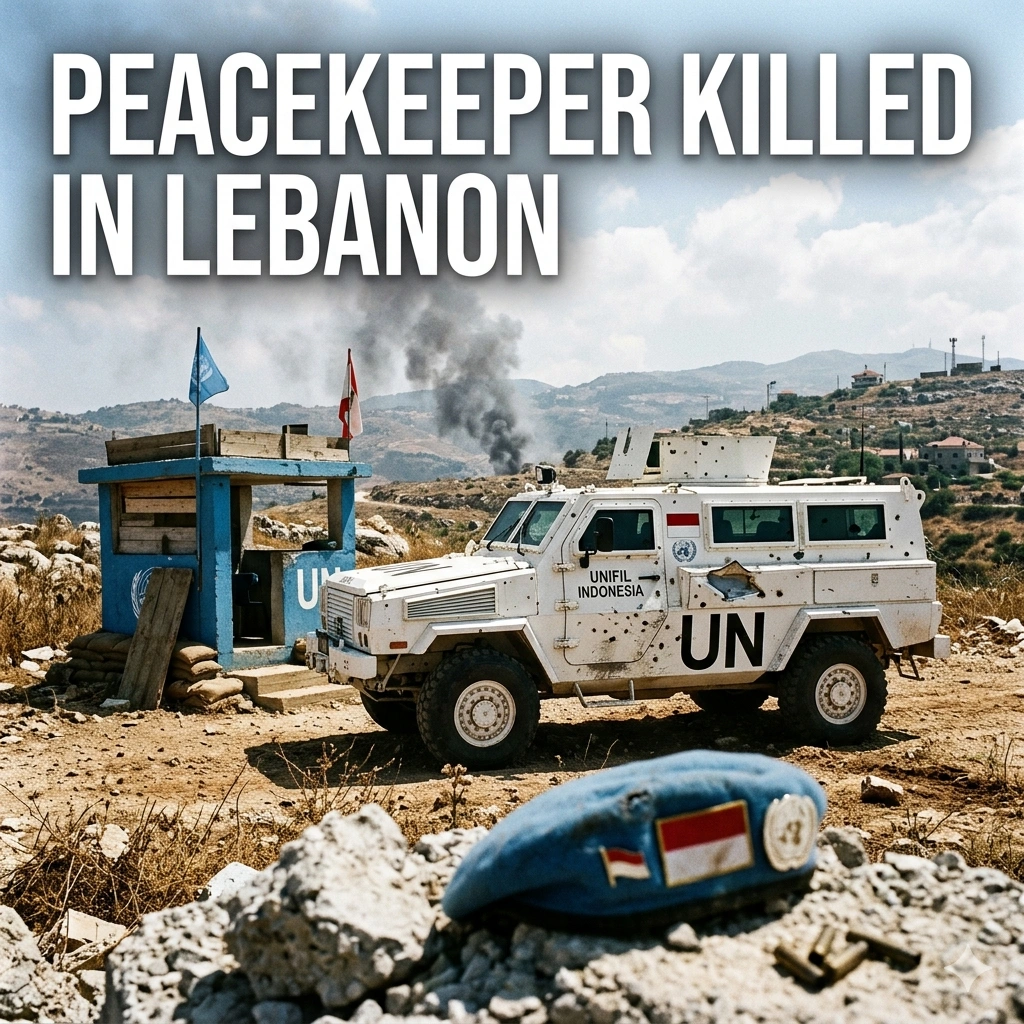
Indonesian peacekeeper killed
The sudden loss of life within the United Nations Interim Force in Lebanon has sent ripples of grief and anger across Jakarta and the wider diplomatic world. Reports confirm that the Indonesian peacekeeper killed in the line of duty was part of a mission intended to provide stability in a region long plagued by cyclical violence. Consequently, the Indonesian government is now re-evaluating its strategic deployment protocols to ensure that no more lives are lost to preventable artillery fire. Furthermore, the Indonesian Ambassador to the UN is currently engaged in emergency coordination meetings to address this breach of international law.
Military analysts suggest that the specific targeting of areas near UN positions indicates a dangerous shift in the rules of engagement currently being employed. Because an Indonesian peacekeeper killed during these strikes represents a violation of protected status, legal experts are calling for a formal war crimes investigation by international bodies. Meanwhile, the families of the victims are receiving support from the Ministry of Defense as the nation mourns its fallen hero. This incident highlights the extreme vulnerability of peacekeepers when caught between the heavy weaponry of modern state militaries and non-state actors.
The escalation of hostilities in Southern Lebanon has reached a point where even clearly marked international compounds are no longer treated as safe havens. Since the Indonesian peacekeeper killed was serving under the blue flag of the UN, this attack is viewed as a direct affront to the authority of the United Nations Security Council. Therefore, many nations are now questioning the effectiveness of current peacekeeping mandates in zones where high-intensity conflict is actively occurring. The international community must decide if these missions can continue without significantly enhanced defensive capabilities and clearer diplomatic safeguards.
Escalating Artillery Strikes in Southern Lebanon
The intensity of the bombardment in the southern border regions has increased significantly over the last forty-eight hours, leading to widespread civilian and military casualties. Following the news of the Indonesian peacekeeper killed, reports indicate that over 1,000 Lebanese civilians have also lost their lives in the current wave of violence. This massive scale of destruction suggests that the conflict is moving toward a total war scenario that could engulf neighboring countries. Consequently, the risk of a broader regional conflagration involving Iran and its allies has never been higher in recent years.
Strategic defense experts point out that the artillery used in these strikes possesses high precision, which raises difficult questions about the intent behind the hits on UNIFIL positions. While the Israeli military claims these are retaliatory measures against Hezbollah, the fact that an Indonesian peacekeeper killed by these shells occurred remains a point of intense international friction. As a result, the diplomatic pressure on Israel to modify its operational tactics is mounting from both Western and Eastern power blocs. The situation demands a cooling-off period that currently seems unlikely given the rhetoric from all sides.
International monitors have observed a steady buildup of heavy machinery along the border, signaling that the ground situation is likely to worsen before it improves. Because the Indonesian peacekeeper killed was stationed in a high-risk sector, other troop-contributing countries are now expressing similar concerns for their personnel. This collective anxiety could lead to a vacuum in peacekeeping if nations decide the risk to their citizens is too great to justify continued participation. Thus, the integrity of the entire UNIFIL mission is currently hanging in a very delicate balance.
Diplomatic Consequences for Regional Stability
The death of an Indonesian soldier on foreign soil has forced a hardline stance from the Indonesian government, which has traditionally sought a balanced diplomatic path. After the Indonesian peacekeeper killed was identified, Jakarta immediately summoned representatives to express its “strongest possible” protest against the disregard for international safety standards. This move signals a potential shift in how Southeast Asian nations interact with Middle Eastern conflicts, moving from passive observation to active diplomatic intervention. Moreover, the incident has galvanized public opinion in Indonesia, leading to widespread calls for justice and systemic change.
On the global stage, the Indonesian peacekeeper killed has become a symbol of the collateral damage inherent in the ongoing struggle between Hezbollah and the Israeli Defense Forces. Many members of the UN Security Council are now pushing for a new resolution that would provide stricter protections for peacekeepers in active combat zones. However, political gridlock remains a significant hurdle to achieving any meaningful consensus on the matter. Consequently, the diplomatic fallout is expected to persist for months as investigations into the specific circumstances of the strike continue to unfold.
Security analysts are particularly concerned that this tragedy will provide further justification for increased involvement by regional proxies. Since the Indonesian peacekeeper killed was a neutral party, his death is being used by various factions to bolster their respective narratives regarding the morality of the conflict. This politicization of a military tragedy often leads to further radicalization and a breakdown in the potential for ceasefire negotiations. Therefore, the immediate goal for international mediators is to decouple this specific incident from the broader ideological battle to prevent further bloodshed.
The Role of UNIFIL in Modern Conflicts
The United Nations Interim Force in Lebanon was established to maintain peace, but the environment it operates in has changed drastically since its inception. As the Indonesian peacekeeper killed in this recent strike illustrates, the “interim” nature of the force has become a permanent fixture in a perpetually unstable region. The mission is currently facing its greatest challenge yet as it attempts to mediate between two sides that show little interest in de-escalation. Furthermore, the lack of a robust mandate to use force in self-defense often leaves units like the Garuda Contingent in highly precarious positions.
- UNIFIL must update its technological surveillance to detect incoming threats more rapidly.
- Troop-contributing countries are demanding better armored infrastructure for all remote outposts.
- Communication channels between the UN and the Israeli military require immediate and transparent overhaul.
The Indonesian peacekeeper killed was part of a long tradition of Indonesian service to global peace, a role the country takes with immense pride. To honor this legacy, the UN must ensure that the conditions leading to such a tragedy are never allowed to repeat themselves. This includes establishing clear “no-fire zones” around international bases that are respected by all combatants regardless of the tactical situation. Without these changes, the credibility of the UN as a peacekeeping entity will continue to erode in the eyes of the world.
Impact on Indonesian Foreign Policy and Defense
Jakarta’s defense strategy has always emphasized the protection of its citizens abroad, whether they are migrant workers or elite military personnel. The news of the Indonesian peacekeeper killed has prompted a comprehensive review of how the nation participates in overseas UN missions. While Indonesia remains committed to global peace, the cost of participation is now being weighed against the safety of its soldiers in increasingly volatile theaters. Consequently, future deployments may come with much stricter requirements for ground-level security and air support.
Domestically, the Indonesian peacekeeper killed has united various political factions in a rare display of national solidarity and mourning. Leaders from across the political spectrum have joined the Ministry of Foreign Affairs in demanding that the perpetrators of the strike be held accountable under international law. This internal pressure is forcing the government to take a more assertive role in international forums, potentially leading to new alliances with other troop-contributing nations. The incident has essentially transformed a regional conflict into a core issue of Indonesian national interest.
Strategic planners in Jakarta are also looking at the technological lessons learned from this tragic event to better equip their forces. Because the Indonesian peacekeeper killed was a victim of long-range artillery, there is a clear need for better early-warning systems and anti-missile technologies for peacekeeping units. Investing in these areas will be a priority for the upcoming defense budget to ensure that the Garuda Contingent remains one of the most capable forces in the world. Ultimately, the goal is to ensure that Indonesian soldiers can fulfill their international obligations without being subjected to unnecessary or illegal risks.
Human Rights and International Law Violations
The legal framework governing the protection of UN personnel is clear, yet the Indonesian peacekeeper killed serves as a grim reminder that laws are often ignored in the heat of battle. Under the Geneva Conventions, intentional attacks on peacekeeping missions are classified as war crimes and are subject to prosecution by the International Criminal Court. The Indonesian government is currently gathering evidence to present a formal case, asserting that the artillery strike was not a simple accident. This legal battle will likely be long and complex, given the geopolitical sensitivities involved.
Human rights organizations have also weighed in, noting that the death of the Indonesian peacekeeper killed is just one part of a larger pattern of disregard for human life in the region. The continuous shelling of civilian infrastructure and the displacement of thousands have created a humanitarian crisis of epic proportions. Therefore, the call for an immediate ceasefire is not just a political necessity but a moral imperative to prevent further loss of innocent lives. The international community has a duty to uphold the rule of law, especially when it involves those who have volunteered to protect it.
- Legal teams are documenting the precise coordinates of the strike to prove proximity to UN markers.
- Testimonies from the three injured soldiers are being recorded for use in international tribunals.
- Satellite imagery is being analyzed to determine the exact origin of the artillery fire.
- International law experts are drafting a memo on the specific breaches of the UN Charter involved.
The pursuit of justice for the Indonesian peacekeeper killed is essential for maintaining the integrity of international norms. If such an act goes unpunished, it sets a dangerous precedent that UN personnel are “fair game” in modern warfare. This would effectively end the era of neutral peacekeeping, as no nation would be willing to send its troops into a zone where they have no legal or physical protection. The outcome of this specific case will therefore have lasting implications for global order and the safety of thousands of other peacekeepers worldwide.
Future of Peacekeeping in the Middle East
The Middle East remains the most challenging environment for UN operations, and the Indonesian peacekeeper killed has brought the mission’s future into sharp focus. As the conflict between Hezbollah and Israel continues to intensify, the space for neutral mediation is shrinking at an alarming rate. Many analysts believe that the current model of peacekeeping is outdated for the type of high-tech, high-intensity warfare being seen in 2026. Consequently, there are growing calls for a complete “reimagining” of what it means to keep the peace in a landscape dominated by drones and precision artillery.
One proposed solution is the implementation of a “Peace Enforcement” mandate, which would allow UN troops to actively defend their positions and nearby civilians. While this would be a radical departure from the traditional neutral stance, the death of the Indonesian peacekeeper killed suggests that neutrality is no longer a shield against modern weaponry. However, such a change would require a level of international cooperation that is currently lacking among the permanent members of the Security Council. For now, the mission must rely on existing protocols while hoping for a diplomatic breakthrough.
The legacy of the Indonesian peacekeeper killed will undoubtedly be one of sacrifice and a call to action for the global community. As Indonesia continues to mourn its fallen soldier, the world must reflect on the true cost of ongoing conflicts and the value of those who stand in the gap. The hope is that this tragedy serves as a catalyst for a renewed effort toward a lasting peace in Lebanon and the wider region. Only through genuine dialogue and a commitment to international law can we ensure that no more families have to receive the news of a loved one killed while serving the cause of peace.
Security Infrastructure for Peacekeeping Bases
Improving the physical security of UN outposts is now a top priority following the incident where an Indonesian peacekeeper killed by artillery fire exposed critical vulnerabilities. These bases were often designed for monitoring and observation rather than withstanding heavy bombardment from state-of-the-art military hardware. Consequently, there is an urgent need to upgrade bunkers and reinforced structures to provide better protection for the troops. This requires significant financial investment from the UN and its member states, many of whom are already facing budget constraints.
- Implementation of advanced radar systems to provide early warning of incoming artillery.
- Construction of deep-underground shelters for personnel during active shelling events.
- Deployment of mobile medical units to provide immediate care for injured soldiers on-site.
The tragedy of the Indonesian peacekeeper killed has shown that even the most experienced soldiers are at the mercy of their environment if the infrastructure is insufficient. Therefore, the Indonesian military is considering providing its own supplementary equipment to its contingents abroad to ensure they have the best possible protection. This proactive approach could serve as a model for other nations that contribute troops to high-risk missions. In the end, the safety of the soldiers must be the primary consideration in every aspect of mission planning.
Global Response to the UNIFIL Tragedy
The reaction from world capitals has been one of near-universal condemnation, yet the path to a resolution remains blocked by competing interests. When the news broke that an Indonesian peacekeeper killed in the strike was a member of the Garuda Contingent, leaders from the EU to the AU expressed their solidarity with Jakarta. These statements often emphasize the need for a “full and transparent investigation” into the events of March 28. However, without a neutral third party to lead such an inquiry, many fear the truth of what happened may be obscured by military propaganda.
Social media and global news outlets have kept the story of the Indonesian peacekeeper killed at the forefront of the public consciousness, driving a demand for diplomatic action. This public pressure is vital in ensuring that the incident is not simply forgotten as another statistic in a long-running war. Because the victim was part of an international mission, his death has a resonance that transcends national borders, reminding everyone of the shared risks of global instability. The ongoing media coverage also serves to hold the involved military forces accountable for their actions in the eyes of the global public.
As we look toward the coming weeks, the focus will remain on whether the rhetoric of condemnation translates into actual policy changes on the ground. The death of the Indonesian peacekeeper killed must lead to more than just speeches; it must lead to a tangible improvement in the security and status of all international peacekeepers. If the world fails to act now, it risks the total collapse of the UN’s ability to intervene in conflicts before they spiral into global catastrophes. The time for decisive action is now, for the sake of those who continue to serve in the face of such extreme danger.
For more details & sources visit: Gotrade
Read more about Indonesia news on 360 News Orbit – Indonesia.