
The Indian bond yields hit their most significant quarterly spike in four years this March, sending ripples of concern through the nation’s financial corridors. As the fiscal year 2025-2026 comes to a volatile close, the benchmark 10-year government bond has become a focal point for investors grappling with a destabilized global energy market. This surge is not merely a local fluctuation but a direct consequence of the escalating conflict in the Middle East, which has fundamentally altered inflation expectations. Market participants are now bracing for a new era of higher borrowing costs as the financial landscape shifts under the weight of geopolitical tension.
Recent data indicates that the Indian bond yields hit a staggering 6.9451% on the final trading day, capping a quarter defined by a 35-basis-point jump. This represents the steepest rise since the central bank’s aggressive rate-hiking cycle began four years ago, catching many institutional traders off guard. The primary catalyst remains the unprecedented 60% monthly spike in Brent crude prices, triggered by the closure of the Strait of Hormuz. As a nation that imports the vast majority of its energy needs, India is uniquely vulnerable to these external shocks, which threaten to derail its post-pandemic recovery.
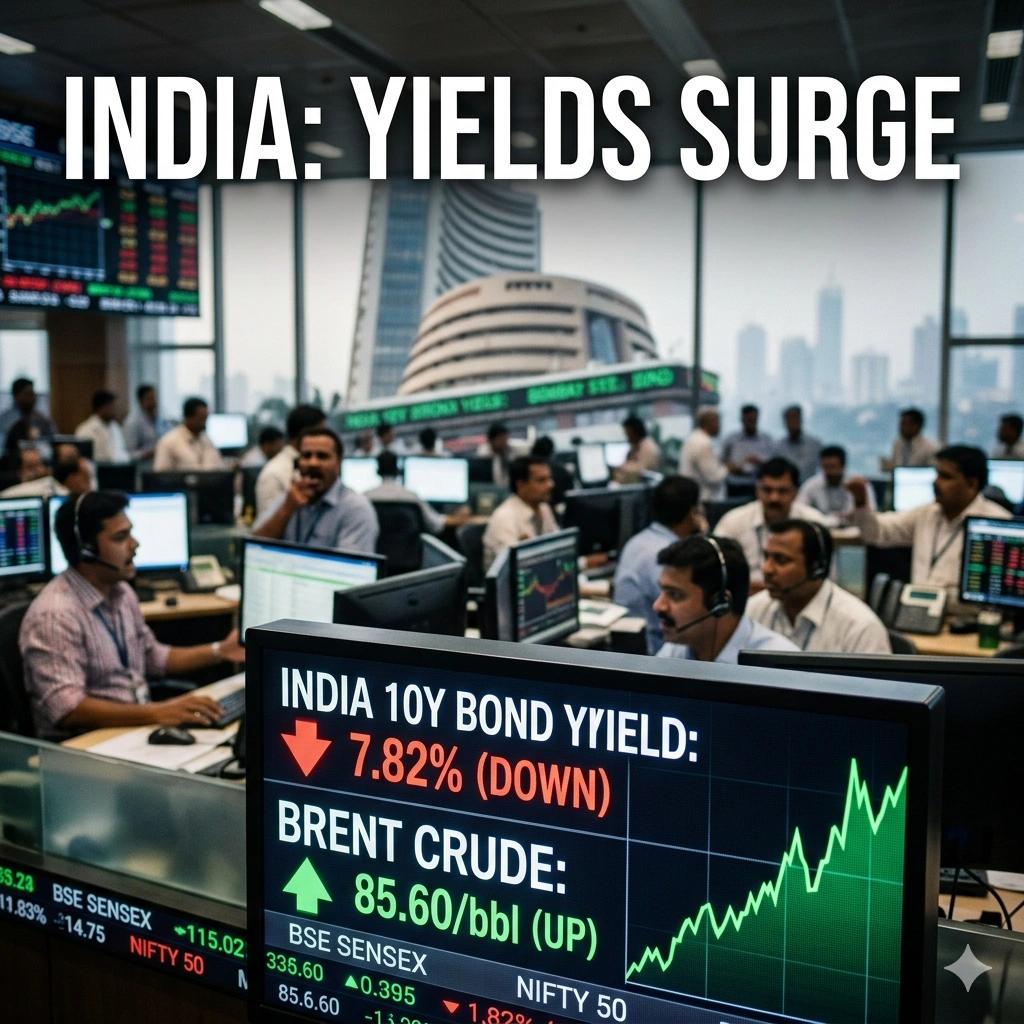
Indian bond yields hit
The Indian bond yields hit a four-year quarterly peak primarily because of the “unprecedented” escalation in the Middle East, which mirrors the oil shocks of the 1990s. For a country like India, which is the world’s third-largest crude importer, the cost of oil is the single most important variable in determining domestic inflation. When the Strait of Hormuz closed in February 2026, the supply chain for Middle Eastern crude was effectively severed, sending Brent prices into a vertical ascent. This energy crisis has forced bond investors to demand higher yields to compensate for the eroding purchasing power of the Rupee.
The Indian bond yields hit also reflects a shift in global “carry trade” dynamics, as rising yields in developed markets attract capital away from emerging economies. As US and European central banks respond to their own inflation crises, the yield differential that previously favored Indian debt has narrowed significantly. This capital flight puts additional pressure on the Reserve Bank of India to raise domestic rates, further pushing up the benchmark 10-year yield. The interplay between domestic energy costs and global capital flows has created a “perfect storm” for the Indian debt market at the start of the 2026-2027 fiscal year.
- Benchmark Status: The 10-year bond is the primary indicator of the government’s borrowing cost.
- Quarterly Jump: A 35-basis-point rise is the largest since the 2022 inflationary spike.
- Global Context: Indian yields are tracking the 60% rise in Brent crude prices.
State-run banks, which are the largest buyers of government securities, are the first to feel the pain when the Indian bond yields hit these multi-year highs. Their treasury departments, which often rely on stable bond prices to bolster quarterly earnings, are now facing the prospect of “haircuts” on their holdings. This reduction in bank profitability can lead to tighter lending standards for the private sector, creating a secondary drag on economic growth. The government is monitoring these developments closely, as a healthy banking sector is vital for its ambitious infrastructure spending plans.
Impact of the Strait of Hormuz Closure
The closure of the Strait of Hormuz is the “black swan” event that triggered the Indian bond yields hit seen in late March. Since over 30% of the world’s seaborne oil passes through this narrow waterway, any military disruption leads to an immediate and violent price reaction. For Indian refineries, the closure meant finding alternative, much more expensive routes for crude delivery, or tapping into strategic reserves. The uncertainty regarding when the strait might reopen has added a “risk premium” to Indian bonds that shows no signs of dissipating.
This maritime blockade has also impacted the broader logistics and freight industry, contributing to the Indian bond yields hit by raising the cost of all imported goods. Inflation is no longer just about fuel; it is now about the cost of electronics, chemicals, and fertilizers that rely on global shipping lanes. As these costs are passed on to Indian consumers, the Consumer Price Index (CPI) is projected to stay well above the central bank’s comfort zone. Bond traders, who are essentially “inflation hawks,” react to this data by selling off long-term debt, driving yields even higher.
Government Borrowing and Market Sentiment
In a bid to counteract the Indian bond yields hit, the Indian Finance Ministry announced a strategic reduction in its borrowing plan for the first half of the new fiscal year. By signaling that the government would issue fewer bonds, they hoped to increase demand for existing securities and lower the yields. However, this “dovish” surprise was short-lived, as the relentless rise in oil prices proved to be a much stronger market force. Investors remain skeptical that the government can stick to its lower borrowing targets if energy subsidies need to be increased to protect the public.
The “bearish” sentiment in the market is further fueled by the expectation that the Indian bond yields hit is just the beginning of a longer upward trend. Many veteran traders believe that the “new normal” for the 10-year yield will be above 7.2% if the Middle East conflict enters a prolonged stalemate. This shift in expectations has led to a “wait and see” approach among foreign portfolio investors, who have slowed their purchases of Indian debt. Without a steady stream of foreign capital, the domestic market must absorb the government’s debt, putting more upward pressure on the yield curve.
- H1 Borrowing Goal: Lowered to signal fiscal prudence amidst the energy crisis.
- Yield Breach: Market expects the 7% psychological barrier to fall on Tuesday.
- Fiscal Deficit: Concerns grow that high oil will widen the gap despite lower borrowing.
Inflation Fears and the Reserve Bank of India
The Indian bond yields hit is a direct message to the Reserve Bank of India (RBI) that the market expects a more aggressive stance on inflation. While the central bank has tried to maintain an “accommodative” stance to support growth, the 60% spike in oil makes that position increasingly untenable. If the RBI does not raise the repo rate soon, the Rupee could face a significant devaluation against the US Dollar, further exacerbating the cost of imports. This “monetary dilemma” is a primary reason why bond yields have remained so volatile in the final week of March.
Core inflation, which excludes volatile food and energy prices, is also beginning to creep upward as the “secondary effects” of high oil prices filter through the economy. Manufacturers are raising prices for everything from cement to consumer durables to offset their rising energy and transport bills. When the Indian bond yields hit their quarterly high, it was a reflection of the market pricing in at least two more rate hikes in the 2026 calendar year. This hawkish outlook is now the baseline for all major domestic brokerage houses and investment banks.
Treasury Profits and State-Run Banks
The Indian bond yields hit has created a significant “valuation risk” for the banking sector, particularly for public sector banks (PSBs). These institutions are required to hold a certain percentage of their deposits in government bonds (the Statutory Liquidity Ratio), making them highly sensitive to yield movements. A 35-basis-point rise in a single quarter can lead to billions in paper losses, which must be accounted for in their year-end balance sheets. This “treasury hit” could limit the ability of these banks to pay dividends or invest in technology upgrades.
- Mark-to-Market (MTM): Banks must revalue their bond portfolios at current market prices, leading to losses.
- Capital Adequacy: Falling bond prices can lower a bank’s capital ratios, attracting regulatory scrutiny.
- Lending Rates: High government bond yields often lead to higher interest rates for home and car loans.
Furthermore, the Indian bond yields hit means that the government itself must pay more to service its massive national debt. Every basis point increase in the yield adds thousands of crores to the interest payment burden of the federal budget. This diverts funds away from essential services like healthcare, education, and rural development, creating a long-term drag on social welfare. The “vicious cycle” of high oil, high inflation, and high yields is the greatest challenge facing Indian economic planners as they enter the second quarter of 2026.
Comparison to the 1990 Gulf War Shock
Economic historians are drawing parallels between the current Indian bond yields hit and the shock of the 1990 Gulf War. In both instances, a sudden disruption in Middle Eastern supply led to a vertical spike in oil prices and a subsequent crisis in India’s balance of payments. However, unlike in 1990, India now has much larger foreign exchange reserves and a more diversified economy. Despite these strengths, the sheer scale of the 60% monthly oil price jump is testing the limits of India’s modern financial infrastructure and its ability to absorb external shocks.
The Indian bond yields hit is actually more severe in some ways than previous crises because of the higher level of global financial integration today. High-frequency trading and algorithmic selling can accelerate a market downturn in seconds, making it harder for the central bank to manage the “narrative.” The “velocity” of the current yield spike is what has most analysts concerned, as it leaves very little time for businesses to adjust their Capex plans. In 1990, the reaction was slower; in 2026, the market prices in the end of the world before the first missile has even landed.
Domestic Demand vs Global Volatility
While the Indian bond yields hit is a cause for concern, the underlying domestic demand in the Indian economy remains remarkably resilient. Urban consumption, GST collections, and digital transaction volumes continue to show strong year-on-year growth despite the high interest rates. This internal strength is what prevents the bond market from entering a total freefall. If the Middle East conflict is resolved quickly, the Indian bond yields hit could be reversed just as fast as it began, leading to a “relief rally” in the summer of 2026.
- GST Collections: Remain at record highs, providing a buffer for the federal budget.
- Digital Economy: Fintech growth continues to drive efficiency and lower costs for small businesses.
- Reserves: India’s US$700 billion forex reserve is a powerful tool for stabilizing the Rupee.
However, the “wait and see” period for the Indian bond yields hit is proving to be a long and expensive one for the corporate sector. Large infrastructure projects that require long-term debt are being put on hold as CFOs wait for a more stable interest rate environment. This delay in capital expenditure could lead to a “growth vacuum” in late 2026 if the yields do not stabilize soon. Balancing the needs of a growing population with the realities of a global energy war is the defining economic task of the current administration.
Looking Ahead: The 7% Yield Milestone
All eyes are now on the Tuesday market opening, where the Indian bond yields hit is expected to cross the 7% threshold for the first time in years. This level is more than just a number; it is a psychological barrier that often triggers “stop-loss” selling by large funds. If the yield stays above 7% for a sustained period, it will signal a fundamental repricing of risk in the Indian economy. Investors will be looking for a strong statement from the Finance Ministry to provide a “floor” for bond prices and prevent a disorderly exit of capital.
The Indian bond yields hit will also influence the upcoming municipal and state-level elections, as the cost of living becomes a central political issue. Higher yields lead to higher EMI payments for the middle class, while high oil prices lead to more expensive food for the poor. The government’s ability to manage these “twin pressures” will determine its political capital heading into the second half of the decade. As the world watches the Middle East, the Indian bond market remains the most sensitive barometer of the true cost of global conflict.
For more details & sources visit: Business Recorder
Read more about India news on 360 News Orbit – India.