
Lebanon Updates: Syrian Military Discovers and Seals Strategic Smuggling Tunnel on Lebanese Border. Syrian defense officials have shut down a cross-border tunnel near Homs, which was allegedly being used by Lebanese militias for smuggling operations. The discovery highlights ongoing efforts by the post-Assad government to sever old militant supply lines and secure the historically porous border. A defense ministry official in Syria confirmed the discovery of a tunnel connecting Syrian territory to Lebanon near the village of Hosh Al-Sayyid Ali. The tunnel, located west of Homs, was reportedly utilized by “Lebanese militias”—a term often associated with the Iran-backed group Hezbollah—to bypass official border controls.
Since the overthrow of Bashar Assad in December 2024, the new Islamist coalition in Syria has remained hostile toward the Shia movement, leading to a concerted effort to dismantle Hezbollah’s traditional supply routes. The eastern border of Lebanon remains a stronghold for Hezbollah, which is currently engaged in active conflict with Israel. For years, the group relied on Syrian territory for logistical support; however, the shift in Syrian leadership has left their supply chains increasingly vulnerable. Both Syrian and Lebanese authorities are now intensifying operations to combat smuggling, seeking to stabilize a border region that has seen decades of irregular movement. Military units involved in the operation confirmed the tunnel has been completely sealed to prevent further transit.
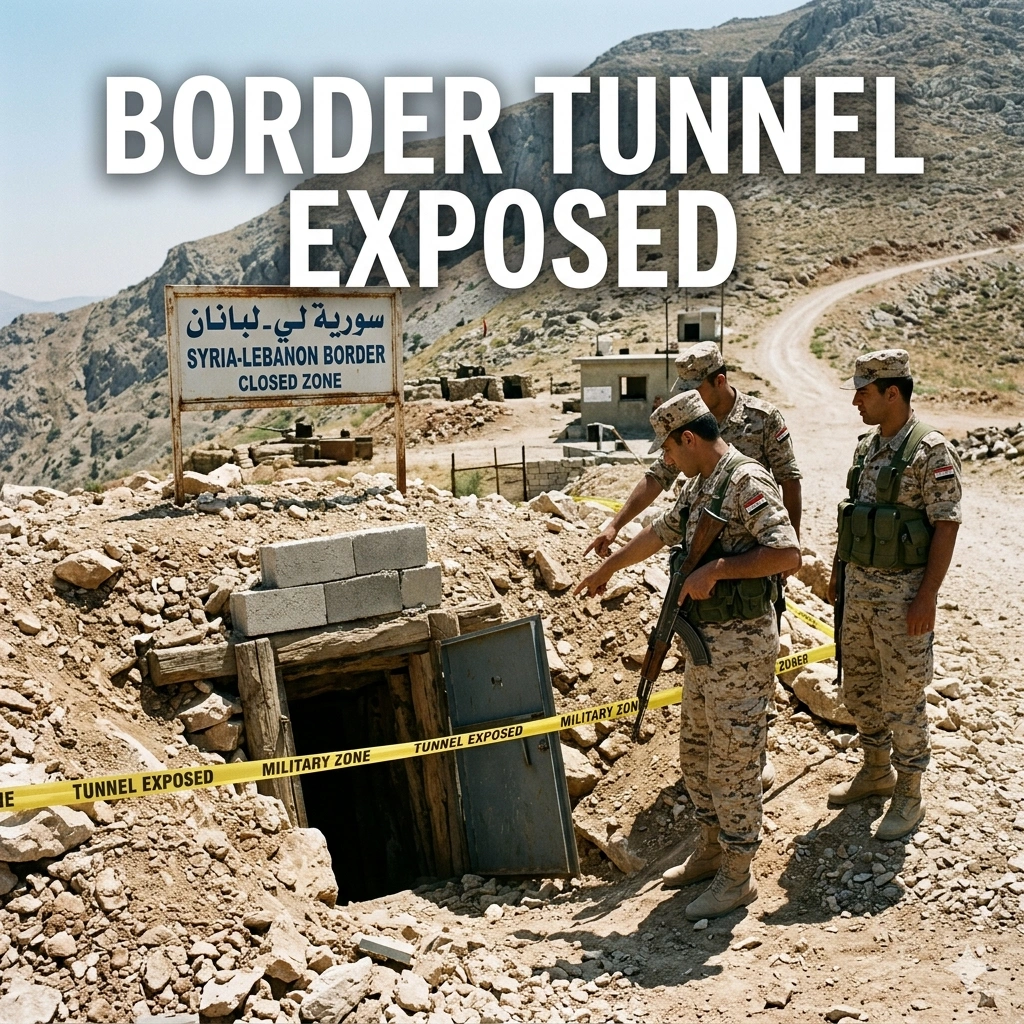
Lebanese Border Security Crisis
Lebanese Border Security has become a central focus for regional military planners as the post-Assad administration in Syria takes drastic measures. The discovery of a sophisticated smuggling tunnel near Hosh Al-Sayyid Ali marks a significant escalation in efforts to isolate militant groups. By sealing this strategic artery, the Syrian defense ministry is sending a clear message that the days of unchecked transit are officially over.
The geopolitical shift in Damascus has fundamentally altered the Lebanese Border Security landscape, forcing groups like Hezbollah to rethink their logistics. This specific tunnel was a vital link for moving hardware and personnel away from the prying eyes of international monitors and aerial surveillance. Its destruction represents a major blow to the “Resistance Axis” that once operated with total impunity across the Homs corridor.
Maintaining Lebanese Border Security is now a shared priority for the new Syrian leadership and Lebanese state forces. Both sides recognize that a porous border invites instability and allows non-state actors to undermine national sovereignty. As military units continue to patrol the rugged terrain, more of these hidden paths are expected to be uncovered and permanently disabled.
Hezbollah Supply Chain Vulnerability
The current Hezbollah supply chain vulnerability is at an all-time high following the collapse of the previous Syrian regime. For decades, the group enjoyed a “land bridge” that stretched from Tehran through Baghdad and Damascus into Beirut. However, the new Islamist coalition in Syria has proven to be a hostile gatekeeper, systematically dismantling the infrastructure that supported this vast network.
Recent military operations near Homs highlight how Lebanese Border Security measures are specifically targeting these clandestine routes. Without the cover of a friendly Syrian government, the group must rely on increasingly dangerous and exposed paths to move essential supplies. This Hezbollah supply chain vulnerability is being exploited by regional adversaries who seek to weaken the group’s combat effectiveness in Southern Lebanon.
Tactical experts suggest that the loss of the Hosh Al-Sayyid Ali tunnel will force militants to use official crossings, where they are much easier to monitor. The tightening grip of the Syrian military ensures that the Lebanese Border Security environment remains restrictive for those who previously ignored state authority. The strategic depth that Syria once provided to Lebanese militias has effectively vanished in the spring of 2026.
Post-Assad Syria Foreign Policy
The post-Assad Syria foreign policy is characterized by a radical departure from the alignment with Iran and its regional proxies. The new governing coalition in Damascus is prioritizing national integrity and the removal of foreign militant influence from its soil. This shift is most visible in the aggressive patrolling of the Lebanese border and the destruction of smuggling infrastructure.
Under this new post-Assad Syria foreign policy, the government views Lebanese militias as a threat to internal stability rather than strategic allies. By sealing the Homs tunnel, Syria is aligning itself more closely with regional powers that seek to contain the spread of Shia militant influence. This realignment has created a new security architecture in the Levant that prioritizes state-to-state relations over militia patronage.
Diplomats note that the decision to prioritize Lebanese Border Security is a key component of Syria’s bid for international legitimacy. By demonstrating that it can control its borders and stop the flow of illegal arms, the new government hopes to attract investment and aid. The destruction of the tunnel is as much a political statement as it is a military necessity.
Homs and the Smuggling Corridor
The region of Homs has historically served as the primary smuggling corridor between Syria and Lebanon due to its geography. The village of Hosh Al-Sayyid Ali is situated in a location that allows for easy transit through rural landscapes and mountain passes. This natural advantage was exploited for years by various groups seeking to bypass Lebanese Border Security.
With the Syrian military now occupying these strategic points, the Homs corridor is being transformed into a high-security zone. The discovery of the tunnel confirms that the “old ways” of doing business are being met with modern surveillance and engineering solutions. Every tunnel sealed is a step toward ending the lawlessness that has plagued this border region for a generation.
Local residents in Hosh Al-Sayyid Ali have reported a massive increase in military activity as the government conducts house-to-house searches for additional shafts. This focus on the Homs area is essential because it remains the most direct route to Hezbollah’s strongholds in the Bekaa Valley. Securing this sector is the linchpin of the broader Lebanese Border Security strategy.
Impact on Regional Conflict Dynamics
The sealing of the Hosh Al-Sayyid Ali tunnel has immediate implications for the regional conflict dynamics involving Israel and Lebanon. As Hezbollah finds its northern supply routes blocked, its ability to sustain a prolonged conflict in the south is significantly diminished. This change in Lebanese Border Security directly impacts the group’s inventory of precision-guided munitions and specialized personnel.
Syria’s proactive stance is altering the math for regional planners who previously assumed the Syrian-Lebanese border was a safe haven. The isolation of Lebanese militias is a goal shared by many, and the new Syrian government is delivering results that the international community has desired for years. These actions are reshaping the balance of power in the Middle East in real-time.
Furthermore, the tension between the Syrian military and Lebanese militias could lead to localized skirmishes along the border. As the state reasserts its authority over Lebanese Border Security, the risk of “militia-state” friction increases. This internal conflict within the old “resistance” alliance is a defining feature of the 2026 geopolitical landscape.
Technical Aspects of Tunnel Interdiction
The Syrian military utilized advanced ground-penetrating radar to locate the tunnel near the Lebanese border. This technical approach to Lebanese Border Security allows for the discovery of deep-underground structures that were previously undetectable. Once the location was confirmed, combat engineers used industrial explosives and concrete to permanently seal the passage.
Interdicting such structures requires specialized knowledge of the local geology and the construction techniques used by the militias. The Hosh Al-Sayyid Ali tunnel was reportedly reinforced with concrete and equipped with lighting and ventilation systems. This level of sophistication indicates that it was a long-term project designed for heavy-duty Lebanese Border Security circumvention.
Future operations will likely involve the use of seismic sensors to monitor for any new excavation attempts by the militias. The Syrian defense ministry has stated that it will spare no expense in maintaining the integrity of its frontier. This high-tech approach is a significant upgrade from the manual border patrols of the past, making the Lebanese Border Security net much tighter.
Humanitarian and Economic Consequences
The crackdown on smuggling routes has both humanitarian and economic consequences for the communities living along the border. Many families in Hosh Al-Sayyid Ali and neighboring Lebanese villages relied on informal trade for their livelihoods. The sudden enforcement of strict Lebanese Border Security has disrupted these local economies, leading to calls for increased government aid.
From a humanitarian perspective, the closure of these routes prevents the unregulated movement of people, which was often exploited by traffickers. While it complicates the lives of locals, it also protects the region from the spillover of militant violence. Balancing Lebanese Border Security with the needs of the local populace is a challenge that both Beirut and Damascus must address.
Economic stabilization projects are being planned to replace the “smuggling economy” with legitimate trade and agricultural development. By investing in the Homs region, the Syrian government hopes to create a loyal civilian base that will assist in maintaining Lebanese Border Security. These social initiatives are as important as the military tunnels in ensuring long-term peace.
Coordination Between Beirut and Damascus
Effective Lebanese Border Security requires a high degree of coordination between the authorities in Beirut and the new administration in Damascus. Despite the political complexities, military-to-military communication has improved as both sides face common threats from non-state actors. This collaborative spirit is essential for managing a border that is over 300 kilometers long.
Joint patrols and shared intelligence are becoming more frequent, particularly in the rugged terrain where tunnels are most likely to be hidden. The successful operation near Homs was reportedly aided by tip-offs from Lebanese intelligence, highlighting the synergy in current Lebanese Border Security efforts. This cooperation is a departure from the one-sided dominance seen during the Assad era.
Regular meetings between border guard commanders are now a standard part of the security protocol. They discuss everything from illegal migration to the movement of narcotics, creating a comprehensive approach to Lebanese Border Security. This united front is the best deterrent against those who wish to return to the era of porous and lawless borders.
Future Projections for Border Stability
The future of regional stability depends on the sustained enforcement of Lebanese Border Security over the coming years. If the Syrian government can maintain its current pressure on smuggling routes, the influence of regional militias will continue to wane. This would pave the way for a more normalized and peaceful relationship between Syria and Lebanon.
Analysts predict that the militias will attempt to find new ways to bypass the Lebanese Border Security measures, possibly by moving further north or using maritime routes. Therefore, the security forces must remain adaptive and continue to invest in new surveillance technologies. The victory at the Hosh Al-Sayyid Ali tunnel is just one battle in a much longer campaign for territorial control.
As the post-Assad government consolidates its power, its ability to secure the border will only grow. The ultimate goal is a border that is open for legal trade and tourism but closed to the tools of war. This vision for Lebanese Border Security is a cornerstone of the new Middle East that is emerging in 2026.
Strategic Role of the Post-Assad Military
The post-Assad military has reinvented itself as a professional force focused on border integrity and internal security. By prioritizing Lebanese Border Security, the army is distancing itself from the sectarian conflicts of the past. This new focus is helping to rebuild the national identity of the Syrian armed forces as a true protector of the people.
Units stationed in Homs are receiving specialized training in counter-tunneling and mountain warfare. These elite squads are the primary tool for maintaining Lebanese Border Security in the most difficult environments. Their success in sealing the cross-border tunnel has boosted morale and demonstrated their capability to both domestic and international audiences.
The transformation of the military is a key part of the broader transition toward a stable Syrian state. As the army becomes more effective at Lebanese Border Security, the need for foreign military intervention decreases. This self-reliance is essential for the long-term sovereignty and dignity of the Syrian nation.
Deterring International Arms Trafficking
A primary objective of the Lebanese Border Security initiative is to deter the international trafficking of advanced weaponry. The tunnels were often used to transport missiles and drone components that are now being used in regional conflicts. By cutting these lines, Syria is contributing to a reduction in the overall level of violence in the Levant.
International monitoring groups have praised the discovery of the Homs tunnel as a win for global non-proliferation efforts. The strict Lebanese Border Security measures make it much harder for state sponsors of terrorism to deliver their lethal aid to local proxies. This disruption is a vital component of the international strategy to stabilize the Middle East.
Ongoing investigations are being conducted to identify the sources of the materials found within the tunnel. This intelligence will be shared with global partners to further squeeze the logistics of the militant groups. The battle for Lebanese Border Security is thus linked to the global effort to combat illegal arms sales.
Civil-Military Relations in Border Towns
Improving civil-military relations in border towns like Hosh Al-Sayyid Ali is crucial for the success of Lebanese Border Security. The military is working to build trust with the local population by providing security and infrastructure support. When the people see the army as a partner rather than an occupier, they are more likely to report illegal activities like tunnel construction.
Community outreach programs have been established to explain the benefits of Lebanese Border Security to the residents. These programs focus on the long-term economic gains of having a stable and secure border. This “hearts and minds” campaign is a vital supplement to the kinetic operations being conducted by the troops.
The government is also providing compensation for any property damage caused during the search for tunnels. This fairness in dealing with the public is a hallmark of the new Syrian administration’s approach. A cooperative local population is the best form of human intelligence for maintaining Lebanese Border Security.
Use of Surveillance Drones and AI
The Syrian defense ministry has deployed a fleet of surveillance drones to monitor the Lebanese border in real-time. These drones are equipped with thermal imaging and AI-driven movement detection to spot any irregular activity. This technology-driven approach is a force multiplier for Lebanese Border Security, allowing a smaller number of troops to cover larger areas.
The AI systems can distinguish between normal agricultural activity and the suspicious movement of people or goods. When an anomaly is detected, ground units are dispatched immediately to investigate, as was the case with the Homs tunnel. This proactive Lebanese Border Security model is significantly more efficient than the old system of static checkpoints.
Investments in these technologies are being supported by regional allies who share Syria’s interest in a stable border. The data collected by these systems is also used to map out potential new tunnel locations based on historical patterns. The future of Lebanese Border Security is clearly digital and data-driven.
Conclusion and National Security Outlook
In conclusion, the sealing of the strategic smuggling tunnel near the Homs border is a triumph for Lebanese Border Security. It represents the successful implementation of the post-Assad Syria foreign policy and a commitment to regional stability. The isolation of Lebanese militias is a necessary step toward ending the cycle of proxy wars in the Levant.
The road to a completely secure border is long, but the progress made in Hosh Al-Sayyid Ali provides a clear blueprint for success. By combining high-tech surveillance with professional military operations, Syria and Lebanon can protect their sovereignty. Lebanese Border Security remains the top priority for both nations as they navigate the challenges of 2026.
As the international community watches, the new leadership in Damascus is proving that it can be a responsible actor on the world stage. Every tunnel that is found and filled is a brick in the wall of a new, more peaceful Middle East. The commitment to Lebanese Border Security is unwavering, and the results speak for themselves.
The Lebanese Border Security initiative has successfully dismantled a major militant artery today. No longer can Lebanese militias expect easy transit through Syrian soil as the state reclaims its rightful authority. Stability, sovereignty, and security are the new watchwords for this transformed and vital border region.
For more details & sources visit: Arab News
Read more on global developments: 360 News Orbit – Extended Orbit