
Italy Economic Resilience 2026 remains a cornerstone of the Mediterranean nation’s fiscal strategy as it navigates a complex global landscape. Economy Minister Giancarlo Giorgetti addressed a high-level finance conference in Cernobbio, asserting that the nation’s financial infrastructure is robust enough to withstand external shocks. This declaration comes at a critical time as geopolitical instability in the Middle East threatens to disrupt global energy markets and trade routes.
The minister’s confidence in Italy Economic Resilience 2026 is rooted in the steady performance of national indicators despite these external pressures. While many European neighbors are struggling with stagnation, Italy has maintained a position of relative strength that allows for a more flexible budgetary approach. This stability is essential for the government’s plan to reassure international investors and maintain a favorable credit rating during turbulent times.
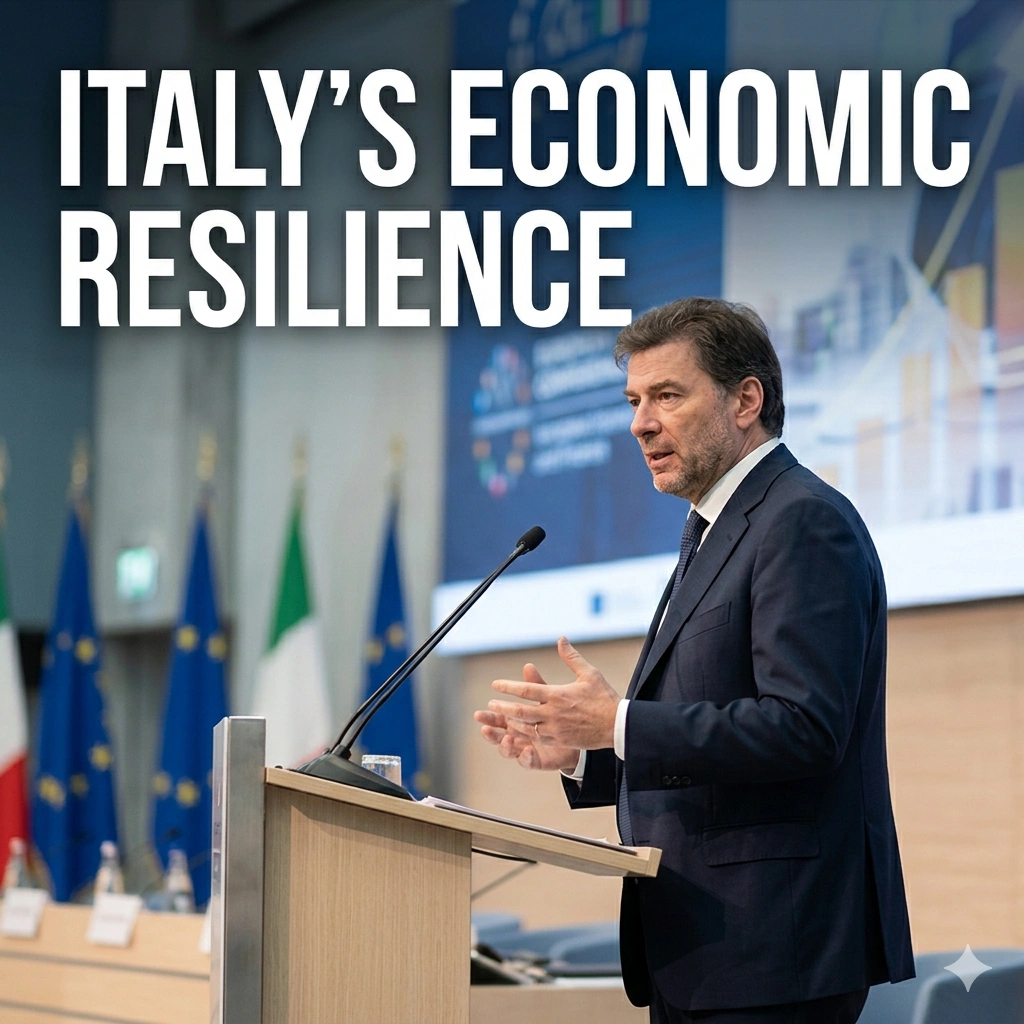
Italy Economic Resilience 2026
The concept of Italy Economic Resilience 2026 is centered on the government’s ability to decouple domestic fiscal health from volatile international events. Minister Giorgetti emphasized that while the Middle East crisis presents a clear risk to energy prices, the Italian state finances are prepared to absorb these costs. This proactive stance is intended to prevent a repeat of the inflationary spikes seen in previous years.
To bolster Italy Economic Resilience 2026, the Ministry of Economy and Finance is working closely with ISTAT to finalize the 2025 deficit figures. Early indications suggest the deficit could be revised downward from 3.1% to 3.0% of the national output. Such a technical adjustment is significant because it meets the European Union’s threshold for fiscal responsibility, potentially removing Italy from strict oversight.
Furthermore, Italy Economic Resilience 2026 is supported by a diversified industrial base that has proven adaptable to changing market demands. From high-end manufacturing to the resurgent tourism sector, the Italian economy is not dependent on a single industry. This diversity acts as a natural hedge against specific sector downturns, ensuring that the broader economy remains on a path of gradual but consistent growth.
Navigating Geopolitical Uncertainty
The ongoing crisis in the Middle East has cast a shadow over European growth, yet Italy Economic Resilience 2026 remains a beacon of stability. Giorgetti noted that while the situation is concerning, the Italian energy grid has been significantly modernized to handle supply chain disruptions. This shift away from high-risk energy dependencies is a key component of the nation’s long-term economic security strategy.
Another factor supporting Italy Economic Resilience 2026 is the strategic use of National Recovery and Resilience Plan (PNRR) funds. These European investments are being channeled into infrastructure and digitalization projects that enhance productivity. By modernizing the state apparatus, Italy is making it easier for businesses to operate efficiently, even when global trade conditions are less than ideal.
The government’s communication strategy also plays a role in maintaining Italy Economic Resilience 2026. By providing transparent and frequent updates on fiscal targets, the treasury reduces market speculation. This clarity is vital for maintaining low bond spreads, which in turn lowers the cost of servicing Italy’s substantial national debt and frees up capital for social programs.
Revised Growth Estimates for 2026
As part of the broader Italy Economic Resilience 2026 framework, the government is preparing to release updated GDP forecasts. Current estimates suggest a growth rate of approximately 0.5% to 0.6% for the current year. While these figures are slightly lower than the optimistic targets set in late 2025, they still represent positive territory in a challenging environment.
These conservative estimates are a hallmark of Italy Economic Resilience 2026, as the government prefers to under-promise and over-deliver. By setting realistic benchmarks, Giorgetti ensures that the budget remains balanced even if external conditions worsen. The 2027 outlook is slightly more favorable, with growth expected to climb to 0.7% as new stimulus measures take full effect.
- Updated GDP growth forecast for 2026 sits at 0.6%.
- Deficit reduction target remains focused on the 3.0% threshold.
- Debt-to-GDP ratio is expected to stabilize by the end of the fiscal year.
- Employment rates in the northern industrial hubs continue to show strength.
These metrics provide a data-driven foundation for Italy Economic Resilience 2026. By focusing on sustainable growth rather than short-term spikes, the government is building a more durable economic model. This approach is designed to protect the purchasing power of Italian households while encouraging long-term business investment across the peninsula.
Impact of EU Deficit Procedures
Exiting the EU’s excessive deficit procedure is a top priority for maintaining Italy Economic Resilience 2026. Being under this procedure limits the government’s ability to implement independent fiscal policies and increases the scrutiny from Brussels. A successful exit would signal to the world that Italy has regained full control over its financial destiny and is a safe harbor for capital.
The path to achieving this goal involves rigorous cost-cutting and revenue optimization, which are central themes of Italy Economic Resilience 2026. Minister Giorgetti has been clear that “unproductive spending” will be eliminated to make room for strategic investments. This disciplined approach is earning praise from European regulators who were previously skeptical of Italy’s fiscal trajectory.
If ISTAT confirms the 3.0% deficit figure, the transition will be significantly smoother. This development would bolster Italy Economic Resilience 2026 by lowering the perceived risk of Italian sovereign debt. As a result, the government would spend less on interest payments, allowing those billions of euros to be redirected toward healthcare, education, and energy subsidies for the most vulnerable citizens.
Stimulus Measures and Household Support
A key pillar of Italy Economic Resilience 2026 is the planned introduction of new stimulus measures by April 10. These interventions are designed to shield businesses and families from the rising costs of living. By providing targeted relief, the government ensures that domestic consumption—a major driver of GDP—does not collapse under the weight of high energy prices.
These measures are carefully integrated into the Italy Economic Resilience 2026 strategy to ensure they do not blow a hole in the budget. The funding for these programs often comes from windfall taxes on energy companies or the reallocation of underutilized state funds. This “budget-neutral” approach allows for social support without increasing the national deficit.
- Direct energy subsidies for low-income households and pensioners.
- Tax credits for small and medium-sized enterprises (SMEs).
- Incentives for green energy transitions in the manufacturing sector.
- Reduced VAT on essential goods to combat persistent inflation.
The effectiveness of these programs is essential for the long-term success of Italy Economic Resilience 2026. By maintaining social cohesion and preventing a sharp rise in poverty, the government preserves the stability necessary for economic growth. This social safety net is as much an economic tool as it is a moral imperative for the current administration.
Industrial Production and Export Strength
The manufacturing sector remains the engine room of Italy Economic Resilience 2026. Despite global headwinds, Italian exports have remained competitive in the luxury goods, automotive, and machinery sectors. The “Made in Italy” brand continues to command a premium price on the world stage, providing a steady stream of foreign currency.
To further enhance Italy Economic Resilience 2026, the government is incentivizing the reshoring of critical supply chains. By bringing production back to Italian soil, companies reduce their exposure to geopolitical disruptions like the Middle East crisis. This trend is creating high-quality jobs and strengthening the domestic industrial fabric against future global shocks.
Moreover, the digital transformation of traditional industries is a major contributor to Italy Economic Resilience 2026. AI-driven logistics and automated manufacturing are lowering costs and increasing the speed to market. These innovations ensure that Italian firms can compete with lower-cost producers in Asia while maintaining the high quality for which the nation is famous.
Energy Independence and Security
True Italy Economic Resilience 2026 cannot be achieved without a secure and affordable energy supply. The government is aggressively pursuing a strategy of diversification, seeking new natural gas partnerships in Africa and expanding domestic renewable energy production. This shift is critical for insulating the economy from the volatility seen in the Middle East.
The expansion of solar and wind farms, particularly in the southern regions, is a centerpiece of Italy Economic Resilience 2026. These projects not only provide clean energy but also stimulate the economy in areas that have historically lagged behind the industrial north. The goal is to turn Italy into a “green energy hub” for the entire European continent.
- Increased investment in liquid natural gas (LNG) terminals.
- Simplified bureaucratic hurdles for new renewable energy projects.
- Strategic partnerships with North African energy exporters.
- Expansion of the national power grid to handle decentralized energy sources.
These steps are vital for the long-term sustainability of Italy Economic Resilience 2026. By reducing the reliance on any single region or fuel source, Italy becomes a much harder target for economic coercion. This energy sovereignty is the ultimate shield for the nation’s industry and its citizens’ standard of living.
The Role of the Banking Sector
Italy’s banking system has undergone a massive transformation, becoming a pillar of Italy Economic Resilience 2026. Following years of consolidation and the aggressive reduction of non-performing loans (NPLs), Italian banks are now among the most well-capitalized in Europe. This health allows them to continue lending to businesses even during periods of global uncertainty.
The stability of the financial sector is a prerequisite for Italy Economic Resilience 2026. When banks are strong, they can absorb losses without requiring state bailouts, protecting taxpayers. Minister Giorgetti has highlighted the “responsible management” of the nation’s largest lenders as a reason for international confidence in the Italian economy.
Furthermore, the banking sector is a key partner in delivering Italy Economic Resilience 2026 by facilitating the PNRR investments. Banks are providing the co-financing necessary for large-scale infrastructure projects, acting as a bridge between public funds and private enterprise. This synergy is essential for ensuring that the recovery funds are used effectively and transparently.
Future Outlook and Fiscal Roadmap
The upcoming publication of the Economic and Financial Document (DEF) on April 10 will provide the definitive roadmap for Italy Economic Resilience 2026. This document will outline the government’s spending priorities and tax policies for the next three years. It is expected to strike a balance between fiscal discipline and the need for growth-oriented investments.
Looking beyond the immediate horizon, Italy Economic Resilience 2026 is about preparing for the demographic shifts and technological changes of the late 2020s. The government is exploring pension reforms and labor market updates to ensure the economy remains vibrant as the workforce ages. These long-term planning efforts are what will sustain Italy’s strength in the decades to come.
- Focus on attracting high-tech foreign direct investment (FDI).
- Ongoing efforts to simplify the national tax code.
- Enhanced vocational training to bridge the skills gap in tech sectors.
- Commitment to maintaining a primary budget surplus.
The journey toward total fiscal health is ongoing, but the progress made under the Italy Economic Resilience 2026 banner is undeniable. The nation has proven that it can face down crises and emerge stronger, provided there is a clear vision and a disciplined approach to governance.
Strengthening the Labor Market
A vibrant labor market is essential for the longevity of Italy Economic Resilience 2026. Recent data shows that employment levels are reaching record highs in several key sectors, particularly in tech and tourism. The government is focused on reducing the youth unemployment rate, which has long been a drag on the nation’s potential growth.
By offering tax breaks for companies that hire young professionals, Italy Economic Resilience 2026 is investing in the next generation. These policies are designed to stem the “brain drain” and keep Italy’s brightest minds working at home. A younger, more tech-savvy workforce will naturally drive the productivity gains needed to sustain the economy in the long run.
- Targeted tax incentives for permanent hiring of workers under 35.
- Expansion of apprenticeship programs in traditional craft industries.
- Support for female labor participation through better childcare services.
- Investment in lifelong learning programs for older workers.
These labor reforms are a vital part of the Italy Economic Resilience 2026 narrative. They ensure that the benefits of economic stability are felt by all levels of society, not just the corporate elite. A more inclusive economy is a more resilient economy, capable of weathering any storm that may arise from the Middle East or elsewhere.
Conclusion and National Stability
Italy Economic Resilience 2026 is more than just a government slogan; it is a lived reality for a nation that has consistently defied expectations. Minister Giorgetti’s optimistic tone in Cernobbio reflects a genuine turnaround in the country’s fiscal fortunes. By prioritizing stability and transparency, Italy has positioned itself as a leader in the post-pandemic European economy.
The road ahead will undoubtedly have its challenges, particularly as the Middle East crisis continues to evolve. However, the foundations of Italy Economic Resilience 2026 are solid. With a narrowing deficit, a strong manufacturing base, and a clear fiscal roadmap, the nation is well-prepared to maintain its growth trajectory and secure its place as a cornerstone of the European project.
As we look toward the April 10 budget updates, the international community will be watching closely. The success of Italy Economic Resilience 2026 serves as a blueprint for how other high-debt nations can navigate geopolitical shocks while maintaining fiscal integrity. The resilience of the Italian people and their economy remains a powerful force in global finance.
For more details & sources visit: Reuters
Read more about Italy news on 360 News Orbit – Italy.