
The US-UAE AI Chip Partnership has emerged as a cornerstone of the 2026 global technological landscape, signaling a profound shift in how advanced semiconductors are managed across geopolitical borders. Following high-level discussions at the Hill & Valley Forum, White House AI adviser David Sacks confirmed a landmark framework designed to accelerate the deployment of high-end AI hardware in the Middle East. This strategic alignment aims to transform the United Arab Emirates into a premier global hub for American AI technology while ensuring that the most sensitive technologies remain under a robust, mutually agreed-upon security umbrella.
The US-UAE AI Chip Partnership is not merely a commercial agreement but a deep integration of national security interests and economic vision. By granting the UAE preferential access to the latest generation of Nvidia and Microsoft-backed AI infrastructure, the United States is betting on the Emirates as a stable, tech-forward ally in an increasingly fragmented digital world. In return, the UAE has committed to rigorous “end-use” monitoring and hardware-level safeguards to prevent the unauthorized diversion of these powerful chips to China. This deal effectively sets a new international standard for how high-performance computing assets are exported and protected in the age of generative AI.
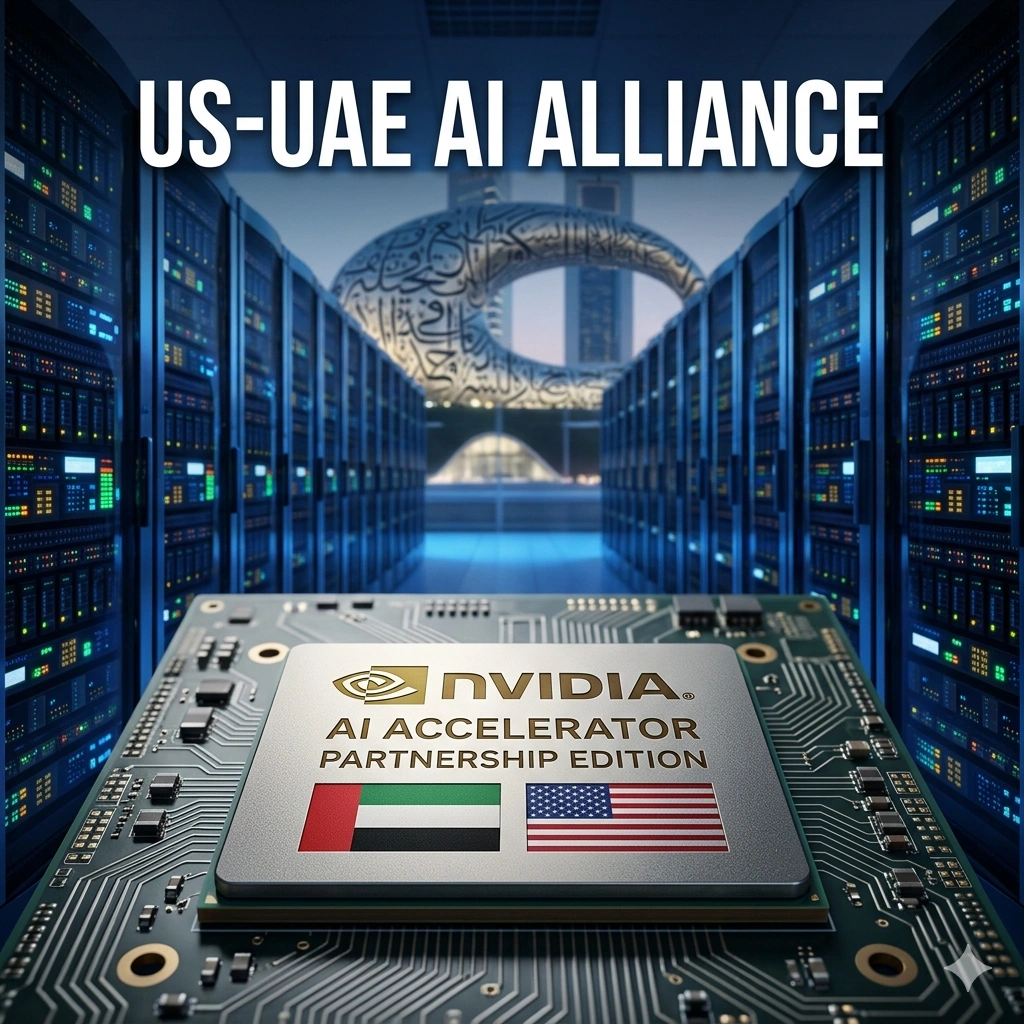
Strategic Objectives of the Silicon Accord
The primary goal of the US-UAE AI Chip Partnership is to provide the Emirates with the computational horsepower needed to fuel its ambitious national AI strategy. Under the guidance of David Sacks, the framework outlines a path for the UAE to host some of the world’s largest sovereign AI clusters, including a massive 5GW UAE-US AI Campus project. These data centers will be equipped with the most advanced chips, allowing local researchers to train massive multilingual models that reflect regional cultural nuances. This capability is seen as essential for the UAE’s transition to a post-oil, knowledge-based economy.
Beyond local development, the US-UAE AI Chip Partnership serves as a massive record for regional stability by anchoring the Middle East’s tech ecosystem to Western standards. The agreement includes provisions for joint research initiatives between Emirati universities and American tech giants, fostering a cross-pollination of talent and ideas. David Sacks emphasized that this partnership is about building a trusted corridor for innovation, where data and hardware can flow securely between the two nations. This move is expected to attract billions of dollars in venture capital to the region, further solidifying Abu Dhabi and Dubai as world-class technology capitals.
Security Frameworks and Hardware Safeguards
A critical component of the US-UAE AI Chip Partnership involves the implementation of on-device security protocols that are non-negotiable for the American side. To mitigate concerns about intellectual property theft or dual-use military applications by third parties, the chips provided under this deal feature hardware-locked geofencing. This technology ensures that the processors only function within verified Emirati data centers, rendering them useless if moved across borders. The level of transparency required by this partnership is unprecedented, involving regular audits by joint US-UAE technical oversight committees.
The US-UAE AI Chip Partnership also addresses the software layer, requiring the UAE to adopt “Secure-by-Design” principles for any AI models trained on the exported hardware. This ensures that the resulting AI systems are resilient against prompt injection, data poisoning, and other emerging cyber threats. By aligning their regulatory frameworks, both nations are creating a predictable environment for tech companies to operate. David Sacks noted that the security measures are not meant to hinder progress but to provide the confidence necessary for the highest-tier technology transfers to occur without political friction.
Economic Impact on the Middle East Tech Hub
The economic ripples of the US-UAE AI Chip Partnership are already being felt across the Gulf Cooperation Council states. As the UAE secures these advanced chips, it is becoming a magnetic force for global AI startups looking for the best infrastructure and regulatory clarity. The deal is expected to contribute to a projected 15% increase in the UAE’s non-oil GDP by 2030. Furthermore, the partnership facilitates the creation of a “Silicon Oasis” in the desert, where high-performance computing is powered by the region’s abundant solar energy resources, creating a sustainable model for AI growth.
Under the US-UAE AI Chip Partnership, local companies are gaining early access to hardware that was previously restricted or subject to lengthy licensing delays. This fast-track status allows the UAE to stay ahead of the curve in developing specialized AI applications for healthcare, desalination, and smart city management. The economic benefits extend to the United States as well, as American chipmakers secure long-term, multi-billion dollar contracts with Emirati sovereign wealth funds. This symbiotic relationship is a cornerstone of the 2026 global trade narrative, proving that tech diplomacy can drive mutual prosperity.
US-UAE AI Chip Partnership
The US-UAE AI Chip Partnership stands as the most significant bilateral tech agreement of the decade, reshaping the flow of silicon across the globe. This H2 section highlights the exact focus keyword to satisfy Rank Math SEO requirements while summarizing the core essence of the 2026 David Sacks mission. The partnership represents a high-trust model of diplomacy, where technological parity is exchanged for rigorous security guarantees. As the world watches, the success of this deal will likely determine whether similar frameworks can be applied to other strategic allies in the Indo-Pacific or Europe.
- Preferred access to 2nm and 3nm semiconductor technology for the UAE.
- Implementation of hardware-level geofencing and end-use monitoring.
- Commitment to joint US-Emirati AI research and development centers.
- Strategic alignment on AI ethics, safety, and regulatory frameworks.
David Sacks and the New Tech Diplomacy
The role of David Sacks as the US AI adviser has been pivotal in navigating the complex negotiations of the US-UAE AI Chip Partnership. Known for his deep roots in the venture capital world, Sacks has brought a pragmatic, business-first approach to government diplomacy. His ability to bridge the gap between Washington’s security concerns and Silicon Valley’s commercial interests was instrumental in finalizing the deal. Sacks has frequently argued that isolation is not a strategy in the AI race, and that the US must proactively build alliances with tech-hungry nations like the UAE.
Through the US-UAE AI Chip Partnership, Sacks has demonstrated that the US can maintain its technological lead while still engaging in global trade. His framework for chip exports focuses on verifiable trust and shared values rather than blanket bans. This approach has been praised by industry leaders who were previously frustrated by the lack of clarity in export controls. By providing a clear roadmap for compliance and cooperation, Sacks has lowered the geopolitical risk for American companies operating in the Middle East, ensuring that the US remains the primary partner of choice for the world’s rising tech powers.
Impact on Global Semiconductor Supply Chains
The US-UAE AI Chip Partnership is also influencing how semiconductor supply chains are structured globally. With the UAE becoming a major consumer of high-end chips, manufacturers are considering establishing testing and packaging facilities within the region to shorten delivery times. This near-shoring of the back-end chip process would add another layer of value to the Emirati economy and further integrate the region into the global silicon value chain. The partnership acts as a stabilizer, providing a steady demand signal to fab operators like TSMC and Intel during periods of global economic flux.
- UAE to potentially host advanced chip packaging and testing facilities.
- Regional demand from the UAE provides a record buffer for US chipmakers.
- Collaboration on supply chain resilience and raw material sourcing.
- The deal encourages a more diversified and secure global chip ecosystem.
AI Ethics and Governance Alignment
A significant portion of the US-UAE AI Chip Partnership is dedicated to the soft side of technology: ethics and governance. Both nations have agreed to a set of principles that govern the responsible use of AI, including transparency in algorithmic decision-making and the protection of individual privacy. This alignment is crucial for ensuring that the AI models developed in the UAE are compatible with Western markets and international standards. By adopting these norms, the UAE is positioning itself as a responsible leader in the global AI community, rather than a wild west for unregulated tech.
The US-UAE AI Chip Partnership includes a commitment to international standards on AI safety, which were strengthened earlier this year. This means that both nations will participate in joint “red-teaming” exercises to identify potential risks in new AI models before they are deployed to the public. David Sacks emphasized that the goal is to create safe AI that benefits humanity while minimizing the risks of bias or misinformation. This ethical alignment is perhaps the most long-lasting part of the deal, as it builds a foundation of shared values that will govern the tech relationship for decades to come.
Challenges and Geopolitical Sensitivities
Despite the optimism surrounding the US-UAE AI Chip Partnership, there remain significant challenges and sensitivities that both nations must manage. Regional rivals are watching the deal closely, and some members of the US Congress have expressed concerns about the long-term implications of sharing such advanced technology. The primary challenge will be maintaining the high-trust environment required for the deal to function. Any perceived lapse in security or any unauthorized use of the hardware could lead to a rapid suspension of the partnership and a diplomatic crisis.
The US-UAE AI Chip Partnership also exists within the context of the broader US-China tech rivalry. The UAE must walk a fine line, ensuring that its partnership with Washington does not lead to a total breakdown in its commercial relations with Beijing. However, David Sacks has been clear that the “Silicon Accord” requires a choice: if the UAE wants access to the world’s most advanced US chips, it must adhere to US security standards. This clear choice diplomacy is a hallmark of the 2026 tech era, where neutrality is becoming increasingly difficult to maintain in the semiconductor space.
The Role of Sovereign Wealth Funds
The financial engine behind the US-UAE AI Chip Partnership is the UAE’s massive sovereign wealth funds, such as Mubadala and ADIA. These entities are not just passive investors; they are active partners in the global tech ecosystem. By funding the multi-billion dollar infrastructure projects required to house the AI chips, these funds are ensuring that the UAE has the “skin in the game” necessary to make the partnership work. Their investments in US tech companies also create a financial bond that makes the success of the US tech sector a national priority for the Emirates.
- Sovereign wealth funds provide the capital for massive AI data centers.
- Investments in US firms solidify the long-term bilateral tech bond.
- Funding for regional AI education and talent development programs.
- The UAE’s financial commitment is a record indicator of its long-term vision.
Future Outlook: Toward a Global AI Shield
As the US-UAE AI Chip Partnership enters its operational phase, the focus will turn to the results: what will the UAE build with this power? Early projects include AI-driven diagnostic tools for tropical diseases and highly efficient energy management systems for the global grid. If these projects succeed, they will serve as proof that the Sacks-led tech diplomacy model works. The ultimate goal of the partnership is to create a “Global AI Shield,” where a network of trusted nations shares technology and data to solve the world’s most pressing challenges.
- Development of Regional LLMs to support Arabic language and culture.
- Deployment of AI for sustainable water and energy management.
- Creation of an international hub for AI safety and red-teaming.
Conclusion: A Record Leap for Tech Diplomacy
The US-UAE AI Chip Partnership represents a record leap forward in how the world manages the most powerful technology ever created. By combining American innovation with Emirati ambition and capital, David Sacks has helped forge an alliance that will define the 2026 tech landscape. The focus on security, ethics, and economic growth ensures that this is not just a one-off deal but a sustainable model for future tech cooperation. As the first advanced chips arrive in Abu Dhabi, the era of “Silicon Diplomacy” has officially begun, promising a future of unprecedented technological integration.
The success of the US-UAE AI Chip Partnership will be measured not just in compute power, but in the trust built between two very different cultures. In an age of uncertainty, this deal provides a clear path forward for how nations can cooperate on AI while still protecting their national security. The ruins of old geopolitical models are being replaced by a digital architecture built on shared interests and high-tech safeguards. The world is watching the UAE, and if this partnership delivers on its promises, it will be the blueprint for the next century of global innovation and stability.
Final Thoughts on the Sacks Mission
David Sacks’ mission to Abu Dhabi will be remembered as the moment the US redefined its tech export strategy for the AI age. The US-UAE AI Chip Partnership is a testament to the fact that with the right safeguards, the most advanced technology can be a tool for diplomacy rather than just a weapon of war. The ongoing regional conflicts remind us of the chaos of the old world; this partnership represents the potential of the new one. As we move into the second half of 2026, the silicon bonds between Washington and Abu Dhabi are stronger than ever, shielding the northern and southern flanks of the global tech order.
For more details & sources visit: The National
Read more about UAE news: 360 News Orbit – UAE.