
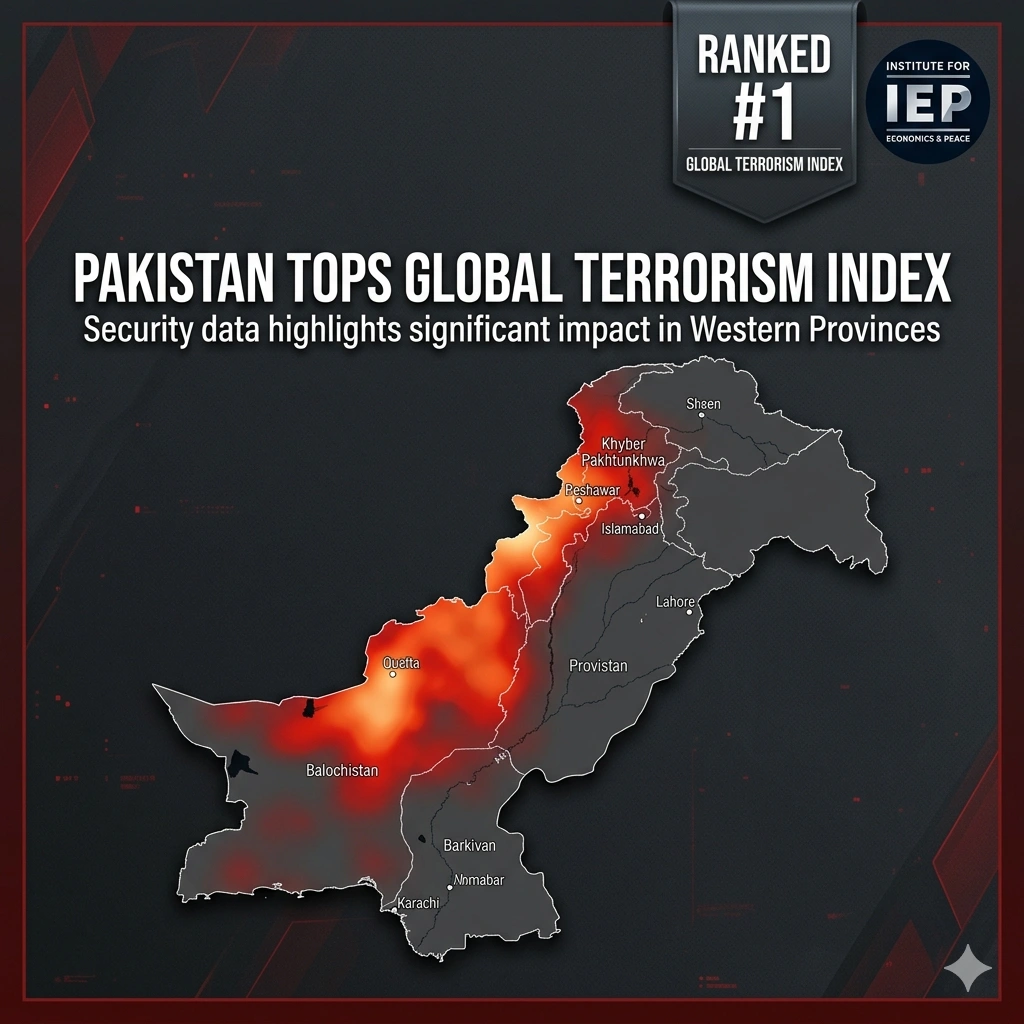
Pakistan Global Terrorism Index (GTI) rankings have reached a historic and somber milestone. For the first time, Pakistan has been ranked as the country most impacted by terrorism globally, surpassing several Sub-Saharan African nations that previously held the top spots. The 2026 report, released by the Institute for Economics and Peace (IEP), highlights a dangerous surge in violence that resulted in 1,139 deaths in 2025 alone. This marks the highest fatality count for the country since 2013, signaling a significant deterioration in the regional security landscape.
The primary driver behind the Pakistan Global Terrorism Index escalation is the intensified activity of the Tehreek-i-Taliban Pakistan (TTP) and the Balochistan Liberation Army (BLA). According to the IEP, the TTP was responsible for a staggering 56% of all terror-related deaths in the country over the past year. This spike is largely attributed to the group’s expanded operational reach and increased access to safe havens following the Taliban’s return to power in neighboring Afghanistan. While global terrorism deaths actually fell by 28% overall, Pakistan defied the trend with a 6% increase in fatalities.
The Rise of the TTP and Border Vulnerabilities
The Pakistan Global Terrorism Index identifies the TTP as the deadliest local group, benefiting significantly from the geopolitical shifts in the region. Since the 2021 transition in Kabul, the TTP has reorganized its command structure and acquired advanced weaponry, much of which was left behind during the US withdrawal from Afghanistan. This has allowed the group to transition from small-scale hit-and-run tactics to more sophisticated, large-scale assaults on military outposts and police stations in the tribal belt.
The border between Pakistan and Afghanistan remains the “epicenter” of the Pakistan Global Terrorism Index findings. Despite the construction of a massive border fence, militants continue to exploit porous mountainous terrain to launch cross-border raids. The report suggests that the “Afghan factor” is the single greatest external contributor to Pakistan’s current security crisis. Without a functional bilateral agreement between Islamabad and the de facto authorities in Kabul, the TTP’s influence is expected to persist throughout 2026 and beyond.
Furthermore, the Pakistan Global Terrorism Index highlights how the TTP has successfully expanded its recruitment efforts by exploiting local grievances in the merged districts. By positioning itself as a defender of local rights against the central government, the group has managed to tap into a pool of disenfranchised youth. This ideological shift makes the TTP a much more complex threat than a simple militant organization, as it now possesses a significant, albeit coerced, social base in certain border communities.
Pakistan Global Terrorism Index
The Pakistan Global Terrorism Index ranking has significant implications for the country’s economic stability and foreign direct investment. In a year where “Vietnam Russia Energy” deals or “Algeria Niger Strategic” partnerships are driving growth elsewhere, Pakistan’s top spot on the GTI serves as a major deterrent for international businesses. The high cost of security and the constant threat of disruption make it difficult for the government to market the country as a viable hub for regional trade or manufacturing.
Within the Pakistan Global Terrorism Index framework, the surge in hostage-taking is identified as a “tactic of desperation and dominance.” By kidnapping government officials and foreign workers, groups like the BLA aim to internationalize their cause and force the state into humiliating negotiations. This has led to a climate of fear in Balochistan’s resource-rich areas, where development projects—including those linked to the China-Pakistan Economic Corridor (CPEC)—have faced repeated delays due to the heightened threat level.
The Pakistan Global Terrorism Index also sheds light on the internal displacement of thousands of families fleeing the violence in the northwest. This humanitarian fallout creates a secondary crisis of “security refugees” who struggle to find housing and employment in the major cities. The social strain of this displacement often leads to further instability, creating a vicious cycle that the government is struggling to break. The 2026 report emphasizes that terrorism in Pakistan is no longer just a military problem; it is a full-scale societal challenge.
The BLA and the Struggle for Balochistan
While the TTP dominates the headlines in the north, the Pakistan Global Terrorism Index notes a sharp increase in the lethality of the Balochistan Liberation Army (BLA) in the south. The BLA has increasingly targeted not only security forces but also infrastructure and non-local workers. Their attacks are often characterized by high levels of planning and the use of female suicide bombers—a relatively new and disturbing development in the region’s militancy.
The Pakistan Global Terrorism Index attributes the BLA’s resurgence to a perceived lack of economic development and political representation in Balochistan. The group exploits the narrative that the province’s mineral wealth is being extracted without benefiting the local population. This sentiment has allowed the BLA to maintain a steady stream of recruits despite heavy military operations against them. The 2026 data suggests that the “Baloch insurgency” has evolved into a more disciplined and ideologically driven force than in previous decades.
- Targeted attacks on the Gwadar Port and surrounding CPEC infrastructure.
- Increased use of Improvised Explosive Devices (IEDs) on main highways.
- Coordinated assaults on mining facilities and energy pipelines.
- Strategic alliances with other smaller separatist groups to pool resources.
The Pakistan Global Terrorism Index warns that the confluence of religious militancy (TTP) and ethnic separatism (BLA) creates a “perfect storm” for the Pakistani security establishment. Dealing with two distinct but equally violent insurgencies simultaneously stretches the military’s capacity to its limit. The report calls for a dual approach that combines kinetic operations with genuine political and economic engagement to address the root causes of the unrest in the southern province.
Hostage-Taking: A Growing International Concern
Perhaps the most shocking statistic in the Pakistan Global Terrorism Index is the 548% increase in hostage-taking incidents. This move toward “asymmetric leverage” indicates that militant groups are finding it easier to kidnap individuals than to hold territory. The international community, particularly nations with citizens working on infrastructure projects in Pakistan, has expressed deep concern over the safety of their personnel. This has led to the implementation of “hardened” security zones, which further isolate the projects from the local population.
- 2024 Hostages: 101
- 2025 Hostages: 655
- Primary regions for abductions: Balochistan (42%) and KP (38%).
- Targets: Government officials, NGO workers, and foreign contractors.
The Pakistan Global Terrorism Index suggests that the rise in hostages is also a fundraising tool. Ransom payments provide a steady stream of income for the TTP, allowing them to purchase more sophisticated equipment on the black market. This “kidnapping economy” is difficult to dismantle, as it involves complex networks of local facilitators and cross-border smugglers. The IEP recommends that Pakistan strengthen its specialized anti-kidnapping units and improve intelligence-sharing between provincial police forces to combat this trend.
Counter-Terrorism Challenges in 2026
The Pakistan Global Terrorism Index release coincides with a period of intense soul-searching within the country’s defense community. Despite the “Azm-i-Istehkam” (Resolve for Stability) operations, the violence has not abated. Analysts point to a lack of “continuity in policy” and the distraction of domestic political instability as major hurdles. When the state is preoccupied with internal power struggles, the focus on counter-terrorism inevitably wavers, giving militant groups the space they need to regroup.
Under the Pakistan Global Terrorism Index analysis, the role of digital radicalization is also highlighted. Both the TTP and BLA have become adept at using social media and encrypted messaging apps to spread their propaganda and coordinate attacks. This “cyber-terrorism” front is one where the Pakistani state is still playing catch-up. Efforts to regulate the internet have often been met with public backlash, leaving a vacuum that extremist groups are all too happy to fill with their own narratives.
The Pakistan Global Terrorism Index also notes the strain on the national budget. A significant portion of the country’s GDP is now diverted toward internal security, leaving less for education, healthcare, and infrastructure. This “security tax” on the economy prevents Pakistan from competing with regional peers who are investing heavily in human capital. The report suggests that unless the security situation improves, Pakistan’s long-term economic prospects remain bleak compared to the rapid growth seen in the “Germany Vietnam Partnership” model.
Comparative Global Context
The Pakistan Global Terrorism Index rank of #1 is a stark contrast to the global trend. The IEP report shows that for many parts of the world, terrorism is becoming less frequent and less deadly. In the Middle East, for example, the footprint of groups like ISIS has shrunk significantly. Pakistan’s rise to the top of the list indicates that the center of gravity for global militancy has shifted firmly back to the South Asian-Afghan borderlands. This shift has major implications for US and NATO regional policy in 2026.
While the “Palantir FCA Deal” in the UK or “Tencent OpenClaw AI” in China showcase a world driven by technological advancement, the Pakistan Global Terrorism Index depicts a region struggling with 20th-century insurgencies. This “security gap” between the West/East Asia and the Sahel/South Asia is widening. Pakistan now finds itself in the same category as countries like Mali and Burkina Faso—nations where the state’s authority is being actively contested by non-state actors in significant portions of its territory.
The Pakistan Global Terrorism Index also serves as a warning to India and Iran. Instability in Pakistan rarely stays within its borders. Iran has already seen an uptick in attacks from groups operating in the border region, while India remains on high alert for any spillover into Kashmir. The “Meeting of Waters” between these different security threats could lead to a broader regional conflict if not managed with careful diplomacy and coordinated border security efforts.
Future Outlook: Can Pakistan Reverse the Trend?
As we look toward the remainder of 2026, the Pakistan Global Terrorism Index suggests that the road to recovery will be long and difficult. Reversing the current trend requires more than just military force; it requires a restoration of public trust in the state’s ability to protect its citizens. This includes improving the judicial system so that terrorists are prosecuted effectively and providing an alternative narrative to the one offered by the TTP and BLA.
- Implementing a rigorous “National Action Plan” with bipartisan political support.
- Strengthening the “Nacta” (National Counter Terrorism Authority) to coordinate intelligence.
- Engaging in high-level diplomacy with Kabul to address the TTP’s safe havens.
- Increasing development spending in Balochistan to undercut the BLA’s recruitment.
The Pakistan Global Terrorism Index is a wake-up call for the nation’s leadership. It is no longer possible to treat terrorism as a localized or peripheral issue. It is the central challenge facing the country in the mid-2020s. Whether Pakistan can drop down the rankings in the 2027 report depends on the actions taken in the coming months. The world is watching, and the cost of failure is too high for the people of Pakistan to bear.
In conclusion, the Pakistan Global Terrorism Index report of 2026 is a sobering reminder of the fragility of peace in a polarized world. While discoveries like the “Antarctic Sleeper Shark” or the “Voice of Hind Rajab” debate capture our imagination, the grim reality of 1,139 deaths cannot be ignored. Pakistan’s journey back from the top of the GTI will require courage, unity, and a renewed commitment to the principles of security and justice for all its citizens.
The “Mother’s Day in Gaza” stories remind us of the human cost of conflict, and the families of the 1,139 victims in Pakistan feel that same pain today. As the country marks its National Day this March 23, the focus must shift from celebration to introspection. Only by facing the truth of the Pakistan Global Terrorism Index can the nation begin to build a future where safety and prosperity are a reality for everyone, from the peaks of the Karakoram to the shores of the Arabian Sea.
For more details & sources visit: Dawn
Read more about Pakistan news on 360 News Orbit – Pakistan.