
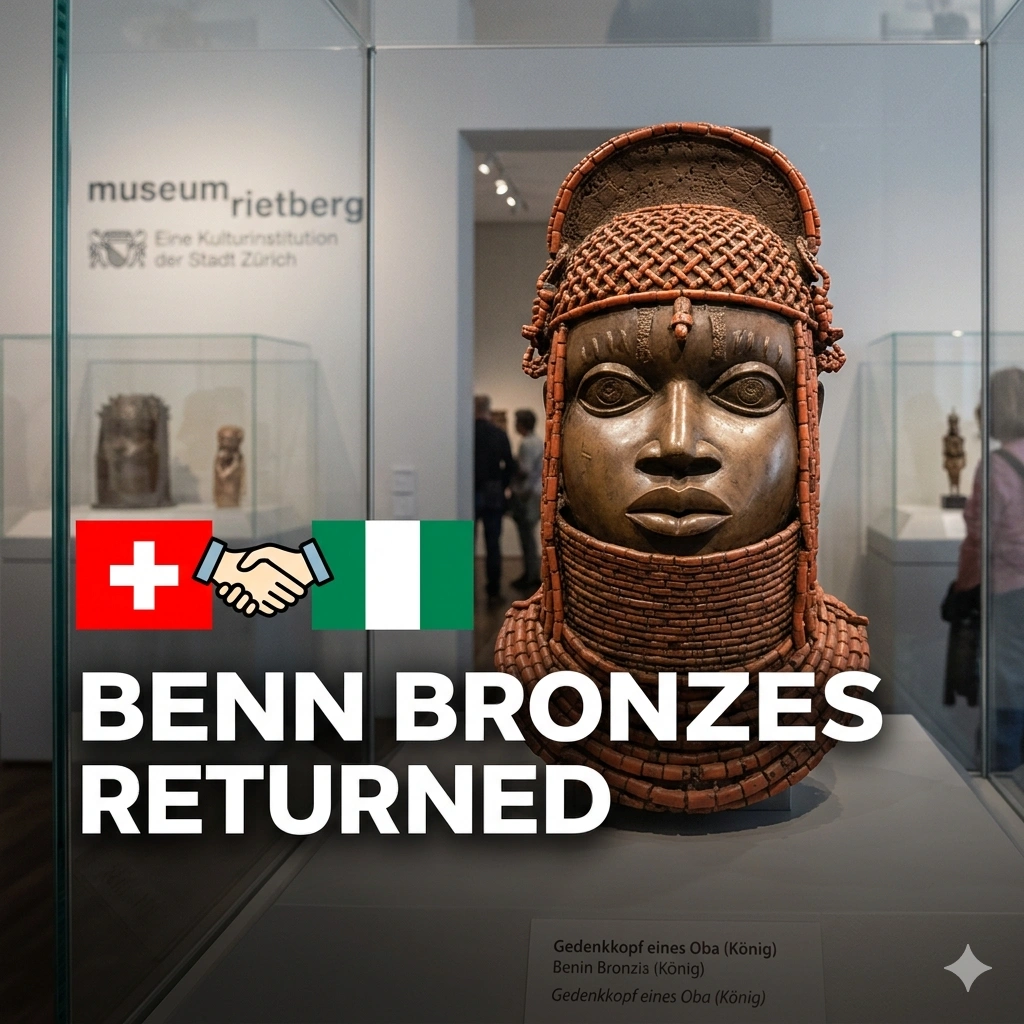
The global landscape of cultural heritage is undergoing a profound transformation as European institutions reckon with their colonial legacies. The City of Zurich and the prestigious Museum Rietberg officially announced the transfer of ownership of 11 historic artifacts to the Republic of Nigeria. This landmark decision marks a significant milestone in the repatriation movement, specifically regarding the famous Benin Bronzes that were looted during the British invasion of 1897. While the legal title has been fully transferred to the Nigerian government, the agreement includes a sophisticated framework for both physical return and long-term research cooperation.
The Historical Context of the 1897 Looting
The history of these artifacts is deeply rooted in the tragic events of the late 19th century when British forces launched a punitive expedition against the Kingdom of Benin. During this violent raid, thousands of sacred objects, including brass plaques, ivory tusks, and bronze heads, were seized from the Royal Palace. These items were then dispersed across the globe, ending up in private collections and national museums throughout Europe and North America. The Zurich’s Benin Bronze Return represents a formal acknowledgement that these items were acquired under circumstances that are no longer ethically defensible in the modern era.
For decades, the Kingdom of Benin’s descendants and the Nigerian government have campaigned for the return of these cultural treasures. The objects were not merely decorative art; they were essential components of royal ancestral shrines and historical records of the Edo people. The recent move by Switzerland highlights a growing international consensus that historical wrongs must be addressed through the restitution of cultural property. This shift is not just about the physical objects but about restoring dignity and agency to the communities from which they were taken.
The process leading to this transfer was meticulous and involved years of provenance research. Experts from both Switzerland and Nigeria worked together to trace the lineage of each specific piece within the Museum Rietberg collection. By establishing a clear link to the 1897 raid, the researchers provided the necessary evidence to justify a full transfer of ownership. This collaborative approach has set a new standard for how museums can handle sensitive colonial-era collections without resorting to prolonged legal battles or diplomatic friction.
The Role of the Benin Initiative Switzerland
The success of this repatriation effort can be traced back to the Benin Initiative Switzerland (BIS), a project launched in 2021. This initiative brought together eight Swiss museums to investigate the origins of their Benin collections in a transparent and scholarly manner. The Zurich’s Benin Bronze Return is a direct outcome of this collective transparency, proving that rigorous academic investigation can lead to tangible social justice. The BIS focused on dialogue with Nigerian partners to ensure that the process was inclusive and respectful of West African perspectives.
The research conducted under the BIS umbrella revealed that many of the objects in Swiss museums were sold through well-known art dealers in the early 20th century who specialized in colonial spoils. By mapping these trade routes, the initiative was able to confirm that the 11 objects in Zurich were indeed part of the broader 1897 loot. This clarity allowed the City of Zurich to move forward with a clear conscience, recognizing that the Zurich’s Benin Bronze Return was the only moral path forward for a city that prides itself on human rights.
Furthermore, the initiative has fostered a new era of “provenance diplomacy” between Switzerland and Nigeria. Instead of a simple transactional return, the BIS has built a foundation for ongoing academic exchange. This means that even after the objects are returned, Swiss and Nigerian scholars will continue to collaborate on exhibitions and educational programs. The Zurich’s Benin Bronze Return is therefore seen as a beginning rather than an end, sparking a long-term partnership that transcends national borders and historical grievances.
Zurich’s Benin Bronze Return
The formal transfer of ownership covers 11 distinct items, each with its own unique historical and spiritual significance. Among these is a mid-19th-century commemorative bronze head and a masterfully carved 18th-century ivory tusk. These specific items are slated for physical repatriation to Nigeria by mid-2026, where they will likely be housed in the planned Edo Museum of West African Art. The Zurich’s Benin Bronze Return ensures that these high-value ritual objects are returned to their original spiritual context.
The remaining nine objects, however, will follow a different trajectory under the new agreement. While Nigeria now holds the legal title to these pieces, they will remain in Zurich as long-term loans. This arrangement allows the Museum Rietberg to continue displaying Benin art while acknowledging that they do so at the discretion of the Nigerian people. The Zurich’s Benin Bronze Return serves as a model for “circulating heritage,” where ownership is corrected, but the objects remain accessible to a global audience for educational purposes.
Among the items staying in Switzerland on loan is a 17th-century pendant bronze mask, a piece of extraordinary craftsmanship that has been a centerpiece of the Rietberg for years. By allowing these items to stay, the Nigerian National Commission for Museums and Monuments (NCMM) demonstrates a pragmatic approach to cultural diplomacy. The Zurich’s Benin Bronze Return proves that restitution does not always mean the immediate emptying of European museum shelves, but rather a rebalancing of power and recognition.
Cultural Significance of the Returned Artifacts
To understand the weight of the Zurich’s Benin Bronze Return, one must appreciate the artistic mastery of the Edo craftsmen. The bronze casting technique used in Benin was among the most advanced in the world, producing works of incredible detail and durability. The commemorative heads were created to honor deceased Obas (kings) and served as a focal point for the living to communicate with the divine. When these items were stolen, it was not just a loss of wealth, but a disruption of the spiritual life of the kingdom.
The ivory tusks, like the one included in the Zurich’s Benin Bronze Return, were often carved with intricate scenes depicting the history and mythology of the Benin Empire. These tusks were placed on top of the bronze heads on the royal altars, creating a visual record of the dynasty’s achievements. By returning these items, Zurich is helping to stitch back together a fragmented historical narrative. The physical presence of these objects in Nigeria will allow local communities to reconnect with their ancestors in a way that was previously impossible.
Education is a central pillar of the Zurich’s Benin Bronze Return agreement. Both parties have committed to developing digital resources that will allow students in both Nigeria and Switzerland to study the 11 artifacts. This ensures that the knowledge surrounding the objects is as shared as the objects themselves. The Zurich’s Benin Bronze Return is a testament to the fact that cultural heritage is a living, breathing entity that continues to evolve and inform our understanding of the world today.
Global Impact on Museum Policies
The Zurich’s Benin Bronze Return is being watched closely by museum directors across the globe. Institutions in the United Kingdom, Germany, and France have all faced similar pressures to return looted goods. Germany has already made significant strides in this area, but the Swiss approach adds another layer of complexity by emphasizing the “long-term loan” model. This specific aspect of the Zurich’s Benin Bronze Return provides a roadmap for museums that are hesitant to lose their entire African collections.
International organizations such as UNESCO have praised the move, noting that it aligns with the 1970 Convention on the Means of Prohibiting and Preventing the Illicit Import, Export and Transfer of Ownership of Cultural Property. The Zurich’s Benin Bronze Return reinforces the idea that cultural property is not a commodity but a part of a nation’s identity. As more cities follow Zurich’s lead, the pressure on national museums, which often have more restrictive legal frameworks, will likely increase.
Critics of repatriation often argue that African museums may lack the infrastructure to protect these delicate items. However, the Zurich’s Benin Bronze Return addresses this by including provisions for technical support and facility upgrades. Nigeria has been investing heavily in museum infrastructure, and the return of these 11 items provides further momentum for these projects. The Zurich’s Benin Bronze Return shows that when European and African institutions work as equals, logistical challenges can be overcome through mutual investment.
Ritual Objects and Spiritual Homecoming
The two items set for immediate physical return—the bronze head and the ivory tusk—are classified as “ritual objects of great importance.” Their return is particularly symbolic because of their role in the Edo traditional religion. The Zurich’s Benin Bronze Return acknowledges that some objects are too sacred to be kept as mere museum exhibits. For the people of Benin City, the return of these items is a spiritual homecoming that has been awaited for over a century.
Traditional leaders in Nigeria have expressed profound gratitude for the Zurich’s Benin Bronze Return. They view the gesture as an act of healing that goes beyond politics. The return ceremony, expected in mid-2026, will likely involve traditional rites to welcome the spirits of the ancestors back to their rightful place. The Zurich’s Benin Bronze Return is thus a bridge between the secular world of international law and the sacred world of indigenous belief systems.
It is also important to note the role of the contemporary Oba of Benin in these negotiations. The Royal Palace has remained a central figure in the push for restitution. The Zurich’s Benin Bronze Return honors the Oba’s request for the return of his family’s heritage while maintaining a modern diplomatic relationship with the City of Zurich. This balance of traditional authority and modern governance is a key feature of the successful outcome of the Zurich’s Benin Bronze Return.
Future Collaborations and Research
The agreement surrounding the Zurich’s Benin Bronze Return includes a robust framework for future scientific research. One of the primary goals is to use advanced imaging and chemical analysis to learn more about the alloys used in the 17th and 18th centuries. Because the 11 objects are now legally Nigerian, any new findings will be co-authored by Swiss and Nigerian scientists. This ensures that the Zurich’s Benin Bronze Return contributes to the decolonization of knowledge and the scientific record.
- Joint research initiatives focusing on metallurgical analysis of the 11 artifacts.
- Curatorial exchange programs where Nigerian experts spend time at Museum Rietberg.
- Educational workshops for Swiss students to learn about the Kingdom of Benin’s history.
- Development of a shared digital archive containing high-resolution 3D scans of the objects.
The loan of the nine objects back to Zurich as part of the Zurich’s Benin Bronze Return is not a permanent solution but a renewable agreement. This keeps the door open for future discussions as the situation in Nigeria evolves. The Zurich’s Benin Bronze Return proves that flexibility is the most valuable tool in international diplomacy. By not demanding everything at once, Nigeria has secured a friend and an advocate in the heart of Europe’s banking and cultural capital.
The economic impact of the Zurich’s Benin Bronze Return should not be overlooked either. As Nigeria develops its cultural tourism sector, having these high-profile artifacts back in the country will be a significant draw for international visitors. The Zurich’s Benin Bronze Return helps position Nigeria as a leader in African cultural preservation. Meanwhile, Zurich retains its reputation as a progressive cultural hub that is willing to lead by example in the complicated field of ethics and art.
Ethical Standards in Modern Curation
The Museum Rietberg has undergone a significant internal shift following the Zurich’s Benin Bronze Return. The museum’s staff have embraced a new ethical code that prioritizes the “biography” of an object over its aesthetic value alone. This means that every label in the museum now reflects the complex history of how an object arrived in Switzerland. The Zurich’s Benin Bronze Return has essentially changed the way the museum talks to its audience, moving away from a Eurocentric narrative toward a more global and inclusive perspective.
Visitors to the museum have responded positively to the transparency surrounding the Zurich’s Benin Bronze Return. There is a growing public desire to understand the ethics of art collecting, and the Rietberg’s openness has turned a potential PR crisis into a triumph of institutional integrity. The Zurich’s Benin Bronze Return serves as a teaching moment for the public, illustrating that history is not a static collection of facts but a constantly evolving conversation about values and justice.
Other Swiss cities, such as Basel and Bern, are now looking to the Zurich’s Benin Bronze Return as a template for their own collections. The initiative has shown that legal hurdles, which are often cited as reasons to block restitution, can be cleared with sufficient political will. The Zurich’s Benin Bronze Return has demonstrated that the city’s legal department and cultural department can work in tandem to achieve a goal that benefits the international community.
Conclusion of a Historic Transfer
As we look toward the physical return of the first two items in mid-2026, the legacy of the Zurich’s Benin Bronze Return is already clear. It is a story of reconciliation, rigorous scholarship, and the power of dialogue. The 11 artifacts, once symbols of colonial conquest, have now become symbols of international cooperation and respect. The Zurich’s Benin Bronze Return will be remembered as a turning point in the history of the Museum Rietberg and a defining moment for the City of Zurich.
The Republic of Nigeria has welcomed this gesture with open arms, signaling a new chapter in its bilateral relations with Switzerland. The Zurich’s Benin Bronze Return is more than just a legal transfer; it is a heart-felt acknowledgment of a shared past and a commitment to a shared future. By returning these items, Zurich has not lost a collection; it has gained a partner and helped restore a piece of the world’s cultural soul.
Ultimately, the Zurich’s Benin Bronze Return reminds us that while we cannot change the past, we have every opportunity to change how we respond to it. The 11 objects at the center of this story have survived centuries of upheaval, and their journey is far from over. Through the Zurich’s Benin Bronze Return, they continue to teach us about the resilience of culture and the enduring importance of doing what is right, regardless of how much time has passed since the initial wrong.
A New Model for the 21st Century
The Zurich’s Benin Bronze Return offers a sophisticated model that moves beyond the “all or nothing” debate of repatriation. By splitting the collection between physical return and long-term loans, the agreement respects the immediate spiritual needs of Nigeria while maintaining a global educational presence. This nuanced approach in the Zurich’s Benin Bronze Return is likely to be the standard for the next decade of cultural negotiations.
Critics who once feared that restitution would lead to empty museums can now look at the Zurich’s Benin Bronze Return as evidence to the contrary. The Museum Rietberg remains a world-class institution, but it now operates with a clear legal and moral title to the works it displays. The Zurich’s Benin Bronze Return has enriched the museum’s mission rather than diminishing it, proving that ethics and excellence are not mutually exclusive in the world of fine art.
For more details & sources visit: The Art Newspaper
Read more on Nigeria news: 360 News Orbit – Nigeria.