
The Japanese government recently executed a rare ANA charter flight to transport key Cabinet ministers to Washington. This logistical pivot occurred because the primary government reserve aircraft was sidelined for scheduled maintenance, leaving the official fleet temporarily constrained. While the Prime Minister utilized the main government jet, the rest of the high-level delegation boarded a commercial All Nippon Airways Boeing 777.
This rare ANA charter flight marks a significant departure from standard diplomatic protocol, a move not witnessed since the era of the late Shinzo Abe. The deployment of a commercial widebody aircraft lacking the iconic red-and-white government livery sparked immediate discussions across Japanese media regarding state continuity. Beyond the visual shift, the mission signals a deepening of the defense and technology alliance between Tokyo and Washington during a period of global supply chain fragility.
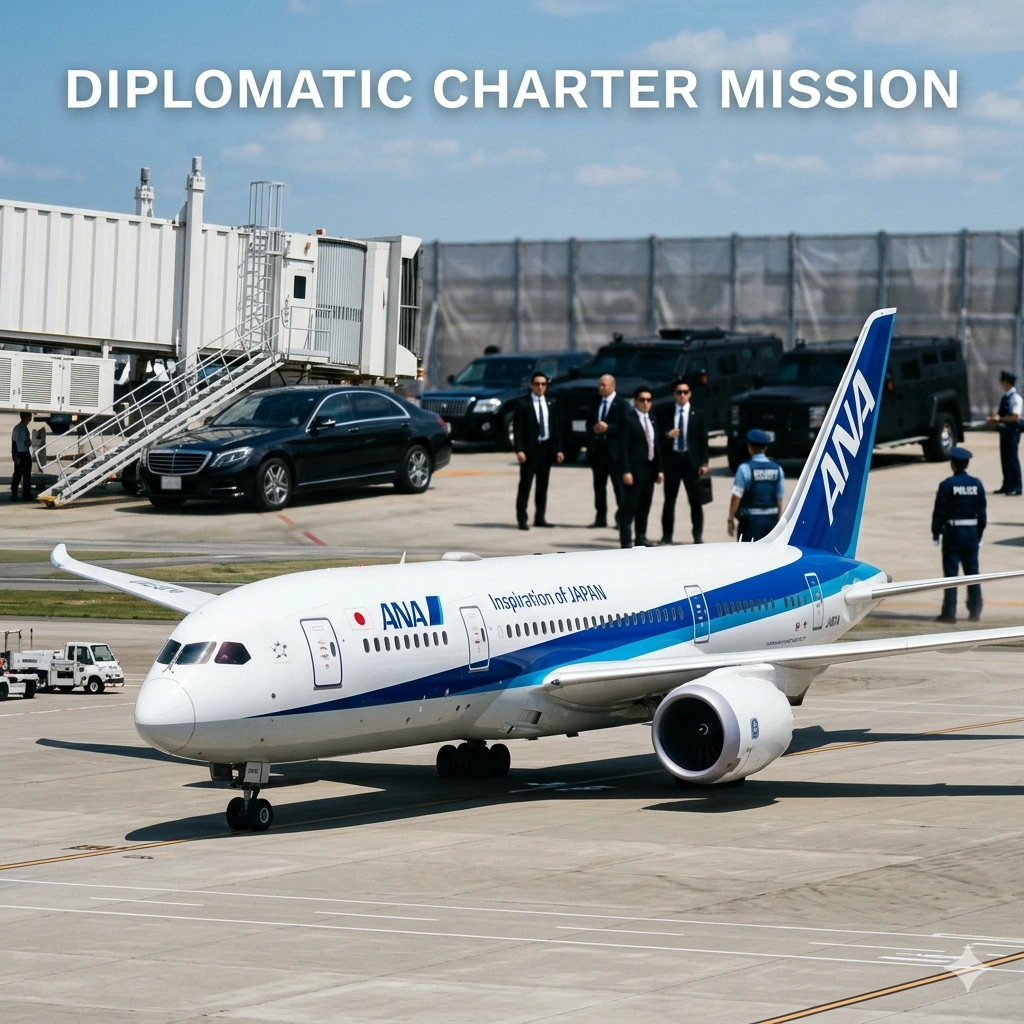
Context of the Rare ANA Charter Flight
The decision to utilize a rare ANA charter flight was primarily a tactical necessity to ensure the group movement of ministers was not delayed. According to the Foreign Ministry, the official reserve aircraft requires rigorous periodic servicing to maintain its high-readiness status for emergency evacuations. By opting for a commercial partner, the Kantei demonstrated flexibility in maintaining its diplomatic schedule despite hardware limitations. This rare ANA charter flight highlights how the Japanese administration prioritizes its international commitments over traditional ceremonial optics during critical geopolitical windows.
Analysts note that the use of a rare ANA charter flight provides a unique case study in government-private sector cooperation for sovereign logistics. The seamless integration of a commercial jet into a high-security diplomatic mission requires immense coordination between the Japan Self-Defense Forces and ANA’s ground staff. This rare ANA charter flight underscores the reliability of Japan’s domestic aviation infrastructure when called upon for state-level duties. As the delegation arrived in Washington, the focus shifted from the unusual transport method to the heavy diplomatic agenda awaiting the ministers.
The rare ANA charter flight also serves as a reminder of the aging nature of certain segments of the government’s dedicated long-haul fleet. While the primary jets are modern, the reliance on a single reserve unit creates bottlenecks that a rare ANA charter flight must occasionally solve. This event may prompt future discussions in the Diet regarding the procurement of additional government-owned transport assets to avoid commercial dependencies. For now, the successful arrival of the Cabinet via this rare ANA charter flight ensures that Japan’s voice remains present in vital Washington dialogues.
Rare ANA charter flight
The rare ANA charter flight implemented on March 20 serves as a bridge for Japanese statecraft during a period of intense bilateral negotiations. By utilizing a commercial widebody, the government managed to transport a large contingent of advisors and security personnel alongside the Cabinet ministers. This rare ANA charter flight allowed for a unified arrival in the U.S. capital, which is essential for the “all-hands” approach to the current defense talks. The mission specifically demonstrates the Kantei’s ability to pivot its logistics strategy without compromising the security or timing of the trip.
One of the most discussed aspects of the rare ANA charter flight was the absence of the official government livery on the tarmac at Dulles International Airport. Instead, the blue-and-white tail of the ANA aircraft stood as a symbol of Japan’s commercial aviation strength. This rare ANA charter flight captured the attention of aviation enthusiasts and market observers alike, who viewed it as a high-profile endorsement of the airline’s operational excellence. The event effectively turned a maintenance hurdle into a demonstration of national logistical resilience and public-private partnership.
Furthermore, the rare ANA charter flight is being analyzed for its cost-efficiency compared to maintaining a larger permanent government fleet. Some fiscal hawks suggest that the charter model could be utilized more frequently for non-prime ministerial travel to save on long-term maintenance costs. However, the prestige associated with the official Air Force One equivalent usually outweighs these savings in the eyes of traditionalists. Regardless of the future path, this rare ANA charter flight will be remembered as a masterclass in adaptive government logistics during a high-stakes diplomatic week.
Impact on Defense Procurement and Security
The ministers traveling on the rare ANA charter flight are in Washington to discuss critical updates to Japan’s defense procurement calendar. These discussions include the acquisition of advanced radar systems and the co-development of next-generation interceptors to counter regional threats. The rare ANA charter flight allowed the defense and foreign ministers to arrive simultaneously, facilitating immediate high-level briefings with their American counterparts. This coordinated arrival emphasizes the urgency Japan places on its modernizing its military capabilities in 2026.
- Acceleration of the F-3 fighter jet program through increased technology sharing with U.S. aerospace giants.
- Expansion of maritime security interoperability to protect vital shipping lanes in the Indo-Pacific region.
- Procurement of additional long-range cruise missiles to bolster Japan’s “counterstrike” capability.
- Enhancement of joint training exercises involving both government transport assets and commercial logistics partners.
The rare ANA charter flight mission is also expected to produce new guidelines for semiconductor export controls and supply chain resilience. As the ministers disembarked from the aircraft, they carried proposals aimed at securing the flow of critical components for Japan’s tech sector. The flight thus facilitated a meeting of minds that will likely influence the global electronics market for years to come. By ensuring these leaders arrived safely and on time, the rare ANA charter flight played a supporting role in Japan’s broader national security strategy.
The rare ANA charter flight also highlights the importance of widebody aircraft utilization in Japan’s strategic planning. By maintaining a fleet of high-capacity jets, ANA provides a secondary layer of transport capability that the government can tap into during crises. This rare ANA charter flight proves that the commercial aviation sector is an integral part of Japan’s overall national defense ecosystem. The mission serves as a practical test of this synergy, showing that the transition from civilian to government use can be handled with professional precision.
Semiconductor Diplomacy and Supply Chain Shifts
A major objective for the Cabinet members on the rare ANA charter flight is the stabilization of the global semiconductor supply chain. Japan and the U.S. are looking to tighten coordination on the production of high-end chips that are essential for both consumer electronics and military hardware. The mission brought together the ministers of economy and trade, ensuring a holistic approach to these complex industrial negotiations. This mission, facilitated by the rare ANA charter flight, seeks to reduce dependency on a single geographic source for essential silicon wafers.
The rare ANA charter flight arrives at a time when Japanese toolmakers are seeing increased demand for precision manufacturing equipment. By discussing export protocols in Washington, the ministers hope to create a predictable environment for Japanese companies like Tokyo Electron. The success of the mission will be measured by how well these diplomatic efforts translate into stable capital spending and growth for the domestic tech sector. It is a clear example of how logistics, like a rare ANA charter flight, underpin the grander movements of international trade.
Moreover, the rare ANA charter flight mission includes discussions on “friend-shoring” critical mineral processing to ensure long-term energy security. As the world shifts toward electric vehicles and renewable energy, the ministers are seeking to secure the materials needed for Japan’s green transition. The transport provided the necessary access for this diverse group of experts to engage in multi-sectoral talks. This demonstrates that the rare ANA charter flight was not just a flight, but a mobile headquarters for Japan’s future economic security.
Aviation Market Implications for ANA and JAL
Market analysts are closely watching the rare ANA charter flight for signs of increased government reliance on commercial carriers. If such arrangements become a recurring solution for secondary diplomatic missions, it could provide a steady stream of high-margin revenue for Japan’s major airlines. This rare ANA charter flight serves as a massive marketing opportunity for ANA, showcasing its ability to handle the world’s most sensitive passengers. Investors in the aviation sector view the deployment as a testament to the operational robustness of the Japanese airline industry.
The rare ANA charter flight also highlights the incremental demand for charter services in a post-2025 economic environment. As global travel patterns shift, the flexibility offered by commercial partners becomes more attractive for large organizations and governments alike. This could lead to a strategic expansion of specialized charter divisions, catering to high-security or high-priority clients. The rare ANA charter flight is essentially a live demonstration of a business model that prioritizes agility and reliability over fixed schedules.
- Strengthening of corporate-government ties through long-term service level agreements for emergency transport.
- Increased valuation of widebody aircraft that can be quickly reconfigured for various mission types.
- Development of specialized ground handling protocols for VIP and diplomatic commercial charters.
- Potential for joint investment in secure communications technology for commercial jets used in high-level missions.
The visibility of the rare ANA charter flight in international media also boosts Japan’s reputation for logistical precision. As observers watch the diplomatic mission unfold, they see a nation that can maintain its global presence even when faced with technical hurdles. This perception is vital for maintaining Japan’s status as a top-tier investment destination and a reliable partner in international affairs. The mission, while unusual, ultimately reinforces the strength of the Japanese brand on the world stage.
Currency Risks and the USD/JPY Outlook
The high-profile diplomatic visit facilitated by the rare ANA charter flight is expected to have a noticeable impact on the USD/JPY currency pair. Traders are looking for clues in the post-summit statements that might indicate shifts in Japan’s monetary policy or trade balances. The mission coincides with a period of significant yen volatility, making the outcome of these Washington talks crucial for market sentiment. A successful outcome for those on the rare ANA charter flight could lead to a more stable outlook for the Japanese currency against the dollar.
Government officials are likely discussing the management of currency risks with their U.S. counterparts to prevent excessive fluctuations. The mission thus carries the weight of Japan’s financial stability as well as its physical security. By ensuring the finance minister reached Washington via the rare ANA charter flight, the government guaranteed that Japan’s fiscal interests are represented at the highest levels. This flight acts as a conduit for the high-level dialogue that keeps global markets functioning smoothly.
The rare ANA charter flight also symbolizes the “all-hands” approach to managing Japan’s economic health in 2026. By bringing a wide array of ministers on a single aircraft, the administration can present a unified front on everything from trade to defense spending. This unity is a powerful signal to currency markets that Japan is committed to a coherent and stable economic path. The rare ANA charter flight, therefore, serves as more than a transport solution; it is a tool for psychological market stabilization.
Regional Maritime Security and Interoperability
One of the most pressing topics for the delegation on the rare ANA charter flight is the security of the South China Sea and the Taiwan Strait. Japan is seeking to increase its maritime security interoperability with the U.S. Coast Guard to ensure free and open passage for trade. The flight transported the leadership necessary to sign new agreements on joint patrols and information sharing. This aspect of the mission is vital for protecting Japan’s lifeblood—the maritime trade routes that feed its economy.
The ministers are also advocating for increased investment in regional port infrastructure to provide alternatives during times of conflict. By using the rare ANA charter flight to reach Washington, the Japanese team can engage in deep-dive sessions on maritime logistics and defense. The arrangement ensures that these critical conversations happen face-to-face, which is essential for building the trust required for deep military cooperation. This rare ANA charter flight mission is a direct investment in the long-term safety of the Indo-Pacific.
- Development of shared maritime domain awareness (MDA) platforms to track unauthorized vessel movements.
- Coordination on the deployment of unmanned underwater vehicles (UUVs) for coastal defense.
- Strengthening of search and rescue (SAR) cooperation between the two nations’ respective maritime forces.
- Expansion of port-call access for government-affiliated transport and logistics vessels.
Through the rare ANA charter flight, Japan is demonstrating its commitment to being a proactive security partner. The ability to deploy a full Cabinet team shows that the Kantei is ready to mobilize its diplomatic resources at a moment’s notice. This readiness is a core deterrent against those who would disrupt regional peace or challenge the international order. The rare ANA charter flight mission is a physical manifestation of Japan’s “proactive contribution to peace” doctrine.
The Role of the Kantei in Crisis Logistics
The orchestration of the rare ANA charter flight was led by the Kantei, the Prime Minister’s official residence and executive office. This highlights the centralized control and rapid decision-making capabilities of the current administration. By choosing the rare ANA charter flight option, the Kantei bypassed the potential for a diplomatic embarrassment caused by grounded aircraft. This proves that the executive branch has the operational depth to handle unforeseen logistical crises.
The decision-making process involved the Cabinet Secretariat and the Ministry of Land, Infrastructure, Transport, and Tourism. The rare ANA charter flight required a fast-track approval process for flight paths and security clearances for the commercial crew. The successful execution of the mission reflects a high level of inter-agency cooperation that is often invisible to the public. This rare ANA charter flight is a victory for the bureaucrats who work behind the scenes to keep the gears of government turning.
Furthermore, the rare ANA charter flight serves as a blueprint for future contingency planning. The Kantei will likely conduct a full review of the mission to identify areas for further optimization in public-private transport. This event has set a new standard for how Japan handles its most important diplomatic travels when the primary tools are unavailable. The rare ANA charter flight is not just a one-off event; it is an evolution in the doctrine of state logistics.
Future Projections for Japan’s Government Fleet
Looking ahead, the rare ANA charter flight may accelerate plans for the modernization of the government’s dedicated transport fleet. While the flight was a success, the government may prefer to have more “in-house” options to avoid the logistical hurdles of commercial charters. This could lead to the procurement of a third long-haul aircraft to serve as a secondary reserve, preventing the need for a rare ANA charter flight in the future. The debate over this spending will likely be a highlight of the upcoming budget sessions in the Diet.
However, some argue that the rare ANA charter flight model is actually the way of the future for a fiscally responsible government. By relying on a commercial partner for lower-tier missions, the state can avoid the massive overhead of maintaining a large fleet of specialized jets. This mission has proven that the commercial sector can meet the security and reliability standards required for state visits. The rare ANA charter flight mission has opened a new conversation about the most efficient way to project Japanese diplomacy abroad.
In the end, the rare ANA charter flight will be remembered as a symbol of Japan’s pragmatic and flexible approach to governance. Whether it leads to more government jets or more commercial partnerships, the mission showed that the objective always comes first. The rare ANA charter flight ensured that Japan remained at the table in Washington during one of the most important weeks of 2026. This mission is a testament to the resilience and ingenuity of the Japanese state.
Conclusion and Diplomatic Outlook
The rare ANA charter flight to Washington is a milestone in Japanese diplomatic logistics, proving that the Kantei can adapt to any challenge. By successfully transporting its Cabinet via a commercial jet, the government maintained its presence in vital talks on defense, technology, and finance. The rare ANA charter flight ensured that Japan’s interests were represented without delay, despite the maintenance issues with the official fleet. This mission has strengthened the ties between Tokyo and Washington at a critical juncture.
As the ministers return from their mission on the rare ANA charter flight, the results of their discussions will begin to ripple through the global economy. From semiconductor trade to maritime security, the impact of the meetings will be profound. The rare ANA charter flight served as the essential link that made these achievements possible. This mission stands as a clear example of Japan’s commitment to its international responsibilities.
The global community will look back at this rare ANA charter flight as a moment when Japan showed its true logistical and diplomatic strength. If such models continue to be used, it will change the face of international travel for world leaders. For now, the flight remains a unique and successful episode in the history of Japanese statecraft. The rare ANA charter flight mission has achieved its goals, ensuring a secure and prosperous future for Japan.
For more details & sources visit: Meyka
For the latest updates from Japan, visit our Japan news page.