
The 2026 World Happiness Report Netherlands analysis reveals a complex landscape of social prosperity and emerging psychological challenges. While the nation continues to outshine its Western European neighbors in overall life satisfaction, this year marks a historic shift in its global standing. The Dutch have consistently occupied the top five spots in previous years, but the 2026 data points toward a cooling of the national mood.
Researchers are now dissecting the variables that led to this unprecedented drop, focusing on the intersection of digital life and mental health. Despite a robust economy and a deeply ingrained culture of community support, the Netherlands is facing a modern crisis that transcends financial wealth. As the government reviews these latest findings, the conversation has shifted from economic growth to the sustainability of happiness in the digital age.
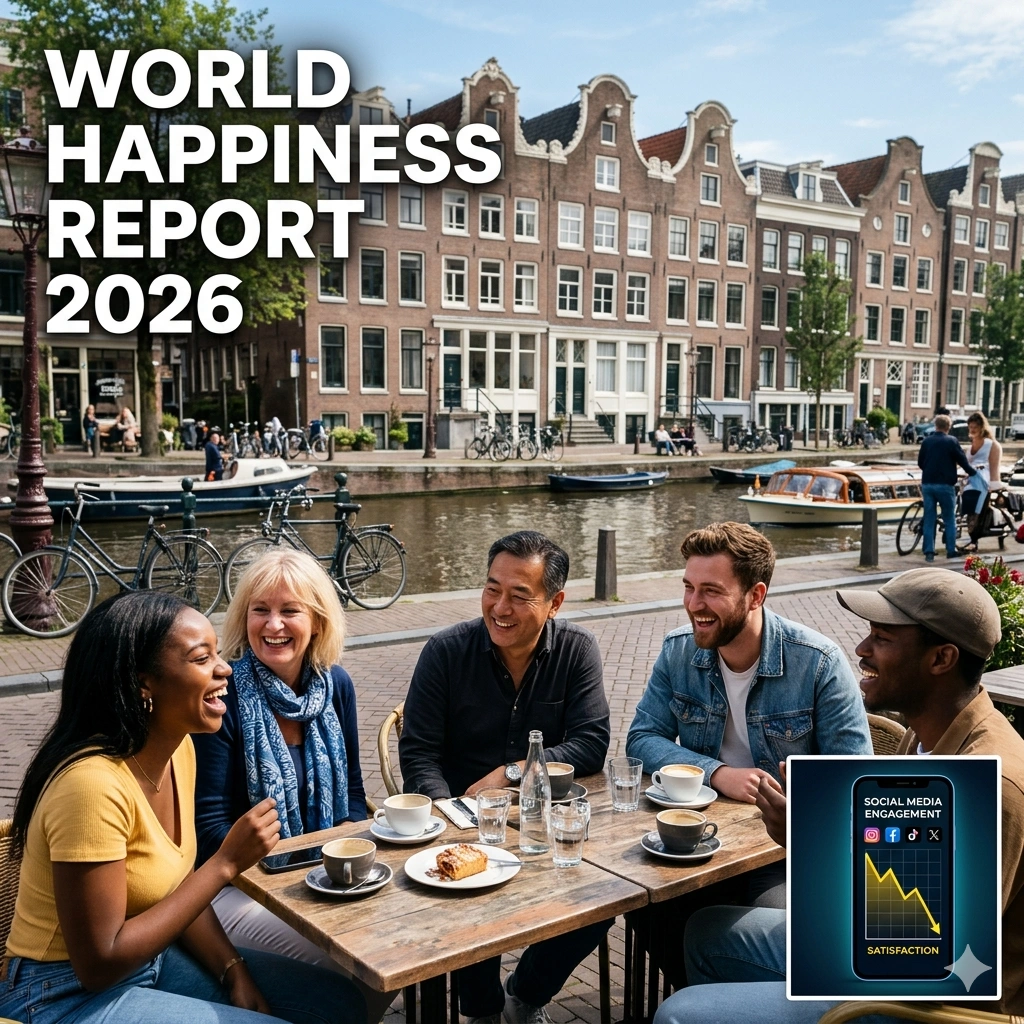
Analyzing the 2026 World Happiness Report Netherlands
The global ranking for the 2026 World Happiness Report Netherlands indicates a slip to the seventh position, the lowest ever recorded for the country. This transition is particularly striking given that the Netherlands has long been a benchmark for social stability and citizen satisfaction. The report, a joint effort by Gallup and the UN Sustainable Development Solutions Network, utilizes a three-year average of life evaluation scores to determine the final standings.
For the Dutch, the average score currently rests at 7.141 out of 10, a figure that remains high but shows a clear downward trend. Finland continues to lead the global pack, followed closely by other Nordic nations like Iceland and Denmark. Interestingly, Costa Rica has also surged ahead, suggesting that the “Dutch model” of happiness may be facing new competition from different social structures.
Experts suggest that while the 2026 World Happiness Report Netherlands score is still enviable, the plateauing of satisfaction levels is a cause for concern. The data suggests that the traditional pillars of Dutch happiness—freedom, trust in government, and income—are no longer sufficient to offset new societal pressures. This year’s report serves as a wake-up call for policy makers who have perhaps taken the nation’s high happiness levels for granted.
Economic Stability and the Culture of Generosity
- The Netherlands maintains one of the highest GDP per capita ratios in the European Union.
- Over 67% of the Dutch population participated in charitable giving over the last twelve months.
- High levels of social support ensure that 95% of citizens feel they have someone to count on in times of trouble.
- Institutional trust remains a cornerstone of the 2026 World Happiness Report Netherlands high regional ranking.
The 2026 World Happiness Report Netherlands highlights that the country’s economic engine remains a primary driver of well-being. A high GDP per capita provides a safety net that many other nations lack, allowing for a high standard of living and quality public services. This financial security is complemented by a remarkably strong culture of generosity and volunteerism.
Charitable donations are not just a fiscal metric in the Netherlands; they are a reflection of a cohesive social fabric. The fact that two-thirds of the population gives to charity suggests a deep sense of communal responsibility and empathy. This “pro-social” behavior is one of the strongest predictors of long-term happiness, acting as a buffer against individual stressors.
However, the 2026 World Happiness Report Netherlands also notes that wealth alone cannot solve the “happiness gap” appearing in younger generations. While the older population remains satisfied with their economic security, the youth are experiencing a different reality. The disconnect between financial prosperity and psychological health is the most significant takeaway from this year’s economic data.
2026 World Happiness Report Netherlands
The 2026 World Happiness Report Netherlands specifically identifies the mental health of Dutch youth as a primary factor in the country’s ranking decline. While the nation excels in traditional metrics, it is struggling with the phenomenon of “problematic social media use” (PMSU). This digital addiction is linked to rising levels of anxiety and depression among adolescents.
Researchers found that the negative correlation between screen time and well-being is more pronounced in the Netherlands than in many of its peer nations. Younger teenagers, in particular, are showing signs of psychological fatigue that were not present a decade ago. The 2026 World Happiness Report Netherlands underscores that the digital landscape is fundamentally changing the way Dutch youth perceive their lives.
This trend is troubling because the Netherlands has historically been a leader in child well-being. To see a decline in this specific area suggests that the modern digital environment may be overwhelming the existing social protections. The 2026 World Happiness Report Netherlands calls for a nationwide strategy to address digital literacy and mental health resilience among the youth.
The Impact of Digital Engagement on Youth
The rise of social media as a primary source of social interaction has created a “comparison trap” for many young Dutch people. Constant exposure to curated, idealized versions of life can lead to feelings of inadequacy and social isolation. The 2026 World Happiness Report Netherlands identifies this as a significant drain on the national happiness index.
Problematic use is often characterized by an inability to disconnect, leading to sleep deprivation and a lack of physical activity. In a country like the Netherlands, where outdoor activity and cycling are cultural staples, this shift toward sedentary digital consumption is particularly noticeable. The physical health of the youth is starting to mirror the decline in their mental health scores.
Furthermore, the 2026 World Happiness Report Netherlands highlights that the psychological complaints among teenagers are not just anecdotal. Clinical data supports the report’s findings, showing a steady increase in youth seeking professional help for digital-related stress. This strain on the healthcare system is a secondary effect of the happiness decline that the government must now manage.
Comparing the Netherlands to Nordic Neighbors
- Finland remains the undisputed leader in global happiness for the ninth consecutive year.
- Iceland and Denmark have successfully balanced digital innovation with strong social regulations.
- The Netherlands has slipped behind these neighbors due to a higher sensitivity to social media trends.
- Nordic countries often implement stricter parental controls and school-based digital health programs.
When comparing the 2026 World Happiness Report Netherlands results to Finland or Iceland, a clear distinction emerges in how these societies handle digital life. The Nordic countries have been more proactive in integrating “digital hygiene” into their education systems. This proactive approach seems to have protected their youth from the worst effects of PMSU.
In contrast, the Netherlands has taken a more liberal approach to digital integration, which may have backfired in the context of adolescent mental health. The 2026 World Happiness Report Netherlands suggests that the Dutch can learn from the Nordic models of digital regulation. Balancing freedom with protection is the new challenge for the “happiest” nations in the world.
Despite this slip, the Netherlands remains the happiest country in Western Europe, outperforming Germany, France, and the UK. This indicates that while the country has internal challenges to address, its fundamental social structure is still superior to much of the continent. The 2026 World Happiness Report Netherlands ranking is a relative decline, but the country is still a global leader.
The Role of Government and Policy Changes
The Dutch government has responded to the 2026 World Happiness Report Netherlands by proposing new legislation regarding smartphone use in schools. A nationwide ban on mobile devices in secondary school classrooms is already being implemented to foster better face-to-face interaction. This is a direct attempt to combat the digital isolation noted in the report.
Additionally, funding for youth mental health services is being significantly increased to meet the growing demand. The 2026 World Happiness Report Netherlands serves as a roadmap for where these resources should be allocated. By focusing on the most vulnerable age groups, the government hopes to reverse the downward trend in happiness scores by the 2027 report.
There is also a push for more “offline” community spaces where youth can gather without the pressure of digital performance. These initiatives aim to reclaim the physical social fabric that has been eroded by social media. The 2026 World Happiness Report Netherlands highlights that happiness is often found in the “analog” moments of life that are being lost to the screen.
Life Satisfaction Metrics and Methodology
The methodology behind the 2026 World Happiness Report Netherlands involves the Cantril Ladder, where respondents imagine a ladder with steps from 0 to 10. The top of the ladder represents the best possible life for them, and the bottom represents the worst. This subjective self-assessment is the core of the global ranking.
The Dutch score of 7.141 is derived from thousands of these individual assessments across different demographics. While the 2026 World Happiness Report Netherlands shows a drop, it is important to note that the scores are very close at the top. A difference of just a few decimal points can mean a shift of several places in the global ranking.
Nonetheless, the “trend line” is what concerns sociologists most. A steady decline over several years suggests a systemic issue rather than a one-time statistical fluke. The 2026 World Happiness Report Netherlands provides the data necessary to identify these long-term shifts before they become irreversible features of Dutch society.
Social Media and Psychological Complaints
- Anxiety levels among Dutch girls aged 12-16 have increased by 15% since 2023.
- Sleep disorders linked to “blue light” exposure are at an all-time high in urban Dutch centers.
- Cyberbullying continues to be a major factor in the 2026 World Happiness Report Netherlands youth data.
- Positive digital interactions are being overshadowed by high-frequency, low-quality scrolling.
The 2026 World Happiness Report Netherlands makes a clear distinction between “social” use and “problematic” use. Social media can be a tool for connection, but for many Dutch teens, it has become a source of stress. The constant need for validation through likes and comments creates a volatile emotional environment.
This psychological pressure often manifests as physical symptoms, including headaches and fatigue, which are being reported at higher rates in Dutch clinics. The 2026 World Happiness Report Netherlands suggests that the “digital well-being gap” is the new frontier of social inequality. Those with the skills to manage their digital lives are thriving, while others are falling behind.
Educators are now being trained to recognize the signs of PMSU in the classroom. By identifying these issues early, schools can provide the necessary support before a student’s mental health deteriorates. The 2026 World Happiness Report Netherlands has successfully moved the conversation about social media from a “parenting issue” to a public health priority.
Regional Happiness Disparities in the Netherlands
While the national average is down, the 2026 World Happiness Report Netherlands identifies significant regional differences within the country. Rural provinces like Friesland and Drenthe continue to report higher levels of life satisfaction than the heavily urbanized Randstad area. The slower pace of life in the north seems to provide a natural defense against modern stress.
In contrast, cities like Amsterdam and Rotterdam show the highest concentrations of “problematic social media use” and psychological complaints. The intensity of urban life, combined with high digital connectivity, creates a “pressure cooker” effect for residents. The 2026 World Happiness Report Netherlands suggests that urban planning must include more green spaces to offset this.
These regional insights are crucial for local municipalities as they develop their own well-being strategies. Promoting a “northern” approach to life—focused on nature and local community—could be the key to raising the national average. The 2026 World Happiness Report Netherlands proves that happiness is often tied to the local environment as much as national policy.
The Future of Dutch Happiness in 2027
Looking ahead, the 2026 World Happiness Report Netherlands provides a clear set of challenges for the coming year. The primary goal for the country is to stabilize the mental health of its youth while maintaining its economic and social strengths. Success in these areas could see the Netherlands return to the top five in 2027.
The “generosity” factor will likely remain a strong pillar of Dutch happiness, as the population continues to support those in need. If the government can successfully implement its new digital health policies, the “PMSU” factor could begin to diminish. The 2026 World Happiness Report Netherlands is a snapshot in time, but it has the power to shape the future of the nation.
Ultimately, the Dutch people remain resilient and committed to a high quality of life. The dip to seventh place is a significant event, but it does not diminish the incredible achievements of the Dutch social model. The 2026 World Happiness Report Netherlands is simply a reminder that even the happiest nations must constantly adapt to new challenges.
Charitable Giving and Social Trust
- The high rate of donation (67%) reflects a high degree of trust in non-governmental organizations.
- Social trust in the Netherlands is among the highest in the world, with neighbors often looking out for each other.
- This trust acts as a social lubricant, making daily life easier and more pleasant for the average citizen.
- The 2026 World Happiness Report Netherlands emphasizes that trust is the “secret sauce” of Dutch success.
The 2026 World Happiness Report Netherlands highlights that high levels of trust are essential for a functioning democracy and a happy population. When citizens trust their institutions and each other, they are more likely to cooperate and less likely to experience chronic stress. This social capital is a major reason why the Netherlands remains in the top ten globally.
However, trust is fragile and can be eroded by misinformation and digital polarization. The report warns that the same social media platforms causing mental health issues are also being used to spread distrust. Protecting the “Dutch trust” is just as important as protecting the mental health of the youth in the 2026 World Happiness Report Netherlands framework.
Community-building activities, such as local festivals and neighborhood “borrels,” are vital for maintaining this trust. These face-to-face interactions build the social bonds that digital platforms often fail to replicate. The 2026 World Happiness Report Netherlands advocates for a return to these traditional forms of social engagement to bolster national well-being.
The Resilience of the Dutch Model
Despite the slide in rankings, the “Dutch Model” remains one of the most successful social experiments in history. The combination of personal freedom, economic prosperity, and a strong social safety net is rare on the global stage. The 2026 World Happiness Report Netherlands confirms that the foundations of this model are still solid.
The decline to seventh place should be viewed as a “course correction” rather than a failure. It identifies the specific areas where the model needs to be updated for the 21st century. By addressing the digital challenges head-on, the Netherlands can ensure that its citizens remain some of the happiest people on Earth.
The 2026 World Happiness Report Netherlands is an essential tool for understanding the modern human condition. It shows that even in a nearly perfect society, new problems will always arise. The hallmark of a truly happy nation is not the absence of problems, but the ability to solve them together with empathy and innovation.
Conclusion: A Call for Digital Mindfulness
The 2026 World Happiness Report Netherlands has shed light on the invisible challenges facing one of the world’s most prosperous nations. The slip to seventh place is a direct consequence of a digital revolution that has outpaced our social regulations. As the Dutch move forward, the focus must be on digital mindfulness and protecting the psychological well-being of the next generation.
By prioritizing mental health over digital engagement, the Netherlands can reclaim its place at the very top of the global rankings. The strengths of the nation—its economy, its generosity, and its trust—provide the perfect platform for this transition. The 2026 World Happiness Report Netherlands is not an ending, but a new chapter in the ongoing story of Dutch prosperity.
For more details & sources visit: NL Times
Read more on Netherland news: 360 News Orbit – Netherland.