
Chinese Foreign Minister Wang Yi has issued a strong call for global cooperation, warning that ongoing trade wars and the politicization of economic relations threaten global stability. Speaking at a major forum in Beijing on Monday, Wang declared that the rise of a multipolar world is inevitable and urged countries to reject zero-sum competition in favor of dialogue and shared prosperity.
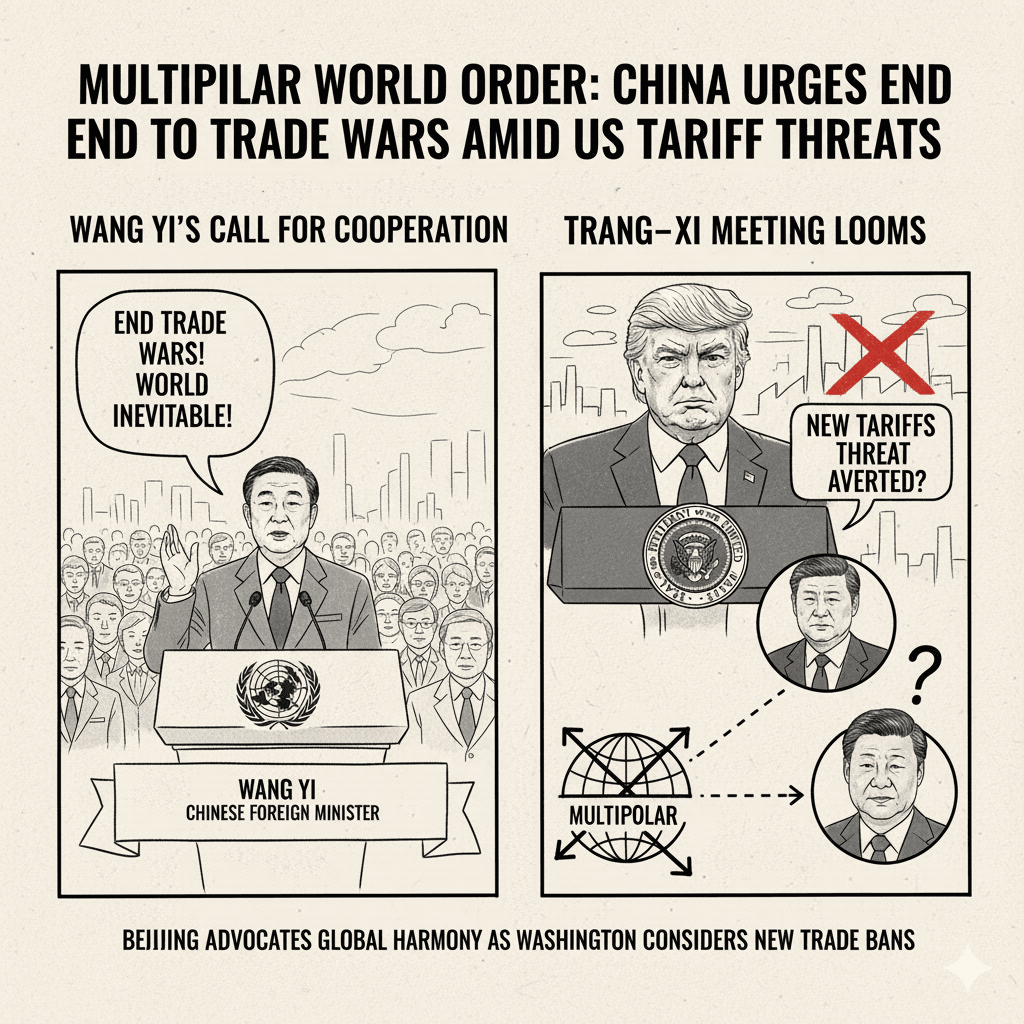
Wang Yi Calls for End to Trade Wars
Addressing diplomats, business leaders, and academics, Wang Yi said the world must “stop politicizing economic issues” and move beyond tariff battles that have disrupted global supply chains. His comments were widely interpreted as a response to renewed trade pressure from Washington, following U.S. President Donald Trump’s decision to reimpose steep tariffs on key Chinese exports earlier this year.
“The tide of history cannot be reversed — a multipolar world is coming,” Wang said. “Countries must choose cooperation over confrontation and openness over protectionism.”
Wang’s remarks come as tensions escalate over technology access, rare earth exports, and intellectual property rules — areas that remain central to the U.S.–China trade dispute.
Trump–Xi Meeting Aims to Ease Tensions
The statement precedes a highly anticipated meeting between President Donald Trump and Chinese President Xi Jinping in South Korea later this week. The two leaders are expected to discuss tariff rollbacks and frameworks to stabilize trade, as both nations face domestic economic pressures.
According to diplomatic sources, recent negotiations between U.S. Treasury Secretary Scott Bessent and China’s Vice Premier He Lifeng led to a preliminary agreement to prevent the 100% tariffs scheduled for November 1. The deal reportedly includes limited progress on soybean imports and rare earth exports, signaling cautious optimism that broader talks could resume.
China Promotes a Multipolar Global Order
In his address, Wang Yi emphasized China’s vision of a multipolar world order rooted in mutual respect, non-interference, and shared growth. He noted that China seeks to build stronger ties with the Global South, as well as with emerging economies in Asia, Africa, and Latin America.
“We are entering a new era of global balance, where no single country can dominate international affairs,” Wang asserted.
Analysts say this message reflects Beijing’s long-term goal of reshaping global governance institutions to reflect a more diverse and representative world system. It also aligns with President Xi’s Belt and Road Initiative (BRI), which aims to expand China’s influence through infrastructure investment and trade connectivity.
Global Reactions and Economic Outlook
Economists have warned that escalating tariff measures could trigger new disruptions in supply chains already strained by post-pandemic recovery and geopolitical tensions. Major U.S. technology firms and agricultural exporters have lobbied against the tariffs, citing risks to competitiveness and inflation.
In contrast, Chinese state media portrayed Wang’s remarks as a defense of globalization and multilateralism, positioning Beijing as a stabilizing force amid Western economic fragmentation.
With the Trump–Xi talks expected to shape the next phase of global trade relations, observers say Wang Yi’s call for moderation signals Beijing’s readiness to engage — but only on “equal and respectful terms.”
For more China-related updates, visit our China News page.