
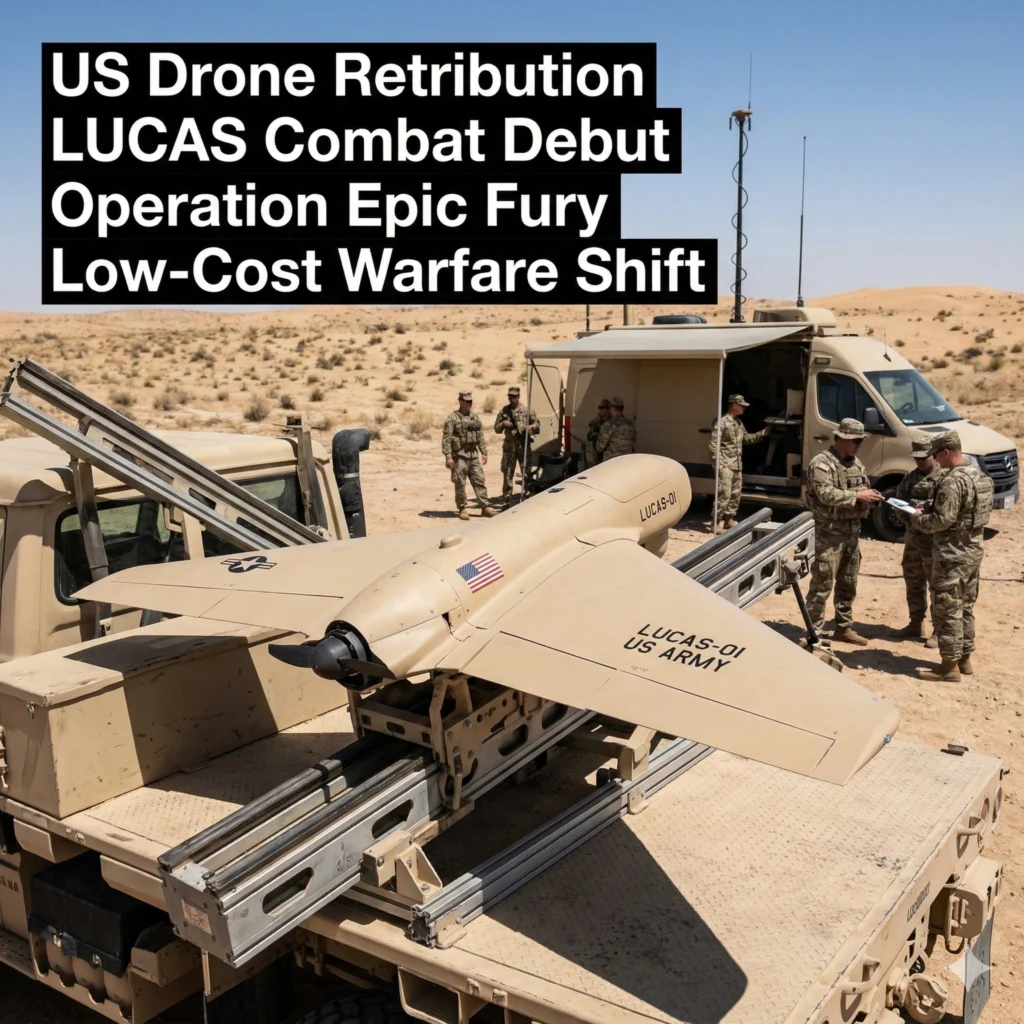
US Military Drone Strategy undergoes a revolutionary transformation as the Pentagon deploys the LUCAS platform against the very nation that inspired its design. U.S. Central Command confirmed the inaugural combat use of the Low-Cost Uncrewed Combat Attack System during Operation Epic Fury. This strategic pivot involves utilizing one-way attack drones, reverse-engineered from captured Iranian Shahed-136 specimens, to strike command facilities and air defense sites. By adopting these high-volume attrition tactics, the United States aims to overwhelm sophisticated adversary defenses through sheer numbers and cost-efficiency. The US Military Drone Strategy is now focused on “flipping the script” on adversaries who have long utilized inexpensive, mass-produced aerial weaponry to challenge traditional American air superiority.
US Military Drone Strategy
The implementation of the US Military Drone Strategy through the LUCAS platform represents a significant departure from the historical reliance on multi-million dollar precision missiles. Each LUCAS unit costs approximately $35,000, a fraction of the price of a standard Tomahawk cruise missile, allowing for unprecedented mass deployment. This shift was operationalized by the Scorpion Strike task force, which was established in late 2025 to fast-track inexpensive technology.
Military analysts suggest that the US Military Drone Strategy is now prioritizing “affordable mass” to counter the growing threat of integrated air defense systems. By launching swarms of these autonomous drones, the U.S. can exhaust enemy surface-to-air missile stocks while preserving its more expensive assets for high-value targets. This tactical evolution was tested extensively in the Arabian Gulf before being utilized in active combat operations within Iranian territory this month.
The irony of the US Military Drone Strategy has not been lost on international observers, as a global superpower replicates the domestic designs of its adversary. Iranian officials have publicly noted the mimicry, highlighting how their “asymmetric” tactics have now been integrated into the standard American playbook. Despite the criticism, the Pentagon maintains that the LUCAS program is essential for maintaining a competitive edge in modern, high-attrition warfare environments.
Technical Evolution of the LUCAS Platform
Central to the US Military Drone Strategy is the ability to produce these uncrewed systems at a scale that was previously impossible for Western defense contractors. The LUCAS drone is designed for simplicity, utilizing off-the-shelf components and a streamlined airframe that mimics the delta-wing shape of the Shahed. This design allows for long-range flight and a significant explosive payload while remaining difficult to detect on traditional radar systems.
The US Military Drone Strategy emphasizes the use of autonomous swarm intelligence, where multiple drones communicate to identify and strike various components of an enemy’s infrastructure. During Operation Epic Fury, these swarms successfully navigated through contested airspace to hit critical command and control nodes deep within Iran. The success of this mission validates the transition toward using expendable systems as a primary tool for initial strikes in high-threat zones.
Furthermore, the US Military Drone Strategy includes multi-domain launch capabilities, as demonstrated by previous tests from the USS Santa Barbara. Being able to launch these drones from both ground positions and naval vessels provides commanders with a flexible array of options for striking time-sensitive targets. This versatility ensures that the LUCAS fleet can be deployed rapidly across different theaters, including recent reported missions in Caracas, Venezuela, earlier this year.
Economic Shifts in Modern Air Power
The economic implications of the US Military Drone Strategy are profound, as it forces adversaries to spend millions of dollars in interceptors to shoot down $35,000 drones. This “cost-exchange ratio” is a fundamental pillar of the new American approach to regional conflicts and global power projection. By forcing an opponent into an unsustainable defensive spending cycle, the U.S. can degrade military capabilities without risking expensive manned aircraft.
Budgetary experts within the Department of Defense have praised the US Military Drone Strategy for its ability to stretch defense dollars further during periods of fiscal scrutiny. The Scorpion Strike task force proved that rapid prototyping and reverse engineering could deliver combat-ready results in less than a year. This accelerated timeline is now being looked at as a model for future procurement programs across all branches of the American armed forces.
The US Military Drone Strategy also reduces the political risk associated with military interventions, as the loss of a LUCAS unit does not involve a human pilot. This allows for more aggressive operations in areas where the risk to manned aviation would be considered unacceptably high. Consequently, the threshold for utilizing air power has lowered, potentially leading to more frequent and persistent strikes against non-state actors and hostile regimes alike.
Strategic Deployment Beyond the Middle East
While the primary focus remains on Iran, the US Military Drone Strategy has already shown its global reach with operations in the Western Hemisphere. The deployment of LUCAS drones in Caracas signifies that the Pentagon is willing to use these “attrition” tools to address security challenges in various geographic locations. This global footprint demonstrates that the low-cost drone model is now a permanent fixture of American foreign policy and military interventionism.
The US Military Drone Strategy in South America serves as a deterrent to other regional actors who might consider utilizing similar technology against U.S. interests. By demonstrating a superior ability to mass-produce and deploy these systems, Washington is sending a clear message about its technological dominance in the uncrewed sector. The versatility of the LUCAS platform allows it to be used for reconnaissance as well as direct-action strikes, making it a multi-purpose tool for regional commanders.
Looking forward, the US Military Drone Strategy will likely involve the integration of even more advanced AI to manage larger and more complex swarms. As the technology matures, these drones could be used to provide persistent “overwatch” in contested maritime regions, such as the South China Sea. The ability to maintain a constant, low-cost aerial presence would significantly change the dynamics of territorial disputes and international shipping lane security.
Challenges to Traditional Defense Industry
The US Military Drone Strategy is causing a ripple effect throughout the traditional defense industrial base, which has historically focused on high-cost, low-volume production. Large contractors are now being forced to adapt their business models to accommodate the demand for “expendable” and “attrition-based” platforms like LUCAS. This shift toward the US Military Drone Strategy may lead to a more diverse ecosystem of smaller, more agile tech companies entering the military market.
Some critics of the US Military Drone Strategy argue that the reliance on cheap technology could lead to a decline in the quality and reliability of American military hardware. However, proponents point out that the goal is not to replace high-end systems but to complement them with high-volume alternatives. The hybrid approach allows for a “high-low” mix of assets that provides the best of both worlds: extreme precision and overwhelming mass.
The US Military Drone Strategy also raises questions about the long-term sustainability of the supply chain for these mass-produced systems. Ensuring a steady flow of specialized components during a large-scale conflict will be a major logistical challenge for the Scorpion Strike task force. To address this, the military is looking into localized 3D printing and modular assembly techniques to keep the LUCAS fleet replenished in the field.
Ethical and Legal Considerations of Swarm Tech
As the US Military Drone Strategy moves toward higher levels of autonomy, ethical concerns regarding “killer robots” have resurfaced in international forums. The use of swarms that can operate independently of human control once launched is a point of contention for human rights organizations. They argue that the US Military Drone Strategy could lead to unintended civilian casualties or the escalation of conflicts without sufficient human oversight.
The Department of Defense counters these arguments by stating that the US Military Drone Strategy includes strict “human-in-the-loop” protocols for target selection. While the flight path and swarm coordination may be autonomous, the final decision to engage a target remains with a human commander. Maintaining this balance is crucial for the legal legitimacy of the LUCAS program and the broader US Military Drone Strategy in the eyes of the international community.
Moreover, the US Military Drone Strategy must navigate the complex legal landscape of international airspace and sovereignty. The use of one-way attack drones in Iranian territory has already sparked a diplomatic firestorm and calls for new international treaties governing uncrewed systems. As more nations adopt their own versions of the US Military Drone Strategy, the risk of accidental escalation and mid-air collisions in congested airspace increases significantly.
Future Projections for Uncrewed Combat
The future of the US Military Drone Strategy involves a continuous cycle of innovation to stay ahead of adversary countermeasures. Iranian air defenses are already being upgraded to specifically target low-flying, slow-moving drones like the LUCAS. In response, the next generation of the US Military Drone Strategy will likely incorporate stealth coatings and electronic warfare suites to bypass these newer threats.
Experts predict that the US Military Drone Strategy will eventually see these drones acting as “loyal wingmen” for manned fighters like the F-35. In this scenario, a single pilot could command a dozen LUCAS units to scout ahead, draw fire, or strike targets identified by the jet’s sensors. This integration of manned and uncrewed systems is the ultimate goal of the current US Military Drone Strategy, creating a force that is both lethal and resilient.
- Cost per LUCAS unit is roughly $35,000.
- Scorpion Strike task force manages rapid drone deployment.
- LUCAS drones use autonomous swarm technology for strikes.
- Strategy focuses on high-volume attrition against enemy defenses.
Ultimately, the success of the US Military Drone Strategy depends on the ability of the U.S. to maintain its lead in AI and manufacturing. The transition to low-cost, mass-produced weaponry is a recognition of the changing nature of 21st-century warfare. The US Military Drone Strategy is not just about a single drone; it is about a fundamental shift in how the nation thinks about and applies military force in a complex global landscape.
Impact on Global Stability and Deterrence
The US Military Drone Strategy has the potential to fundamentally alter the concept of deterrence among major powers. If a nation knows that a single provocation could result in hundreds of cheap drones hitting its infrastructure, it may be less likely to engage in aggressive behavior. Conversely, the ease with which the US Military Drone Strategy can be executed might tempt leaders into more frequent uses of force, potentially destabilizing fragile regions.
International security experts are monitoring how the US Military Drone Strategy influences the arms race in uncrewed technology. Nations like China and Russia are already developing their own low-cost attack systems to match or exceed the capabilities of the LUCAS platform. This global competition, driven by the US Military Drone Strategy, is creating a world where air defense must be constant, pervasive, and highly automated.
The long-term legacy of the US Military Drone Strategy will be decided by its effectiveness in preventing large-scale conflicts through superior tactical flexibility. By providing a mid-tier option between economic sanctions and full-scale war, the LUCAS program offers a new tool for modern statecraft. As of March 2026, the US Military Drone Strategy is at the forefront of this evolution, reshaping the skies and the battlefield in equal measure.
Summary of the New Doctrine
The US Military Drone Strategy has effectively bridged the gap between expensive precision warfare and the “low-tech” solutions used by insurgent groups. By repurposing Iranian technology, the United States has demonstrated a pragmatic approach to modern combat that prioritizes results over tradition. The deployment of LUCAS in Operation Epic Fury is just the beginning of a larger shift toward an attrition-based US Military Drone Strategy.
For more details & sources visit: The Conversation
Read more on Iran news: 360 News Orbit – Iran.