
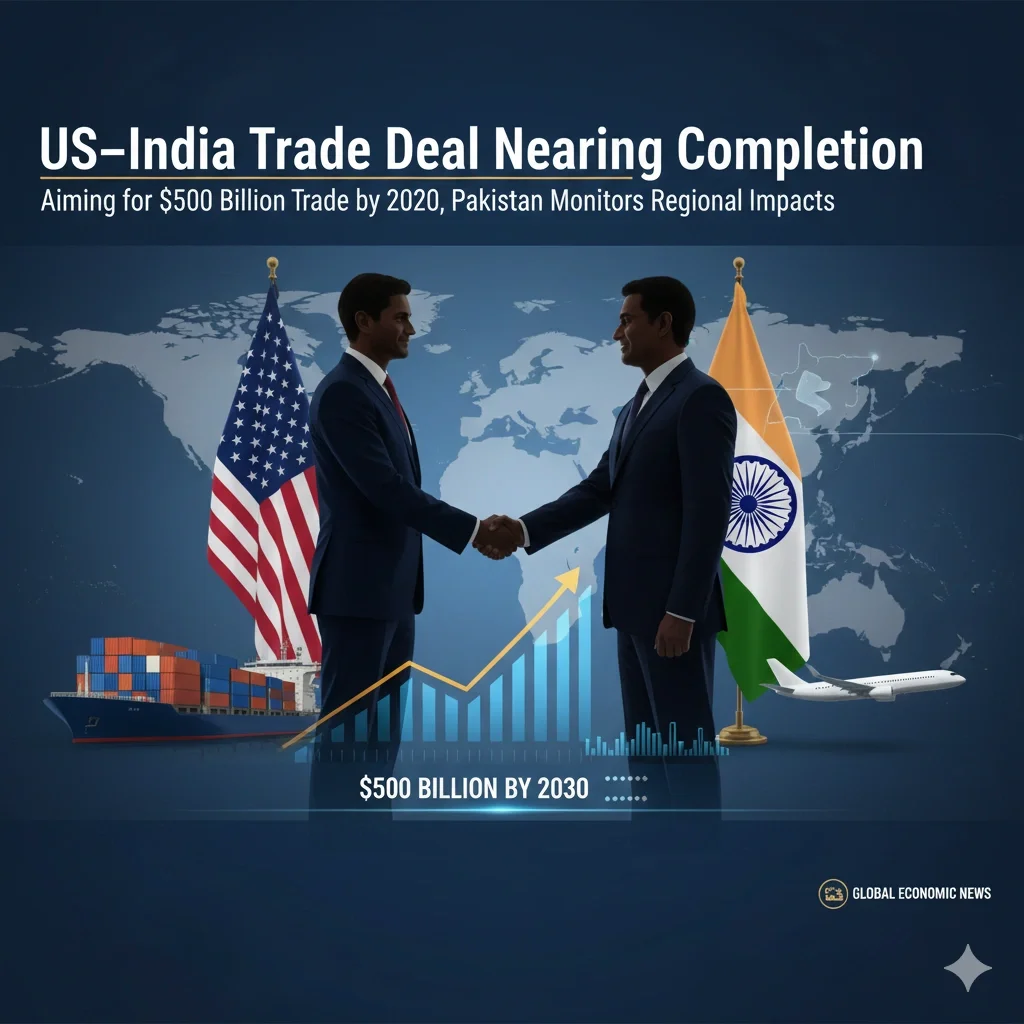
The US-India trade deal 2025 is in its final negotiation stages, with completion expected before the end of November. Market analysts suggest the agreement could dramatically reshape trade relations across South Asia, as the United States and India aim to push bilateral trade to an ambitious $500 billion by 2030. The deal’s scope, structure, and tariff frameworks are being watched closely by Pakistan, which is calibrating its next trade steps based on the outcome.
As the largest economy in the region and a key US strategic partner, India’s negotiations are viewed as a benchmark for how Washington may structure future agreements with other South Asian economies. The US-India trade deal 2025 thus carries implications far beyond the two negotiating countries.
A Benchmark Agreement for South Asia
Experts note that the US-India trade deal 2025 is likely to influence how Washington approaches trade frameworks with neighboring countries. South Asian economies—including Pakistan, Bangladesh, and Sri Lanka—are hoping the deal results in more predictable, fair, and mutually beneficial trade norms.
Pakistan, in particular, is paying close attention. For Islamabad, the finalized deal will help clarify how it should position its own exports and tariff expectations in upcoming talks with the US.
Pakistan Continues Talks with the US Trade Representative
Pakistan is already in discussions with the US Trade Representative (USTR) on multiple fronts, especially regarding tariff reductions for goods produced using US-origin raw materials.
A key example is Pakistan’s cotton-based textile sector, where many inputs are imported from the United States. Pakistan is seeking tariff relief to remain competitive in the global value chain.
The US-Pakistan trade deal, which came into force on 7 August 2025, has already brought benefits:
- Reduced tariffs on Pakistani textiles, leather, and surgical instruments
- Lower duties on agricultural exports
- Removal of Pakistan’s digital services tax in compliance with US requests
These developments highlight Islamabad’s willingness to align with US trade demands while strengthening its export competitiveness.
Tariff Pressures: India Under Strain, Pakistan Gains Some Relief
A significant dimension of the US-India trade deal 2025 is Washington’s tariff stance toward New Delhi. Recent US tariffs on India have gone as high as 50%, driven largely by India’s imports of discounted Russian oil—an issue that has caused friction between Washington and New Delhi.
By contrast, Pakistan has received relatively favorable treatment:
- Pakistan’s US tariff rate dropped from 29% to 19%, improving export potential
- India continues to face the world’s highest US reciprocal tariffs among major partners
Global think tanks—including the Peterson Institute for International Economics (PIIE) and the Center for Strategic and International Studies (CSIS)—warn that high tariff environments could:
- Slow US and global economic growth
- Prolong inflationary pressures
- Disrupt global value chains
- Hurt developing economies reliant on export markets
These concerns amplify the stakes of the US-India trade deal 2025 for the broader region.
Pakistan Waits Before Announcing Further Trade Policies
Pakistan’s economic planners have decided to pause major trade announcements until the US-India deal becomes public. This strategic wait-and-see approach allows Islamabad to:
- Adjust its tariff expectations
- Negotiate favorable terms without locking itself into premature commitments
- Evaluate how the US plans to balance its relationships with South Asian economies
Pakistan hopes that the deal will reflect equitable treatment across the region, rather than disproportionately favouring India.
A Deal Shaped by Economics and Geopolitics
Beyond trade, the US-India trade deal 2025 sits at the heart of a shifting geopolitical landscape. The United States sees India as a critical partner in Asia—economically and strategically—especially amid growing tensions with China.
Pakistan, meanwhile, is attempting to maintain strong ties with both Washington and Beijing, requiring careful political and economic navigation.
For South Asia as a whole, the trade deal will test whether regional economies can achieve balanced, sustainable growth while adapting to high-stakes geopolitical competition.
For the latest updates from India, visit our India news page.