
Brussels, November 24, 2025 – Nearly four months after President Trump and EU chief Ursula von der Leyen shook hands on a trade agreement, the US EU trade deal remains unresolved. High-level meetings in Brussels this week underscored lingering tensions over tariffs, regulatory compliance, and unmet obligations, leaving the 27-nation bloc facing uncertainty.
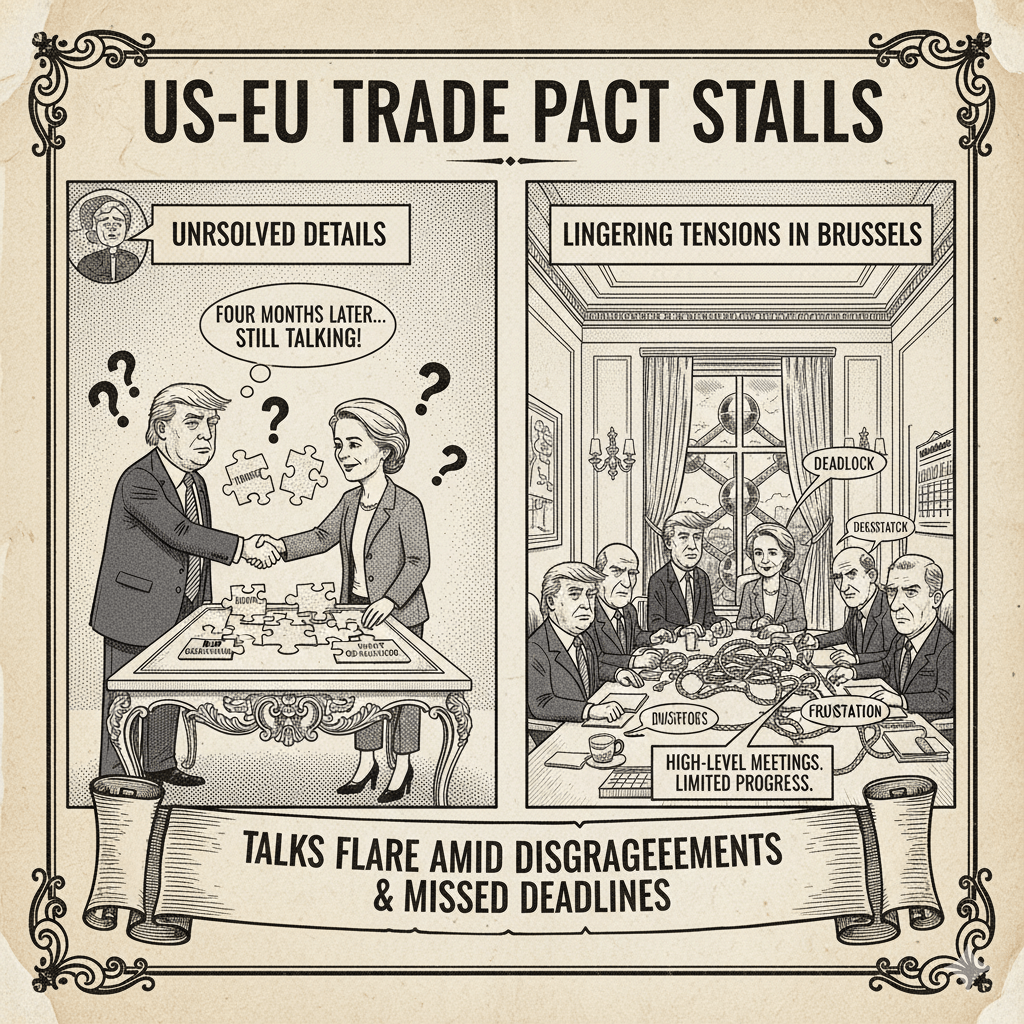
Recent Talks in Brussels
American officials, including U.S. Trade Representative Jamieson Greer and Commerce Secretary Howard Lutnick, met with EU Trade Commissioner Maros Sefcovic to try to break the deadlock. Despite weeks of negotiations, critical details remain unresolved. European leaders are pressing for improved terms on sectors like wine, spirits, steel, aluminum, medical devices, and pasta, while Washington insists the EU must first fulfill earlier commitments, including investment pledges.
Core Points of Contention
The stalled US EU trade deal highlights several sticking points:
- Tariffs: The EU still faces a 15% tariff on certain U.S. goods, with only limited exemptions granted.
- Technology regulations: U.S. companies argue that certain European regulations create unfair restrictions on American tech firms.
- Investment commitments: The U.S. demands that Europe honor prior promises of investment before additional concessions are offered.
These unresolved issues illustrate the difficulty of reconciling deeply intertwined yet politically tense trans-Atlantic economic interests.
Impact on Businesses and Consumers
The ongoing stalemate has real-world consequences. American exporters face uncertainty over tariffs and regulatory compliance, while European businesses confront delayed market access for key sectors. Consumers in both regions may see higher costs for goods such as wine, medical devices, steel, and aluminum. Analysts warn that prolonged delays could slow economic growth and undermine confidence in future trade negotiations.
Why the US EU Trade Deal Matters
The US EU trade deal represents more than a handshake—it is a critical framework for stabilizing trade between two of the world’s largest economies. Resolving these disagreements could reduce tariffs, open new markets for exporters, and harmonize technology regulations across borders. However, failure to reach consensus risks prolonging trade tensions and creating uncertainty for companies dependent on trans-Atlantic commerce.
Looking Ahead
Both sides have pledged to continue discussions, but observers note that without significant compromise, the US EU trade deal may remain stalled. Upcoming meetings in early 2026 are expected to focus on concrete timelines for investment pledges, tariff reductions, and regulatory alignment. Stakeholders are closely monitoring progress, hoping that both Washington and Brussels can translate the original handshake agreement into actionable commitments.
For more details, see The New York Times.