
The United Nations Relief and Works Agency has taken one of its most severe cost-cutting measures to date as UNRWA axes 571 Gaza staff pay amid an escalating financial crisis that now threatens the agency’s ability to operate in 2026. The decision, confirmed on January 12, 2026, comes as UNRWA faces a staggering $310 million funding shortfall following sharp donor pullbacks linked to allegations of staff ties to militant groups.
The terminated employees were former local staff members who fled Gaza during the ongoing war and had remained on UNRWA’s payroll until being placed on unpaid leave in March 2025. Their contracts were officially ended this week, with severance payments issued as the agency struggles to stay solvent.
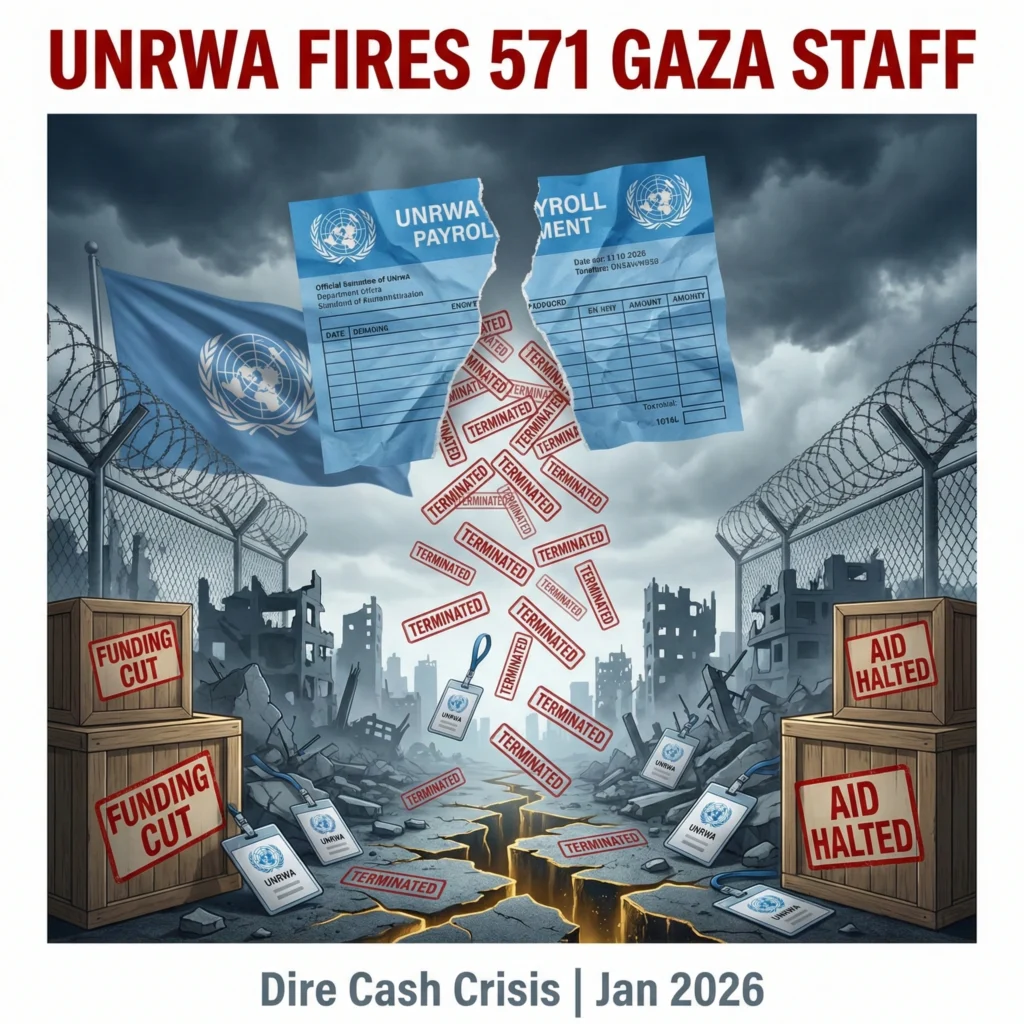
Why UNRWA Axes 571 Gaza Staff Pay Now
UNRWA stated that the move was driven by “circumstances beyond our control,” emphasizing that the affected employees could no longer perform duties remotely and that the agency lacks the funds to sustain inactive contracts. As UNRWA axes 571 Gaza staff pay, officials described the decision as unavoidable amid collapsing donor confidence and shrinking operational budgets.
According to internal figures, UNRWA had budgeted approximately $880 million for core operations but received only $570 million after multiple donor nations suspended or reduced contributions. This sudden gap has forced sweeping austerity measures across departments.
The terminated staff had not received full salaries for nearly 10 months, making the severance payouts both a legal obligation and a financial strategy to free up limited resources for active operations.
Donor Backlash and Terror Allegations Deepen Crisis
The financial collapse accelerated after Israel alleged that more than 10 percent of UNRWA’s Gaza workforce had links to terror organizations. The Israeli Defense Forces further claimed to have uncovered Hamas data infrastructure beneath UNRWA headquarters in Gaza, intensifying scrutiny of the agency.
These allegations prompted several major donors to freeze or reassess funding, delivering a devastating blow to UNRWA’s already fragile finances. While UNRWA has said it is investigating claims and cooperates with oversight mechanisms, the reputational damage has proven costly.
As UNRWA axes 571 Gaza staff pay, the agency warned that additional cuts could follow if funding is not restored quickly.
Heavy Human Toll as Conflict Continues
Beyond finances, the human cost of the war remains staggering. UNRWA reports that over 300 of its staff members have been killed in Gaza since October 2023, marking one of the deadliest periods in the agency’s 75-year history.
Despite these losses, UNRWA continues to operate with approximately 12,000 staff still inside Gaza, delivering humanitarian aid under extreme conditions. The agency also maintains refugee services across the West Bank, Lebanon, Jordan, Syria, and East Jerusalem, underscoring the scale of its mandate even as resources shrink.
Hamas Condemns Move as Rights Violation
Hamas strongly criticized the terminations, calling them unjust and labeling the decision a violation of workers’ rights. The group urged UNRWA to reverse course and reaffirm its commitment to Palestinian employees displaced by the conflict.
UNRWA, however, maintained that the decision was administrative rather than political. Officials stressed that continuing to pay staff unable to work was no longer feasible and that the agency must prioritize lifesaving services over payroll obligations.
As UNRWA axes 571 Gaza staff pay, the situation highlights the tension between humanitarian principles and financial survival.
What the Cuts Mean for UNRWA in 2026
The termination of 571 staff members signals a broader operational contraction that could worsen in the coming year. UNRWA has already warned that 2026 may bring an even deeper funding crisis, potentially forcing reductions in education, healthcare, and food assistance programs serving millions of Palestinian refugees.
The severance payments provide short-term relief, but analysts warn that without renewed donor confidence, UNRWA may face further layoffs or service suspensions. The agency has urged international partners to separate humanitarian aid from political disputes to prevent a total collapse.
Final Takeaway: A Warning Sign for Global Humanitarian Aid
As UNRWA axes 571 Gaza staff pay, the decision reflects more than a budget cut. It exposes how fragile humanitarian systems become when funding, politics, and conflict collide. The agency’s struggle underscores the risks faced by relief organizations operating in prolonged war zones under intense international scrutiny.
Unless donor funding stabilizes and accountability concerns are addressed, UNRWA’s crisis may deepen in 2026, with consequences reaching far beyond payrolls. For millions of refugees dependent on its services, the current collapse is not just an institutional problem, but a humanitarian emergency unfolding in real time.
For more details & sources visit: The Times of Israel
For the latest updates from Palestine, visit our Palestine news page.