
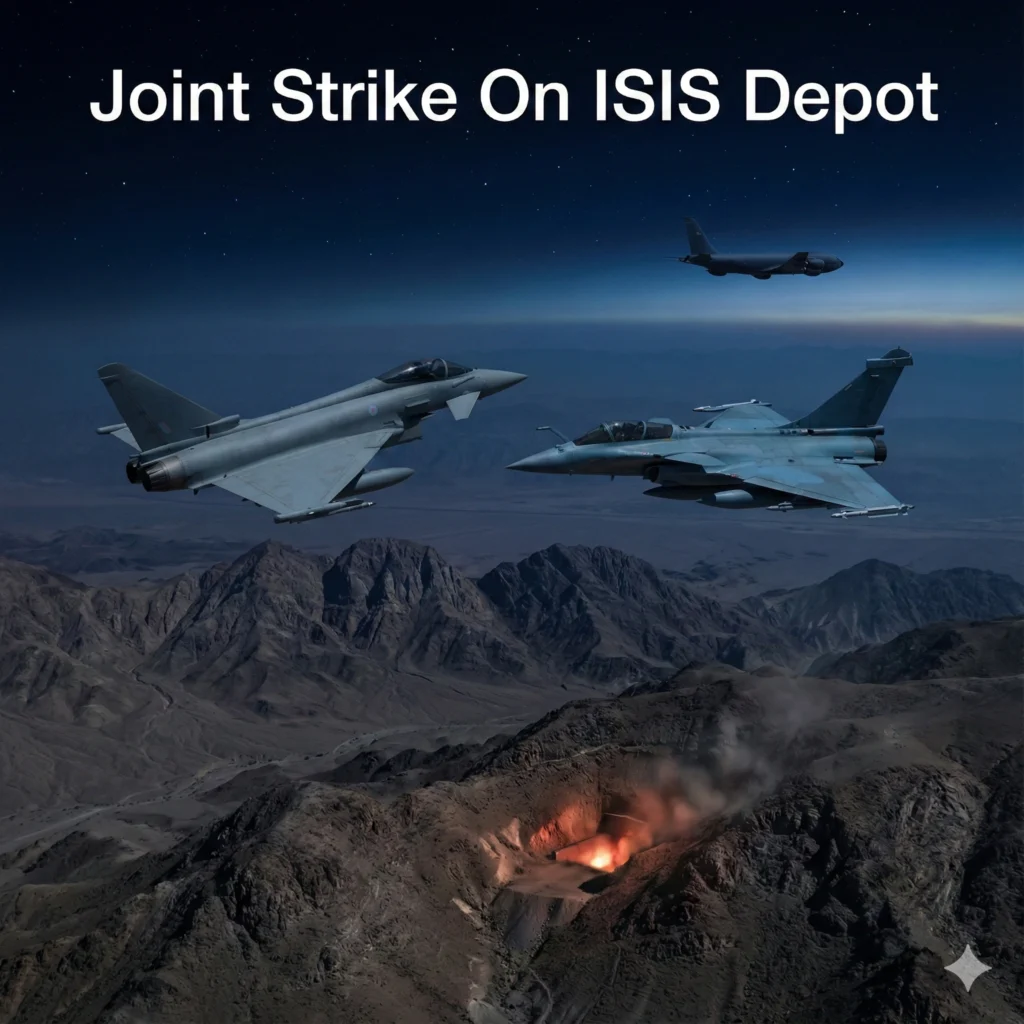
UK-France airstrikes on ISIS bunker near Palmyra marked a significant escalation in Western efforts to prevent the militant group’s resurgence in Syria. On the night of January 4, 2026, British and French forces carried out a coordinated precision strike targeting a suspected underground Islamic State weapons depot hidden in the mountainous terrain north of Palmyra.
The operation, conducted using RAF Typhoon FGR4 fighter jets armed with Paveway IV precision-guided bombs, aimed to neutralize a critical logistics hub believed to store weapons and explosives. According to UK officials, the strike was successful, civilian casualties were avoided, and all aircraft returned safely.
Background: Why Palmyra Remains Strategically Important
Palmyra has long been a symbolic and strategic location in Syria. Once seized by ISIS during its territorial expansion, the area became infamous for both cultural destruction and militant operations. Although ISIS lost its territorial control in 2019, intelligence agencies have continued to warn that remnant cells are attempting to regroup in remote and sparsely populated regions.
Western surveillance missions have detected increased militant movement in eastern and central Syria. Intelligence analysts recently identified an underground tunnel complex north of Palmyra that matched known ISIS weapons storage patterns, prompting urgent action.
UK-France Airstrikes on ISIS Bunker Near Palmyra: How the Operation Unfolded
The joint mission involved close coordination between British and French forces. RAF Typhoon FGR4 jets, supported by a Voyager aerial refuelling tanker, struck multiple tunnel entrances leading into the suspected bunker.
Key operational highlights include:
- Precision-guided Paveway IV bombs used to minimize collateral damage
- Target location verified as far from civilian settlements
- Multiple access points hit to prevent future reuse of the facility
- Early battle damage assessments confirming the target was effectively neutralized
The UK Ministry of Defence emphasized that extensive checks were conducted to ensure the area was uninhabited, reinforcing compliance with international humanitarian standards.
Western Strategy: Preventing an ISIS Resurgence
Since the fall of ISIS’s self-declared caliphate, Western militaries have maintained regular patrols and reconnaissance flights over Syria. The goal is not territorial control but disruption: preventing ISIS from rebuilding command structures, stockpiling weapons, or launching coordinated attacks.
Defence Secretary John Healey stated that the operation demonstrated Britain’s resolve and leadership, adding that the UK would continue to stand “shoulder to shoulder with allies” to confront Daesh and its violent ideology wherever it attempts to re-emerge.
France echoed similar sentiments, reaffirming its commitment to collective security and counterterrorism operations in the Middle East.
Regional and Global Implications
The UK-France airstrikes on ISIS bunker near Palmyra send a clear message that ISIS remains under close international scrutiny. While the group no longer controls territory, its ability to destabilize the region through guerrilla attacks and arms stockpiling remains a concern.
Strategically, the strike highlights:
- Continued UK-France military cooperation
- NATO allies’ readiness to act on actionable intelligence
- A shift toward targeted, intelligence-driven operations rather than large-scale deployments
These actions aim to prevent Syria from once again becoming a launchpad for transnational terrorism.
What Happens Next?
Military officials caution that this strike is part of an ongoing campaign, not a one-time response. Surveillance operations will continue, and further action remains possible if new threats are identified.
For broader context on counterterrorism operations in the region, you may also read our related coverage on ISIS activity and security developments in Syria (internal link example).
For the original reporting and official statements, see the full source coverage from CNN .
Final Takeaway
The UK–France airstrikes on ISIS bunker near Palmyra send a clear and firm message that any attempt by ISIS to regroup will be met with swift and coordinated action. By targeting a suspected underground weapons depot in a remote area, the operation demonstrated how intelligence-led strikes can disrupt militant networks without endangering civilians. This approach reflects a broader commitment by Western allies to maintain pressure on extremist groups even after their territorial defeat.
More importantly, the UK–France airstrikes on ISIS bunker near Palmyra highlight the strength of allied military cooperation and long-term counterterrorism strategy. Continuous surveillance, precise airpower, and close coordination between partners are designed to prevent ISIS from rebuilding its operational capacity. These actions reinforce the goal of ensuring that the group’s defeat is lasting and that Syria does not once again become a safe haven for violent extremism.
For more details & sources visit: CNN
For the latest updates from France, visit our France news page.