
The UAE Non-Oil PMI rose sharply at the start of 2026, signaling stronger momentum across the country’s private sector. The latest S&P Global survey shows business activity improving as companies reported a surge in new orders, higher output, and renewed confidence despite rising cost pressures.
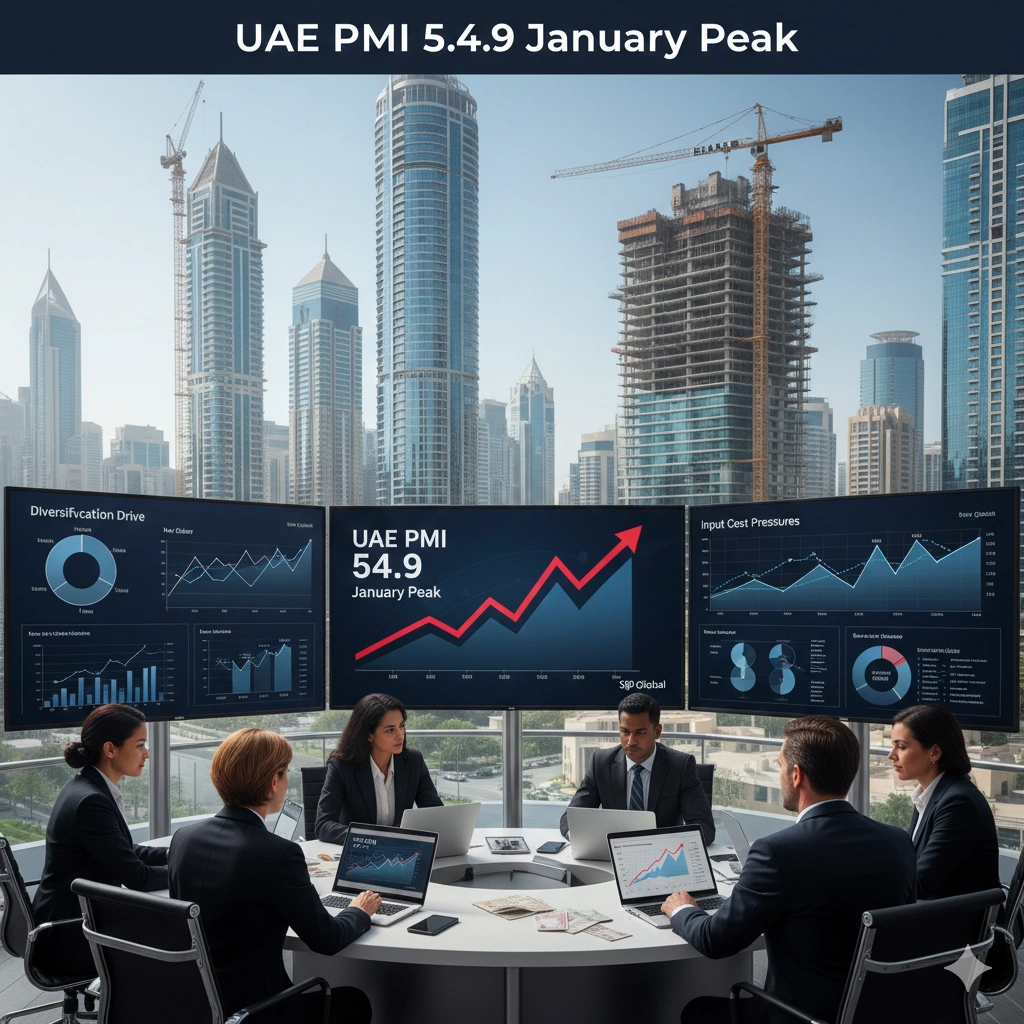
UAE Non-Oil PMI Reaches 54.9 in January 2026
The UAE Non-Oil PMI increased to 54.9 in January 2026, up from 54.2 in December, marking the highest reading in nearly a year and pointing to improving operating conditions across the non-energy economy.
A PMI figure above 50 indicates expansion, meaning the sector continues to grow at a steady pace as demand strengthens.
This improvement reflects a broader rebound in business activity, with companies reporting stronger workloads and increased production levels. Firms scaled up operations to keep pace with incoming demand, suggesting that the non-oil sector has entered 2026 on a solid footing.
New Orders Surge at Fastest Pace in Nearly Two Years
A major driver behind the rise in the UAE Non-Oil PMI was a sharp acceleration in new business, which expanded at its fastest rate in around 22 months.
Stronger domestic demand played a key role, supported by positive responses to new products and services offered by companies.
The surge in new orders pushed firms to increase output and expand purchasing activity. Businesses also built up inventories as supplier delivery times improved, helping ease pressure on capacity and allowing companies to meet rising customer demand more efficiently.
This combination of stronger demand and improved logistics highlights growing resilience within the UAE’s private sector outside the oil industry.
Rising Costs Put Pressure on Profit Margins
Despite the upbeat growth data, companies faced mounting cost pressures. Input prices climbed at their fastest rate in 18 months, driven by higher raw material costs, wages, and operating expenses.
However, intense competition across the market limited the ability of firms to pass these increases on to customers. Many businesses kept selling prices relatively stable to protect market share, which squeezed profit margins even as activity expanded.
This dynamic suggests that while growth remains healthy, profitability could remain under pressure if cost inflation continues.
Business Activity and Purchasing Expand Sharply
Stronger order inflows led companies to raise production and increase purchasing at a rapid pace. Survey data indicated that purchasing activity grew at one of the fastest rates in several years as firms prepared for sustained demand.
Stock levels also increased as businesses built inventories to prevent supply disruptions. At the same time, improved supplier delivery times helped reduce bottlenecks, allowing companies to operate more efficiently.
These developments point to a more stable supply environment compared with previous periods of global logistical strain.
Confidence Improves as Firms Eye Expansion
Business sentiment across the UAE’s non-oil private sector improved, with companies expressing optimism about future demand. Expectations for growth were supported by stronger domestic conditions and continued investment in new products and services.
The overall tone of the survey suggests firms are preparing for expansion opportunities in 2026, even as they navigate competitive pricing and higher input costs.
Regional Context Shows Mixed Momentum
While the UAE recorded solid expansion, growth trends across the region remained uneven. Saudi Arabia’s non-oil private sector continued to expand, reflecting resilient demand conditions at the start of the year.
This broader regional performance highlights the Gulf’s ongoing push to diversify economic activity beyond hydrocarbons.
What the Latest UAE Non-Oil PMI Signals for the Economy
The latest UAE Non-Oil PMI reading reinforces the view that the country’s diversification strategy is supporting steady private-sector growth. Rising new orders, stronger output, and improved business confidence indicate that domestic demand remains a key pillar of economic expansion.
At the same time, persistent cost pressures and tight competition show that businesses must balance growth with margin protection. The coming months will likely depend on whether demand continues to strengthen enough to offset rising expenses.
Overall, the January data suggests the UAE’s non-oil economy has begun 2026 with solid momentum, positioning the private sector for continued expansion if current trends hold.
For more details & sources visit: Arab News
Stay informed with the latest United Arab Emirates news on 360 News Orbit – UAE.