
Turkey Italy Joint UAV Production is set to achieve its first major manufacturing milestone by April 2026, marking a rapid success for the strategic defense partnership between Baykar and Leonardo. During a recent financial briefing, Leonardo CEO Roberto Cingolani confirmed that the project is currently running ahead of schedule, with the first medium-class unmanned aerial vehicles (UAVs) nearing completion. This collaboration represents a significant integration of Turkish aerospace innovation and Italian high-tech manufacturing, aimed at capturing a massive share of the global drone market.
The Turkey Italy Joint UAV Production initiative has moved from the drawing board to the factory floor in just eight months of active development. Engineers from both nations are collaborating daily at Leonardo’s Ronchi dei Legionari facility to synchronize complex hardware and software systems. This project is not merely about a single drone; it is a comprehensive program designed to develop a family of fixed-wing and rotary-wing platforms that can meet the diverse operational needs of modern military forces.
As the April production deadline approaches, the defense industry is watching closely to see how this partnership influences the broader Global Combat Air Program (GCAP). By combining Baykar’s proven combat-tested designs with Leonardo’s world-class electronics and sensors, the venture is positioned to deliver a superior medium-class system. The speed of this development cycle suggests that the Turkey Italy Joint UAV Production framework could become a blueprint for future multinational defense collaborations across Europe and the Middle East.
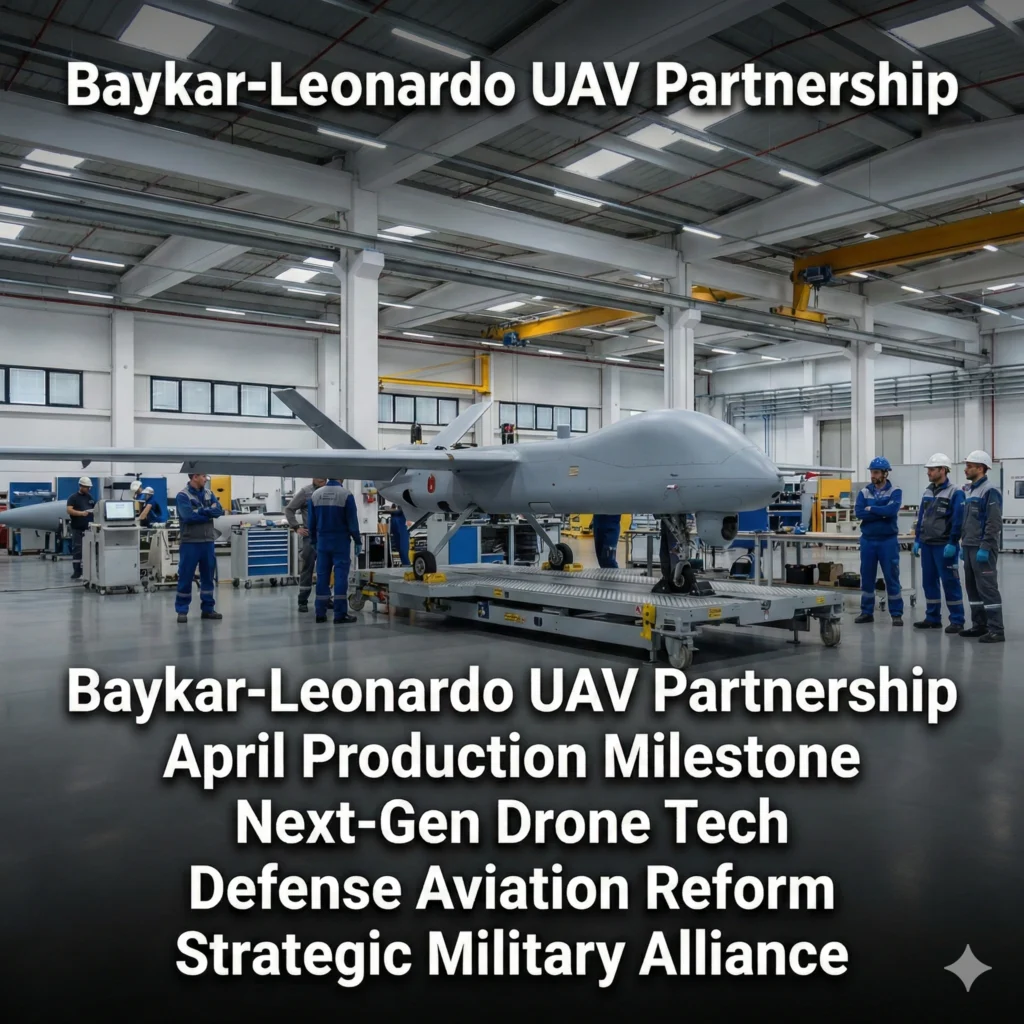
Turkey Italy Joint UAV Production and the April Milestone
The Turkey Italy Joint UAV Production timeline has surprised many industry analysts who expected a multi-year development cycle. CEO Roberto Cingolani’s announcement that the first units will be finished by April demonstrates the efficiency of the Baykar-Leonardo synergy. These initial units represent the “medium-class” tier of drones, which are highly sought after for their balance of endurance, payload capacity, and cost-effectiveness in both surveillance and strike missions.
The final assembly at the Ronchi dei Legionari facility is currently focused on integrating advanced Italian avionics into the Turkish-designed airframes. This facility has been repurposed to handle the high-tempo production required to meet the April goal. The success of the Turkey Italy Joint UAV Production at this site is also expected to provide a significant boost to Leonardo’s specialized electronics division, which is providing the “brains” for these sophisticated aerial platforms.
Following the April rollout, the aircraft will transition into an intensive one-year testing and demonstration phase. This phase is critical for validating the performance of the new technologies integrated during the development process. The Turkey Italy Joint UAV Production team is specifically focused on ensuring that these drones can operate in contested electronic environments, a requirement that has become mandatory following recent global conflicts.
Testing Swarm Operations and Landing Capabilities
A core focus of the Turkey Italy Joint UAV Production program is the development of complex coordinated swarm operations. This technology allows multiple drones to communicate and act as a single cohesive unit, overwhelming enemy defenses through sheer numbers and synchronized maneuvers. The upcoming trials in mid-2026 will push the boundaries of current AI-driven flight control systems to achieve this goal.
- Development of autonomous “leader-follower” algorithms for drone clusters.
- Integration of jam-resistant communication links for inter-drone data sharing.
- Testing of specialized short-takeoff and vertical landing (STOVL) capabilities.
- Validation of automated target acquisition and hand-off between swarm members.
The ability to perform specialized landings is another key pillar of the Turkey Italy Joint UAV Production. Researchers are working on systems that allow these medium-class drones to land on unconventional surfaces, including small naval vessels and rugged forward operating bases. This flexibility greatly expands the tactical utility of the drones, making them an attractive option for navies and specialized ground units that operate far from traditional runways.
These specialized landing trials are scheduled to take place at various testing ranges across the Mediterranean. By proving that the Turkey Italy Joint UAV Production units can handle these difficult maneuvers, Baykar and Leonardo hope to secure large-scale contracts from maritime nations. The successful integration of these capabilities will mark a new era for medium-class UAVs, moving them away from reliance on large, vulnerable airfields.
Leonardo’s Financial Strategy and GCAP Integration
The Turkey Italy Joint UAV Production is a vital component of Leonardo’s 2025-2026 financial strategy, as highlighted in Cingolani’s recent briefing. By investing in high-growth drone technology, the company is diversifying its portfolio and reducing its dependence on traditional manned aircraft programs. The CEO noted that the project is already showing a positive impact on the company’s specialized electronics division’s bottom line.
Furthermore, the Turkey Italy Joint UAV Production is being developed with an eye toward the Global Combat Air Program (GCAP). The technologies birthed in this drone partnership are expected to trickle up into the sixth-generation fighter programs currently being developed by Italy, the UK, and Japan. This “technology bridge” ensures that the investments made in the UAV sector provide long-term value across the entire defense framework.
- Alignment of UAV sensors with GCAP data-fusion requirements.
- Use of modular architecture for easy software updates across platforms.
- Shared manufacturing techniques to lower costs for future stealth airframes.
- Collaborative training programs for pilots and drone operators.
This strategic alignment makes the Turkey Italy Joint UAV Production much more than a standalone project. It is a testing ground for the future of networked warfare, where manned and unmanned systems work together in a seamless “system of systems.” The financial community has reacted positively to this roadmap, seeing it as a way for Leonardo to stay at the cutting edge of the global defense industry.
Baykar’s Role in Modernizing European Drone Fleets
Turkey’s Baykar brings unparalleled combat experience to the Turkey Italy Joint UAV Production. Having seen its platforms perform in multiple theaters of war, Baykar provides the practical, “battle-hardened” insights that are often missing from purely theoretical development programs. This experience has been instrumental in keeping the production phase ahead of the original timeline.
The Turkey Italy Joint UAV Production allows Baykar to expand its influence within NATO and European defense circles. By partnering with an established European giant like Leonardo, Baykar can navigate the complex regulatory and procurement landscapes of the EU more effectively. This partnership is a win for both sides: Italy gets access to world-leading drone designs, and Turkey gains a powerful gateway into the Western defense market.
The collaboration also highlights the growing importance of “middle-power” defense alliances. As the cost of developing high-end military technology continues to skyrocket, partnerships like the Turkey Italy Joint UAV Production allow nations to share the burden and the rewards. This trend toward collaborative manufacturing is expected to accelerate as more countries seek to build indigenous defense capabilities without the massive overhead of a purely domestic program.
Future Projections: Mass Production and Global Sales
Looking beyond the 2026 testing phase, the ultimate goal of the Turkey Italy Joint UAV Production is mass production. Leonardo and Baykar have projected that the sales of these systems could eventually reach hundreds of units globally. The target market includes not just European and Middle Eastern nations, but also countries in South America and Southeast Asia looking for a reliable, medium-class UAV solution.
- Establishment of regional service and maintenance hubs for global clients.
- Creation of localized assembly lines in key customer nations.
- Development of export-compliant “light” versions for non-NATO allies.
- Continuous software integration to counter evolving electronic threats.
The scalability of the Turkey Italy Joint UAV Production is one of its most attractive features. The use of modular components means that the drones can be easily customized for specific mission types, whether it be maritime patrol, border security, or precision strike. This versatility is expected to drive high demand once the mass production phase begins in earnest toward the end of 2027.
The partnership is also exploring the use of 3D printing and advanced composite materials to further speed up the Turkey Italy Joint UAV Production. By lowering the time and cost required to build each unit, the partners can offer a more competitive price point than traditional aerospace manufacturers. This focus on “affordable mass” is a central theme of the 2026 production strategy.
Advancing Specialized Electronics and Sensors
A major benefit of the Turkey Italy Joint UAV Production is the advancement of specialized electronics and sensors. Leonardo’s expertise in radar and electronic warfare systems is being integrated directly into the UAV’s airframe. These sensors allow the drone to “see” through adverse weather and identify targets with a level of precision that was previously reserved for much larger aircraft.
The Turkey Italy Joint UAV Production is also a pioneer in “cognitive” electronic warfare. This involves using AI to automatically detect and jam enemy radar signals, protecting the drone from anti-aircraft systems. This high-end technology is a significant value-add that sets the Baykar-Leonardo drone apart from cheaper, less capable competitors in the international market.
As the electronics division continues to refine these systems, the Turkey Italy Joint UAV Production will likely see several “Block” updates over its lifecycle. This allows the drones to stay relevant as new threats emerge on the battlefield. The ability to upgrade the electronics without redesigning the entire airframe is a key advantage of the modular approach adopted by the Turkish and Italian teams.
Impact on the Ronchi dei Legionari Defense Cluster
The Turkey Italy Joint UAV Production has breathed new life into the Ronchi dei Legionari defense cluster in Italy. The facility has become a hub of international activity, attracting top engineering talent from across Europe and Turkey. This influx of expertise is helping to maintain Italy’s status as a leader in aerospace manufacturing.
The economic impact on the local region has been significant, with the Turkey Italy Joint UAV Production creating hundreds of high-skilled jobs. These roles range from software development to advanced composite manufacturing, providing a boost to the local economy and the broader Italian industrial base. The project is seen as a source of national pride and a symbol of Italy’s commitment to modernizing its defense sector.
Moreover, the success of the Turkey Italy Joint UAV Production at this facility has paved the way for future joint ventures. Leonardo is reportedly exploring similar partnerships in other domains, such as naval systems and ground vehicles. The Ronchi dei Legionari plant is now a model of how international cooperation can drive industrial growth and technological innovation simultaneously.
Finalizing the Fixed-Wing and Rotary-Wing Platforms
The Turkey Italy Joint UAV Production program is unique in its dual focus on both fixed-wing and rotary-wing systems. Fixed-wing drones are ideal for long-range surveillance and high-altitude missions, while rotary-wing (helicopter-style) drones offer the ability to hover and operate from very small spaces. By developing both, the partnership covers the entire spectrum of medium-class UAV requirements.
Finalizing these two distinct platforms requires a massive amount of engineering coordination. The Turkey Italy Joint UAV Production team must ensure that both systems share as many common components as possible to simplify logistics and maintenance for the end-user. This “commonality” approach is a key selling point for nations that want to operate a diverse fleet of drones without the headache of managing different spare parts and training programs.
The rotary-wing variant of the Turkey Italy Joint UAV Production is particularly interesting for urban operations and search-and-rescue missions. Its ability to navigate tight spaces and land on rooftops makes it an invaluable tool for modern emergency services and special forces. The completion of these prototypes by April will mark a major leap forward in tactical unmanned aviation.
Global Market Competition and Strategic Positioning
The Turkey Italy Joint UAV Production is entering a highly competitive global market, with established players from the US, China, and Israel already offering mature systems. However, the Baykar-Leonardo partnership has a unique advantage: it combines the low-cost, high-efficiency manufacturing of Turkey with the high-end technology and regulatory access of Italy. This combination is hard for any single nation to match.
The strategic positioning of the Turkey Italy Joint UAV Production is aimed at the “sweet spot” of the market. While some drones are too cheap and unreliable for high-end missions, and others are too expensive for mass deployment, the medium-class drone being built by Italy and Turkey offers a perfect middle ground. This makes it an ideal choice for nations looking to modernize their air forces on a sustainable budget.
- Leveraging Turkey’s “Diplomacy of Drones” to open new markets in Africa.
- Utilizing Italy’s standing in the EU to secure continent-wide defense contracts.
- Positioning the drone as a “NATO-standard” alternative to Chinese exports.
- Focusing on transparency and reliability to build long-term trust with buyers.
As the production phase accelerates, the Turkey Italy Joint UAV Production is becoming a powerful geopolitical tool. It allows both nations to build stronger security ties with their neighbors and allies through joint manufacturing and technology sharing. This “soft power” aspect of the defense industry is a key reason why both governments have prioritized the project so heavily in 2026.
Conclusion: The Spring Rollout and Beyond
The Turkey Italy Joint UAV Production is on track for a historic spring rollout, with the first units expected to be finished by April. This achievement is a testament to the hard work and coordination of the Baykar and Leonardo teams. By moving ahead of schedule, they have demonstrated that international defense partnerships can be agile and efficient when there is a clear shared vision.
As the testing phase begins, the world will get its first look at what the Turkey Italy Joint UAV Production can really do. From swarm operations to specialized landings, the capabilities being built into these drones are truly next-generation. The success of this program will not only bolster the defenses of Italy and Turkey but will also reshape the global landscape of unmanned aviation for years to come.
The Turkey Italy Joint UAV Production is a shining example of what happens when two nations combine their unique strengths to solve complex challenges. As we look toward the April milestone, it is clear that the future of defense is collaborative, and the Turkey-Italy partnership is leading the way. The sky is no longer the limit; it is just the beginning of this transformative journey.
For more details & sources visit: Anadolu Agency
For the latest updates from the Italy, visit our Italy news page.