
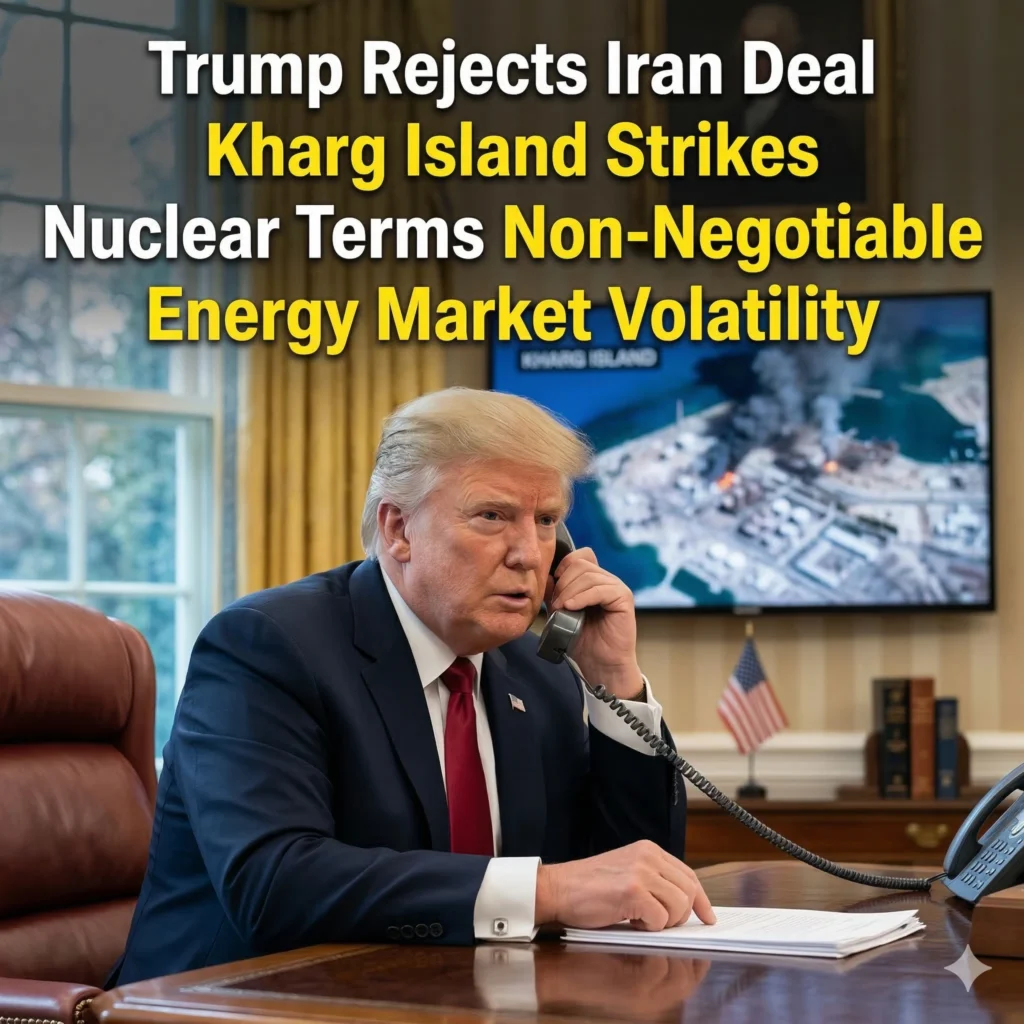
President Donald Trump recently addressed the Iran Peace Deal during a press conference, making it clear that the United States is not ready to sign any immediate agreements with Tehran. Following the devastating strikes on Kharg Island, the administration has signaled a shift in strategy that prioritizes total military leverage over diplomatic haste. This refusal to engage in a rapid ceasefire comes as the global community watches the escalating conflict with intense concern for regional stability. Trump emphasized that while the Iranian leadership may be seeking a way out, the current terms presented by the Islamic Republic do not meet the rigorous security standards required by the White House.
The President confirmed that the military infrastructure on Kharg Island has been significantly neutralized, leaving Iran’s primary oil terminal in a state of severe disarray. This strategic move was designed to cripple the economic engine of the regime while simultaneously removing key military assets from the board. Despite the destruction, Trump indicated that the “fun” of the military campaign might continue if the regime does not comply with international demands. By focusing on the removal of nuclear threats and the stabilization of the Strait of Hormuz, the U.S. is setting a high bar for any potential peace treaty.
Historical Context of the Iran Peace Deal
The pursuit of a lasting Iran Peace Deal has been a cornerstone of Middle Eastern diplomacy for decades, yet it remains one of the most elusive goals in modern geopolitics. Since the withdrawal from previous nuclear agreements, the relationship between Washington and Tehran has been characterized by “maximum pressure” campaigns and intermittent military skirmishes. These tensions peaked this week after American forces targeted the Kharg Island facility, which handles roughly 90 percent of the nation’s crude exports.
Experts believe that the current administration is using these strikes to force a complete capitulation rather than a compromise. The historical precedent for such high-stakes negotiations suggests that without a clear economic or military advantage, neither side is willing to blink first. Trump’s latest rhetoric suggests that he views the previous frameworks as fundamentally flawed and is seeking a “new deal” that addresses ballistic missiles and proxy warfare.
Strategic Impact of Kharg Island Strikes
The recent bombardment of Kharg Island serves as a physical manifestation of why an Iran Peace Deal is currently off the table. By targeting the military installations near the oil terminal, the United States has effectively held the Iranian economy hostage without actually destroying the energy infrastructure itself. Central Command officials have been careful to note that the core energy lines were spared to prevent a global oil price catastrophe.
This calculated restraint allows the U.S. to maintain a “carrot and stick” approach where the “stick” is the total destruction of the facility and the “carrot” is the lifting of sanctions. However, the regime in Tehran views this as a direct violation of sovereignty, making the path to a deal even more treacherous. The administration’s refusal to accept current terms reflects a belief that the Iranian government is at its weakest point in years.
Iran Peace Deal
The prospect of an Iran Peace Deal hinges on the verified dismantling of the Iranian nuclear program, a condition that Trump has doubled down on during his recent media appearances. He told reporters that any signature on a document must be preceded by “concrete actions” rather than just “hollow promises” from the leadership in Tehran. This stance has created a significant gap between the expectations of the two nations, as Iran continues to demand the removal of all economic sanctions upfront.
Furthermore, the uncertainty surrounding the leadership in Iran has complicated the negotiation process significantly. With rumors circulating about the health and status of Supreme Leader Mojtaba Khamenei, the U.S. is hesitant to sign a deal with a government that may be facing an internal power struggle. Trump’s suggestion that the leader should “surrender if he is alive” indicates a psychological warfare component that accompanies the kinetic military operations currently underway.
The Role of Global Oil Markets
Global energy markets have reacted sharply to the stalling of the Iran Peace Deal, with oil prices hitting four-year highs in a matter of days. While the Trump administration downplays the impact on the average consumer, analysts warn that prolonged conflict in the Persian Gulf will inevitably lead to higher costs at the pump. The White House maintains that these “clogs” in the energy market are temporary and will be resolved once the Strait of Hormuz is fully secured.
To mitigate these risks, the U.S. has encouraged domestic producers to increase output, though this is a long-term solution to a short-term crisis. The intersection of energy security and foreign policy has never been more evident than in the current standoff. If the administration cannot provide a clear timeline for a resolution, market volatility is expected to persist throughout the spring and into the summer months.
Domestic Political Pressure and Criticism
Inside the United States, the refusal to expedite an Iran Peace Deal has drawn both praise and sharp criticism from various political factions. Supporters of the President’s “tough on Tehran” stance argue that a quick deal would only embolden the regime and provide it with much-needed cash to fund proxy groups. They believe that the strikes on Kharg Island were a necessary show of force to prevent a larger regional war.
- Critics argue that the lack of a coherent long-term strategy could lead to an “infinite war” scenario.
- Many analysts point out that the absence of a diplomatic channel increases the risk of a miscalculation.
- Humanitarian groups have expressed concern over the impact of sanctions on the Iranian civilian population.
- Some members of Congress are demanding a clearer definition of what an “acceptable” deal actually looks like.
The Question of Iranian Leadership
A major hurdle for any future Iran Peace Deal is the legitimacy and stability of the Iranian high command. Trump openly questioned whether Mojtaba Khamenei is still in control or even alive, a move that has further incensed the Iranian political establishment. Such public questioning of a sovereign leader’s status is rare in diplomacy and suggests that the U.S. might be angling for regime change.
If the leadership is indeed in flux, it creates a vacuum where hardline military factions like the IRGC could take more aggressive control. This would make the possibility of a peaceful resolution nearly impossible in the short term. The administration’s strategy seems to involve waiting for the internal pressure within Iran to reach a breaking point, forcing a new leadership to come to the table with fewer demands.
Military Readiness and Future Operations
The Pentagon has indicated that more strikes could follow if the Iran Peace Deal remains stalled and the regime continues its provocative behavior. While the Kharg Island mission was successful, there are numerous other strategic sites that have been identified for potential action. This “escalation ladder” is a key part of the administration’s negotiation tactic, though it carries the risk of a full-scale regional conflict involving Israel and other allies.
Ground forces in the region have been put on high alert to protect U.S. interests and ensure that shipping lanes remain open. The coordination between the U.S. and Israeli intelligence has reached an all-time high, with both nations sharing the goal of neutralizing the “northern threat.” Trump’s comment about conducting strikes “for fun” has been dismissed by some as hyperbole, but it reflects a military posture that is unapologetically aggressive.
Economic Sanctions as a Negotiation Tool
The economic component of the Iran Peace Deal cannot be overstated, as the Iranian rial continues to plummet against the dollar. Sanctions have successfully cut off most of Iran’s access to the international banking system, making it difficult for the government to pay its own security forces. The White House believes that this financial strangulation is the most effective way to bring Tehran back to the bargaining table on American terms.
- The U.S. Treasury has identified several shell companies used to bypass oil sanctions.
- New restrictions are being placed on the trade of industrial metals and technology.
- Secondary sanctions are being threatened against any nation that continues to buy Iranian crude.
- The goal is to reduce Iran’s oil exports to “zero” until a deal is finalized.
Regional Allies and Their Interests
An effective Iran Peace Deal must also take into account the security concerns of regional partners like Saudi Arabia, the UAE, and Israel. These nations have long felt excluded from previous negotiations and are now demanding a seat at the table. They are particularly concerned about Iran’s drone technology and its influence in Yemen, Lebanon, and Iraq.
Trump has made it a priority to consult with these allies before making any major diplomatic moves. This collective approach ensures that any agreement reached will have the backing of the nations most affected by Iranian regional policy. However, this also means that the list of demands for a deal is much longer and more complex than it was in previous years, leading to the current stalemate.
The Humanitarian Perspective
While the focus remains on the Iran Peace Deal and military strikes, the humanitarian situation within Iran continues to deteriorate. The combination of heavy sanctions and the disruption of oil exports has led to shortages of medicine and basic food items. This has sparked protests in several Iranian cities, which the regime has met with a heavy-handed response, further complicating the international image of the country.
International observers are calling for “humanitarian corridors” or specific exemptions that would allow aid to reach those in need without benefiting the military. The U.S. maintains that the responsibility for the suffering of the Iranian people lies solely with the regime’s choices. This moral debate adds another layer of complexity to an already fraught diplomatic process that shows no signs of an easy resolution.
Comparing Past and Present Strategies
To understand the current failure to reach an Iran Peace Deal, one must compare the current administration’s tactics with those of the past. The previous approach focused on a narrow nuclear scope, whereas the current strategy is holistic, aiming to dismantle the entire regional influence of the Islamic Republic. This “all or nothing” mentality is what has led to the current impasse and the subsequent military action on Kharg Island.
- The 2015 agreement was seen as too lenient by the current White House staff.
- Current demands include the total cessation of all uranium enrichment activities.
- The U.S. is now requiring permanent inspections of all military sites.
- The inclusion of the ballistic missile program is a non-negotiable point for Trump.
The Role of the United Nations
The United Nations has attempted to mediate the Iran Peace Deal with little success, as both the U.S. and Iran have bypassed traditional UN channels. The Security Council remains divided, with Russia and China often siding with Tehran or calling for a more balanced approach. This division has rendered the UN largely ineffective in de-escalating the current military conflict.
The Secretary-General has issued several warnings about the potential for a “global catastrophe” if the strikes continue, but these pleas have mostly fallen on deaf ears in Washington. The administration views the UN as a forum that has historically failed to hold Iran accountable, leading them to prefer bilateral or “coalition of the willing” diplomacy. Without a unified international front, the path to peace remains blocked by competing national interests.
Future Outlook for 2026
As we move further into 2026, the likelihood of a rapid Iran Peace Deal appears slim unless there is a significant change in the Iranian government. The military success at Kharg Island has given the U.S. a sense of confidence that they can dictate terms, but it has also backed the Iranian regime into a corner. Historically, a cornered regime is often more dangerous and prone to unpredictable retaliatory actions.
The next few weeks will be critical as the world waits to see if Iran will attempt to block the Strait of Hormuz or if they will finally concede to the heavy pressure. Trump’s refusal to sign a “bad deal” means that the state of war will likely persist, keeping energy prices high and regional tensions at a boiling point. The international community can only hope that a channel for communication remains open to prevent a total collapse into regional chaos.
Negotiating Under Fire
The concept of “negotiating under fire” is exactly what is happening with the Iran Peace Deal right now. The U.S. believes that the best time to talk is when the opponent is reeling from a major blow, such as the destruction of their primary economic hub. Tehran, conversely, views negotiating under such conditions as a total surrender, which is culturally and politically unacceptable for the current leadership.
This fundamental difference in negotiating philosophy is why the meetings in neutral locations have yielded no results. Every time a potential breakthrough is whispered, a new military action or a provocative statement resets the clock. The cycles of violence and diplomacy are now so intertwined that it is difficult to see where one ends and the other begins, leaving the world in a state of constant anxiety.
Impact on Domestic Iranian Protests
The lack of progress on the Iran Peace Deal has direct consequences for the internal stability of Iran. As the economy fails, the “Woman, Life, Freedom” movement and other dissident groups have found new energy, blaming the regime for the isolation and the strikes on Kharg Island. These internal pressures could eventually force the hand of the leadership, but they could also lead to a more brutal internal crackdown.
- Protests have been reported in Tehran, Isfahan, and Tabriz over the last 48 hours.
- Digital blackouts have been implemented by the regime to stop the spread of information.
- The U.S. has expressed support for the protesters, further angering the IRGC.
- A change from within is now seen by some as the only real way to achieve a lasting deal.
Conclusion and Final Thoughts
In summary, the Iran Peace Deal remains a distant dream as the U.S. continues its military and economic campaign. President Trump’s recent comments reflect a leader who feels he has the upper hand and is in no rush to provide the Iranian regime with an exit ramp. The destruction of military targets on Kharg Island has sent a clear message: the U.S. is willing to use its full military might to achieve its foreign policy goals.
While the “fun” of the strikes may be a rhetorical flourish, the reality of the conflict is a grim reminder of the volatility of the Middle East. Until both sides can find a common ground that addresses nuclear proliferation, regional security, and economic stability, the cycle of strikes and sanctions will continue. The world remains on edge, waiting for the next move in this high-stakes game of geopolitical chess.
For more details & sources visit: DW
Read more on Iran news: 360 News Orbit – Iran.