
President Trump 2026 military draft options remain open as the White House addresses the escalating conflict with Iran during the second week of a massive air campaign. White House Press Secretary Karoline Leavitt clarified the administration’s stance on Sunday, emphasizing that while a draft is not currently under discussion, the President refuses to remove any strategic tools from the table. As “Operation Epic Fury” continues to target Iranian infrastructure, the possibility of a military draft has resurfaced in national discourse, sparked by the intensity of the ongoing military strikes and the President’s commitment to achieving total regime change.
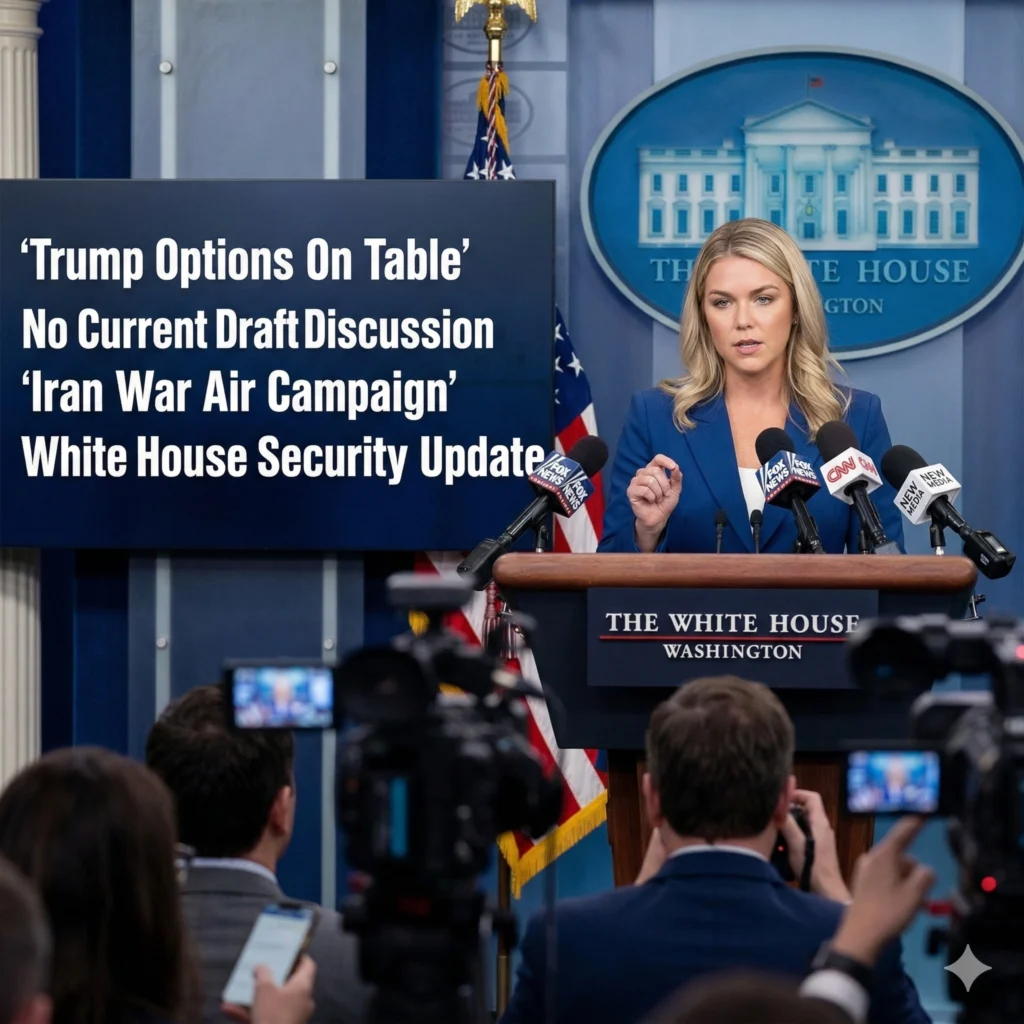
President Trump 2026 military draft
The White House has signaled a firm stance regarding the future of American involvement in the Middle East. During a televised appearance on Fox News, Press Secretary Karoline Leavitt was asked directly about the concerns of American families regarding a potential return to conscription. She noted that the President Trump 2026 military draft position is one of strategic flexibility rather than immediate implementation. Leavitt explained that the President believes in maintaining a full spectrum of options to ensure the success of the current military operation against the Iranian regime.
The administration’s refusal to explicitly rule out a draft comes at a time of significant regional instability. Since the launch of the joint U.S.-Israeli offensive on February 28, the conflict has expanded rapidly, involving multiple neighboring nations and resulting in casualties on both sides. While the current focus remains on a high-tech air and sea campaign, military analysts suggest that the President Trump 2026 military draft conversation is a necessary part of long-term contingency planning should the conflict require a more substantial ground presence to secure nuclear sites.
President Trump has frequently used his social media platform, Truth Social, to update the American public on the progress of the war. He has characterized the Iranian forces as being “decimated” and has praised the efficiency of the U.S. military. Despite this optimism, the administration recognizes that a prolonged war could strain the current all-volunteer force. Consequently, the President Trump 2026 military draft remains a theoretical possibility that the White House is monitoring as they assess the evolving threat landscape and the effectiveness of the initial strikes.
Strategic Options and Military Readiness
The White House emphasis on keeping options open is a hallmark of the current administration’s foreign policy. By not ruling out the President Trump 2026 military draft, the administration aims to project strength and unpredictability to its adversaries in Tehran. This approach is intended to signal that the United States is prepared for any level of escalation required to dismantle Iran’s nuclear capabilities and facilitate a transition of power.
Internal discussions within the Pentagon have focused on the sustainability of the current air assault. While the U.S. has achieved significant air superiority, the transition to a ground-based phase would fundamentally change the manpower requirements of the conflict. This is where the President Trump 2026 military draft could become a more prominent topic of debate. Currently, the military relies on its highly trained volunteer corps, but the scale of “Operation Epic Fury” is unlike any engagement seen in recent decades.
Public reaction to the mention of a draft has been swift, with many expressing concern over the potential for mandatory service. However, the administration maintains that the President Trump 2026 military draft is not a plan but a “tabled option.” This distinction is crucial for the White House as it attempts to balance the need for military readiness with the domestic political implications of a draft. The President has stated that any decision would be based strictly on national security needs and the real-time success of the campaign.
Operation Epic Fury and the Air Campaign
The military operation, dubbed Operation Epic Fury, has entered a critical stage as it reaches its tenth day of active hostilities. U.S. and Israeli forces have conducted thousands of sorties, targeting command and control centers, missile silos, and the naval assets of the Islamic Revolutionary Guard Corps. The President Trump 2026 military draft is seen by some as a backup measure if these precision strikes do not lead to the desired political collapse within Iran.
The intensity of the air campaign has been unprecedented, with the U.S. utilizing its most advanced stealth technology and long-range munitions. According to White House reports, the initial waves of the assault were successful in neutralizing key Iranian leadership figures. As the mission progresses, the President Trump 2026 military draft serves as a reminder of the high stakes involved. The administration is determined to see the mission through to completion, regardless of the resources required.
Israeli cooperation has been a cornerstone of the offensive, with both nations sharing intelligence and coordinating strike packages. This partnership has allowed for a comprehensive degradation of Iran’s defensive posture. However, the threat of Iranian retaliation remains high, with missile strikes reported against U.S. bases in the region. These developments keep the President Trump 2026 military draft at the periphery of the strategic conversation as the U.S. prepares for potential escalation.
Escalation Risks in the Middle East
As the conflict spreads, the risk of a wider regional war becomes more pronounced. Iran’s proxies in Lebanon, Yemen, and Iraq have already begun launching harassing attacks against U.S. and Israeli interests. In this environment, the President Trump 2026 military draft is a topic that surfaces whenever the prospect of a multi-front war is discussed. The White House is working to contain the conflict while simultaneously preparing for the worst-case scenarios that might necessitate a larger troop surge.
The impact on global oil prices and shipping routes has also added a layer of complexity to the administration’s decision-making. With the Strait of Hormuz effectively a combat zone, the economic pressure on the international community is growing. The President Trump 2026 military draft might be viewed by some as a sign of the administration’s long-term commitment to stabilizing the region, even if it requires a significant domestic sacrifice.
Transition words such as “furthermore” and “consequently” help illustrate the logical progression of the administration’s policy. The White House has been clear that they are not seeking a long-term occupation of Iran. Instead, the goal is a rapid disruption of the current regime. The President Trump 2026 military draft is therefore presented as a tool of last resort, one that the administration hopes will not be necessary but must be acknowledged for the sake of total transparency regarding military readiness.
Impact on the Selective Service System
The Selective Service System has seen increased scrutiny following the White House comments. While the agency has existed in a “standby” capacity for decades, the current war has led to a surge in inquiries about registration requirements. The President Trump 2026 military draft would require an act of Congress to be officially reinstated, a hurdle that the administration is well aware of. Nevertheless, the infrastructure for such a move remains in place and is being regularly updated.
Recent legislative changes have streamlined the registration process, making it more efficient for the federal government to identify eligible individuals. This modernization effort is often cited alongside the President Trump 2026 military draft as evidence of the government’s preparation for a major conflict. While the White House insists that there is no immediate plan for conscription, the legislative groundwork ensures that the option remains viable if the national interest demands it.
- Mandatory registration for males aged 18 to 25 continues under federal law.
- Recent NDAA provisions have automated parts of the registration process to ensure accuracy.
- The Selective Service System maintains a database of millions of potential draftees for national emergencies.
- Any actual activation of the draft would involve a national lottery system based on birth dates.
These technical aspects of the President Trump 2026 military draft are important for the public to understand. The administration’s rhetoric is designed to maintain a high level of readiness without causing undue panic. By explaining the existing laws and the role of the Selective Service, the White House is attempting to ground the conversation in legal and historical context rather than speculation.
Congressional Response and Public Sentiment
The reaction from Capitol Hill has been divided, with some lawmakers supporting the President’s “all options” approach while others warn against the President Trump 2026 military draft. Supporters argue that the credible threat of a draft is a necessary component of a robust national defense strategy. They believe that the President must have the flexibility to respond to any Iranian escalation with the full power of the American people behind him.
Opponents of the move express concern that even discussing the President Trump 2026 military draft could lead to unnecessary fear and social unrest. They point to the history of conscription in the United States and the potential for a draft to disproportionately affect certain demographics. These debates are likely to intensify as the war with Iran continues and the demands on the military increase. The White House, however, remains focused on the immediate military objectives.
Public opinion polls show a complex picture, with a majority of Americans supporting the strikes on Iran but remaining wary of a return to the draft. The President Trump 2026 military draft is a sensitive issue that touches on the fundamental relationship between the citizen and the state. As the administration navigates this delicate terrain, they are relying on clear communication to explain why certain options must remain on the table during a time of war.
Evaluating the Need for Ground Forces
A critical factor in the President Trump 2026 military draft debate is whether the air campaign will be sufficient to achieve the administration’s goals. If the Iranian regime remains resilient despite the loss of its top leadership, the pressure for a ground invasion may grow. Military leaders are currently assessing the “Bunker Buster” capabilities and the effectiveness of strikes against deeply buried nuclear facilities.
Should a ground offensive become necessary, the sheer volume of troops required would dwarf the current volunteer levels. This reality is what keeps the President Trump 2026 military draft as a centerpiece of strategic planning. The White House is coordinating with Israeli defense officials to determine the minimum force requirements for a successful regime change operation. This data-driven approach is intended to minimize the risk to American service members while maximizing the impact on the ground.
The role of technology in modern warfare is also being weighed. Some argue that drones and cyberwarfare reduce the need for large numbers of infantry, potentially making the President Trump 2026 military draft unnecessary. Others contend that technology cannot replace the “boots on the ground” needed to hold territory and oversee a transition of power. These competing views are currently being debated at the highest levels of the national security council.
Regional Allies and the Draft Debate
The United States is not acting alone in this conflict, and the stance of regional allies plays a significant role in the President Trump 2026 military draft considerations. Nations like Israel, Saudi Arabia, and the United Arab Emirates have a direct stake in the outcome of the war. Their support—whether through intelligence, logistics, or direct military participation—influences the total manpower the U.S. needs to provide.
The collaboration with Israel has been particularly intense, with joint command centers managing the day-to-day operations. This partnership reduces the burden on the U.S. military to some extent, but the overall lead remains with Washington. The President Trump 2026 military draft is a topic that has been broached in diplomatic circles as a way to gauge the long-term commitment of the United States to regional security.
- Israel provides advanced aerial intelligence and specialized strike capabilities.
- Gulf allies offer basing rights and logistical support for the U.S. Navy and Air Force.
- The coalition aims to create a unified front against Iranian regional influence.
- Diplomatic efforts are ongoing to prevent the conflict from drawing in other global powers.
The effectiveness of this coalition will ultimately determine if the President Trump 2026 military draft moves from a “tabled option” to a policy proposal. If the alliance can successfully degrade Iran’s capabilities without a massive influx of U.S. ground troops, the pressure for conscription will likely fade. However, the administration is preparing for all eventualities to ensure that no single point of failure can jeopardize the mission.
The Future of the Conflict and Conscription
As the war enters its third week, the international community is watching closely to see how the Trump administration manages the next phase of hostilities. The President Trump 2026 military draft will continue to be a subject of intense interest and speculation. The White House has made it clear that their primary focus is the “unconditional surrender” of the Iranian regime and the total elimination of its nuclear threat.
The President’s advisors are constantly reviewing the success of the air campaign and the state of the Iranian military. If the current strategy continues to yield results, the need for more drastic measures like the President Trump 2026 military draft will diminish. But as Press Secretary Leavitt stated, the President is a leader who believes in keeping his adversaries guessing. This psychological element is a key part of the current U.S. strategy.
The long-term implications of this conflict for the U.S. military are profound. Regardless of whether a draft is ever implemented, the war with Iran is reshaping the way the United States thinks about force structure and national service. The President Trump 2026 military draft is just one part of a much larger conversation about the role of the military in the 21st century and the sacrifices that may be required to maintain global stability.
The Administration’s Final Stance
In conclusion, the White House has positioned the President Trump 2026 military draft as a strategic contingency rather than a current plan. By doing so, they have maintained the initiative and forced both domestic and foreign actors to consider the full extent of American resolve. The air assault on Iran is proceeding with high intensity, and the administration is confident in its current path.
As the situation develops, the American public can expect regular updates from the White House regarding the status of the war and the potential for any changes in military policy. The President Trump 2026 military draft remains a powerful symbol of the high stakes involved in the Middle East. For now, the focus remains on the brave men and women currently serving in the all-volunteer force and the success of “Operation Epic Fury.”
The administration’s transparency about “keeping options on the table” is intended to build trust while preparing the nation for a variety of outcomes. The President Trump 2026 military draft is a serious consideration, but it is one that the White House hopes to avoid through the decisive application of air and sea power. The coming weeks will be critical in determining the ultimate trajectory of the war and the future of American military service.
For more details & sources visit: People
For the latest updates from the United States, visit our U.S. news page.