
The President’s Cake film review highlights how the story follows a young Iraqi girl tasked with baking a birthday cake for Saddam Hussein, turning a simple assignment into a dangerous quest that exposes the cruelty of sanctions and dictatorship. The film balances heartbreak, suspense and moments of warmth, earning critical acclaim and the Cannes Caméra d’Or for its quietly devastating look at resilience.
Set in rural Iraq in the early 1990s, the movie centers on Lamia, a schoolgirl living with her grandmother Bibi amid severe shortages caused by UN sanctions. When Lamia is selected to provide the cake for a compulsory celebration of Saddam Hussein’s birthday, what is framed as an honor becomes a perilous obligation, since failure to deliver could be read as defiance of the regime.
The story sends Lamia and Bibi to the city, where Bibi secretly hopes to leave her granddaughter with better-off relatives, prompting Lamia to flee and team up with her friend Saeed as they search for ingredients that might symbolically repair her fractured family. This The President’s Cake film review notes how writer-director Hasan Hadi crafts the film as both intimate coming-of-age journey and political critique, using closeups of Baneen Ahmad Nayyef’s nuanced performance to show how a child absorbs fear, loss and fleeting hope without heavy-handed exposition.
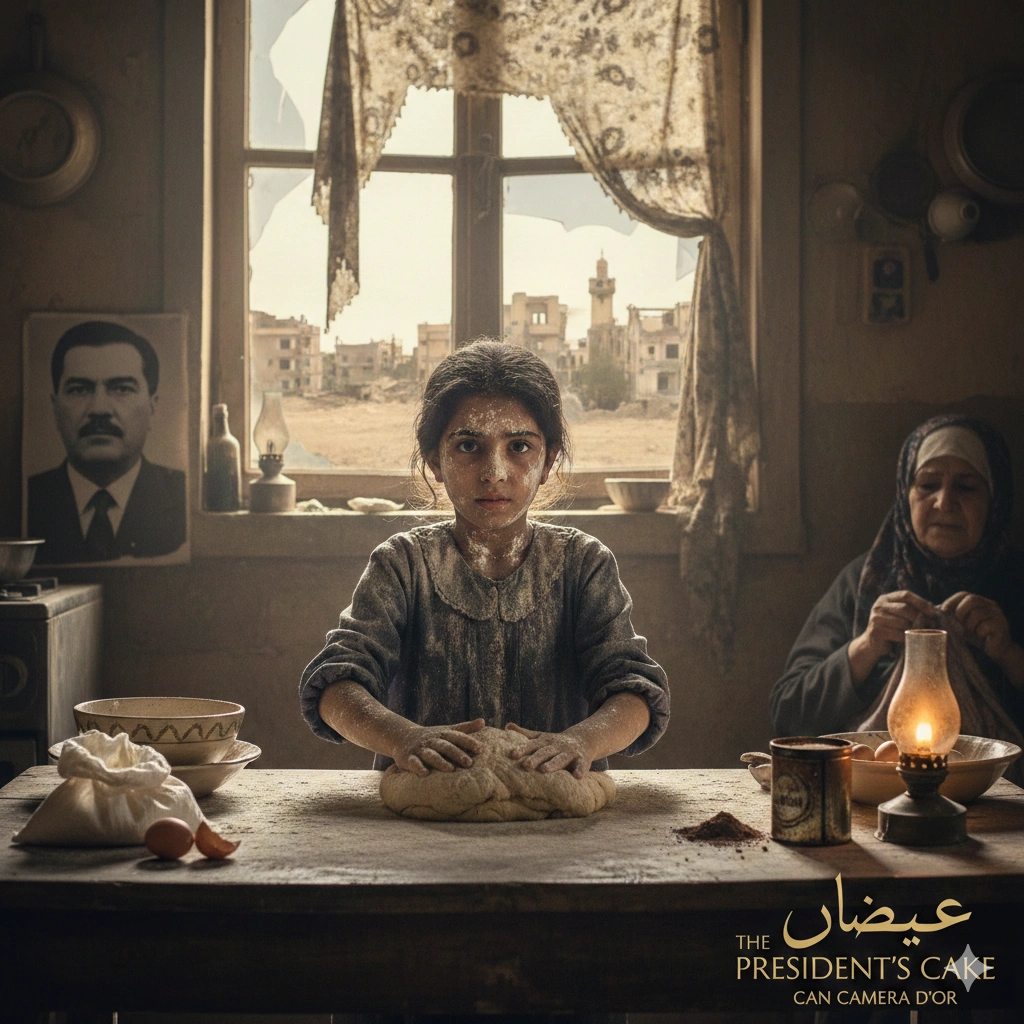
The Cinematography of Rural Iraq in the 1990s
The visual language used by Hasan Hadi is essential to understanding the depth of the story. Any The President’s Cake film review must mention the muted color palette that reflects the dusty, resource-depleted reality of rural Iraq during the UN sanctions. Every frame feels heavy with the weight of history, yet there is an undeniable beauty in the way the light hits the Iraqi landscape. This contrast serves to highlight the resilience of the characters who must find joy in a world stripped of its vibrancy.
The director avoids the typical tropes of war cinema, choosing instead to focus on the domestic sphere and internal struggles. By keeping the camera close to Lamia, the audience experiences the world through her eyes, which is a point of praise in every The President’s Cake film review. This perspective makes the political reality feel more personal and immediate. The lack of sweeping wide shots emphasizes the claustrophobia of living under a totalitarian regime, where even the open desert can feel like a prison.
Impact of UN Sanctions on Iraqi Children
A central theme of the movie is the devastating impact of international sanctions on the most vulnerable members of society. In the early 1990s, Iraq faced a total trade and financial embargo that led to widespread malnutrition and a lack of medical supplies. A comprehensive The President’s Cake film review showcases this by explaining how the search for simple cake ingredients like flour and sugar feel like an epic, life-or-death odyssey.
The film suggests that while sanctions are intended to pressure a regime, they often end up crushing the spirits of ordinary citizens. For Lamia, the honor of baking a cake is a cruel joke in a country where bread is a luxury, a detail often cited in The President’s Cake film review articles. This irony is the driving force of the narrative, pushing the characters into desperate situations. By focusing on a child’s perspective, Hadi highlights the absurdity of global politics when filtered through the lens of basic survival.
The President’s Cake film review
The titular cake serves as a powerful metaphor for the performative loyalty required by the Ba’athist regime during the 1990s. In this The President’s Cake film review, we see that the cake is not a celebration but a symbol of the fear that permeated every level of society. To fail at this task is not just a disappointment; it is a potential death sentence for Lamia and her grandmother. This tension drives the suspense of the film, turning a kitchen drama into a political thriller.
Furthermore, the cake represents the fractured family that Lamia is trying to repair through her arduous journey. Each ingredient she finds is a small victory against the entropy of her life, as noted in many a The President’s Cake film review. The film masterfully uses the preparation of food—an act of love and nourishment—and twists it into an act of state-mandated submission. This juxtaposition is what makes the film so quietly devastating for viewers.
Critically Acclaimed Performance by Baneen Ahmad Nayyef
The success of the film rests largely on the shoulders of its young lead, Baneen Ahmad Nayyef. Her portrayal of Lamia is being hailed as one of the most nuanced child performances in recent years. She manages to convey a deep sense of internal conflict without the need for excessive dialogue, making any The President’s Cake film review incomplete without mentioning her. This performance is a key reason why the film resonated so strongly with the jury at Cannes.
- Emotional Depth: Nayyef captures the transition from childhood innocence to the grim realization of adulthood.
- Physicality: Her movements in the film reflect the constant alertness of someone living in fear.
- Chemistry: The bond between Lamia and her grandmother Bibi provides the emotional heart of the story.
- Resilience: Her character’s stubborn refusal to give up serves as a beacon of hope throughout the film.
Through her performance, the audience can see how the film effectively communicates the psychological toll of dictatorship. Every The President’s Cake film review published recently highlights how this performance stays with the viewer long after the credits roll. By focusing on the small, quiet moments, Nayyef makes the grand political themes of the film feel deeply human and relatable.
Historical Context of the 1990s Ba’athist Regime
To fully appreciate the film, one must understand the era it depicts. The 1990s in Iraq were defined by the aftermath of the Gulf War and the tightening grip of Saddam Hussein’s personality cult. This The President’s Cake film review looks at how the movie captures the mandatory nature of public celebrations during this time. Every citizen was expected to participate in the veneration of the leader, regardless of their personal suffering.
The film subtly depicts the omnipresence of the regime’s security apparatus. While soldiers and police are not always on screen, their influence is felt in every interaction, a point often emphasized in a The President’s Cake film review. The fear of being reported by a neighbor or failing a state-mandated task creates a constant background hum of anxiety. This historical accuracy provides a solid foundation for the fictional narrative.
The Symbolism of the Quest for Ingredients
Lamia’s journey to the city with her grandmother is more than just a search for sugar and eggs; it is a search for agency. In a world where every aspect of life is controlled, the act of seeking out what is forbidden becomes a form of rebellion. This is a recurring theme in any professional The President’s Cake film review that explores the spirit of the Iraqi people.
- The City vs. Rural Life: The city represents a glimmer of hope and better-off relatives, yet it is where power is concentrated.
- Friendship with Saeed: Their partnership shows how shared hardship can forge unbreakable bonds.
- The Fractured Family: The search for ingredients mirrors Lamia’s attempt to find a sense of belonging.
- Symbolic Repair: Completing the cake is, in Lamia’s mind, the only way to keep her family together.
This quest structure keeps the audience engaged while allowing the director to explore various facets of Iraqi society. Each stop on their journey reveals another layer of the story, as highlighted in this The President’s Cake film review. The film suggests that while the regime can take away resources, it cannot take away the human impulse to create and care for one another.
Directorial Vision of Hasan Hadi
Hasan Hadi has emerged as a major new voice in Middle Eastern cinema. His ability to balance political critique with intimate human storytelling is evident in every scene. In this The President’s Cake film review, we see how Hadi demonstrates a mastery of pacing, allowing the tension to build slowly until it reaches its quietly haunting conclusion.
The director’s choice to use humor and moments of wonder is a stroke of brilliance. It prevents the film from becoming a misery porn piece, which is a common pitfall for dramas set in conflict zones. By showing that children still play and laugh even in the harshest conditions, Hadi creates a more authentic portrait of life, a sentiment echoed in every The President’s Cake film review. This balance is central to the critical acclaim that the film has received globally.
Global Reception and the Cannes Caméra d’Or
Winning the Caméra d’Or at Cannes is a significant milestone for Iraqi cinema. It signals a growing international interest in stories from the region that go beyond headlines of war. The global reception found in any The President’s Cake film review proves that universal themes of love and endurance can transcend cultural boundaries. Critics have praised the film for its quietly devastating approach to a complex subject.
- Critical Acclaim: Major publications have noted the film’s lack of heavy-handed exposition.
- Festival Success: The film has toured the global festival circuit, picking up awards for direction and acting.
- Cultural Impact: It has sparked discussions about the long-term effects of sanctions on civilians.
- Artistic Merit: The film is being used as a benchmark for contemporary Iraqi storytelling.
The award serves as a testament to the hard work of the cast and crew. It also highlights the importance of supporting diverse voices in the film industry, as noted in this The President’s Cake film review. As more people watch the film, the legacy of the story will continue to grow, offering a window into a period of history that is often misunderstood by the global community.
Themes of Resilience and Stubborn Love
At its heart, the film is a story about love. The relationship between Lamia and Bibi is the anchor that keeps the narrative from drifting into total despair. In this The President’s Cake film review, we explore how love is a stubborn presence that refuses to be extinguished by authoritarian rule. This emotional core is what makes the film feel so urgent and necessary.
The resilience shown by the characters is not loud or heroic in the traditional sense. It is found in the quiet persistence of everyday life. It is in the way Bibi tries to secure a better future for her granddaughter, a recurring point of discussion in any The President’s Cake film review. This moving testament to endurance is the final message of the film. It reminds us that even in the darkest times, human connection remains our most powerful tool for survival.
Future Outlook for Iraqi Cinema
The success of this film could be a turning point for the local film industry. With increased international attention, there is hope for more funding and opportunities for Iraqi filmmakers. This The President’s Cake film review concludes that the movie has set a high bar for what is possible when a local story is told with global sensitivity. It opens the door for more intimate coming-of-age journeys.
As the industry evolves, we can expect to see more films that challenge existing narratives. The path blazed by Hasan Hadi and his team is one of artistic integrity and courage. By telling the story of Lamia and her cake, they have given a voice to millions who lived through that era, as detailed in this The President’s Cake film review. The haunting portrait they have created will serve as a lasting reminder of the strength of the human spirit.
Conclusion: Why You Should Watch It
If you are looking for a story that moves you to your core, look no further than this masterpiece. This The President’s Cake film review has outlined how the film uses a simple cake to tell a much larger story of a nation under pressure. It is a film that demands to be seen, not just for its political importance, but for its sheer artistic beauty.
Ultimately, the movie is a victory for storytelling. It proves that the most powerful stories are often the ones told in whispers rather than shouts. By the end of this The President’s Cake film review, it should be clear that the film is a landmark achievement in world cinema. It is a haunting, beautiful, and necessary film that will be discussed for years to come by fans and critics alike.
For more details & sources visit: Highbrow Magazine (review)
Read more about Iraq news on 360 News Orbit – Iraq.