
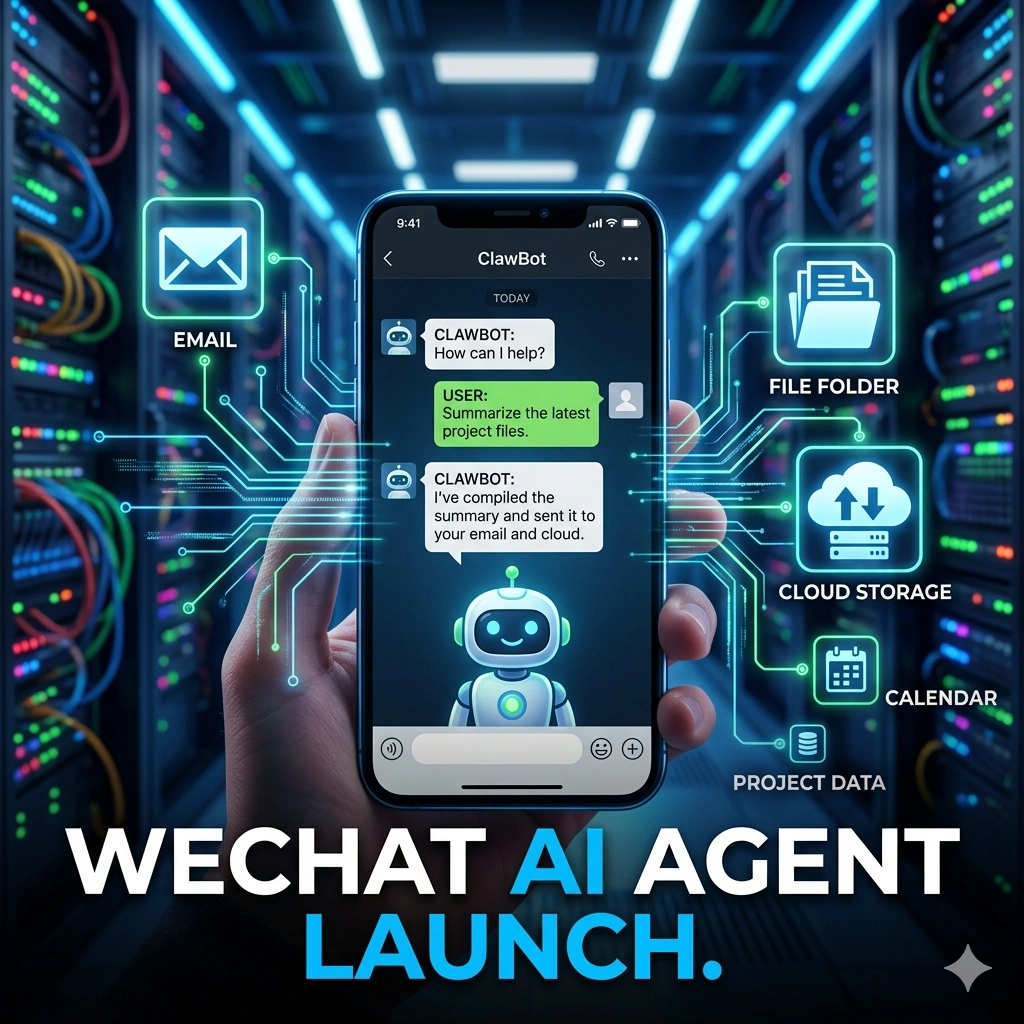
Tencent OpenClaw AI integration has officially transformed the world’s largest messaging ecosystem as of March 23, 2026. By embedding the sophisticated OpenClaw AI agent into WeChat, Tencent has moved beyond simple chatbots to fully autonomous digital assistants. This strategic rollout, featuring the newly launched “ClawBot,” allows over 1.3 billion users to automate complex digital workflows without leaving their chat interface. The move marks a definitive shift in the Chinese tech landscape toward agentic AI that prioritizes action over conversation.
The primary appeal of the Tencent OpenClaw AI implementation lies in its seamless user experience. Users can now interact with ClawBot as if it were a standard contact in their messaging list. This bot is capable of managing file transfers, organizing emails, and even scheduling multi-person meetings through simple natural language commands. As the rivalry between Chinese tech giants intensifies, Tencent’s decision to integrate open-source agent architecture gives it a significant edge in flexibility.
The Strategic Leap of ClawBot
The Tencent OpenClaw AI launch represents a pivot from generative AI to functional AI agents. While previous iterations of AI were focused on generating text or images, ClawBot is designed to “act” on behalf of the user. For example, a user can instruct the bot to “find the last three invoices from March and forward them to my accountant,” and the agent will execute the task autonomously. This level of integration reduces friction and saves hours of manual labor for busy professionals.
Tencent OpenClaw AI utilizes the OpenClaw open-source framework, which allows for rapid iteration and community-driven improvements. This open-source strategy is a direct challenge to more closed proprietary systems being developed by competitors like Baidu and Alibaba. By allowing developers to build on top of the Lighthouse platform, Tencent is fostering a massive library of “skills” for its AI agents. This community-led growth model ensures that WeChat remains the central hub for innovation in the Asian market.
The Tencent OpenClaw AI rollout also addresses the growing demand for “ambient computing” where AI is always available but never intrusive. ClawBot operates quietly in the background, only intervening when explicitly summoned by the user. This design philosophy respects user attention while providing powerful tools at a moment’s notice. As users become more comfortable with AI agents, this form of integrated automation is expected to become the global standard for social platforms.
Tencent OpenClaw AI
The Tencent OpenClaw AI integration is currently the most discussed topic in the Shenzhen and Hangzhou tech corridors. Industry analysts note that this move effectively turns WeChat into a giant automated brain for the Chinese economy. Because so much of China’s commerce and social interaction already happens on WeChat, adding an autonomous layer creates a massive data flywheel. Each task completed by the agent provides more context to improve the accuracy of future interactions.
Security remains a top priority during the Tencent OpenClaw AI deployment phase. Because these agents have the authority to move files and access emails, Tencent has implemented a “Permission-First” protocol. Users must explicitly grant the bot access to specific folders or third-party accounts before any automation occurs. This layer of security is designed to prevent the accidental sharing of sensitive information within the massive social network.
The Tencent OpenClaw AI suite is also being optimized for cross-platform compatibility. While it lives inside WeChat, the WorkBuddy enterprise tool can sync with desktop office suites and cloud storage providers. This ensures that the automation started on a mobile device can be completed on a workstation without any loss of data. Tencent is clearly positioning itself as the leader in the “AI-as-a-Service” market for both consumers and businesses.
Regulatory Scrutiny and Privacy Concerns
The rapid adoption of Tencent OpenClaw AI has caught the attention of Chinese regulators. Government officials have issued warnings regarding the potential for autonomous agents to be used for malicious purposes if not properly monitored. Concerns include the risk of “automated phishing” and the privacy implications of AI having deep access to personal chat logs. Tencent has responded by promising full transparency in how the OpenClaw models process and store user data.
To satisfy these regulatory requirements, the Tencent OpenClaw AI system includes an “Audit Log” feature. This allows users and administrators to see exactly what actions an agent took and why it made specific decisions. This move toward “Explainable AI” is crucial for building trust in high-stakes environments like banking or healthcare. Tencent is working closely with the Ministry of Industry and Information Technology to set new safety standards for the industry.
Despite these challenges, the Tencent OpenClaw AI expansion shows no signs of slowing down. The convenience of having a personal assistant that never sleeps is proving too attractive for the average user to ignore. As long as the benefits outweigh the perceived risks, the integration of AI agents will continue to accelerate. Tencent’s proactive approach to security may actually become a competitive advantage if it can prove its system is safer than the rivals’.
The “Claw” Suite Breakdown
The Tencent OpenClaw AI strategy is cleverly divided into four distinct products to capture different market needs. This segmentation allows Tencent to offer a tailored experience whether the user is a grandmother sending a photo or a CEO managing a multinational corporation. Each tool is built on the same core OpenClaw logic but is wrapped in a different user interface.
- QClaw: Focused on personal life management, such as setting reminders and organizing photos.
- Lighthouse: A developer-centric platform for building custom AI “skills” and integrations.
- WorkBuddy: Designed for the workplace, handling enterprise-level data and collaboration.
- ClawBot: The general-purpose agent found directly in the WeChat contact list for all users.
By providing these diverse options, the Tencent OpenClaw AI ecosystem ensures that no user is left behind in the AI revolution. QClaw makes AI accessible to the non-technical public, while Lighthouse keeps the developer community engaged and productive. This multi-pronged attack on the market is what makes Tencent’s strategy so formidable against its tech rivals.
Impact on the Global Tech Rivalry
The Tencent OpenClaw AI launch has global implications for the future of software development. Silicon Valley companies like Meta and Google are watching closely to see how WeChat users react to deep agent integration. If the rollout is successful, it could force Western companies to accelerate their own agentic AI plans for apps like WhatsApp and Instagram. This is no longer just a local battle; it is a fight for the future of the global internet.
Experts believe that the Tencent OpenClaw AI success will depend on its ability to integrate with non-Tencent services. If ClawBot can effectively manage Gmail or Dropbox for international users, it could potentially expand WeChat’s influence outside of China. However, geopolitical tensions and data localization laws remain significant hurdles for any such expansion. For now, Tencent is focused on dominating its home turf and setting the gold standard for AI-driven social media.
The Tencent OpenClaw AI initiative is also a test case for open-source AI in a highly regulated market. By using the OpenClaw framework, Tencent is betting that the speed of open-source development will outpace the precision of closed models. This “Open vs. Closed” debate is a central theme in 2026 tech discourse. Tencent’s massive user base provides the perfect testing ground to see which philosophy will ultimately win the hearts and minds of the digital population.
Future Outlook for AI Agents
As we look toward the second half of 2026, the Tencent OpenClaw AI experience will likely become even more proactive. Future updates are expected to include “predictive automation,” where the agent anticipates user needs based on previous behavior. For example, if you usually send a weekly report on Mondays, ClawBot might have the file drafted and ready for your approval before you even ask. This move from reactive to proactive AI is the final frontier of the digital assistant.
- Implementation of voice-activated agent commands for hands-free automation.
- Integration with smart home devices to manage physical environments via WeChat.
- Enhanced emotional intelligence to better understand the tone of user requests.
- Greater focus on “Local AI” processing to keep sensitive data on the user’s device.
The Tencent OpenClaw AI roadmap suggests a future where our devices don’t just wait for instructions but actively help us navigate our lives. While this level of automation brings up valid concerns about dependency and privacy, it also offers a glimpse of a more efficient world. Tencent is not just building a bot; they are building a new way of interacting with the digital realm. The “Claw” era has truly arrived, and the tech world will never be the same.
In summary, the Tencent OpenClaw AI integration into WeChat is a landmark event in the history of artificial intelligence. It represents the successful transition of AI from a novelty into a necessary tool for daily survival. By combining social networking with autonomous agency, Tencent has created a platform that is uniquely positioned for the challenges of 2026. Whether you are a casual user or a high-powered executive, the “Claw” is now part of your digital DNA.
The coming months will reveal the true impact of the Tencent OpenClaw AI project as more users begin to rely on ClawBot for their daily routines. Competition will surely follow, but Tencent’s first-mover advantage in the messaging space is hard to overstate. As the lines between human and machine interaction continue to blur, WeChat remains the center of the storm. The future of AI isn’t just coming—it’s already in your chat list.
The Tencent OpenClaw AI saga is a reminder that in the tech world, the only constant is change. What started as a simple messaging app has become a global powerhouse of automation and intelligence. As we embrace these new tools, we must also remain vigilant about the responsibilities that come with such power. The journey of the OpenClaw agent has just begun, and its impact will be felt for generations to come in the ever-evolving digital landscape.
For more details & sources visit: The News International
Read more about China news on 360 News Orbit – China.