
Tehran Endures Intensified Aerial Bombardment as the conflict reaches a devastating peak, leaving the Iranian capital in a state of unprecedented chaos. Residents reported the most severe night of airstrikes since the hostilities began, with United States and Israeli jets focusing their munitions on strategic military and industrial sites. While President Donald Trump recently suggested that the war could be nearing its completion, the messaging remains deeply fractured.
Defense Secretary Pete Hegseth countered this optimism by warning of further strikes to ensure a decisive defeat of the regime’s capabilities. This duality in communication has left the international community bracing for an even more violent escalation in the region. The sheer scale of the nightly raids has transformed the skyline of Tehran into a theater of fire and thunder, marking a dark chapter in modern Middle Eastern history.
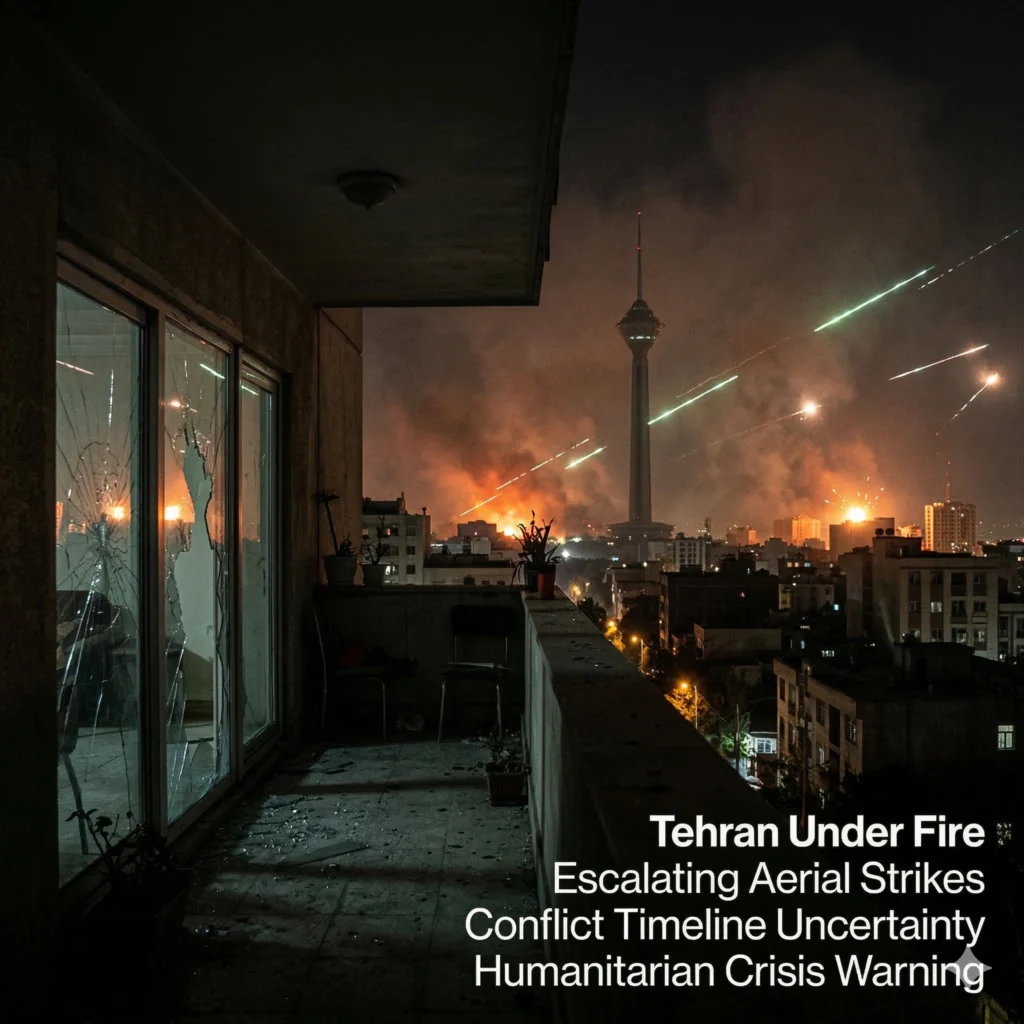
Tehran Endures Intensified Aerial Bombardment
The primary focus of the recent campaign, where Tehran Endures Intensified Aerial Bombardment, has been the systematic dismantling of the Iranian military infrastructure. Early Tuesday morning, a massive wave of aerial attacks caused widespread building tremors and back-to-back explosions that could be felt for miles. The Israel Defense Forces confirmed they successfully struck a major weapons development facility, which they claim is a hub for regional instability. This strike is part of a broader, high-intensity air campaign that was officially launched on February 28 to neutralize immediate threats.
Local residents living near the blast zones described a terrifying sequence of events as the Tehran Endures Intensified Aerial Bombardment continued throughout the early hours. Rolling blackouts have now become a permanent fixture across the city, plunging millions into darkness while the sounds of jet engines roar overhead. Furthermore, there has been a significant collapse of national communication networks, making it nearly impossible for families to check on loved ones. The digital isolation of the capital has only added to the growing sense of dread among the civilian population.
The physical toll of the night when Tehran Endures Intensified Aerial Bombardment occurred is still being calculated by local emergency services. First responders are struggling to navigate debris-strewn streets to reach those trapped under collapsed structures in industrial districts. Because the strikes targeted high-value military assets, the surrounding civilian neighborhoods have suffered extensive collateral damage. The intensity of the heat from the explosions was so great that it melted asphalt in certain sectors of the northern districts.
Environmental and Health Crisis
As Tehran Endures Intensified Aerial Bombardment, a new and terrifying environmental phenomenon has emerged in the form of hazardous “black rain.” The World Health Organization issued an urgent warning for all civilians to stay indoors to avoid contact with this toxic precipitation. This phenomenon is caused by the massive fires at oil facilities and chemical plants that were targeted during the recent raids. The soot and chemical residue mix with upper-atmosphere moisture, falling back to earth as a corrosive and dangerous liquid.
The health risks associated with the period where Tehran Endures Intensified Aerial Bombardment are not limited to direct trauma from explosions. Medical professionals are seeing a surge in respiratory distress cases linked to the thick, acrid smoke blanketing the metropolitan area. With the pharmaceutical supply chain disrupted by the ongoing siege, hospitals are running dangerously low on oxygen and basic medicines. The long-term ecological impact of these strikes on the Tehran basin could take decades to fully remediate.
Water supplies have also been compromised during the time Tehran Endures Intensified Aerial Bombardment remained the primary military objective. Leaking fuel from damaged storage tanks has seeped into local groundwater systems, rendering many wells unusable for the foreseeable future. International aid agencies are calling for a humanitarian corridor to bring in clean water and filtration units, but the intensity of the air war makes such a mission nearly impossible. The civilian population is caught in a pincer movement between military violence and environmental collapse.
Contradictory United States Messaging
The political landscape is as volatile as the physical one, especially since Tehran Endures Intensified Aerial Bombardment became a daily reality. United States officials provided sharply contradictory timelines regarding the duration of the military campaign during public statements on Monday and Tuesday. While the White House hints at a diplomatic off-ramp, the Pentagon appears to be doubling down on a kinetic solution. This lack of a unified front has led to confusion among allies and adversaries alike regarding the ultimate goal of the operation.
General Dan Caine stated that allied forces have already hit over five thousand sites since Tehran Endures Intensified Aerial Bombardment began. The stated goal is to degrade Iran’s ballistic missile and drone capacity to a point where they can no longer project power beyond their borders. However, without a clear political objective, critics argue that the military is simply punching into a vacuum. The discrepancy between the “end of war” rhetoric and the “decisive defeat” doctrine is creating a dangerous vacuum in international diplomacy.
The human cost of the era where Tehran Endures Intensified Aerial Bombardment has become the norm is staggering. Human rights monitors reported that at least one thousand two hundred forty-five civilians have been killed since the start of hostilities on February 28. These figures are expected to rise sharply as more bodies are recovered from the ruins of the capital. Despite these losses, the tactical pressure from the air shows no signs of abating in the immediate future.
Iranian Response and Retaliation
Iranian officials have not remained silent while Tehran Endures Intensified Aerial Bombardment, vowing to inflict a painful price on the United States and Israel. National Security Council head Ali Larijani dismissed American threats during a defiant televised address, implying potential retaliatory targeting of United States leadership. This rhetoric suggests that the conflict could soon move beyond the borders of Iran and into a much wider regional or even global theater. The defiance of the Iranian leadership remains a major hurdle for any potential ceasefire negotiations.
The internal security situation is equally tense while Tehran Endures Intensified Aerial Bombardment persists. The Iranian police chief cautioned citizens that any internal protests against the regime would be treated as acts of enemy combat. This hardline stance is designed to prevent a domestic uprising while the military is occupied with the external threat. By framing dissent as treason, the government has effectively silenced most public calls for an end to the fighting within the country.
- Military commanders have moved mobile missile launchers into residential areas to complicate allied targeting.
- Cyber warfare units are reportedly attempting to breach Western infrastructure in response to the air raids.
- State media continues to broadcast images of civilian casualties to galvanize nationalistic fervor among the youth.
- The Revolutionary Guard has increased its presence in the Persian Gulf to monitor United States naval movements.
Despite the pressure of the moment when Tehran Endures Intensified Aerial Bombardment, the regime’s grip on power appears to be holding for now. The external threat has, in some ways, forced a temporary unity among the various factions within the Iranian government. However, the long-term sustainability of this position is questionable as the economic and physical infrastructure of the nation continues to crumble under the weight of the allied air campaign.
Global Economic Instability
The global community is feeling the ripples of the conflict as Tehran Endures Intensified Aerial Bombardment. Economic analysts warned that continued disruption in the Strait of Hormuz could trigger a global energy crisis reminiscent of the 1970s. As a vital artery for the world’s oil supply, any prolonged closure or combat in the strait would send fuel prices to record highs. This would, in turn, trigger massive inflation in Western economies already struggling with post-pandemic recovery efforts.
Shipping insurance rates have already skyrocketed since the time Tehran Endures Intensified Aerial Bombardment became a primary headline. Many commercial tankers are now refusing to enter the Persian Gulf without military escorts, leading to a bottleneck in global logistics. The potential for a “tanker war” is high, as Iran has previously demonstrated a willingness to target commercial vessels as a form of asymmetric leverage. The stakes for the global economy have never been higher in the context of a Middle Eastern conflict.
- Gold prices have surged as investors look for safe-haven assets amid the escalating military tensions.
- European nations are scrambling to find alternative energy suppliers to offset the loss of Middle Eastern crude.
- Major airlines have rerouted flights to avoid the airspace over the conflict zone, increasing travel times and fuel costs.
- Stock markets in Asia have seen significant volatility due to their heavy reliance on Iranian oil imports.
The interconnectedness of the modern world means that no nation is truly insulated from the effects of the nights when Tehran Endures Intensified Aerial Bombardment. The transition to green energy is not happening fast enough to mitigate the immediate shock of a fossil fuel supply disruption. Therefore, the duration of this air campaign will directly dictate the economic health of dozens of nations over the next fiscal year.
Humanitarian Crisis Deepens
The sheer scale of the displacement while Tehran Endures Intensified Aerial Bombardment continues is a growing concern for neighboring countries. Thousands of families are attempting to flee the capital toward the mountains or the border with Turkey and Iraq. These refugees are often traveling on foot through dangerous terrain to avoid being caught in the crossfire of the aerial campaign. The lack of formal refugee camps on the borders is creating a secondary humanitarian disaster that the world is currently ill-equipped to handle.
Inside the city where Tehran Endures Intensified Aerial Bombardment is a nightly event, the distribution of food has become a critical issue. Most supermarkets are empty, and the government has begun rationing basic staples like bread and rice. The black market is thriving, but prices are far beyond the reach of the average citizen. Without an immediate pause in the fighting, the threat of localized famine in urban centers becomes a very real possibility by the end of the month.
- International charities are calling for an immediate “silence of the guns” to allow for the delivery of baby formula and hygiene kits.
- Local community groups have organized soup kitchens, but they are frequently targeted or disrupted by the falling debris.
- Elderly residents who cannot flee are often left alone in damaged apartments without heating or electricity.
The social fabric of the city is being stretched to its breaking point as Tehran Endures Intensified Aerial Bombardment. The psychological trauma of living under constant aerial surveillance and bombardment will have lasting effects on the children of the capital. Mental health experts warn of a “lost generation” if the violence is not curtailed through diplomatic intervention soon. The human stories emerging from the wreckage are a stark reminder of the cost of modern warfare.
Infrastructure and Communication Loss
The technological blackout that occurred when Tehran Endures Intensified Aerial Bombardment began has crippled the city’s ability to function. Bank servers are down, making it impossible for people to withdraw cash or use credit cards for essential purchases. This has forced the economy into a primitive barter system in many neighborhoods. The loss of the internet has also cut off the flow of information, leaving many residents dependent on state-run radio for updates on the military situation.
Repairing the damage while Tehran Endures Intensified Aerial Bombardment remains an active threat is an impossible task for local utility companies. Every time a power substation is patched, it is often struck again in the next wave of attacks. This cycle of destruction and temporary repair is exhausting the city’s remaining technical resources and spare parts. The resilience of the local engineers is high, but they are fighting a losing battle against the high-tech precision of allied munitions.
- The main wastewater treatment plants have been disabled, leading to the discharge of raw sewage into local rivers.
- The subway system is being used as a massive bomb shelter, but the lack of ventilation makes it a health hazard.
- Bridges and overpasses have been targeted to prevent the movement of military convoys through the city.
As Tehran Endures Intensified Aerial Bombardment, the very bones of the city are being shattered. The modernization efforts of the last three decades are being erased in a matter of weeks. The cost of rebuilding the capital’s infrastructure will likely run into the hundreds of billions of dollars. For now, the focus remains on survival, as each night brings a fresh wave of destruction from the skies.
Future Projections and Ceasefire Hopes
The prospects for a ceasefire remain dim while Tehran Endures Intensified Aerial Bombardment and both sides maintain their maximalist positions. The United Nations has attempted to broker a temporary truce, but these efforts have been rebuffed by the warring parties. The United States demands a total dismantling of the nuclear and missile programs, while Iran demands an immediate withdrawal of all foreign forces from the region. The gap between these two positions is a chasm that few believe can be bridged through words alone.
Military analysts suggest that the period where Tehran Endures Intensified Aerial Bombardment might be a prelude to a ground operation, though the White House has denied this. A ground invasion would represent a massive escalation that could draw in other regional powers like Turkey or Russia. The “black rain” and environmental damage may also serve as a natural barrier to ground movements, complicating any further military planning. The world remains in a state of anxious waiting as the next phase of the conflict unfolds.
Impact on Regional Stability
The shockwaves of the nights when Tehran Endures Intensified Aerial Bombardment are being felt across the entire Middle East. Proxy groups in Lebanon, Yemen, and Iraq have increased their activity, threatening to turn the localized conflict into a regional conflagration. The balance of power is shifting rapidly, and the long-term consequences for regional stability are unpredictable. Many fear that the current violence is just the beginning of a much larger shift in the geopolitical order.
As Tehran Endures Intensified Aerial Bombardment, the diplomatic missions of many neutral nations have been evacuated, leaving a vacuum where dialogue used to exist. The absence of “track two” diplomacy makes the risk of a miscalculation or accidental escalation much higher. The international community must find a way to re-engage the parties before the situation reaches a point of no return. The future of the region depends on the ability to find a path out of the fire.
Conclusion
Tehran Endures Intensified Aerial Bombardment in a struggle that has captured the world’s attention and redefined the limits of modern air power. The city stands as a symbol of the devastating impact of high-intensity conflict on civilian populations and urban infrastructure. From the “black rain” to the collapse of the economy, the costs are being paid by those who had the least to do with the start of the war. As we look forward, the hope for a peaceful resolution remains the only light in an otherwise dark horizon.
The lessons of the time when Tehran Endures Intensified Aerial Bombardment will be studied by historians and military tacticians for years. It serves as a grim reminder of the fragility of modern civilization when faced with the machinery of war. Whether the conflict ends in a diplomatic breakthrough or a total military collapse, the scars on the city and its people will remain. For now, the world can only watch and wait as the sirens continue to wail over the Iranian capital.
For more details & sources visit: The Guardian
Read more on Iran news: 360 News Orbit – Iran.