
The Taiwan insurers Middle East debt warning has become a focal point for global financial analysts as S&P Global Ratings issued a cautionary note regarding the sector’s significant overseas exposure. As of March 10, 2026, Taiwanese life insurance companies have accumulated approximately NT$1.77 trillion in debt instruments from the Middle East. This massive investment strategy was initially driven by the search for higher-yielding assets to meet long-term policyholder obligations. However, a prolonged regional conflict now threatens to turn these holdings into a source of severe market volatility. The warning underscores the precarious balance firms must strike between achieving returns and maintaining capital stability.
The Taiwan insurers Middle East debt warning highlights the systemic vulnerability of firms with thin capital buffers. While domestic bonds in Taiwan often fail to provide sufficient interest rates, overseas credit has historically been a tempting alternative. S&P Global Ratings noted that while immediate defaults are not the primary concern, the widening of credit spreads could pressure financial statements. Insurers are currently facing a geopolitical environment that makes them susceptible to sudden price fluctuations on their international portfolios. This situation serves as a stark reminder of the risks associated with an aggressive search for yield in emerging markets.
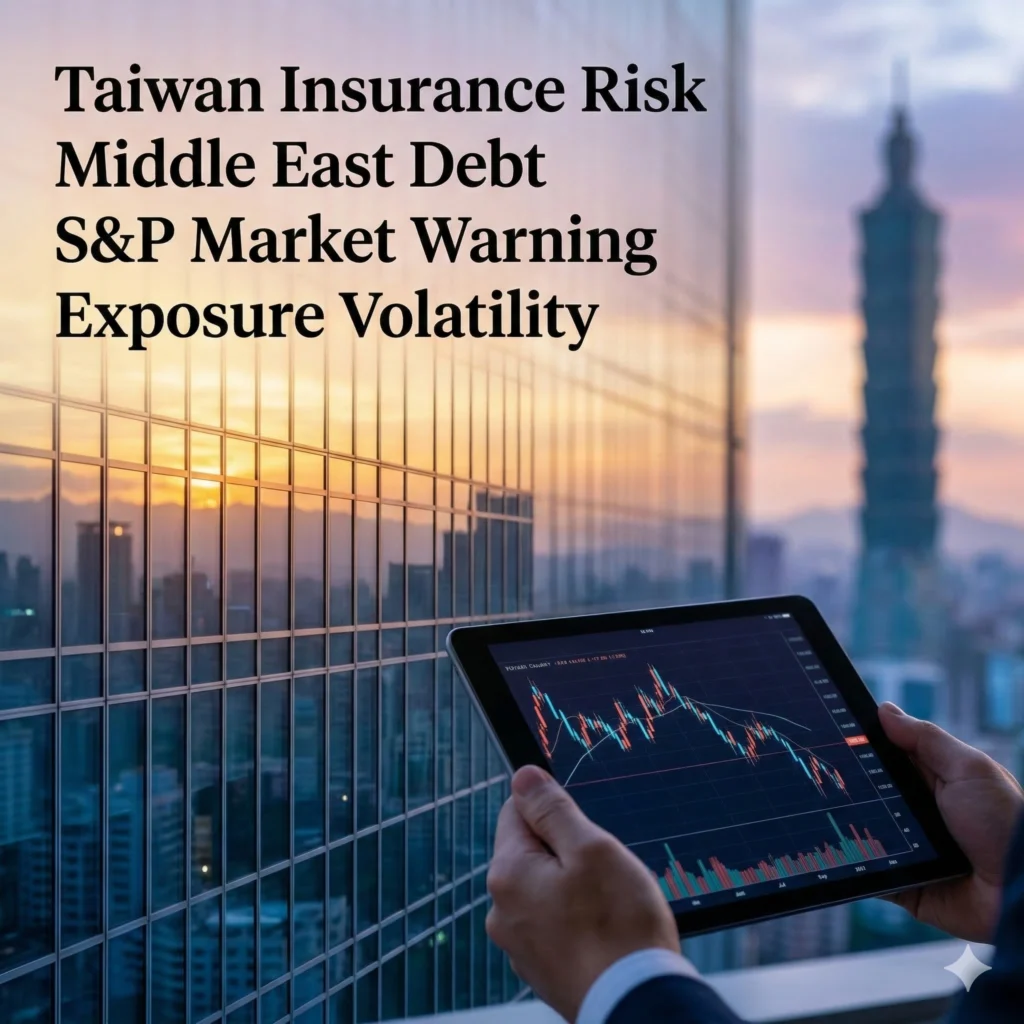
Taiwan insurers Middle East debt warning
The Taiwan insurers Middle East debt warning is particularly relevant for companies that have failed to bolster their capital reserves during more stable economic periods. According to recent financial data, the exposure stands at NT$1.77 trillion, a figure that represents a significant portion of the sector’s total assets. S&P suggests that the primary risk lies in mark-to-market losses, which occur when the market value of these bonds drops due to regional instability. For firms already operating with narrow margins, these fluctuations could necessitate a reevaluation of their risk management frameworks. The credit rating agency’s commentary reflects a growing unease about the sustainability of such concentrated exposure.
Furthermore, the Taiwan insurers Middle East debt warning emphasizes that the capital strength of individual firms across the island varies significantly. While the most robustly capitalized entities can likely absorb current volatility, smaller or more aggressive firms have less room to navigate falling bond prices. S&P has clarified that massive write-downs are not yet the base-case scenario, but they remain a possibility if the conflict escalates further. The reliance on higher-yielding overseas credit has effectively tied the financial health of the Taiwanese insurance sector to the stability of distant geopolitical zones. This interconnectedness is now being tested by the realities of modern warfare and economic sanctions.
Impact of Credit Spread Widening
A critical aspect of the Taiwan insurers Middle East debt warning involves the mechanics of credit spreads and bond pricing. As regional tensions in the Middle East persist, investors demand higher premiums to hold debt from the area, leading to wider credit spreads. When these spreads widen, the market value of existing bonds typically falls, creating unrealized losses on the balance sheets of Taiwanese insurers. Because these firms must report their financial positions periodically, sudden drops in bond values can impact their reported solvency ratios. This technical pressure is what concerns S&P Global Ratings the most in the current fiscal quarter.
- Total sector exposure reaches a staggering NT$1.77 trillion in the region.
- Widening credit spreads lead to immediate mark-to-market valuation pressures.
- Thin capital buffers limit the ability of certain firms to absorb losses.
- Domestic low-interest-rate environment continues to push firms toward riskier assets.
These factors combine to create a challenging environment for financial regulators in Taipei who oversee the insurance industry. The Taiwan insurers Middle East debt warning serves as a signal to these regulators that more stringent stress testing may be required. Ensuring that insurers can withstand a “worst-case” regional scenario is essential for maintaining public trust in the financial system. As the conflict in the Middle East enters a more volatile phase, the focus on asset quality and liquidity has never been more intense for the Taiwanese giants.
Overseas Credit and the Search for Yield
The underlying cause of the Taiwan insurers Middle East debt warning is the long-standing issue of low domestic interest rates. For years, Taiwanese life insurers have struggled to find local investments that pay enough to cover the guaranteed returns promised to policyholders. This “yield gap” forced many companies to look toward emerging markets, with the Middle East offering an attractive combination of high yields and perceived sovereign strength. The current situation proves that these higher yields come with hidden geopolitical costs that are now being realized. The shift toward overseas credit was a rational response to local conditions but carried significant systemic risks.
The Taiwan insurers Middle East debt warning suggests that firms may need to diversify their portfolios to avoid such heavy concentration in a single volatile region. While the Middle East provided steady returns for a decade, the sudden shift in the security landscape has changed the risk-reward calculation. S&P’s report indicates that the ability of these insurance giants to manage this exposure will be a key determinant of their credit ratings in 2026. Transitioning away from these assets during a period of market stress is difficult, as selling large blocks of debt could further depress prices and trigger the very losses the firms seek to avoid.
Capital Buffers and Financial Resilience
Resilience is the central theme of the Taiwan insurers Middle East debt warning as analysts look at which firms can weather the storm. Companies that have proactively raised capital or maintained conservative investment mandates are much better positioned today. In contrast, those that maximized their exposure to high-yield Middle Eastern debt to boost short-term earnings are now under the microscope. S&P Global Ratings has indicated that capital strength is the primary differentiator in how these companies will be treated from a credit perspective. The agency continues to monitor the situation to see if regional damage remains manageable.
- Monitoring of solvency ratios for firms with high exposure to conflict zones.
- Assessment of liquidity positions to ensure claims can be met during volatility.
- Evaluation of hedging strategies used by insurers to mitigate currency and credit risk.
The Taiwan insurers Middle East debt warning also serves as a broader lesson for the global insurance industry regarding emerging market debt. While these assets can provide a necessary boost to income, they require sophisticated monitoring and a deep understanding of local political dynamics. Many Taiwanese firms are now hiring specialized geopolitical analysts to better understand the regions where their capital is deployed. This move toward more comprehensive risk assessment is a direct result of the pressures highlighted by S&P in their recent reports. The goal is to ensure that future investments are made with a clearer view of potential tail risks.
Strategic Outlook and Market Volatility
Looking ahead, the Taiwan insurers Middle East debt warning will likely influence the investment strategies of these firms for the next several years. There is expected to be a gradual shift toward more stable, albeit lower-yielding, Western markets or a greater focus on domestic infrastructure projects. The era of unchecked expansion into emerging market debt may be coming to a close as the costs of volatility become more apparent. S&P Global Ratings will continue to provide updates as the regional conflict in the Middle East evolves and its impact on global bond markets becomes clearer.
For now, the Taiwan insurers Middle East debt warning remains a “yellow flag” rather than a full-blown crisis. The sector-wide damage is currently viewed as manageable, provided there are no massive defaults by sovereign issuers in the region. However, the situation remains fluid, and any escalation of the war could change the outlook overnight. Taiwanese insurers must remain vigilant and prepared to take defensive actions to protect their balance sheets. The financial stability of one of Asia’s largest insurance markets depends on the careful navigation of these turbulent international waters.
Regulatory Response in Taiwan
In light of the Taiwan insurers Middle East debt warning, the Financial Supervisory Commission (FSC) in Taiwan is expected to increase its oversight of overseas investments. New guidelines may be introduced to limit the percentage of a firm’s capital that can be allocated to a single geographical region. This regulatory response aims to prevent the type of concentration risk that led to the current NT$1.77 trillion exposure. By mandating greater diversification, regulators hope to shield the domestic economy from future international shocks. The insurance industry’s reaction to these potential new rules will be closely watched by market participants.
The Taiwan insurers Middle East debt warning has also prompted a dialogue between the government and the insurance industry regarding domestic investment opportunities. If the government can provide more high-quality, long-term local bonds, the pressure on insurers to seek yield abroad would be reduced. This could involve funding for green energy transitions or major transport infrastructure projects. Aligning the needs of insurers with national development goals could provide a sustainable solution to the “yield gap” problem. Such a shift would significantly reduce the systemic risk posed by the Taiwan insurers Middle East debt warning.
Conclusion and Risk Mitigation
Ultimately, the Taiwan insurers Middle East debt warning is a reminder that in the world of finance, there is no such thing as a free lunch. The higher yields offered by Middle Eastern debt came with a geopolitical premium that is now being collected. S&P Global Ratings has performed a vital service by highlighting these risks before they manifest as a full-scale financial emergency. Insurers now have the opportunity to adjust their portfolios and strengthen their capital positions to ensure they can fulfill their promises to policyholders. The resilience of the Taiwanese financial sector will be defined by its response to this warning.
The situation remains a complex puzzle for the management teams of Taiwan’s largest insurers. They must balance the need for income with the absolute necessity of safety. The Taiwan insurers Middle East debt warning has provided the clarity needed to initiate difficult but necessary conversations about risk tolerance and asset allocation. As the market continues to react to news from the Middle East, the focus will remain on the solvency and stability of these critical financial institutions. For now, the path forward involves caution, transparency, and a renewed commitment to conservative financial management.
For more details & sources visit: Finimize
Read more on Taiwan news: 360 News Orbit – Taiwan.