
Taiwan geothermal energy project development received a major boost as Wistron Green Energy Holdings and Hwan Tai Geothermal Holdings formally announced a partnership to co-develop a new geothermal power initiative in Taitung County, eastern Taiwan. The collaboration combines advanced data analytics with deep construction and drilling expertise, signaling growing momentum for geothermal energy within Taiwan’s renewable energy transition.
The agreement was finalized during a signing ceremony attended by senior executives from both companies, as well as a representative from Taiwan’s Ministry of Economic Affairs (MOEA)—a move widely interpreted as a sign of government support for expanding geothermal development.
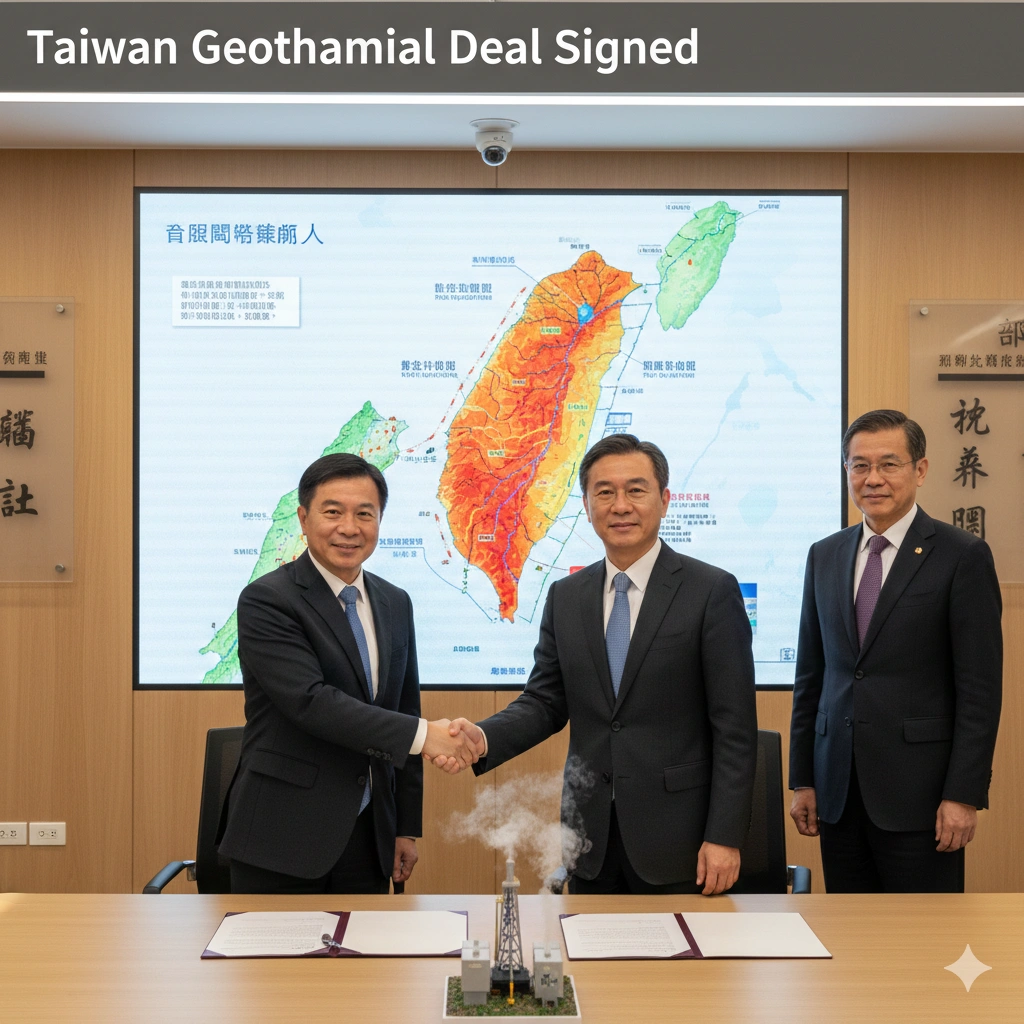
Strategic Partnership Blends Technology and Engineering
The Taiwan geothermal energy project brings together subsidiaries of two major industrial players. Wistron Green Energy Holdings operates under Wistron Corporation, one of Taiwan’s leading electronics manufacturers, while Hwan Tai Geothermal Holdings is affiliated with Hwan Tai Cement, a firm with extensive experience in large-scale construction and subsurface engineering.
Under the partnership structure:
- Hwan Tai will lead drilling, geothermal resource development, and construction activities
- Wistron Green Energy will apply advanced data analytics and digital modeling to optimize site exploration and resource assessment
Executives from both companies emphasized that the integration of engineering know-how with digital intelligence will reduce exploration risk and improve project efficiency—two of the biggest challenges in geothermal deployment.
Government Support and Policy Alignment
The presence of an MOEA representative at the signing ceremony underscores Taiwan’s growing policy emphasis on diversifying renewable energy sources beyond solar and offshore wind. While Taiwan has made significant progress in solar photovoltaics and wind power, geothermal energy remains largely underdeveloped despite favorable geological conditions.
Officials have increasingly highlighted geothermal energy as a stable, baseload renewable resource capable of enhancing grid resilience. This Taiwan geothermal energy project aligns closely with national energy security objectives and long-term decarbonization targets.
Wistron’s Expanding Renewable Energy Strategy
For Wistron, the partnership represents another step in its broader sustainability strategy. According to the company’s 2024 sustainability report, Wistron has already achieved more than 74% renewable energy utilization globally, primarily through on-site generation, power purchase agreements, and renewable energy certificates.
By investing in geothermal energy, Wistron aims to strengthen supply chain resilience while supporting Taiwan’s domestic clean energy capacity. Company representatives noted that geothermal power offers predictable output and long asset lifespans—features particularly attractive for energy-intensive manufacturing operations.
The Taiwan geothermal energy project in Taitung is expected to serve as a pilot model that could be replicated elsewhere on the island if successful.
Untapped Geothermal Potential in Taiwan
Taiwan sits along the Pacific Ring of Fire, giving it significant geothermal potential due to volcanic and tectonic activity. However, development has historically lagged behind countries such as Iceland, Japan, and Indonesia, largely due to high upfront costs, regulatory complexity, and limited technical coordination.
Energy analysts argue that partnerships like the Wistron–Hwan Tai collaboration could help overcome these barriers by sharing risk and leveraging complementary strengths. Advanced subsurface data analysis, in particular, is expected to improve drilling success rates—one of the most expensive and uncertain aspects of geothermal projects.
This Taiwan geothermal energy project highlights how private-sector innovation can unlock resources that have long remained underutilized.
International Collaboration and Future Outlook
Momentum around geothermal energy in Taiwan is expected to accelerate further with an upcoming international geothermal conference, where industry leaders, policymakers, and researchers will explore collaboration opportunities, technology transfer, and financing models.
Both Wistron and Hwan Tai have indicated that they plan to incorporate a mix of local expertise and international technologies to ensure best-in-class development standards. This approach could position Taiwan as a regional hub for geothermal innovation in East Asia.
A Step Toward Energy Resilience
Experts view the project as more than a single development—it represents a strategic shift toward diversified renewable energy portfolios. Unlike intermittent sources such as solar and wind, geothermal power provides continuous output, making it a valuable component of Taiwan’s energy mix.
If successful, the Taiwan geothermal energy project in Taitung could strengthen energy security, reduce carbon emissions, and support Taiwan’s broader net-zero ambitions while attracting further private investment into the geothermal sector.
For more news, visit 360 News Orbit