
Syrian Strategic Neutrality has become the defining feature of the government’s response as the regional conflict between the United States, Israel, and Iran escalates. Despite eighteen documented security incidents involving missile debris and drone crashes on Syrian soil, the administration in Damascus has remained remarkably quiet. This calculated silence is aimed at insulating the country from a direct military confrontation that could destabilize its fragile internal recovery.
By refusing to issue official condemnations or credit specific strikes, the government is effectively signaling its desire to stay out of the crossfire. This Syrian Strategic Neutrality is a pragmatic survival tactic in a geopolitical landscape that is rapidly shifting. While the skies over the Levant remain crowded with munitions, the halls of power in Damascus are choosing the path of quiet observation.
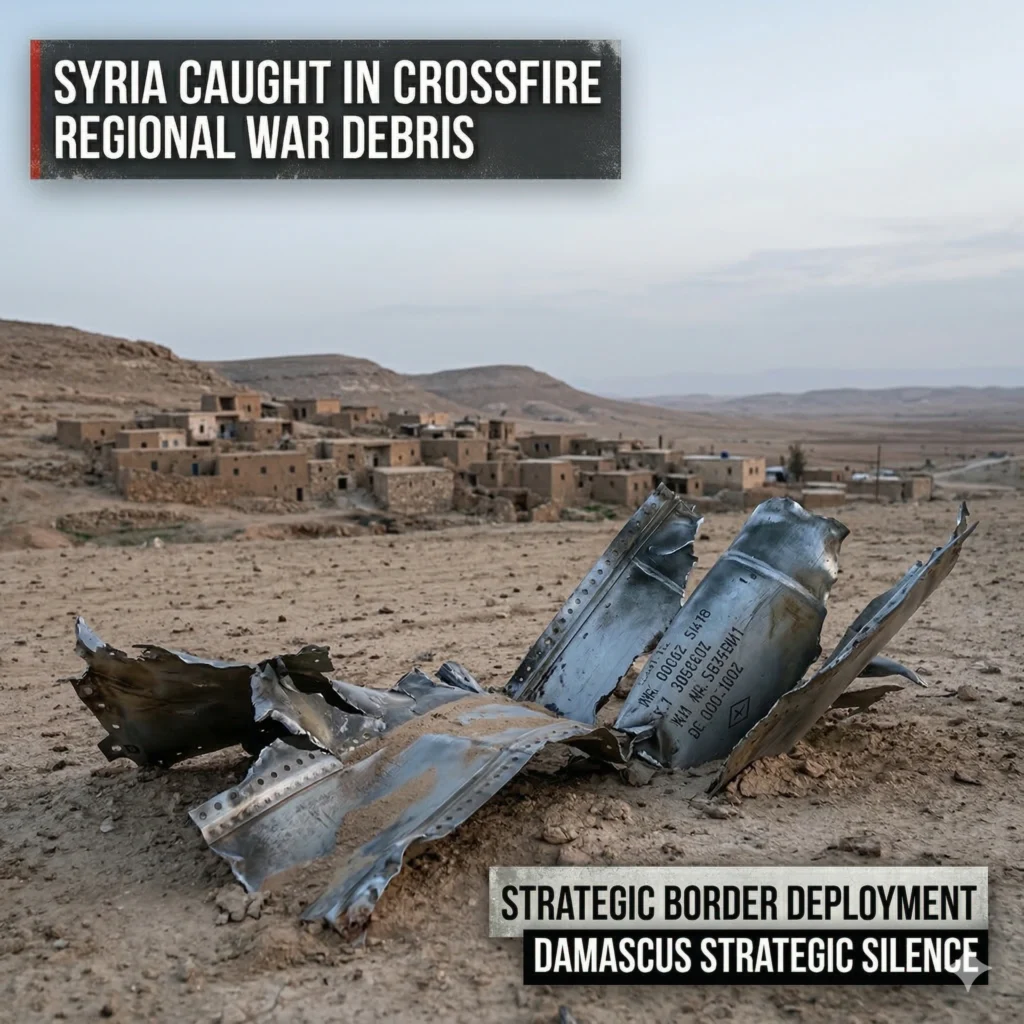
The Physical Toll of War on Syrian Territory
The Syrian Strategic Neutrality policy is being tested by the increasing frequency of physical incursions into Syrian airspace and land. Field monitors have identified at least eighteen distinct locations where debris from intercepted missiles or stray drones has caused significant alarm. In southern regions like Daraa and Quneitra, the crash of a drone near al-Ajami serves as a stark reminder of how close the war has come. These incidents are not merely technical failures; they represent a persistent threat to the safety of Syrian civilians who have already endured a decade of internal strife.
One of the most tragic examples occurred in Suwayda’s industrial zone, where an explosion resulted in five civilian fatalities. The cause of the blast remains a point of intense local debate, with spiritual leaders pointing to an inaccurate Iranian missile while the government maintained it was a domestic accident. This discrepancy in narratives highlights the complexity of Syrian Strategic Neutrality, where the state must balance local grievances against regional alliances. The loss of life in Suwayda has put immense pressure on the government to provide answers, yet the official silence persists.
Infrastructure has also been a casualty of the encroaching conflict, notably with the al-Otaybah power station. The facility went out of service following a direct strike, leaving large portions of the Damascus countryside in darkness. Despite the clear impact on public utilities, the government has refrained from using the incident as a platform for regional escalation. This restraint is a cornerstone of Syrian Strategic Neutrality, prioritizing the avoidance of a wider war over the immediate need for rhetorical retaliation.
Managing the Geopolitical Pressure in Southern Syria
The southern border regions are the most volatile zones under the umbrella of Syrian Strategic Neutrality. Areas bordering the Golan Heights and Jordan have seen frequent debris falls, including ballistic missile fragments south of al-Hasakah. The Syrian army has been forced to reinforce its presence in these areas to monitor the situation without appearing provocative. This delicate balancing act is designed to prevent Syrian territory from becoming a secondary battlefield for foreign powers.
Local authorities in Daraa have been tasked with managing the cleanup of debris while keeping a low profile. The Syrian Strategic Neutrality approach requires local security forces to handle these incidents as domestic police matters rather than military provocations. By treating a missile crash as a “technical accident,” Damascus avoids the need to blame a specific actor, thereby avoiding a diplomatic crisis. This strategy has so far succeeded in keeping the direct conflict at arm’s length.
However, the presence of various militias in the south complicates this Syrian Strategic Neutrality. The government is reportedly working to ensure that Iranian-affiliated groups do not use Syrian soil as a launchpad for attacks against Israeli targets. Such an event would almost certainly trigger a massive Israeli response, ending the government’s policy of distance. Maintaining control over these informal actors is perhaps the greatest challenge to Syria’s current non-interventionist stance.
Syrian Strategic Neutrality
Syrian Strategic Neutrality is often viewed by analysts as a “wait-and-see” approach that seeks to preserve the status quo. By not taking a side in the current hostilities, Damascus hopes to emerge from the crisis with its remaining infrastructure and political standing intact. This is a significant shift from previous decades where Syria was a vocal participant in regional power struggles. The Syrian Strategic Neutrality of 2026 is born out of a necessity to rebuild after years of civil war, leaving little room for external adventures.
The government has even gone as far as to condemn Iranian strikes in Turkey and Azerbaijan while remaining silent on strikes within its own borders. This selective outrage is a key component of Syrian Strategic Neutrality, allowing the state to maintain its international diplomatic standing without offending its primary regional allies. It is a sophisticated game of political gymnastics intended to keep all doors open. The goal is to avoid becoming a target for either the Western coalition or the Iranian-led resistance.
In the Damascus countryside, the population is acutely aware of the Syrian Strategic Neutrality policy. While the lack of official news can be frustrating, many residents prefer the silence to the alternative of a full-scale invasion. The government’s ability to keep the lights on—or at least restore them quickly after strikes—is seen as more important than political rhetoric. This domestic focus is the ultimate justification for the state’s quietude during this regional storm.
Strengthening Border Security Against Smuggling and Militias
- Border Reinforcement: The Syrian army has increased patrols along the Lebanese and Iraqi borders to prevent unauthorized crossings.
- Anti-Smuggling Operations: Security forces are targeting the illicit movement of weapons that could draw Syria into the conflict.
- Militia Oversight: Damascus is actively discouraging non-state actors from using its territory for offensive operations.
A major pillar of Syrian Strategic Neutrality is the tightening of border controls to prevent “spillover” from neighboring conflicts. With Lebanon and Iraq both seeing high levels of military activity, the risk of weapons smuggling into Syria has increased. The Syrian army’s deployment is intended to show both domestic and international observers that the state is in control of its sovereign territory. This is vital for maintaining the Syrian Strategic Neutrality that prevents foreign intervention.
By combatting the use of its land as a transit point for militias, Syria is attempting to de-risk its relationship with Israel and the United States. These Western powers have often cited the presence of Iranian-linked groups in Syria as a reason for targeted strikes. Under the current Syrian Strategic Neutrality, the government is signaling that it is willing to act as a stabilizer. This role as a “buffer zone” is a strategic asset that Damascus is using to ensure its own security.
The focus on the Iraqi border is particularly important for the Syrian Strategic Neutrality policy. The Kharab al-Jir base in Rmeilan has been a flashpoint for tensions, and any escalation there could drag the Syrian military into a confrontation with US forces. By maintaining a professional and defensive posture, the Syrian army avoids providing a pretext for wider hostilities. It is a disciplined approach to a very messy regional situation.
Preparing for a Potential Humanitarian Crisis from Lebanon
As the conflict intensifies, Syrian Strategic Neutrality must also account for the human cost of the war in neighboring Lebanon. Thousands of displaced people are already fleeing toward the Syrian border, seeking safety from the ongoing strikes. The Syrian government is preparing its border facilities to handle a potential influx of refugees, a task that will test its already strained resources. Managing this crisis humanely is essential for maintaining Syria’s international image.
The influx of people from Lebanon poses a unique challenge to Syrian Strategic Neutrality. Among the refugees may be combatants or political figures that could bring the war with them. Security forces are implementing strict screening processes at border crossings like Masnaa to ensure that only civilians are allowed entry. This vetting is a necessary part of keeping Syria a “neutral” zone in the eyes of the global community.
Providing aid to these displaced populations will likely require cooperation with international NGOs and the UN. This interaction allows Syria to re-engage with the global community under a humanitarian banner, reinforcing its Syrian Strategic Neutrality. By focusing on the “victim” aspect of the war rather than the “combatant” aspect, Damascus can secure much-needed aid for its own people as well. The refugee crisis is thus both a challenge and a strategic opportunity.
Historical Precedents for Syrian Distance and Silence
This is not the first time that Damascus has used Syrian Strategic Neutrality to navigate a regional crisis. Throughout the early 2000s and various escalations in Lebanon, the Syrian government has often chosen a path of strategic ambiguity. This history of “diplomatic silence” provides a blueprint for the current administration’s actions. It is a proven method for surviving in a neighborhood where alliances can shift overnight.
The current Syrian Strategic Neutrality is, however, more pronounced than in the past due to the country’s internal exhaustion. After years of fighting, the Syrian military is focused on domestic stability and counter-insurgency rather than regional power projection. The silence from Damascus is a reflection of this reality—a state that is currently more interested in internal consolidation than external conflict. It is a pragmatic evolution of the Syrian political machine.
Comparing Syria’s response to that of other regional actors, such as Jordan or Turkey, highlights the unique nature of Syrian Strategic Neutrality. While other nations are vocal in their condemnations or support, Syria remains a “black box.” This unpredictability is itself a form of defense, as it makes it difficult for adversaries to gauge Syria’s true intentions. Silence, in this case, is a powerful tool of statecraft.
Analyzing the Lack of Official Statements
The absence of any official commentary on the eighteen domestic incidents is the most visible sign of Syrian Strategic Neutrality. Even when civilians die, as in the Suwayda blast, the state avoids using the traditional language of “martyrdom” or “foreign aggression.” This departure from the usual state media playbook is highly intentional. It is designed to lower the political temperature and prevent the media from fueling a call for war.
Analysts believe that this lack of statements is part of a pre-arranged or understood “de-confliction” strategy. By not calling out Israel for strikes, Syria avoids forcing itself into a corner where it would be expected to respond. This Syrian Strategic Neutrality allows both sides to avoid an escalatory spiral that neither wants. The silence is a mutual language spoken by powers that are trying to manage a containment policy.
The Syrian government is also using this time to focus on economic recovery and the restoration of trade routes with Iraq and Jordan. By keeping the country “neutral,” they are ensuring that these vital economic lifelines remain open. The Syrian Strategic Neutrality policy is thus as much about the pocketbook as it is about the gun. A peaceful border is a profitable border, and Damascus knows this well.
Future Projections for Syria’s Regional Role
As we move further into 2026, the success of Syrian Strategic Neutrality will depend on the government’s ability to maintain its grip on internal security. If the state loses control of the militias on its soil, the policy of neutrality will likely collapse. Therefore, we can expect to see an even greater crackdown on unauthorized armed groups in the coming months. The state must be the only actor with the power to decide between war and peace.
Syria may also seek to use its Syrian Strategic Neutrality to position itself as a mediator in future regional talks. While this seems unlikely in the short term, a nation that has successfully avoided the current conflagration could be seen as a useful neutral ground for negotiations. This would be a remarkable turnaround for a country that was once an international pariah. The road to rehabilitation begins with the silence we are witnessing today.
Ultimately, Syrian Strategic Neutrality will be remembered as the strategy that kept the country from falling back into a total war. Whether this silence can be maintained in the face of even larger strikes remains to be seen. For now, the people of Syria are living in a fragile bubble of quiet, protected by a government that has learned the value of not speaking. The regional conflict continues to rage, but for Syria, the goal is simply to survive it.
Conclusion: The Power of Prudence in the Levant
The Syrian Strategic Neutrality of 2026 is a testament to the power of prudence in a time of chaos. By documenting eighteen incidents and choosing to remain silent, the Syrian government has prioritized its own survival and the safety of its remaining infrastructure. This approach has allowed the country to avoid being drawn into a devastating direct military confrontation with technologically superior forces. While the cost has been a loss of rhetorical “face,” the benefit has been the preservation of the state itself.
As the conflict between the US, Israel, and Iran continues to reshape the Middle East, Syria’s role as a quiet observer will be critical. The Syrian Strategic Neutrality policy provides a rare example of restraint in a region often defined by escalation. Whether by design or by necessity, Damascus has found a way to navigate the storm without capsizing. The future of the country now rests on its ability to keep that silence for as long as the regional fire continues to burn.
For more details & sources visit: Enab Baladi
Read more about Syria news on 360 News Orbit – Syria.