
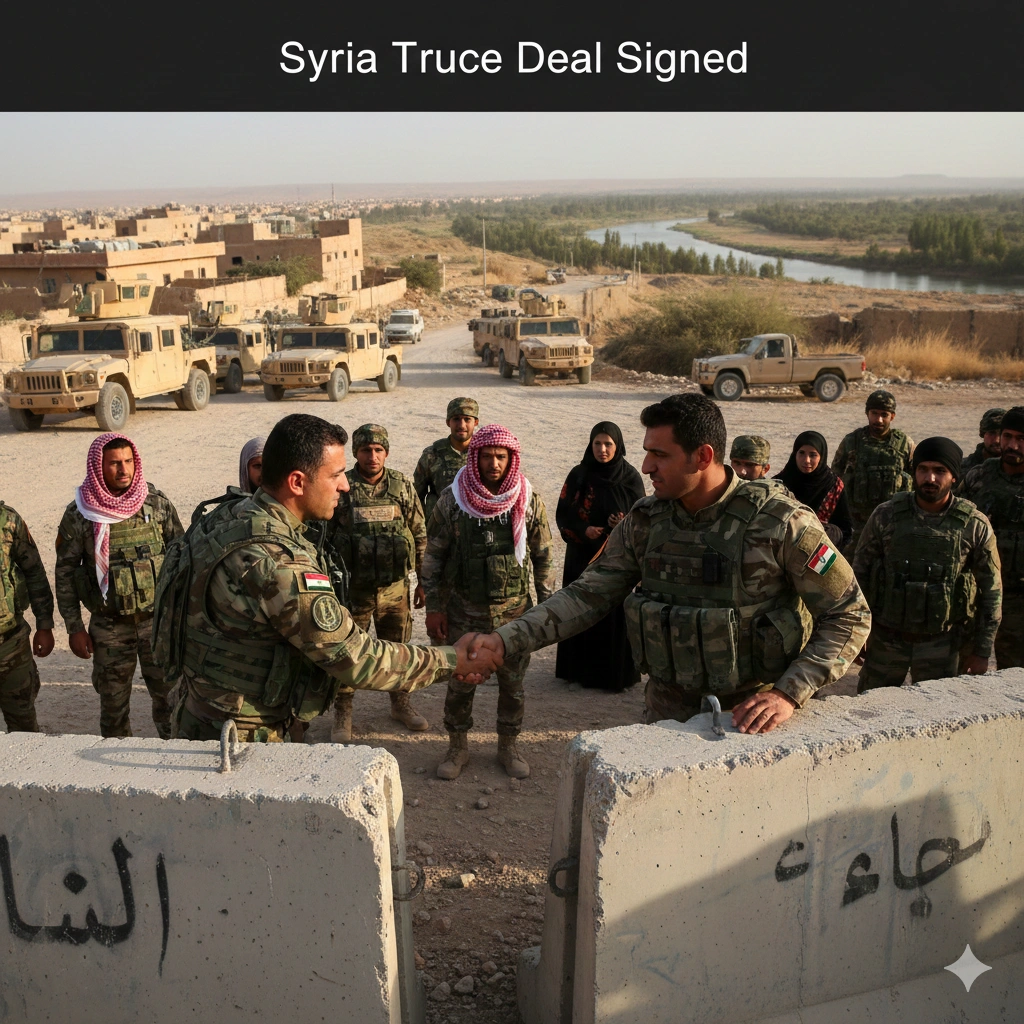
Syrian government Kurdish SDF truce negotiations have culminated in a landmark permanent agreement that reshapes Syria’s political and military landscape after years of instability. The Syrian government and the Kurdish-led Syrian Democratic Forces (SDF) have officially converted a temporary ceasefire into a lasting truce, opening the door for full military integration and centralized governance across northeastern Syria.
This agreement represents one of the most consequential developments in the Syrian conflict since the territorial defeat of ISIS. It not only halts recent fighting but also establishes a framework for reunifying fragmented regions under state authority while addressing long-standing Kurdish demands for rights and representation.
From Ceasefire to Permanent Settlement
The Syrian government Kurdish SDF truce follows weeks of escalating tensions and military advances by Damascus-backed forces. Over the past month, Syrian army units—supported by local Arab militias and tribal fighters—regained control of nearly 80% of territory previously administered by the SDF in northeastern Syria. These rapid territorial shifts significantly altered the balance of power and pressured both sides to pursue a negotiated solution.
As government forces advanced, the SDF strategically withdrew from Arab-majority areas while consolidating defenses around key Kurdish cities such as Hasakah and Qamishli. These cities had long served as administrative and security hubs for Kurdish self-rule. Rather than risk a prolonged urban confrontation, both parties opted for diplomacy.
Key Terms of the Syrian Government Kurdish SDF Truce
Under the finalized agreement, frontline forces from both sides will disengage, allowing Syrian state security institutions to deploy across major population centers. Kurdish-led civilian administrations, which have governed parts of northeastern Syria for nearly a decade, will be gradually absorbed into national government structures.
A central pillar of the Syrian government Kurdish SDF truce is military integration. Three SDF combat units will be reorganized into a newly formed Syrian army brigade, operating under centralized command. Additional Kurdish-affiliated forces will be stationed in Aleppo as part of broader national deployments. This move formally ends the SDF’s status as an independent military force.
End of Kurdish Self-Rule, With Guarantees
While the agreement effectively dissolves Kurdish autonomous governance, it includes significant political and social guarantees. The Syrian government has committed to protecting Kurdish ethnic and cultural rights, ensuring access to education in Kurdish-majority areas, and facilitating the return of displaced residents.
For Kurdish communities, the Syrian government Kurdish SDF truce represents a difficult but pragmatic compromise—trading political autonomy for security, recognition, and long-term stability. Analysts note that the inclusion of rights protections was critical in securing SDF approval.
International Mediation and Regional Impact
The truce was brokered with diplomatic support from both the United States and France, highlighting continued international involvement in Syria’s post-war restructuring. U.S. envoy Tom Barrack described the Syrian government Kurdish SDF truce as a “historic milestone” that prevents further bloodshed and creates conditions for national reconciliation.
Regional experts believe the agreement reduces the likelihood of wider conflict involving Turkey, which has long opposed SDF control near its border. By bringing Kurdish forces under Damascus’s authority, the deal may ease regional tensions while strengthening Syria’s territorial integrity.
Strategic and Political Implications
The Syrian government Kurdish SDF truce significantly consolidates state control over resource-rich regions in the northeast, including vital oil, gas, and agricultural assets. It also weakens external influence by reducing the need for foreign military protection of SDF-held areas.
Politically, the agreement signals Damascus’s gradual reassertion of sovereignty over areas lost during the civil war. It may also serve as a model for future reconciliation deals with other non-state actors across Syria.
A Turning Point for Syria
While challenges remain in implementing the agreement, the Syrian government Kurdish SDF truce marks a decisive turning point. By ending armed confrontation, integrating forces, and addressing minority rights within a unified framework, the deal lays groundwork for reconstruction and long-term stability.
If successfully implemented, this truce could redefine Syria’s post-war order and set a precedent for resolving entrenched conflicts through negotiated integration rather than continued violence.
For more news, visit 360 News Orbit