
The Syrian Currency Reform 2026 represents a monumental shift in the financial landscape of the Middle East as the nation seeks to reclaim its monetary sovereignty. Central Bank Governor Abdulkader Husrieh recently confirmed that approximately 35 percent of the 41 trillion Syrian pounds previously in circulation has been successfully replaced with newly printed banknotes. This strategic overhaul is not merely a cosmetic change but a deep-rooted economic restructuring designed to stabilize a volatile market. By removing two zeroes from the currency and eliminating imagery associated with the former administration, the transition aims to restore public confidence. Analysts suggest that these aggressive measures are essential for curbing the rampant inflation that has plagued the region for over a decade.
This massive undertaking began in early January when the first batches of the new banknotes entered the domestic market to replace the devalued paper. The Syrian Currency Reform 2026 is specifically targeted at reducing the high levels of dollarization that occurred as the pound collapsed from 50 to nearly 10,000 against the US dollar. By modernizing the physical cash supply, the central bank intends to simplify accounting practices and lower the costs of handling massive volumes of paper. This technical adjustment is a prerequisite for any meaningful recovery in the banking sector and retail trade. As the government reasserts control, the new notes serve as a symbol of a fresh start for the Syrian financial system.
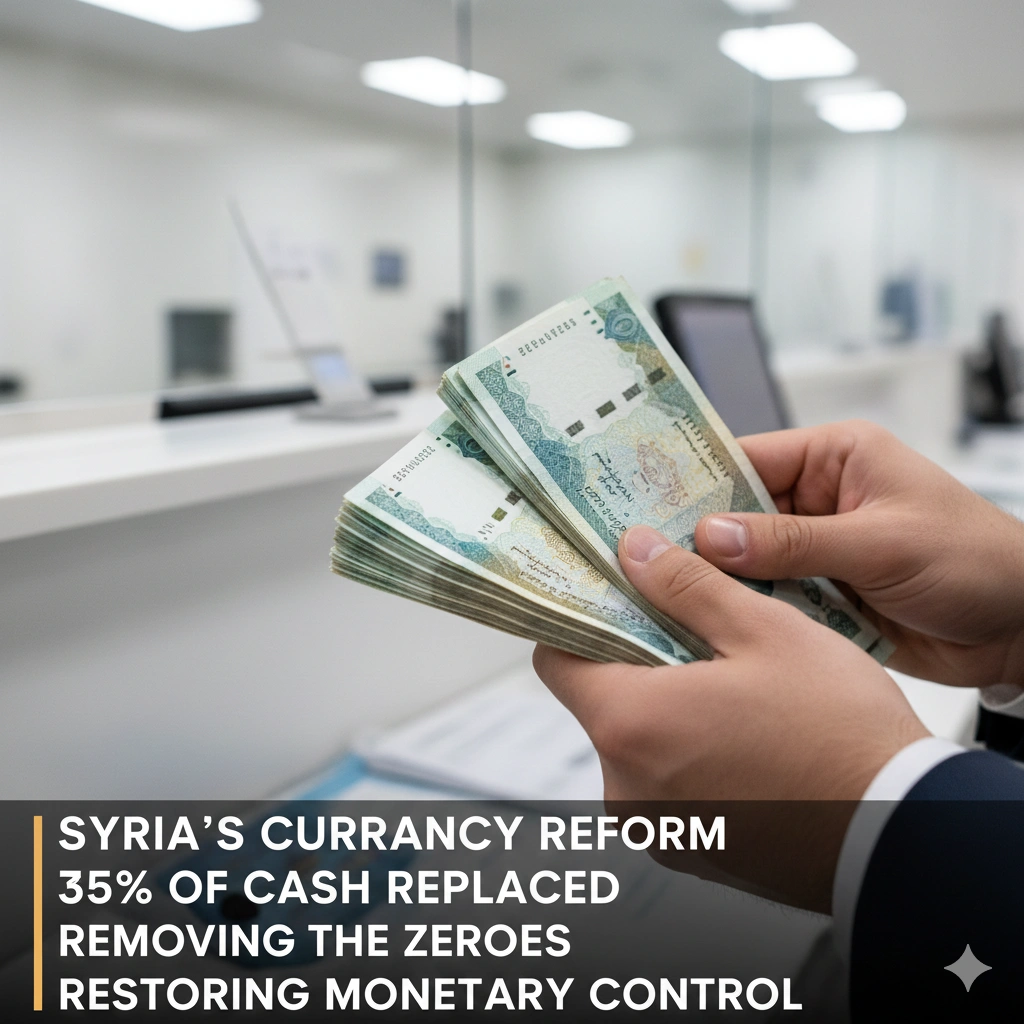
Syrian Currency Reform 2026
The physical distribution of the new banknotes has been prioritized in major urban centers to ensure that the Syrian Currency Reform 2026 reaches the most active economic zones first. Governor Husrieh noted that the replacement of 35 percent of the old supply is a significant milestone achieved in just a few weeks. The logistics of transporting such vast quantities of cash across a recovering nation required extensive coordination between the central bank and local commercial branches. This rapid rollout is intended to minimize market disruption and prevent speculative attacks on the new currency value. Shopkeepers and citizens are gradually adapting to the smaller denominations which make daily transactions significantly more manageable.
Restoring Monetary Sovereignty Through Redenomination
The decision to remove two zeroes from the pound is a central pillar of the Syrian Currency Reform 2026 strategy to fight hyperinflation. For years, the sheer volume of paper required for simple purchases made the old currency impractical for modern commerce. By simplifying the face value of the notes, the central bank is effectively resetting the psychological perception of the national tender. This redenomination process is expected to streamline financial reporting for both private businesses and government agencies. It also reduces the physical burden on the banking infrastructure, which was previously overwhelmed by the need to store and count massive stacks of low-value bills.
Furthermore, the Syrian Currency Reform 2026 aims to eliminate the influence of the former regime by updating the visual identity of the national money. The removal of images associated with the Al Assad administration is a powerful signal of political and economic transition. This symbolic shift is intended to foster a sense of national unity and inclusivity as the country moves toward a post-conflict era. By focusing on neutral national symbols and historical landmarks, the new banknotes represent a collective identity rather than a specific political era. This change is crucial for gaining the trust of various factions and international investors alike.
International observers are closely monitoring the Syrian Currency Reform 2026 to see if it can successfully reduce the reliance on the US dollar. Dollarization has long stripped the central bank of its ability to implement effective monetary policy, as most high-value trades were conducted in foreign cash. If the new pound can maintain its value, the bank will regain the power to influence interest rates and control the money supply. This return of monetary authority is vital for the long-term health of the Syrian economy. Without a stable domestic currency, the government would remain unable to fund public services or manage the national debt effectively.
Aligning with International Financial Benchmarks
As part of the Syrian Currency Reform 2026, the central bank has initiated a formal gap assessment with a prominent US consulting firm. This collaboration is designed to identify areas where the Syrian banking system falls short of global standards and to implement necessary reforms. By inviting external auditors and consultants, the bank is demonstrating a level of transparency that was previously non-existent. The goal is to align domestic regulations with the Basel III framework and other international anti-money laundering protocols. These steps are essential for any country hoping to rejoin the SWIFT network and facilitate international trade.
The assessment is a critical component of the Syrian Currency Reform 2026, as it provides a roadmap for modernizing the legislative framework governing the financial sector. Experts are looking at everything from capital adequacy ratios to the digital infrastructure used for interbank transfers. Upgrading these systems will allow Syria to host foreign bank branches and attract direct foreign investment in the near future. The central bank is also focusing on training its staff to handle complex electronic transactions and modern risk management techniques. This human capital development is just as important as the physical replacement of the currency itself.
Efforts are also underway to reactivate the Syrian central bank’s account with the Federal Reserve Bank of New York as a result of the Syrian Currency Reform 2026. Regaining access to these international accounts would provide the liquidity needed to stabilize the pound during times of market stress. It would also allow the government to facilitate payments for essential imports like food and medicine more efficiently. The restoration of these ties depends heavily on the success of the current reform measures and the bank’s ability to prove its independence. Successfully navigating this diplomatic and financial challenge would be a major victory for the current administration.
Integrating Autonomous Regions into the National Economy
The Syrian Currency Reform 2026 is also being used as a tool for territorial and economic reintegration across the country. New central bank branches are scheduled to open in Raqqa and Hasakah, areas that were previously under autonomous or non-state control. By establishing a physical presence in these regions, the central bank is extending its financial authority and offering residents access to the new currency. This move is intended to displace the various foreign currencies that had taken root in those areas during the conflict. Providing a stable and official alternative is key to bringing these regions back into the national economic fold.
- The opening of the Raqqa branch will facilitate payroll for local civil servants.
- Hasakah’s new facility will support the agricultural sector with official credit lines.
- Local businesses will be able to exchange old currency for new banknotes without traveling to Damascus.
- The expansion helps standardize the value of goods and services across all provinces.
This expansion of the Syrian Currency Reform 2026 ensures that the benefits of the new monetary policy are felt nationwide rather than just in the capital. It allows the central bank to collect better data on economic activity in the northeast, which is vital for planning future growth. The presence of official banking institutions also provides a secure environment for citizens to save money and conduct business. As the state re-establishes these services, it reinforces its role as the primary provider of economic stability. This institutional growth is a clear indicator of the government’s long-term strategy for national recovery.
Leveraging Energy Resources for GDP Growth
The success of the Syrian Currency Reform 2026 is closely tied to the restoration of state control over the nation’s oil and gas fields. Energy revenues are expected to be the primary driver of GDP growth within the coming year, providing the backing needed for the new currency. By funneling these resources through sovereign accounts under state oversight, the government can ensure that the wealth is used for national reconstruction. This transparent management of natural resources is a key demand of international lenders and a cornerstone of the new economic policy. Without the steady income from energy exports, maintaining the value of the new banknotes would be extremely difficult.
- Oil production is projected to double by the end of 2026 through technical upgrades.
- Gas reserves will be prioritized for domestic power generation to reduce energy imports.
- Sovereign wealth funds will manage a portion of the revenue for long-term stability.
Integrating energy revenues into the framework of the Syrian Currency Reform 2026 provides a buffer against external economic shocks. It allows the central bank to build up its foreign exchange reserves, which are necessary to defend the pound on the open market. This synergy between resource management and monetary policy is what sets the current reform apart from previous, less successful attempts. As the energy sector recovers, the increased demand for the Syrian pound for local operations will further strengthen the currency’s position. This cycle of growth and stability is the ultimate goal of the central bank’s current strategy.
Reconnecting Syria with the Global Banking Sector
Financial authorities believe that the Syrian Currency Reform 2026 is the essential bridge needed to reconnect with the global financial system. For too long, Syrian banks have been isolated, making it nearly impossible for citizens to send or receive money internationally. The new reforms are designed to break this isolation by adopting the standards required by global correspondent banks. As the central bank proves its ability to manage the currency and oversee the commercial sector, international trust will slowly return. This reconnection is vital for the private sector, which needs access to global markets to thrive and create jobs.
The Syrian Currency Reform 2026 also includes plans for digital banking upgrades to make the new currency more accessible in the virtual space. By encouraging the use of debit cards and mobile payments, the bank aims to reduce the overall reliance on physical cash. This shift toward a digital economy is a hallmark of modern financial systems and will help reduce the underground economy. Electronic tracking of transactions also makes it easier to combat tax evasion and ensure that the government has the funds needed for public services. These technical improvements are being implemented alongside the physical currency swap to ensure a comprehensive modernization.
- Introduction of a new national payment gateway for online transactions.
- Partnerships with regional banks to facilitate cross-border trade.
- Tax incentives for businesses that adopt electronic payment systems.
- Public awareness campaigns to educate citizens on the benefits of the new pound.
Ultimately, the Syrian Currency Reform 2026 is about more than just paper and numbers; it is about rebuilding the foundations of a nation. The central bank’s proactive approach signals a transition from crisis management to long-term strategic planning. While challenges remain, the successful replacement of a third of the currency supply in just weeks is an optimistic sign. If the government can maintain this momentum and continue its path of reform, the Syrian pound may once again become a symbol of national pride and economic strength. The road ahead is long, but the first major steps have been taken with precision and resolve.
Future Outlook for the New Syrian Pound
The long-term success of the Syrian Currency Reform 2026 will depend on the government’s ability to control fiscal deficits and promote private sector investment. While the currency swap has provided a necessary “reset,” it must be accompanied by broader structural reforms to be sustainable. Investors will be looking for consistency in policy and a stable legal environment before committing significant capital to the country. The central bank has indicated that it will continue to monitor inflation closely and adjust its policies as the new banknotes become fully integrated. This vigilant approach is necessary to prevent the return of the hyperinflationary cycles that destroyed the old pound.
As the Syrian Currency Reform 2026 moves into its next phase, the focus will shift toward enhancing the purchasing power of ordinary citizens. A stable currency means that wages will hold their value, allowing families to plan for the future with greater certainty. This social stability is just as important as the economic metrics, as it reduces the likelihood of further unrest. The government’s commitment to funding public services through transparent energy revenues should also improve the quality of life across the country. By linking the currency’s value to the nation’s actual resources, the central bank is building a more resilient and honest financial system.
In conclusion, the Syrian Currency Reform 2026 stands as a bold attempt to rewrite the nation’s economic narrative. Through a combination of redenomination, international cooperation, and resource management, the Central Bank of Syria is laying the groundwork for a sustainable recovery. The replacement of 35 percent of the cash in circulation is a strong start, but the work is far from over. As the remaining old notes are phased out, the world will be watching to see if this ambitious plan can truly restore the Syrian pound to its former status. For the people of Syria, these changes offer a glimmer of hope for a more stable and prosperous future.
For more details & sources visit: The National
Read more about Syria news on 360 News Orbit – Syria.