
Syria recovery crisis 2026 remains a stark reminder of the long-term consequences of conflict as the nation marks fifteen years since the uprising began. A new report by Action For Humanity reveals that recovery efforts risk total failure due to a lack of jobs, infrastructure, and international funding. This research, conducted across eight different governorates, highlights a population facing extreme exhaustion and economic collapse. Without a significant shift in global support, the humanitarian landscape in Syria will continue to deteriorate, leaving millions in a state of permanent displacement. The urgency of this situation cannot be overstated as the window for sustainable intervention begins to close for an entire generation of civilians.
The humanitarian organization published a detailed report titled “Civilian Perspectives on Humanitarian Needs and Recovery Priorities” to capture the ground reality. Data was collected through extensive interviews and focus groups in key regions including Aleppo, Idlib, Damascus, and Tartous to ensure diverse local experiences were represented. These findings show that the basic requirements for human dignity, such as healthcare and clean water, are currently luxuries for many. The Syria recovery crisis 2026 is defined by this gap between the immediate needs of the people and the dwindling interest of the international donor community. As global attention shifts to other conflicts, the Syrian people feel increasingly abandoned by the world.
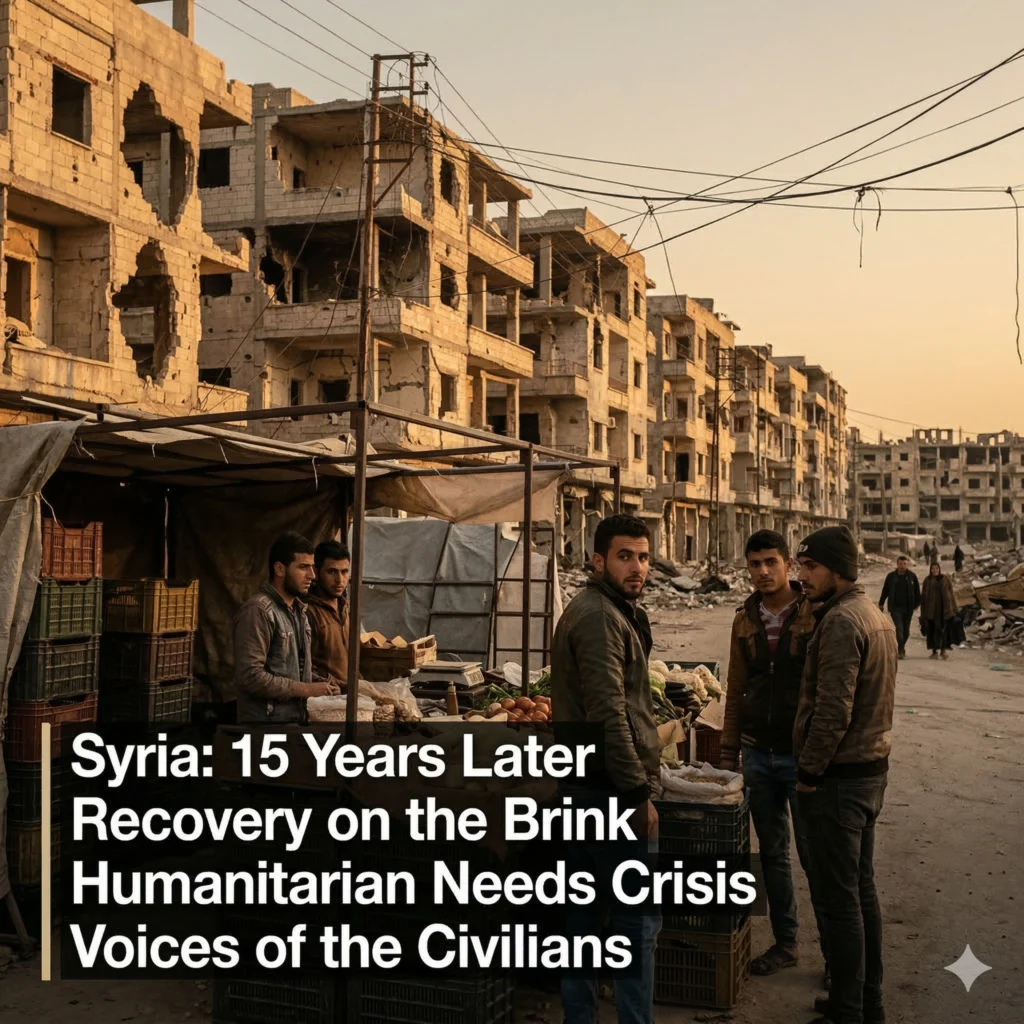
Syria recovery crisis 2026
The Syria recovery crisis 2026 has reached a tipping point where local resilience is no longer enough to sustain the population without external help. Civilians identified healthcare, electricity, clean water, and education as the most critical and urgent needs currently facing the nation. In many governorates, the electrical grid is functional for only a few hours a day, paralyzing hospitals and small businesses alike. This lack of power prevents the pumping of clean water, leading to a rise in waterborne diseases that the crippled healthcare system cannot manage. For the average family, surviving each day has become a complex logistical challenge that drains their remaining physical and emotional resources.
Severe shortages of medicine and skyrocketing food prices have left many displaced families unable to support their children or elderly relatives. The inflation of the local currency has rendered traditional savings worthless, forcing many to rely entirely on sporadic humanitarian aid. In the Syria recovery crisis 2026, the cost of a basic meal often exceeds the daily wage of a laborer, assuming work can even be found. This economic strangulation is creating a cycle of poverty that is difficult to break without large-scale job creation programs. Mothers reported skipping meals to ensure their children have something to eat, a trend that is becoming dangerously common across the country.
The Threat of a Lost Generation
The report warns of a lost generation as many children remain out of school due to damaged buildings or the harsh reality of financial necessity. Education has become a secondary priority for families who must choose between buying textbooks or buying bread for the evening. In the Syria recovery crisis 2026, thousands of schools remain piles of rubble, serving as a constant visual reminder of the destruction of the past decade. Even in areas where schools are standing, the lack of qualified teachers and heating makes learning nearly impossible during the cold winter months. This educational deficit will have profound long-term effects on the country’s ability to rebuild its intellectual and professional capital.
- Over 2.4 million children are currently out of school across various Syrian governorates.
- Child labor has increased by 40 percent as families struggle to meet basic survival needs.
- Early marriage rates among young girls are rising as a desperate coping mechanism for impoverished households.
- Lack of psychological support services is leaving a generation of youth with untreated trauma from the war.
Unemployment among young people has reached critical levels, leading many to consider dangerous migration as their only viable future option. For a young Syrian in 2026, the prospect of building a life at home seems increasingly like an impossible dream. The Syria recovery crisis 2026 is fueling a new wave of displacement as the brightest minds seek opportunities in Europe or neighboring states. This drain of talent further complicates the recovery process, as there are fewer skilled workers available to lead reconstruction efforts. The international community must realize that investing in Syrian youth is the only way to prevent a permanent state of instability.
Infrastructure and Agricultural Barriers
Landmines and unexploded ordnance continue to prevent the safe return of families and the resumption of agricultural work in several rural regions. These hidden killers turn fertile fields into death traps, preventing farmers from contributing to the national food supply. During the Syria recovery crisis 2026, the slow pace of demining operations has kept thousands of internally displaced persons in camps rather than in their original homes. Agriculture was once the backbone of the Syrian economy, but without safe land, the country remains dependent on expensive imports. Clearing these hazards is a technical challenge that requires specialized equipment and significant funding that is currently missing.
The destruction of irrigation systems and grain silos during the conflict has further crippled the agricultural sector’s ability to bounce back. Farmers who do manage to plant crops often find they have no way to transport them to markets due to destroyed roads and fuel shortages. The Syria recovery crisis 2026 highlights the interconnected nature of infrastructure; without transport and storage, food security remains a distant goal. Rebuilding these networks is essential for creating a self-sufficient economy that does not rely on the whims of international aid cycles. Local communities are eager to work, but they lack the heavy machinery and materials needed to restore their land.
Global Funding and Political Stagnation
Action For Humanity CEO Othman Moqbel stated that fifteen years after the uprising began, millions are still struggling for daily survival. He emphasized that the Syria recovery crisis 2026 is a man-made disaster that can be mitigated through better international coordination and genuine political will. The organization is calling for a shift in how aid is delivered, moving away from short-term emergency relief toward long-term development. This requires international donors to act as partners rather than controllers, allowing local organizations to lead the recovery process. Sustainable peace is only possible when the local population has a stake in the reconstruction of their own country.
- International funding for the Syrian Humanitarian Response Plan has dropped to record lows.
- Donor fatigue is cited as the primary reason for the reduction in long-term developmental projects.
- Local NGOs are often excluded from high-level decision-making processes regarding aid distribution.
- Political barriers continue to prevent the flow of reconstruction funds to the most devastated areas.
The report suggests that without immediate intervention, Syria’s post-conflict landscape will remain fragile and prone to further instability. The Syria recovery crisis 2026 is not just a Syrian problem; it is a regional security issue that affects the stability of the entire Middle East. If the country is allowed to remain a failed state, it will continue to be a source of refugees and a vacuum for extremist ideologies. Global powers must look past their political differences to address the humanitarian catastrophe that is unfolding in plain sight. Dignity and local ownership must be at the heart of any new international strategy for the nation.
Healthcare System on the Brink
The collapse of the healthcare sector is perhaps the most visible sign of the Syria recovery crisis 2026. Many doctors and nurses have fled the country, leaving a skeleton crew of medical professionals to handle complex cases with minimal supplies. Specialized treatments for cancer or chronic kidney disease are almost non-existent in several governorates, leading to preventable deaths every day. Hospitals that were once state-of-the-art now operate with rusted equipment and frequent power outages. The lack of clean water has only added to the burden, as clinics are overwhelmed by patients suffering from preventable infections.
- Medical supply chains are frequently disrupted by border closures and internal checkpoints.
- Access to mental health services is restricted to a few major urban centers, leaving rural areas neglected.
- Vaccination rates for preventable childhood diseases have plummeted in displaced person camps.
- Many healthcare workers are operating without pay or reliable security in high-risk zones.
Addressing the Syria recovery crisis 2026 requires a massive infusion of medical aid and training for the next generation of healthcare workers. International organizations must prioritize the restoration of specialized clinics and the provision of essential medications. Without a functional health system, any other recovery efforts will be undermined by a population that is too ill or too traumatized to participate. The resilience of the remaining medical staff is heroic, but heroism is not a substitute for a functioning public health infrastructure. The world must act before the system collapses entirely, leaving millions without any form of medical recourse.
Cultural Heritage and Social Cohesion
Beyond the physical destruction, the Syria recovery crisis 2026 has deeply wounded the social fabric and cultural heritage of the nation. Historic sites that once drew tourists from around the world now sit in ruins, their stones used for makeshift shelters. The loss of these sites is a loss of national identity and a potential source of future revenue from tourism. Rebuilding cultural landmarks is often seen as a secondary priority, but it is vital for the psychological recovery of a people who have lost so much. These sites represent the shared history of all Syrians, regardless of their political or religious background.
Social cohesion is also under threat as the long years of war have created deep divisions within communities. The Syria recovery crisis 2026 necessitates programs that focus on reconciliation and community building alongside physical reconstruction. Local leaders are working to bridge these gaps, but they require the resources to create shared spaces and inclusive local governments. When people work together to rebuild a school or a park, they are also rebuilding the trust that was destroyed by a decade of violence. This “soft” infrastructure is just as important as the “hard” infrastructure of roads and bridges for the long-term health of the nation.
The Role of Local Ownership
Civilians expressed a strong desire for an inclusive recovery process that is rooted in dignity and local ownership rather than top-down mandates. They want to be the architects of their own future, not just the recipients of hand-outs that may not meet their actual needs. The Syria recovery crisis 2026 can only be resolved if the people most affected by the conflict are given a seat at the table. This means supporting local businesses, hiring local workers for reconstruction projects, and listening to the priorities of village councils. When recovery is locally led, it is more sustainable, more cost-effective, and more likely to lead to lasting peace.
The international community must empower these local actors by providing the technical training and financial transparency tools they need. In the Syria recovery crisis 2026, the most effective aid is often that which helps a Syrian start a small business or a cooperative farm. These initiatives create a sense of agency and hope that is far more powerful than any external intervention. By shifting the focus from “giving” to “investing,” global partners can help Syria transition from a state of crisis to a state of growth. This transition is difficult, but it is the only path forward for a nation that has suffered for far too long.
Conclusion: A Call for Immediate Action
The findings of the Action For Humanity report are a clear warning that the Syria recovery crisis 2026 is entering a dangerous new phase. The combination of economic collapse, infrastructure decay, and international neglect is creating a perfect storm of human suffering. However, the report also shows that there is a path forward if the global community chooses to act with urgency and compassion. By focusing on jobs, education, and essential services, we can help the Syrian people move toward a future of stability and dignity. The cost of inaction is far higher than the cost of support, both in human lives and in regional security.
As we mark fifteen years since the start of this tragedy, let it be the year that the world finally gets serious about Syrian recovery. The Syria recovery crisis 2026 does not have to be a permanent state of affairs if we choose to stand with the civilians who are fighting for survival. Their resilience is an inspiration, but they cannot do it alone any longer. It is time for a new global compact for Syria—one that prioritizes people over politics and long-term stability over short-term fixes. The children of Syria deserve a future where they can go to school, find work, and live in peace in their own land.
For more details & sources visit: Arab News
Read more about Syria news on 360 News Orbit – Syria.