
Syria Jordan gas deal implementation is now underway after Damascus and Amman signed a new agreement to supply natural gas to Syria’s electricity sector, marking a key step in stabilising power generation amid ongoing energy shortages.
Under the agreement, Jordan will facilitate the delivery of up to 4 million cubic meters of natural gas per day (around 140 million cubic feet) to Syrian power plants, using regional infrastructure and LNG import capacity at Aqaba. The deal reflects growing regional coordination on energy security and post-conflict recovery.
Syria Jordan Gas Deal Supports Power Generation Amid Shortages
The Syria Jordan gas deal is designed to address chronic fuel shortages that have constrained electricity production across Syria in recent years.
Gas deliveries began on January 1, initially ranging between 30 and 90 million cubic feet per day, and are expected to continue through March. The supplies are being sourced through a floating storage and regasification unit (FSRU) operating at Jordan’s Aqaba terminal and chartered via Egypt.
Officials say the arrangement provides Syria with a more reliable and diversified fuel supply as it works to stabilise essential services for households and businesses.
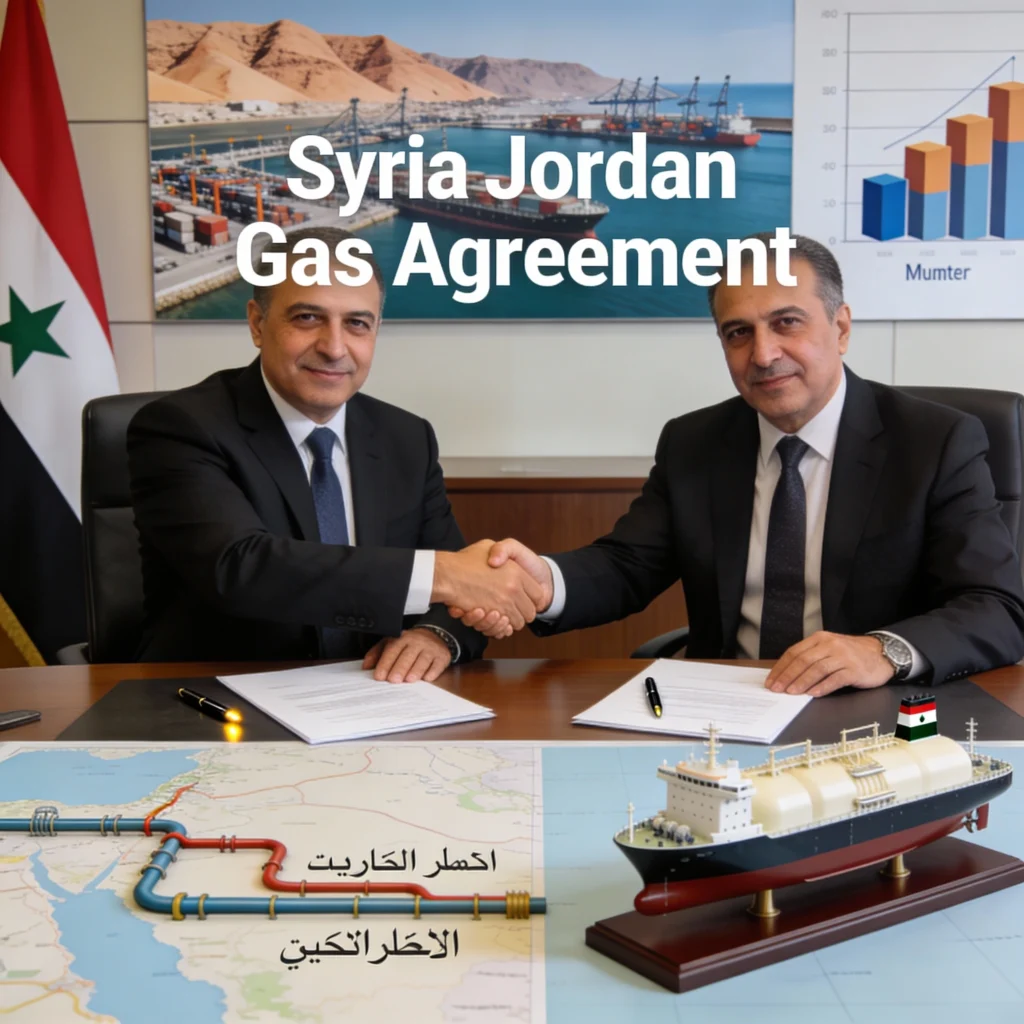
Agreement Signed by Syria and Jordan Energy Authorities
The Syria Jordan gas deal was formally signed in Damascus by representatives of the Syrian Petroleum Company and Jordan’s National Electric Power Company (NEPCO).
The signing ceremony was attended by:
- Syria’s Energy Minister Ghassan al-Bashir
- Jordan’s Minister of Energy and Mineral Resources Saleh al-Kharabsheh
Both sides described the agreement as part of a broader regional energy framework developed in 2025 to strengthen cross-border cooperation and maximise the use of existing infrastructure.
Jordan’s Role As Regional Energy Hub Highlighted
Jordanian officials emphasised that the Syria Jordan gas deal reinforces Jordan’s position as a regional energy transit hub connecting LNG imports, pipelines, and neighbouring markets.
Minister Saleh al-Kharabsheh said Jordan’s infrastructure allows it to:
- Receive LNG via Aqaba
- Regasify imported fuel
- Transport gas efficiently through established pipelines
Jordan has also leased a replacement FSRU to ensure continuity of LNG operations while maintaining flexibility for domestic and regional supply commitments.
Arab Gas Pipeline Central to Syria Jordan Gas Deal
A key logistical component of the Syria Jordan gas deal is the Arab Gas Pipeline, which enables regasified LNG from Aqaba to be transported northward into Syria.
Under the arrangement:
- LNG is regasified at Aqaba
- Natural gas flows through Jordan’s pipeline network
- Supplies are delivered to Syrian power generation facilities
Officials say using existing pipeline infrastructure significantly reduces delivery time and costs compared with alternative fuel transport options.
Qatar Funding Supports Gas Supply Arrangement
The agreement is being implemented with Qatari financial support, helping cover costs associated with LNG procurement and logistics.
This funding component:
- Eases fiscal pressure on Syria’s energy sector
- Supports uninterrupted power generation
- Enhances regional burden-sharing
Syrian Energy Minister Ghassan al-Bashir said the arrangement would improve operational efficiency at power plants and translate into more stable electricity supply for citizens.
Strategic Importance of the Syria Jordan Gas Deal
Analysts view the Syria Jordan gas deal as strategically significant beyond its immediate energy impact.
The agreement:
- Diversifies Syria’s energy sources after years of infrastructure damage
- Strengthens regional energy interdependence
- Demonstrates pragmatic cooperation despite political complexities
It also reflects a wider trend in the Middle East toward leveraging shared infrastructure to address energy shortages and improve resilience.
Outlook: What Comes Next After the Syria Jordan Gas Deal
Energy officials say the current supply volumes could be adjusted depending on:
- Demand from Syrian power plants
- LNG availability at Aqaba
- Regional energy market conditions
The deal may also serve as a template for future energy cooperation, including electricity interconnection and expanded gas flows as infrastructure is rehabilitated.
Conclusion: Syria Jordan Gas Deal Boosts Energy Stability
The Syria Jordan gas deal represents a concrete step toward restoring electricity generation capacity in Syria while reinforcing Jordan’s role as a regional energy gateway.
By combining LNG imports, pipeline connectivity, and regional financing support, the agreement highlights how coordinated energy solutions can address shortages, support recovery, and strengthen regional cooperation.
Source:
Egypt Oil & Gas – Syria, Jordan Sign Gas Supply Deal
For more news, visit 360 News Orbit