
The Sudan Livestock Sector Collapse 2026 represents a devastating blow to the nation’s economic stability and food security as the Ministry of Livestock and Fisheries issues its most dire warning yet. Dr. Ahmed Al-Tijani Al-Mansouri, the leading authority on the sector, has confirmed that the foundations of this vital industry are essentially disintegrating under the pressure of ongoing conflict.
For a nation where livestock traditionally accounts for 20% of the total Gross Domestic Product, the current state of infrastructure and production is nothing short of a national emergency. This crisis is not merely a temporary dip in exports but a structural failure caused by the systematic destruction of the facilities required to meet international veterinary and health standards. As professionals flee the country and laboratories lie in ruins, the path to recovery for the Sudanese pastoralist community appears increasingly obstructed by the realities of war.
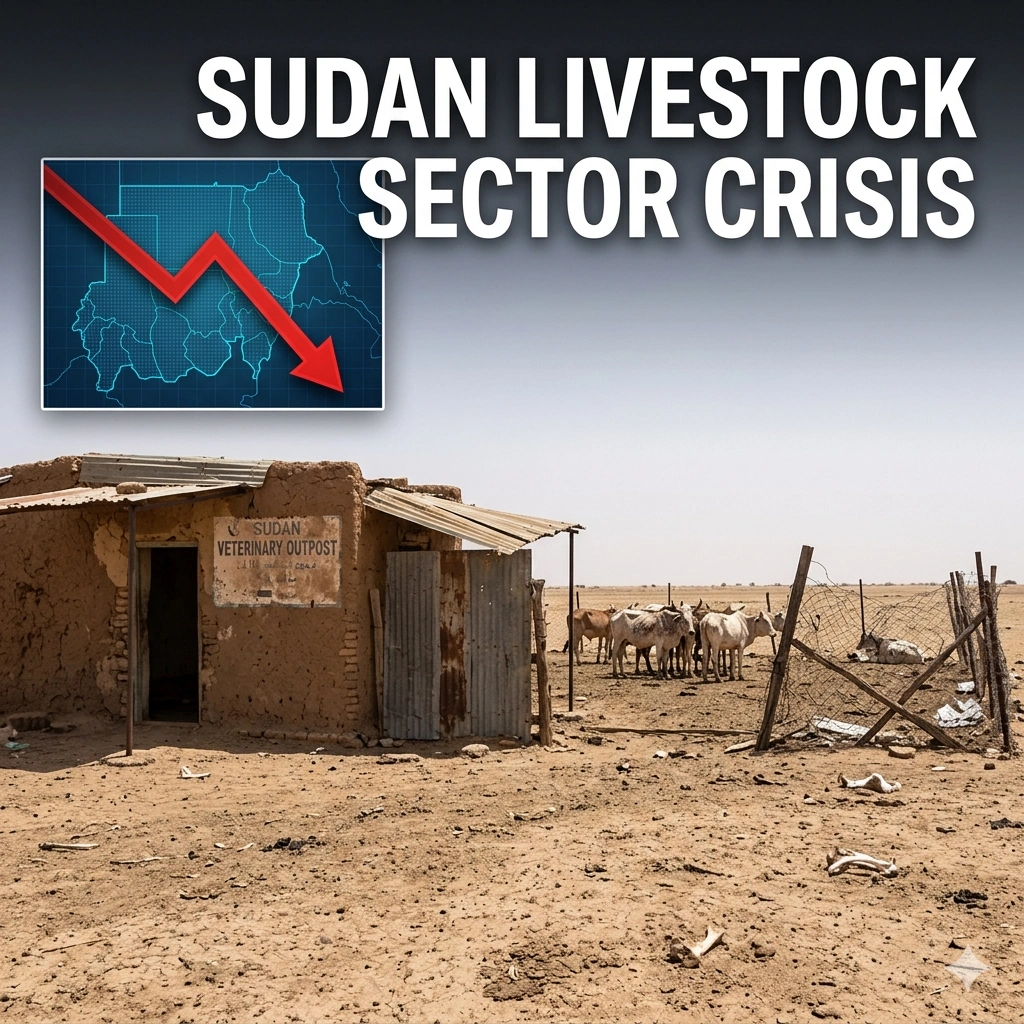
Structural Decay of the Veterinary Infrastructure
The most immediate cause of the Sudan Livestock Sector Collapse 2026 is the physical destruction of the specialized infrastructure that once made the country a regional leader in animal exports. Central veterinary laboratories, which are essential for certifying that animals are free from diseases like Rift Valley Fever, have been looted or destroyed in major conflict zones. Without these diagnostic capabilities, Sudan cannot provide the health guarantees required by major importers in the Middle East and North Africa.
Slaughterhouses and modern quarantine facilities have also faced significant damage, rendering the standardized processing of meat products nearly impossible. These facilities were the result of decades of investment and international cooperation, and their loss means that even healthy livestock cannot be moved safely through the export pipeline. The lack of a functioning administrative database further compounds the problem, as officials can no longer track vaccination schedules or herd movements across state lines.
Furthermore, the logistical chains connecting rural grazing lands to urban export hubs have been severed by the presence of armed groups and damaged roadways. This isolation has forced many pastoralists to sell their animals at a loss in local markets rather than seeking the higher prices offered by international trade. The Sudan Livestock Sector Collapse 2026 is, therefore, a crisis of connectivity as much as it is a crisis of production.
Sudan Livestock Sector Collapse 2026
The Sudan Livestock Sector Collapse 2026 has been accelerated by an unprecedented “brain drain” of the country’s most skilled agricultural and veterinary professionals. Dr. Al-Mansouri highlighted that thousands of trained veterinarians, laboratory technicians, and administrative experts have been displaced by the fighting. Many have sought refuge in neighboring countries, taking their essential knowledge and experience with them, which leaves a massive void in the domestic workforce.
This loss of human capital means that even if the physical infrastructure were to be rebuilt tomorrow, there would be few qualified individuals left to operate it. The ministerial warning emphasizes that the lack of professional oversight is leading to a decline in the quality of the national herd. Without regular vaccination programs and professional health monitoring, the risk of widespread animal epidemics has increased significantly during the Sudan Livestock Sector Collapse 2026.
Moreover, the cessation of both domestic and foreign investment has halted any progress in modernizing the sector. International firms that once viewed Sudan as a high-potential market for meat processing and dairy production have withdrawn their personnel and capital. The Sudan Livestock Sector Collapse 2026 effectively marks a period of de-industrialization for an industry that was once the backbone of Sudan’s non-oil economy.
Impact on National GDP and Exports
- Livestock traditionally contributes nearly 40% of Sudan’s non-oil export earnings.
- The sector supports the livelihoods of approximately 40% of the total population, primarily in rural areas.
- Export volumes to primary markets like Saudi Arabia have seen a double-digit decline since early 2025.
- The loss of tax revenue from livestock markets is significantly depleting the national treasury.
The economic implications of the Sudan Livestock Sector Collapse 2026 are profound, particularly regarding the nation’s foreign exchange reserves. Livestock was one of the few reliable sources of hard currency for the Sudanese government, and its decline has led to a further weakening of the local currency. As the capacity to compete in global markets shrinks, the government finds itself unable to fund the very social services that the displaced population desperately needs.
In rural regions, the collapse of the export market has led to a sharp increase in poverty among pastoralist communities. These groups, who rely almost entirely on the sale of cattle, sheep, and camels, are now facing a reality where their assets are losing value daily. The Sudan Livestock Sector Collapse 2026 is not just an abstract economic figure; it is a direct threat to the survival of millions of people who have raised livestock for generations.
Additionally, the decline in production has led to a shortage of meat and dairy products in domestic urban centers, driving up food prices for the general public. This internal food insecurity is a secondary effect of the export crisis, as the entire supply chain from farm to table has been disrupted. The Sudan Livestock Sector Collapse 2026 is thus a multifaceted disaster impacting both the national balance sheet and the dinner tables of ordinary citizens.
Destruction of Specialized Quarantine Facilities
Quarantine facilities are the “gatekeepers” of the livestock export industry, ensuring that every animal leaving the country meets strict international sanitary requirements. During the Sudan Livestock Sector Collapse 2026, many of these facilities located near Port Sudan and along the Nile have been occupied or damaged. The inability to properly quarantine animals means that international trade partners are increasingly looking to other nations to fill their supply needs.
The maintenance of these facilities requires a constant supply of water, specialized feed, and medicinal inputs, all of which have become scarce due to the blockade of major transport routes. Without these inputs, the health of the animals in the remaining quarantine zones often deteriorates before they can even be loaded onto ships. The Sudan Livestock Sector Collapse 2026 has exposed the fragility of a system that relies on a complex web of logistics and security.
Restoring these facilities will require a massive infusion of international aid and a cessation of hostilities in key strategic corridors. However, as long as the conflict continues, the risk of investing in such permanent infrastructure remains too high for most stakeholders. The Sudan Livestock Sector Collapse 2026 highlights the tragic irony of a nation with vast natural resources being unable to utilize them due to man-made instability.
Pastoralist Displacement and Social Unrest
The displacement of pastoralists is perhaps the most visible aspect of the Sudan Livestock Sector Collapse 2026. As war-torn states become uninhabitable, traditional migratory routes are being abandoned in favor of safer, albeit less productive, regions. This has led to overgrazing in certain “safe zones,” which in turn causes environmental degradation and increases the potential for conflict between different herding groups.
The social fabric of these communities is being torn apart as the traditional structures of livestock management fail. Elders and community leaders are struggling to maintain order when the very basis of their wealth—the herd—is being decimated by disease, theft, or starvation. The Sudan Livestock Sector Collapse 2026 is therefore fostering a long-term social crisis that will persist long after the fighting stops.
Efforts by NGOs to provide mobile veterinary units have been met with limited success due to the high risk of violence. While some local communities have formed “self-protection” units to guard their livestock, this militarization of the pastoralist lifestyle only adds to the overall volatility of the region. The Sudan Livestock Sector Collapse 2026 is a stark reminder of how quickly a centuries-old way of life can be upended by modern warfare.
Brain Drain and the Loss of Human Capital
- Many of Sudan’s top veterinary researchers have accepted positions at universities in Egypt and the Gulf States.
- Specialized training programs for livestock technicians have been suspended indefinitely in Khartoum.
- The loss of “local knowledge” regarding specific regional animal diseases is an irreplaceable setback.
- Private sector veterinary clinics in urban areas have largely closed their doors due to a lack of supplies and staff.
The long-term impact of the Sudan Livestock Sector Collapse 2026 will be felt most acutely in the loss of intellectual property and expertise. Sudan was once a hub for tropical veterinary medicine, attracting students and researchers from across the African continent. The destruction of its academic institutions means that the next generation of Sudanese specialists will have nowhere to train, ensuring that the “brain drain” will have a multi-generational effect.
Rebuilding this expertise will take decades of concerted effort and a return to peace. The ministry’s report indicates that many of the professionals who left have no plans to return, citing the total lack of security and professional infrastructure. This permanent loss of talent is a silent but deadly component of the Sudan Livestock Sector Collapse 2026, as it strips the country of the very people needed to lead a recovery.
Furthermore, the cessation of data collection means that Sudan is “flying blind” regarding its livestock statistics. Without an accurate census of the national herd or a record of disease outbreaks, planning for a post-war recovery is nearly impossible. The Sudan Livestock Sector Collapse 2026 has effectively reset the nation’s agricultural administration back by fifty years.
Diminishing Global Market Competitiveness
In the hyper-competitive world of global meat and livestock trade, reputation and consistency are everything. The Sudan Livestock Sector Collapse 2026 has allowed competitors from Australia, Brazil, and other African nations to capture the market share that Sudan once held. Once a trade route is established with a more stable partner, it is notoriously difficult for a war-torn nation to win that business back.
Major importers have already begun to sign long-term supply contracts with other countries to ensure their own food security. This means that even if Sudan were to achieve peace tomorrow, it would face a global market that has moved on. The Sudan Livestock Sector Collapse 2026 has severely damaged the “Sudan Brand” in the international livestock community, making it synonymous with risk rather than quality.
The Ministry of Livestock is attempting to maintain some diplomatic channels with traditional partners, but these efforts are hampered by the physical inability to deliver products. Promises of future quality cannot overcome the current reality of destroyed labs and uncertified herds. The Sudan Livestock Sector Collapse 2026 represents a loss of global prestige that will haunt the nation’s trade ministers for years to come.
Food Security and Internal Consumption
While the focus of the ministry has been on exports, the Sudan Livestock Sector Collapse 2026 has equally devastating consequences for domestic food security. For many Sudanese families, meat is a primary source of protein and a vital part of the traditional diet. As production falls and prices skyrocket, malnutrition is becoming an increasing concern in both rural and urban areas.
The collapse of the dairy industry is particularly concerning for the health of children. Large-scale dairy farms that once supplied Khartoum and other major cities have been abandoned or repurposed for military use. The lack of pasteurization and refrigerated transport means that the little milk that is produced often spoils before it can reach the market. The Sudan Livestock Sector Collapse 2026 is thus contributing directly to a growing public health crisis.
International aid organizations are struggling to fill the gap with imported food supplements, but these are no substitute for a healthy, functioning domestic livestock sector. The ministry’s warning is a clear signal that without urgent intervention, the country is heading toward a protracted period of severe food shortages. The Sudan Livestock Sector Collapse 2026 is a warning that the “breadbasket” of the Arab world is currently unable to feed its own people.
Environmental Consequences of War-Time Herding
The Sudan Livestock Sector Collapse 2026 is also driving an environmental crisis in the few remaining safe areas of the country. As millions of animals are pushed into smaller geographic regions, the pressure on water sources and grazing lands has become unsustainable. This overgrazing leads to soil erosion and desertification, which will permanently reduce the carrying capacity of the land.
In the chaos of war, environmental regulations are non-existent, and the protection of natural resources has become a secondary concern to immediate survival. The Sudan Livestock Sector Collapse 2026 is accelerating the degradation of the very environment that pastoralists depend on. This creates a vicious cycle where environmental failure leads to further livestock losses, which then drives more displacement.
Restoring the ecological balance will be a gargantuan task that requires sophisticated land-management strategies and a return to traditional migratory patterns. However, as long as the Sudan Livestock Sector Collapse 2026 continues to restrict herd movement, the ecological damage will only deepen. The future of Sudanese agriculture is literally being eaten away by the desperate needs of a displaced population.
Future Outlook and Rebuilding Efforts
- Rebuilding the central veterinary labs is the top priority for the Ministry of Livestock once peace is secured.
- International partnerships will be needed to re-establish the national administrative database and herd tracking.
- Incentives must be created to encourage displaced professionals to return and train a new generation of workers.
- The modernization of the “silicon shield” for livestock—digital health certificates—could help regain market trust.
Despite the bleakness of the Sudan Livestock Sector Collapse 2026, Dr. Al-Mansouri remains focused on the eventual recovery. Plans are being drafted in exile to secure the necessary funding for a “Marshall Plan” for the livestock sector. This would involve a total overhaul of the country’s veterinary infrastructure, incorporating modern technology to ensure that Sudan can leapfrog its competitors in the future.
However, these plans are contingent on a stable political environment and a nationwide ceasefire. The Sudan Livestock Sector Collapse 2026 has shown that without peace, no amount of technical planning can succeed. The international community has a significant role to play in this recovery, as the stability of the entire region is tied to the health of the Sudanese economy.
The resilience of the Sudanese pastoralists is perhaps the only silver lining in this crisis. These communities have survived droughts and conflicts for centuries, and their knowledge of the land remains a powerful asset. If the Sudan Livestock Sector Collapse 2026 can be halted, these groups will be the ones to lead the nation back to its rightful place as a global leader in livestock production.
Conclusion: The Urgent Need for Intervention
The Sudan Livestock Sector Collapse 2026 is a tragedy of epic proportions that threatens the very core of Sudanese identity and prosperity. The warning from Dr. Ahmed Al-Tijani Al-Mansouri should be heard by the world as a cry for help for an industry in its death throes. Every day that the conflict continues, the cost of future recovery grows exponentially as more infrastructure is destroyed and more experts leave.
The sector is currently a shadow of its former self, struggling to meet even the most basic domestic needs, let alone international standards. The Sudan Livestock Sector Collapse 2026 serves as a stark reminder of how war can dismantle the most successful components of a nation’s economy. The time for international mediation and targeted agricultural support is now, before the collapse becomes truly irreversible.
As we look toward the remainder of 2026, the focus must remain on protecting the remaining herds and the professionals who care for them. The spirit of the Sudanese people remains strong, but the physical and administrative pillars of their most important industry have crumbled. The Sudan Livestock Sector Collapse 2026 is a challenge that requires a unified, global response to prevent a humanitarian and economic catastrophe from becoming permanent.
For more details & sources visit: Sudan Horizon (citing SUNA)
Read more on Sudan news: 360 News Orbit – Sudan.