
The intensifying conflict in Sudan has reached a devastating new peak as drone warfare ravages the Kordofan region, leaving a trail of civilian casualties and destroyed humanitarian infrastructure. The war took a tragic turn when separate aerial strikes targeted a religious school and a vital food storage facility. These incidents highlight the growing reliance on unmanned aerial vehicles (UAVs) by both the Sudanese Armed Forces (SAF) and the Rapid Support Forces (RSF).
As the battle for control over the oil- and gold-rich Kordofan territory escalates, the distinction between military targets and civilian safe havens has effectively vanished. The international community now watches in horror as the very tools meant for precision warfare are used to dismantle the fragile survival systems of a population already gripped by a UN-confirmed famine.
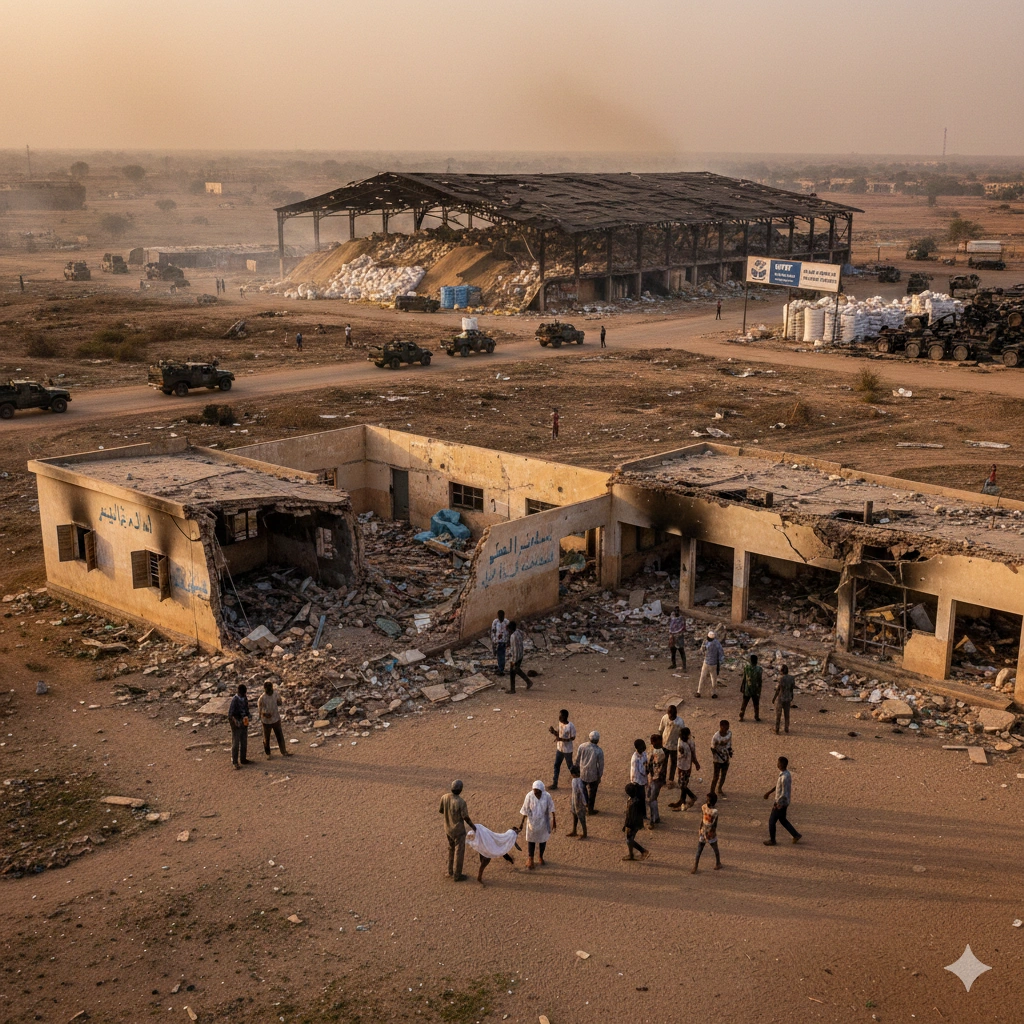
Sudan Drone Strikes Crisis Deepens in North Kordofan
A horrifying strike on a traditional Koranic school in El-Rahad, North Kordofan, resulted in the immediate deaths of two innocent children. Eyewitness Ahmed Moussa reported a scene of total chaos, with at least 12 other students suffering severe injuries during the afternoon attack.
This specific region has become the deadliest battlefield in the ongoing civil war, with drone technology allowing for constant surveillance and sudden, lethal kinetic action. The psychological impact on the local community is profound, as schools were previously seen as neutral zones. Medical sources in the area struggle to provide adequate care, as the influx of wounded children overwhelms the few functional clinics remaining in the warzone.
WFP Famine Aid Destroyed in Kadugli
While the North was mourning its children, a separate drone attack in Kadugli, the capital of South Kordofan, struck a World Food Programme (WFP) warehouse. This facility was the primary storage hub for emergency rations intended for hundreds of thousands of people facing acute starvation. The building was significantly damaged, and a massive portion of the food stocks was incinerated or rendered inedible. This loss is catastrophic because Kadugli has been under a fluctuating siege, making the replenishment of these supplies nearly impossible. The destruction of this warehouse directly sentences the most vulnerable members of the community to prolonged hunger in a region where famine was officially declared in September.
Political Blame Game Over Sudan Drone Strikes
Following the destruction of the WFP warehouse, the political wing of the RSF quickly issued a statement blaming the Sudanese army for the strike. The army had recently made tactical gains in Kadugli, breaking a paramilitary siege that had lasted for months. Conversely, military sources often point to the RSF’s use of consumer-grade drones modified for combat as the source of indiscriminate fire. This cycle of finger-pointing does little to alleviate the suffering of the 115,000 people who have fled their homes since October. The dual sieges of Kadugli and Dilling have created “black holes” of information where both sides trade drone barrages without regard for collateral damage.
UN Reports Massive Civilian Toll from Drones
UN Human Rights Chief Volker Türk has sounded the alarm, noting that Sudan drone strikes have killed 90 civilians and wounded 142 in just the first two weeks of February. These attacks are not isolated to military checkpoints but are frequently targeting public markets, health facilities, and private homes.
The precision promised by drone technology is clearly not being utilized to protect non-combatants in the Sudanese theater. Instead, the data suggests a pattern of terror where the sky has become a source of constant, unpredictable threat. This high casualty rate reflects a total breakdown of the rules of engagement and a blatant disregard for international humanitarian law by all warring factions.+1
Healthcare Infrastructure Collapsing Under Aerial Fire
The World Health Organization (WHO) documented a series of strikes in South Kordofan that hit three separate health centers earlier this month. These attacks killed 30 people, including five children and four dedicated health workers who were providing life-saving care. When health facilities are targeted, the immediate death toll is only the beginning of the tragedy, as thousands lose access to basic medical services. In a warzone where shrapnel injuries and infectious diseases are rampant, the loss of these centers is a death sentence for many. The systematic targeting of the medical sector suggests a deliberate strategy to break the will of the civilian population.
Sudan Drone Strikes
The current trajectory of the conflict suggests that the use of remote warfare will only increase as the 2026 fighting season continues. The strategic importance of Kordofan’s natural resources makes it unlikely that either side will retreat, even as the humanitarian cost becomes unbearable. The international community’s inability to enforce a “no-fly zone” for drones has allowed the Kordofan warzone to become a testing ground for cheap, lethal technology.
Without a significant shift in diplomatic pressure or a negotiated ceasefire, the children of Sudan will continue to pay the highest price for a war they did not start. The destruction of the WFP warehouse serves as a grim reminder that in this war, hunger is being used as a weapon just as effectively as any missile.
Strategic Importance of the Kordofan Warzone
Kordofan is not just a geographic center; it is the economic engine of Sudan, containing the bulk of its remaining oil reserves and significant gold mining operations. Control over this region provides the financial fuel necessary to sustain a prolonged civil war, which explains why the fighting here is so much fiercer than in other provinces.
The army and the RSF are locked in a zero-sum game where losing Kordofan means losing the ability to pay troops and purchase more drones. This economic desperation leads to increasingly risky military maneuvers, often resulting in the Sudan drone strikes that hit civilian infrastructure. For the people living there, the presence of gold and oil has become a curse rather than a blessing.
Displacement Crisis in South Kordofan
The humanitarian fallout from the drone campaign has triggered a fresh wave of displacement that the UN is struggling to manage. Over 115,000 residents have been forced to abandon their farms and livestock, fleeing toward the borders or into increasingly crowded internal displacement camps.
These camps are themselves often near military targets, putting the displaced at risk of being hit by a Sudan drone strikes mistake. The loss of the planting season due to the conflict means that even if the fighting stopped today, the food crisis would persist well into 2027. The social fabric of the region is being torn apart as families are separated and traditional leadership structures are decimated by the violence.
Future Outlook for Sudan’s Drone Warfare
As we look toward the middle of 2026, the proliferation of drone components through illicit trade routes remains a major concern for regional stability. Both the SAF and RSF have established domestic assembly lines or “workshops” to refit drones for dropping mortar shells and specialized explosives.
This localization of drone production means that traditional arms embargoes are becoming less effective at stopping the Sudan drone strikes. The international community must pivot toward sanctioning the dual-use technologies that enable these machines to fly. Failure to act will result in a permanent state of aerial terror that could redefine modern urban warfare in East Africa for years to come.
- Two children killed and 12 wounded at a Koranic school in El-Rahad.
- A WFP warehouse in Kadugli was destroyed, eliminating vital famine aid.
- Over 115,000 people have fled the Kordofan region since October 2025.
- UN reports 90 civilians killed by drones in the first half of February 2026.
Humanitarian Response Challenges in Sudan
Providing aid in the wake of Sudan drone strikes is becoming an impossible task for NGOs and UN agencies. The destruction of the Kadugli warehouse is a prime example of how “deconfliction” protocols are failing to protect humanitarian workers. Many organizations are now forced to consider whether the risk to their staff is too high to continue operations in Kordofan. This withdrawal would leave millions of people with zero support, accelerating the mortality rate from both violence and starvation. The challenge is not just the lack of supplies, but the lack of safe corridors to deliver them.
The Role of International Mediation
Despite the escalating violence, international mediation efforts have remained largely stagnant throughout early 2026. The complexity of the Sudan drone strikes and the multiple actors involved make a simple ceasefire difficult to negotiate. However, experts argue that a specific agreement regarding the use of UAVs could be a starting point for broader peace talks. If both sides could agree to ground their drone fleets, the civilian death toll would drop significantly overnight. Until such a breakthrough occurs, the people of Kordofan remain trapped under a sky that offers no protection and constant peril.
Civil Society and Local Resilience
In the face of the Sudan drone strikes, local civil society groups and “Emergency Response Rooms” (ERRs) have become the true heroes of the conflict. These community-led organizations are often the first to arrive at the scene of a strike, pulling children from the rubble of schools or attempting to salvage grain from burning warehouses.
Their work is done under the constant threat of being targeted themselves, yet they remain the last line of defense against total social collapse. Supporting these local initiatives is perhaps the most effective way for the global community to help Sudan right now. Their resilience is the only light in a region currently defined by the dark shadows of hovering drones.
- RSF and SAF trade blame for the destruction of civilian infrastructure.
- 30 people, including 5 children, killed in health center strikes in South Kordofan.
- Famine in Sudan was UN-confirmed in September and is worsening.
- Oil and gold resources continue to drive the intensity of the Kordofan battles.
For more details & sources visit: The New Arab
Read more on Sudan news: 360 News Orbit – Sudan.