
Spanish Prime Minister Pedro Sanchez is currently charting a bold and independent course that is fundamentally redefining the traditional alliance between Madrid and Washington. By prioritizing strategic autonomy over historical compliance, Sanchez has signaled that Spain will no longer reflexively follow the lead of the United States on the global stage. This shift represents a significant evolution in European geopolitics as a major NATO ally openly challenges established American doctrines.
The current atmosphere in Madrid is one of calculated resistance as the administration navigates a complex web of international pressures. While the Prime Minister maintains that core diplomatic ties remain intact, his actions suggest a desire to position Spain as a principled leader within the European Union. This approach has naturally created friction with officials in Washington who are accustomed to more predictable cooperation from their Mediterranean partners.
Investors and political analysts are closely watching how this Sanchez defiant foreign policy will impact broader Western unity in an increasingly polarized world. The Prime Minister is effectively leveraging international disagreements to consolidate his domestic political standing among left-leaning voters who favor a more independent Spain. Consequently, the diplomatic dance between the Moncloa Palace and the White House has reached a critical and highly sensitive juncture.
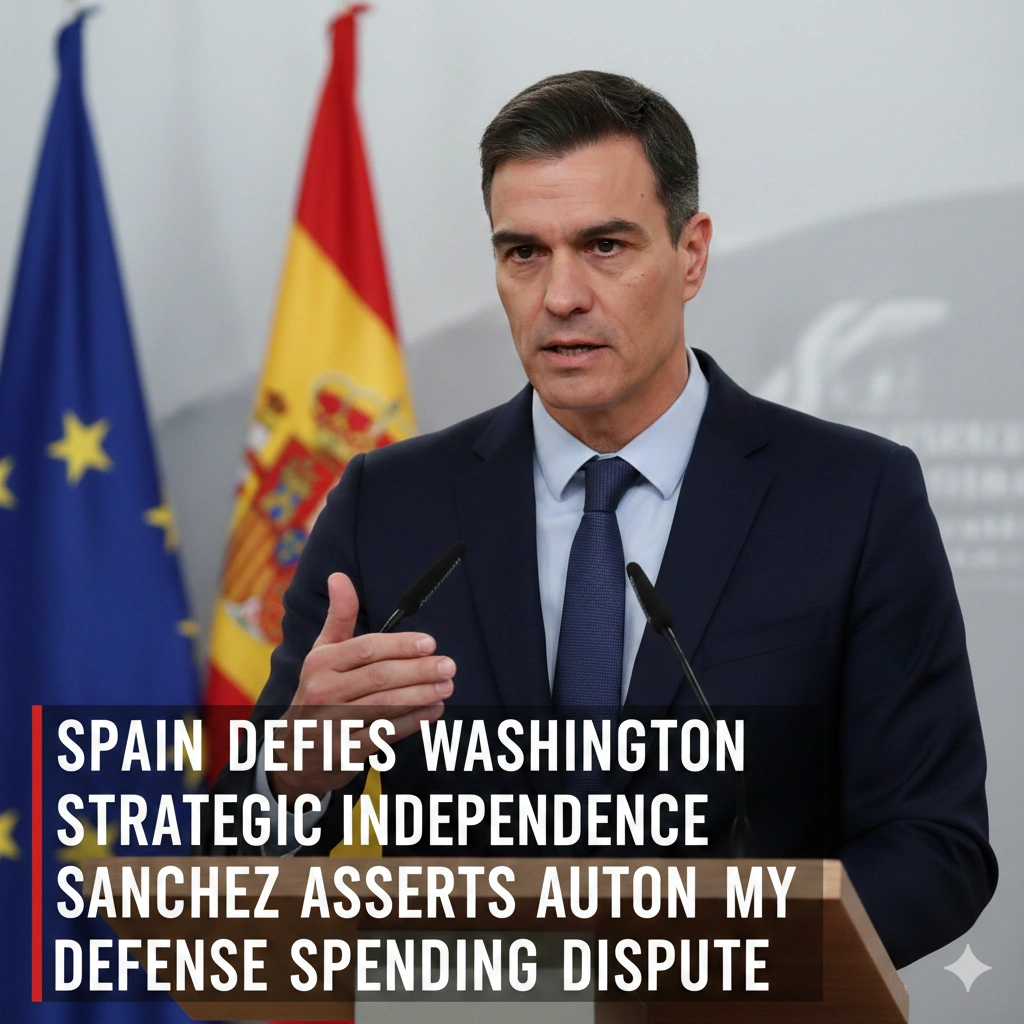
Sanchez Defiant Foreign Policy
The emergence of a Sanchez defiant foreign policy has caught many veteran diplomats by surprise due to its intensity and breadth. Unlike previous administrations that sought to resolve differences behind closed doors, the current Spanish government is making its skepticism of American interventionism a public centerpiece. This transparency is designed to signal to the Spanish electorate that their sovereignty is not for sale to foreign interests.
Washington has responded with a mixture of concern and formal rebukes, particularly regarding Spain’s refusal to align with specific defense benchmarks. The tension is palpable in recent diplomatic exchanges where Spanish officials have stood their ground against American pressure. This assertive posture is not merely rhetorical but is backed by specific legislative and military decisions that deviate from the American playbook.
Furthermore, the Prime Minister has successfully framed this defiance as a necessary step for European integration and self-reliance. By moving away from a US-centric model, Spain is encouraging other EU members to consider their own strategic interests more deeply. This ripple effect is precisely what makes the current Sanchez defiant foreign policy so significant for the future of the transatlantic relationship.
Resisting NATO Defense Spending Targets
One of the primary friction points in the current relationship is Spain’s firm refusal to meet the 5% GDP defense spending target. While the United States has long pressured its allies to increase military budgets, Sanchez has argued that social welfare and domestic stability take precedence. This stance is a direct challenge to the “burden-sharing” narrative that has dominated NATO discussions for several years.
American officials have expressed deep frustration, noting that Spain remains one of the lowest spenders relative to its economic size within the alliance. However, the Spanish government maintains that its contributions to international missions should be valued as much as raw financial data. This disagreement highlights a fundamental difference in how both nations perceive the concept of collective security and national responsibility.
The arrival of Ambassador Benjamin Leon is expected to bring these tensions to a head as he carries a mandate to secure spending commitments. Nevertheless, Sanchez appears unmoved by these looming diplomatic pressures, banking on the idea that Spain’s strategic location makes it indispensable. The standoff over military funding remains a symbolic battleground for the broader struggle over Sanchez defiant foreign policy independence.
Blocking Military Vessel Access to Spanish Ports
In a move that sent shockwaves through the diplomatic community, Spain recently blocked vessels carrying weapons to Israel from docking at its ports. This decision was a direct critique of American-backed military operations and signaled a major departure from Western consensus. By taking this physical action, Sanchez demonstrated that his Sanchez defiant foreign policy includes tangible consequences for allied logistics.
The United States issued a series of sharp rebukes, citing the importance of maintaining open supply lines for strategic partners. Spain, however, stood by its decision, citing humanitarian concerns and its commitment to international law as the primary drivers. This incident served as a clear message that Spanish territory would not be used to facilitate policies the government deems unethical.
Domestically, this move was met with widespread approval from the Prime Minister’s political base, further insulating him from external criticism. It also forced other European nations to reckon with their own roles in Middle Eastern conflicts, showcasing Spain’s growing influence as a moral actor. The port blockade remains one of the most visible and controversial elements of the current Sanchez defiant foreign policy shift.
Divergent Approaches to Venezuelan Interventions
The crisis in Venezuela has long been a point of contention, but the Sanchez administration has now moved toward an even more independent path. While Washington has favored a policy of maximum pressure and sanctions, Madrid is advocating for dialogue and a negotiated political settlement. This divergence has hampered coordinated Western efforts to influence the outcome of the Venezuelan political struggle.
Sanchez has openly criticized what he describes as “failed interventionist models” that do not account for the complexities of regional dynamics. Instead, Spain is leveraging its historical and cultural ties to Latin America to act as a potential mediator between various factions. This role is often at odds with the more aggressive stance taken by the United States State Department regarding the Sanchez defiant foreign policy.
The friction over Venezuela is particularly sensitive because it involves Spain’s backyard in terms of cultural and economic influence. By rejecting the American lead, Sanchez is asserting that Spain is better positioned to understand and manage relations with its former colonies. This regional assertiveness is a cornerstone of the broader strategy to elevate the Sanchez defiant foreign policy profile as an autonomous power.
Strict Regulations on American Social Media Platforms
Technological sovereignty has become another major front in the ongoing diplomatic struggle between Madrid and Washington. The Spanish government has implemented a series of strict regulations on social media giants that are headquartered in the United States. These laws focus on data privacy, algorithmic transparency, and the taxation of digital services, often to the chagrin of American corporations.
Sanchez argues that these regulations are necessary to protect Spanish citizens and the integrity of the national democratic process. American trade representatives, however, view these moves as discriminatory and a violation of free-market principles. The clash over digital policy reflects a wider global debate about how to govern the internet and the power of multinational tech firms within a Sanchez defiant foreign policy.
These legislative actions have been carefully crafted to align with broader European Union goals, making it harder for Washington to isolate Spain. By leading the charge on tech regulation, Sanchez is positioning Spain as a vanguard of digital rights in the 21st century. The tension in this sector is unlikely to dissipate as the Sanchez defiant foreign policy continues to expand into the digital economy.
Leveraging International Disagreements for Domestic Support
Political analysts agree that much of the Prime Minister’s international defiance is calculated to resonate with his domestic audience. By standing up to a global superpower, Sanchez projects an image of a strong leader who puts Spanish interests first. This is particularly effective during times of economic uncertainty when national pride can become a powerful political currency for a Sanchez defiant foreign policy.
The left-leaning coalition that supports Sanchez has long been skeptical of American influence, making this foreign policy shift a winning strategy at the ballot box. Every rebuke from Washington is framed by the Moncloa Palace as a badge of honor and proof of Spanish independence. This feedback loop ensures that the Sanchez defiant foreign policy remains a central pillar of the government’s long-term political survival.
However, this strategy is not without its risks, as it could eventually lead to economic or diplomatic isolation if pushed too far. Sanchez appears to be aware of these limits and frequently balances his rhetoric with reminders of the deep cultural ties between the two nations. This careful calibration allows him to reap the domestic rewards of his Sanchez defiant foreign policy without triggering a total breakdown in relations.
Economic Resilience and the Trade Deficit Factor
One reason Spain feels empowered to take such a defiant stance is its relatively modest trade deficit with the United States. Unlike some of its European neighbors, Spain is less vulnerable to the threat of punitive trade tariffs or economic retaliation. This economic reality provides Sanchez with a level of maneuverability that other leaders might lack when implementing a Sanchez defiant foreign policy.
The Spanish economy has shown remarkable resilience in the face of global fluctuations, allowing the government to focus on its strategic long-term goals. While American investment remains important, it is not the sole driver of Spanish prosperity, giving the Prime Minister more leverage in negotiations. This financial independence is a crucial, though often overlooked, element of the current Sanchez defiant foreign policy framework.
- Spain’s export market is increasingly diversified across Europe and Latin America.
- The domestic tourism sector provides a stable source of revenue that is independent of diplomatic shifts.
- Spanish energy policies are focused on green transitions, reducing reliance on foreign oil interests.
This economic cushion allows Sanchez to prioritize political and ethical considerations over purely commercial ones. As long as the Spanish economy remains on a stable path, the government is likely to continue its Sanchez defiant foreign policy trajectory. The lack of significant economic “hooks” for Washington to pull makes Spain a uniquely challenging partner to manage.
The Role of Public Opinion in Shaping Policy
Public opinion in Spain remains a driving force behind the Prime Minister’s assertive international behavior. Historical skepticism regarding United States influence, dating back decades, continues to color how many Spanish citizens view the transatlantic alliance. Sanchez is essentially tapping into a deep-seated national desire for a more balanced and respectful Sanchez defiant foreign policy relationship with Washington.
Recent polls indicate that a majority of Spaniards support the government’s decision to prioritize social spending over meeting NATO’s military targets. There is also strong public backing for Spain’s humanitarian approach to global conflicts, even when it conflicts with American strategic goals. This alignment between government policy and public sentiment gives Sanchez a powerful mandate to continue his Sanchez defiant foreign policy.
- Surveys show high levels of support for digital sovereignty and tech regulation.
- Citizens favor a neutral stance in conflicts where Spanish interests are not directly at stake.
- The Spanish youth are particularly vocal about maintaining an independent Sanchez defiant foreign policy voice.
As long as the public remains supportive, there is little incentive for the administration to revert to a more submissive posture. The Prime Minister has effectively turned foreign policy into a domestic asset, ensuring that international relations remain a key part of the national conversation. This democratic backing is perhaps the strongest shield Sanchez has against external diplomatic pressure targeting his Sanchez defiant foreign policy.
Diplomatic Friction and the Path Forward
The diplomatic friction between Madrid and Washington is real, but both sides are working to ensure it does not become a permanent rupture. Sources close to the Prime Minister indicate that despite the public rhetoric, professional channels of communication remain open and functional. The goal for Spain is not to end the relationship but to fundamentally rebalance it within a Sanchez defiant foreign policy on more equal terms.
Ambassador Benjamin Leon faces a difficult task in trying to pull Spain back toward the American orbit without causing further alienation. The success of his tenure will likely depend on his ability to find common ground on issues like climate change and economic development. However, the core disagreements over defense spending and regional interventions that define the Sanchez defiant foreign policy are unlikely to be resolved through charm alone.
The path forward will require a high degree of diplomatic finesse from both capitals to avoid unnecessary escalation. Sanchez has made it clear that he will not be intimidated by traditional power politics or threats of isolation. The future of the Spain-US relationship will likely be characterized by a “new normal” where the Sanchez defiant foreign policy becomes a frequently acknowledged reality.
Analyzing the Long-Term Impact on the European Union
Spain’s defiant posture is not happening in a vacuum; it is part of a broader trend of European nations seeking more strategic autonomy. By leading the way on several controversial issues, Sanchez is providing a template for how other powers can assert themselves. This could eventually lead to a more fragmented but also more self-reliant European Union on the global stage, influenced by the Sanchez defiant foreign policy.
If Spain’s strategy proves successful in the long run, it could embolden other nations to similarly challenge American hegemony on specific issues. This shift would require Washington to adopt a more nuanced and multilateral approach to its European alliances. The Sanchez defiant foreign policy may well be remembered as the catalyst for a significant shift in how the West manages its internal differences.
- Increased emphasis on European-led security initiatives rather than NATO-only models.
- Stronger pushes for collective EU regulation of international technology firms.
- A move toward more balanced trade relationships that do not rely on a single superpower.
Ultimately, the long-term impact of this policy shift will depend on Spain’s ability to maintain its economic and political stability. If Sanchez can demonstrate that defiance leads to a more prosperous and respected Spain, his Sanchez defiant foreign policy model will likely be emulated. For now, the eyes of the diplomatic world remain fixed on Madrid as this high-stakes geopolitical drama continues to unfold.
Strengthening Ties with Latin America and the Global South
As Spain distances itself from some American policies, it is simultaneously working to strengthen its ties with Latin America and the Global South. This strategic pivot allows Madrid to claim a unique role as a bridge between Europe and the developing world. Sanchez has made several high-profile visits to regional leaders, emphasizing shared values and economic cooperation that bypasses Washington’s influence.
This “southern strategy” is a key component of the Sanchez defiant foreign policy as it provides Spain with alternative spheres of influence. By acting as an advocate for the Global South within European forums, Spain increases its own diplomatic capital and leverage. This approach also resonates with the historical identity of Spain as a nation with deep roots outside of the immediate North Atlantic sphere.
The United States has traditionally viewed Latin America as its own area of influence, making Spain’s renewed assertiveness there a point of subtle contention. However, Sanchez has framed this engagement as a positive contribution to global stability rather than a zero-sum game. Whether this leads to genuine cooperation or further competition remains one of the most interesting questions for the Sanchez defiant foreign policy in coming years.
Navigating the Challenges of a Multi-Polar World
The shift in Spanish foreign policy is a direct response to the emerging multi-polar world where power is more distributed than in previous decades. Sanchez recognizes that the era of uncontested American leadership is evolving, and Spain must adapt to protect its own interests. This requires a more agile and less ideological approach to international relations within the Sanchez defiant foreign policy framework.
By maintaining a defiant but non-hostile posture, Spain is attempting to navigate this new landscape without making permanent enemies. The Prime Minister is essentially hedging his bets, ensuring that Spain has a seat at every table regardless of who is in power in Washington. This pragmatism is a defining feature of the current administration’s worldview and its Sanchez defiant foreign policy strategy.
- Engaging with emerging economies in Asia and Africa to balance traditional alliances.
- Participating in international climate forums as a leader in renewable energy technology.
- Promoting the Spanish language and culture as a tool of “soft power” diplomacy.
As the world continues to change, the Sanchez defiant foreign policy will likely undergo further refinements to meet new challenges. The core principle, however, remains the same: Spain will determine its own path based on its own values and strategic needs. This commitment to autonomy is the defining legacy of Pedro Sanchez’s current tenure on the international stage.
Final Reflections on Spanish Strategic Autonomy
The current state of Spanish-American relations is a testament to the changing nature of 21st-century diplomacy. Pedro Sanchez has proven that even a traditional ally can become a source of significant challenge when its national interests are perceived to be at stake. The Sanchez defiant foreign policy is not a temporary whim but a structural shift in how Madrid views its place in the world.
While the friction is real, it also presents an opportunity for a more honest and mature relationship between the two nations. By acknowledging their differences openly, Spain and the United States can work toward a partnership based on mutual respect rather than mere compliance. This transition may be uncomfortable for some in Washington, but it is a necessary evolution of the Sanchez defiant foreign policy in a world of sovereign nations.
As the 2026 political calendar progresses, the impact of these decisions will become even clearer to observers around the globe. Whether Sanchez can maintain his domestic support while navigating the pressures of international diplomacy will be the ultimate test of his strategy. For now, the Sanchez defiant foreign policy remains a defiant and independent voice that cannot be ignored by its allies or its critics.
For more details & sources visit: Reuters
For the latest updates from the Spain, visit our Spain news page.