
The SDF Army Integration marks a historic moment in Syria’s post-Assad era, as Kurdish-led Syrian Democratic Forces agreed to gradually merge into the Syrian army and civil institutions following a ceasefire with Damascus. The deal caps months of negotiation after the Assad government’s northeastern offensives reclaimed key oil fields and territories previously held by the SDF.
Strategic Withdrawals and Government Deployment
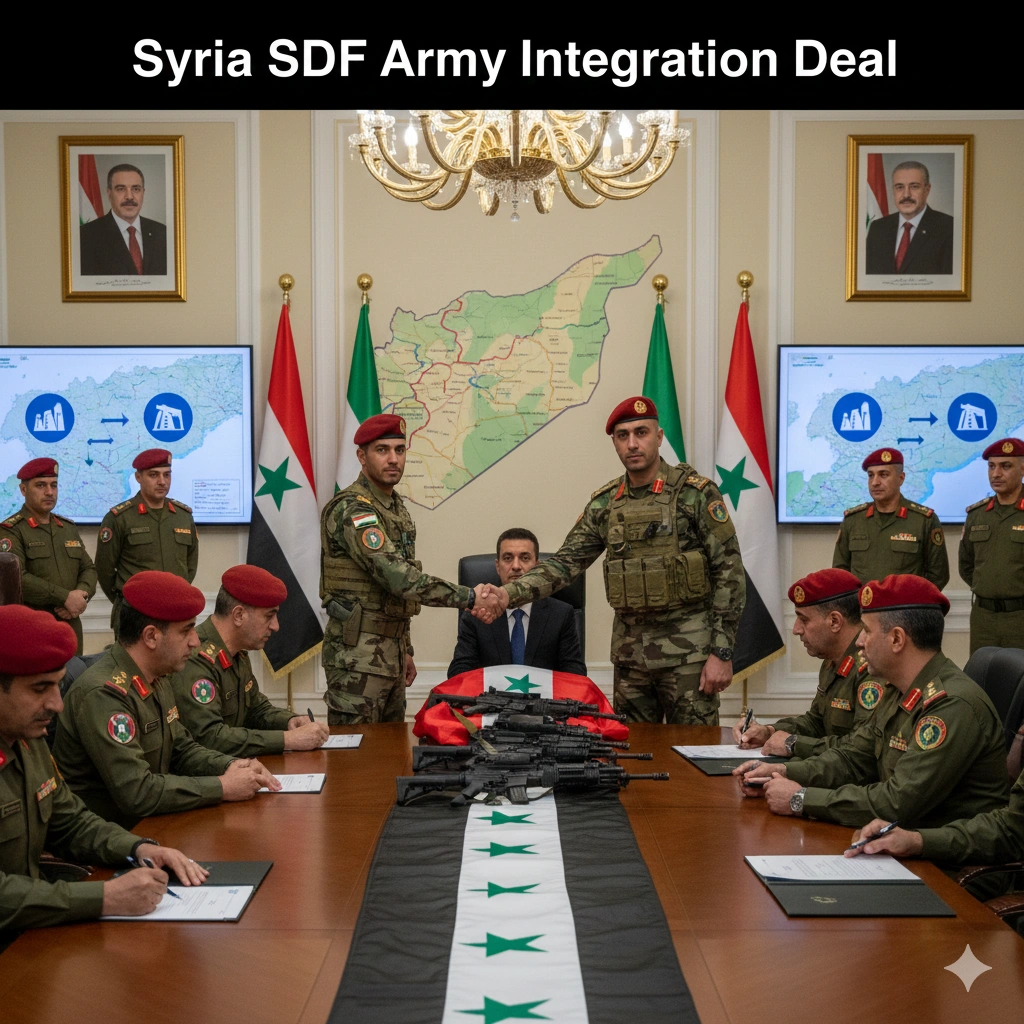
As part of the agreement, SDF forces are executing phased frontline withdrawals, clearing the way for government troops to deploy in critical cities including Hasakah and Qamishli. This redeployment enables the creation of SDF brigades under state command, consolidating local security under a unified framework.
The deal also establishes a three-brigade SDF division and incorporates a Kobane-affiliated unit under the Aleppo governorate, ensuring Kurdish units are formally part of Syria’s military hierarchy while preserving operational coherence.
Integration of Kurdish Institutions
Beyond military alignment, the SDF Army Integration includes folding Kurdish civil institutions into national frameworks immediately. This step aims to facilitate reconstruction efforts, civil administration coordination, and governance unification, aligning local authorities with central government structures.
In a joint statement, the SDF emphasized that the accord advances territorial unification and collaborative rebuilding, reflecting a pragmatic approach to post-conflict stabilization. (Al Jazeera)
Political Context and Mediation
The agreement comes after previous negotiations faced repeated delays, and follows the fall of Assad in December 2024, which reshaped Syria’s political landscape. Interim President Ahmed al-Sharaa’s administration has now consolidated authority in the northeast, bolstered by the SDF’s integration.
While the United States played a mediation role, Turkey’s concerns over PKK-affiliated forces remain a sensitive factor in regional security calculations. Nevertheless, state media reported a swift rollout of integration plans, signaling strong government commitment.
Implications for Regional Stability
Analysts see the SDF Army Integration as a significant step toward national cohesion in Syria, potentially reducing internal friction and facilitating reconstruction across former conflict zones. By embedding Kurdish brigades into state structures, the agreement may also stabilize the northeast economically and politically, allowing international aid and investment to flow more efficiently.
This integration is expected to impact the broader Middle East balance, as unified Syrian forces strengthen governance, secure energy infrastructure, and offer a potential blueprint for other conflict-affected regions.
Strategic Security Coordination Under the SDF Army Integration
The SDF Army Integration enables more structured coordination between Kurdish brigades and the Syrian armed forces, particularly in border and resource-rich regions. Joint command mechanisms are being established to manage patrols, checkpoints, and rapid-response units, ensuring that local security challenges are addressed collaboratively.
This framework also supports intelligence sharing and conflict prevention measures, which are expected to reduce tensions between local communities and central authorities. By formalizing command structures, the integration strengthens Syria’s ability to respond to potential insurgencies or external threats in the northeast.
Socioeconomic Opportunities Following the SDF Army Integration
Beyond military alignment, the SDF Army Integration opens new avenues for economic and social reconstruction in Kurdish-majority areas. Coordinated efforts between local administrations and central government agencies aim to accelerate infrastructure projects, improve public services, and facilitate investment in urban development.
The integration is also expected to encourage workforce participation, particularly in rebuilding initiatives, while creating channels for international aid to reach communities more efficiently. Analysts suggest that this structured approach may serve as a model for integrating other autonomous forces into national development plans.
Next Steps in Integration
Immediate implementation focuses on military restructuring, civil institution alignment, and joint planning for urban administration in Hasakah, Qamishli, and surrounding areas. The SDF will coordinate closely with Syrian government authorities on reconstruction projects, security patrols, and local governance initiatives, ensuring that integration is both symbolic and operational.
Observers note that successful SDF Army Integration could accelerate territorial unification, stabilize key oil-producing regions, and enhance long-term governance across Syria’s northeast.
For more details & sources visit: Al Jazeera
Read more about Syria news on 360 News Orbit – Syria.